Australia Briquette Market (2025-2031) | Growth, Size, Revenue, Forecast, Analysis, Trends, Value, Share, Industry & Companies
Market Forecast By Type (Charcoal, Biomass, Wood, Others (Paper, Coconut Shell etc.)), By End Use (Residential, Commercial, Industrial and Power Generation) And Competitive Landscape
| Product Code: ETC233795 | Publication Date: Nov 2025 | Updated Date: Nov 2025 | Product Type: Report | |
| Publisher: 6Wresearch | Author: Ravi Bhandari | No. of Pages: 64 | No. of Figures: 14 | No. of Tables: 5 |
Topics Covered in Australia Briquette Market Report
Australia Briquette Market Report thoroughly covers the market by type, and end use. Australia Briquette Market Outlook report provides an unbiased and detailed analysis of the ongoing Australia Briquette Market trends, opportunities/high growth areas, and market drivers. This would help stakeholders devise and align their market strategies according to the current and future market dynamics.
Australia Briquette Market Synopsis
Australia briquette market has grown steadily between 2020 and 2024, driven by the expansion of the HoReCa sector, strong residential construction activity, and rising hospitality utilization. With people employed in Accommodation & Food Services and cafes, restaurants, and takeaway businesses operating nationwide in 2024, demand for high-heat cooking fuels used in grills, steakhouses, and catering units has intensified. Monthly household spending on Hotels, Cafes & Restaurants reached more in February 2025, reflecting sustained dining activity. Parallelly, residential construction remained elevated, with dwellings under construction and a unit BTR pipeline in June 2025, alongside federal housing programs delivering homes and planning more, thereby expanding the use of briquettes in home-heating systems and small-scale biomass appliances.
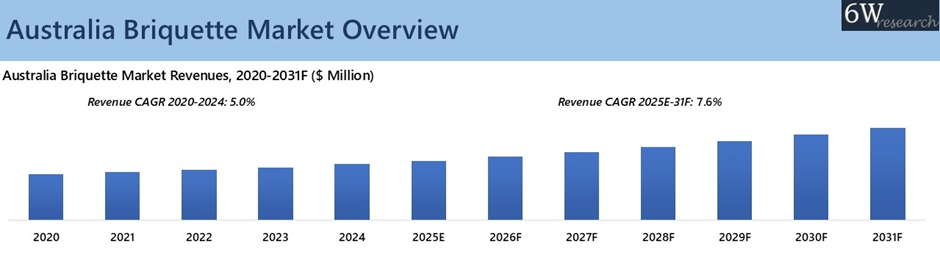
According to 6Wresearch, Australia Briquette Market is projected to grow at a CAGR of 7.6% from 2025-2031F, supported by the strengthening hospitality sector and rising tourism intensity. National hotel occupancy recovered in December 2024, while international arrivals rebounded to pre-pandemic levels, contributing to higher year-round heating and outdoor-use energy needs across hotels, resorts, and serviced apartments. With new hotel rooms added recently and new rooms are under construction for 2025, and with rising outdoor dining and BBQ culture, commercial and residential fuel consumption is set to remain structurally strong. As hospitality capacity expands and homebuilding activity remains firm, Australia briquette market would evolve into a stable, commercially anchored heating and cooking fuel ecosystem through 2031.
Market Segmentation By Type
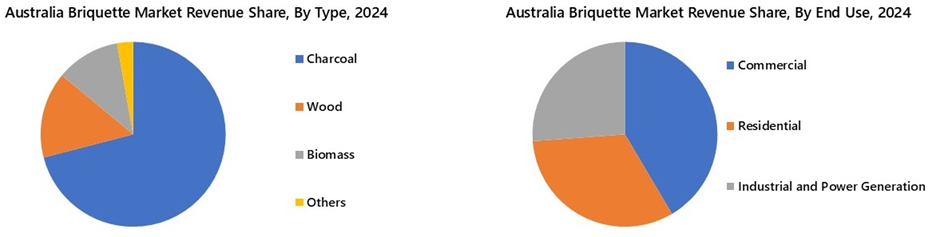
The biomass segment is set to grow the fastest by 2031 due to rising adoption of low-emission solid fuels across construction, industrial heating, and HoReCa, however charcoal would continue to hold the highest share given its wide availability, strong tradition in cooking, and consistent demand from households and restaurants.
Market Segmentation By End Use
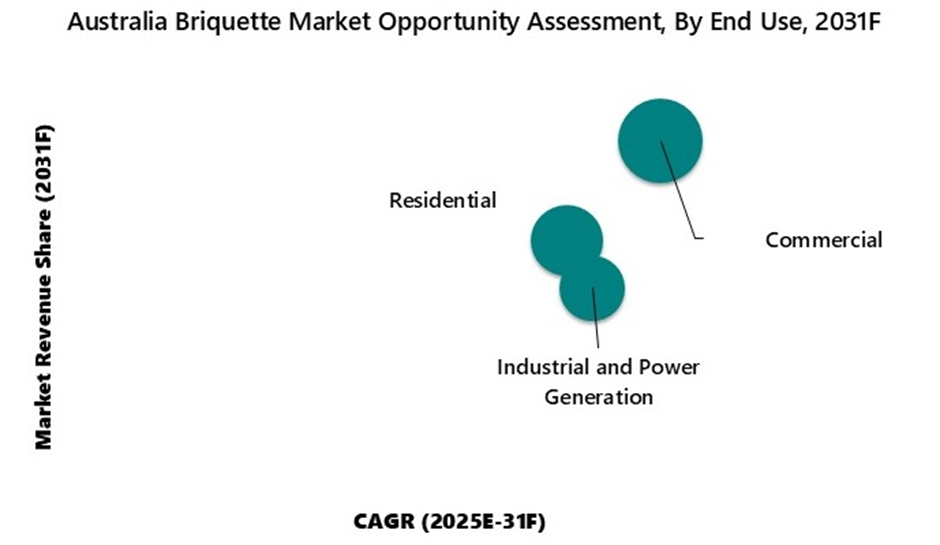
The commercial segment is projected to witness the fastest growth by 2031, driven by rising briquette consumption across restaurants, cafes, catering units, construction contractors, and outdoor dining formats that increasingly rely on stable, cleaner-burning solid fuels. Expanding foodservice activity, premium BBQ concepts, and sustained construction intensity would position the commercial end-use segment as the strongest opportunity.
Key Attractiveness of the Report
- 10 Years Market Numbers.
- Historical Data Starting from 2021 to 2024
- Base Year: 2024
- Forecast Data until 2031
- Key Performance Indicators Impacting the Market.
- Major Upcoming Developments and Projects.
Key Highlights of the Report:
- Australia Briquette Market Overview
- Australia Briquette Market Outlook
- Australia Briquette Market Forecast
- Industry Life Cycle
- Porter’s Five Forces Analysis
- Historical Data and Forecast of Australia Briquette Market Revenues for the Period 2020-2031F
- Historical Data and Forecast of Australia Briquette Market Revenues, By Type, for the Period 2020-2031F
- Historical Data and Forecast of Australia Briquette Market Revenues, By End Use, for the Period 2020-2031F
- Market Drivers and Restraints
- Market Trends
- Key Performance Indicators
- Market Opportunity Assessment
- Competitive Benchmarking
- Company Ranking
- Company Profiles
- Key Strategic Recommendations
Market Scope and Segmentation
The report provides a detailed analysis of the following market segments:
By Type
- Charcoal
- Biomass
- Wood
- Others (Paper, Coconut Shell etc.)
By End Use
- Residential
- Commercial
- Industrial and Power Generation
Australia Briquette Market (2025-2031): FAQs
The Australia Briquette Market is projected to grow at a CAGR of 7.6% from 2025-2031F.
The expanding HoReCa Sector and the Rising Number of Households are driving the growth of the market.
The market faces restraints due to Feedstock Volatility, Logistical Constraints, and Energy-Value Gaps.
Australia Briquette Market Report thoroughly covers the market by type, and end use.
6Wresearch actively monitors the Australia Briquette Market and publishes its comprehensive annual report, highlighting emerging trends, growth drivers, revenue analysis, and forecast outlook. Our insights help businesses to make data-backed strategic decisions with ongoing market dynamics. Our analysts track relevent industries related to the Australia Briquette Market, allowing our clients with actionable intelligence and reliable forecasts tailored to emerging regional needs.
Yes, we provide customisation as per your requirements. To learn more, feel free to contact us on sales@6wresearch.com
| 1. Executive Summary |
| 2. Introduction |
| 2.1. Report Description |
| 2.2. Key Highlights of the Report |
| 2.3. Market Scope & Segmentation |
| 2.4. Research Methodology |
| 2.5. Assumptions |
| 3. Australia Briquette Market Overview |
| 3.1. Australia Briquette Market Revenues, 2020-2031F |
| 3.2. Australia Briquette Market – Industry Life Cycle |
| 3.3. Australia Briquette Market – Porter’s Five Forces |
| 4. Australia Briquette Market Dynamics |
| 4.1. Impact Analysis |
| 4.2. Market Drivers |
| 4.3. Market Restraints |
| 5. Australia Briquette Market Trends and Evolution |
| 6. Australia Briquette Market Overview, By Type |
| 6.1 Australia Briquette Market Revenue Share and Revenues, By Type, 2020–2031F |
| 6.1.1 Australia Briquette Market Revenues, By Charcoal, 2020–2031F |
| 6.1.2 Australia Briquette Market Revenues, By Biomass, 2020–2031F |
| 6.1.3 Australia Briquette Market Revenues, By Wood, 2020–2031F |
| 6.1.4 Australia Briquette Market Revenues, By Others, 2020–2031F |
| 7. Australia Briquette Market Overview, By End Use |
| 7.1 Australia Briquette Market Revenue Share and Revenues, By End Use, 2020–2031F |
| 7.1.1 Australia Briquette Market Revenues, By Residential, 2020–2031F |
| 7.1.2 Australia Briquette Market Revenues, By Commercial, 2020–2031F |
| 7.1.3 Australia Briquette Market Revenues, By Industrial and Power Generation, 2020–2031F |
| 8. Australia Briquette Market - Key Performance Indicators |
| 9. Australia Briquette Market Opportunity Assessment |
| 9.1 Australia Briquette Market Opportunity Assessment, By Type, 2031F |
| 9.2 Australia Briquette Market Opportunity Assessment, By End Use, 2031F |
| 10. Australia Briquette Market, Competitive Landscape |
| 10.1 Australia Briquette Market Company Ranking, 2024 |
| 10.2 Australia Briquette Market Competitive Benchmarking, By Technical Parameters |
| 10.3 Australia Briquette Market Competitive Benchmarking, By Operating Parameters |
| 11. Company Profiles |
| 11.1 Vicbrix |
| 11.2 Olive Pip Co. |
| 11.3 Australian Charcoal Company |
| 11.4 Envirofuel Australia Pty Ltd |
| 11.5 Heat Beads |
| 11.6 B&B Charcoal |
| 11.7 King Coal |
| 11.8 Firebrand Australia Pty Ltd |
| 11.9 Borobudur Coco |
| 11.10 Stronach Pty Ltd |
| 12. Australia Briquette Market - Key Strategic Recommendations |
| 13. Disclaimer |
| List of figures |
| 1. Australia Briquette Market Revenues, 2020-2031F ($ Million) |
| 2. Cafes, Restaurants and Takeaway Food Services, Seasonally Adjusted, March 2021-March 2025, ($ Million) |
| 3. Number of Family and Lone Person Households in Australia, 2021-2036F, (Million) |
| 4. Total Number of Household in Australia, 2021-2036F, (Million) |
| 5. Australia Briquette Market Revenue Share, By Type, 2024 & 2031F |
| 6. Australia Briquette Market Revenue Share, By End Use, 2024 & 2031F |
| 7. Dwelling Units Approved in Australia, Seasonally Adjusted, March 2023-March 2025 |
| 8. Demand & Supply of Accommodation in Australia, By Type, 2024-2025, (Million) |
| 9. New Hotel Rooms Under Construction in Australia, 2025 |
| 10. Demand & Supply of Accommodation in Australia, By Class, 2024-2025, (Million) |
| 11. Demand & Supply of Accommodation in Australia, By States & Territories, 2024-2025, (Million) |
| 12. Australia Briquette Market Opportunity Assessment, By Type, 2031F |
| 13. Australia Briquette Market Opportunity Assessment, By End Use, 2031F |
| 14. Australia Briquette Market Revenue Ranking, By Companies, 2024 |
| List of tables |
| 1. Australia Briquette Market Revenues, By Type, 2020-2031F ($ Million) |
| 2. Australia Briquette Market Revenues, By End Use, 2020-2031F ($ Million) |
| 3. Monthly Change in Private Sector Houses and Dwelling Units in Australia, September 2025, (%) |
| 4. Key Count Across Major Australian Hotels |
| 5. Australia’s Population Density, By Area and States, June 2024, (People per square km) |
Market Forecast By Type (Charcoal, Biomass, Wood, Others (Paper, Coconut Shell etc.)), By End Use (Residential, Commercial, Industrial and Power Generation) And Competitive Landscape
| Product Code: ETC233795 | Publication Date: Aug 2022 | Product Type: Market Research Report | |
| Publisher: 6Wresearch | No. of Pages: 62 | No. of Figures: 12 | No. of Tables: 5 |
Australia Briquette Market Synopsis
Australia briquette market has experienced steady growth, primarily driven by the construction industry's expansion, generating over $350 billion in revenues from construction activities in 2019. Despite setbacks due to the COVID-19 pandemic in 2020, including supply chain disruptions and economic slowdown, the market is rebounding with the resumption of paused projects and pent-up demand from infrastructure projects. This growth is expected to continue, supported by ongoing construction momentum and government housing initiatives like the Indigenous Home Ownership Program (IHOP). Additionally, the construction sector significantly influences briquette demand through various interconnected factors, including manufacturing building materials, infrastructure development, on-site heating and cooking, and adherence to environmental regulations.

According to 6Wresearch, Australia Briquette Market size is projected to grow at a CAGR of 7.9% during 2024-2030F. The anticipated significant growth in the Australia briquette industry is closely tied to the thriving construction and infrastructure sector. Rising construction projects, including residential developments like the $1 billion investment project at 28 Montague Street in Melbourne and the Pentridge Prison redevelopment set for 2025, are driving increased demand for briquettes. Moreover, heightened expenditure on social and economic infrastructure, as emphasized by the Australian Construction Industry Forum (ACIF), further supports this growth trend. The government's commitment to infrastructure development, with plans to invest $4.4 billion over four years until 2025-26, particularly in public transportation, aligns with the push for a more sustainable energy future, driving the demand for briquettes as a cleaner fuel source in construction and infrastructure projects throughout Australia.
Energy output limitations and seasonal dependence can constrain the Australian Briquette Market by reducing production capacity, increasing costs due to fluctuating demand, posing storage challenges, creating market uncertainty, and potentially impeding progress towards renewable energy goals.

Market Segmentation by Type
By type, charcoal briquette accounts majority of revenue share on the back of the nation's substantial reserves of coal, which ensure a reliable and readily available source of energy. The country's well-established infrastructure for coal mining, processing, and briquette production further enhances the accessibility and affordability of coal briquettes.

Market Segmentation by End Use
The commercial sector held the largest revenue share in Australia's briquette market in 2023 and is expected to maintain this position going forward. This is driven by its increased energy demand, cost advantages from economies of scale, and focus on regulatory compliance and corporate responsibility. Additionally, the consistency, efficiency, and widespread availability of briquettes further bolster their preference in commercial applications.
Key Attractiveness of the Report
- 10 Years Market Numbers.
- Historical Data Starting from 2020 to 2023.
- Base Year: 2023
- Forecast Data until 2030.
- Key Performance Indicators Impacting the Market.
- Major Upcoming Developments and Projects.
Key Highlights of the Report:
- Australia Briquette Market Outlook
- Historical Data and Forecast of Australia Briquette Market Revenues for the Period 2024 – 2031F
- Australia Briquette Market Evolution & Trends
- Australia Briquette Market Drivers & Restraints
- Australia Briquette Market Porter's Five Forces
- Australia Briquette Market Industry Life Cycle
- Historical Data and Forecast of Australia Briquette Market Revenues, By Type 2024 – 2031F
- Historical Data and Forecast of Australia Briquette Market Revenues, By End Use 2024 – 2031F
- Key Performance Indicators
- Market Opportunity Assessment
- Australia Briquette Market Top Companies Market Ranking
- Australia Briquette Market Competitive Benchmarking By Technical and Operational Parameters
- Company Profiles
- Key Strategic Recommendations
Market Scope and Segmentation
Thereportprovides a detailed analysis of the following market segments:
By Type
- Charcoal
- Biomass
- Wood
- Others (Paper, Coconut Shell etc.)
By End Use
- Residential
- Commercial
- Industrial and Power Generation
Global Go To Market Strategy - 2030
Export potential enables firms to identify high-growth global markets with greater confidence by combining advanced trade intelligence with a structured quantitative methodology. The framework analyzes emerging demand trends and country-level import patterns while integrating macroeconomic and trade datasets such as GDP and population forecasts, bilateral import–export flows, tariff structures, elasticity differentials between developed and developing economies, geographic distance, and import demand projections. Using weighted trade values from 2020–2024 as the base period to project country-to-country export potential for 2030, these inputs are operationalized through calculated drivers such as gravity model parameters, tariff impact factors, and projected GDP per-capita growth. Through an analysis of hidden potentials, demand hotspots, and market conditions that are most favorable to success, this method enables firms to focus on target countries, maximize returns, and global expansion with data, backed by accuracy.
By factoring in the projected importer demand gap that is currently unmet and could be potential opportunity, it identifies the potential for the Exporter (Country) among 190 countries, against the general trade analysis, which identifies the biggest importer or exporter.
To discover high-growth global markets and optimize your business strategy:
Click Here
Pricing
- Single User License$ 1,995
- Department License$ 2,400
- Site License$ 3,120
- Global License$ 3,795

Leadership Perspectives from Industry Events
Search
Thought Leadership and Analyst Meet





Our Clients








6WResearch In News
- India Export Attractiveness Tracker 2026
- India Air Conditioner Market Set for Strong Rebound in 2026 After Weather-Led Correction and GST-Driven Recovery: 6Wresearch
- ADAS in India: How Automatic Emergency Braking, Blind Spot Detection & Driver Monitoring are Transforming Road Safety
- Doha a strategic location for EV manufacturing hub: IPA Qatar
- Demand for luxury TVs surging in the GCC, says Samsung
- Empowering Growth: The Thriving Journey of Bangladesh’s Cable Industry
Latest Reports
- Qatar Access and Home Network Market (2026-2032)
- Nicaragua RPG Gaming Market (2026-2032)
- New Zealand RPG Gaming Market (2026-2032)
- Netherlands RPG Gaming Market (2026-2032)
- Nauru RPG Gaming Market (2026-2032)
- Namibia RPG Gaming Market (2026-2032)
- Mozambique RPG Gaming Market (2026-2032)
- Montenegro RPG Gaming Market (2026-2032)
- Mongolia RPG Gaming Market (2026-2032)
- Monaco RPG Gaming Market (2026-2032)
Industry Events and Analyst Meet

EV India Expo 2026

HIMTEX 2026

India Refining Summit 2026

India EV Show 2026

EV tech India Expo 2026
Whitepaper
- Middle East & Africa Commercial Security Market Click here to view more.
- Middle East & Africa Fire Safety Systems & Equipment Market Click here to view more.
- GCC Drone Market Click here to view more.
- Middle East Lighting Fixture Market Click here to view more.
- GCC Physical & Perimeter Security Market Click here to view more.


