India Conveyor Belt Market (2025-2031) | Trends, Analysis, Companies, Industry, Outlook, Value, Share, Size, Forecast, Growth & Revenue
Market Forecast By Material (Metal, Polymer, Others), By Product (Flat Belt, Modular Belt, Cleated Belt), By Installation (Portable, Stationary), By Application (Light Weight, Medium Weight, Heavy Weight), By End-user (Mining, Food & Beverage, Power Generation, Recycling, Supply Chain, General Manufacturing, Others) And Competitive Landscape
| Product Code: ETC375744 | Publication Date: Aug 2023 | Updated Date: Nov 2025 | Product Type: Market Research Report | |
| Publisher: 6Wresearch | Author: Ravi Bhandari | No. of Pages: 75 | No. of Figures: 35 | No. of Tables: 20 |
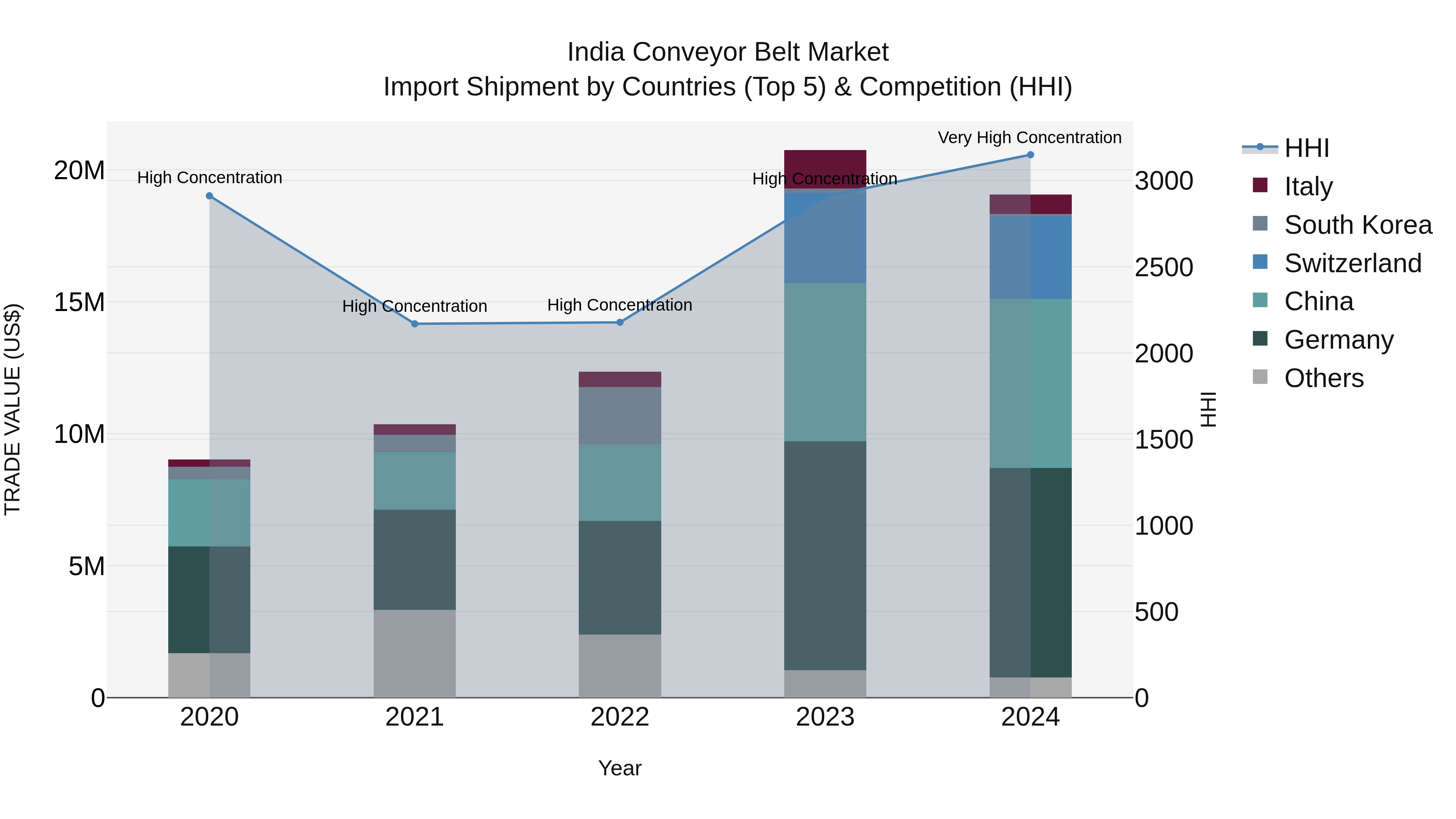
India Conveyor Belt Market Top 5 Importing Countries and Market Competition (HHI) Analysis
India`s conveyor belt import shipments in 2024 continued to showcase a high level of concentration, with top exporting countries being Germany, China, Switzerland, Italy, and Japan. The Herfindahl-Hirschman Index (HHI) indicated a significant increase in concentration from 2023 to 2024, reflecting market dynamics. Despite a notable Compound Annual Growth Rate (CAGR) of 20.56% from 2020 to 2024, the growth rate experienced a slight decline of -8.1% from 2023 to 2024. These trends suggest a complex landscape for conveyor belt imports in India, influenced by various factors impacting the market.
India Conveyor Belt Market Growth Rate
According to 6Wresearch internal database and industry insights
India Conveyor Belt Market Highlights
| Report Name | India Conveyor Belt Market |
| Forecast period | 2025-2031 |
| CAGR | 5.74% |
| Growing Sector | Food & Beverage |
Topics Covered in the India Conveyor Belt Market Report
India Conveyor Belt Market report thoroughly covers the market by material, product, installation, application, and end-user. The market report provides an unbiased and detailed analysis of ongoing market trends, opportunities/high growth areas, and market drivers, which would help stakeholders devise and align their market strategies according to the current and future market dynamics.
India Conveyor Belt Market Synopsis
The India Conveyor Belt Market is expected to experience a gradual increase in growth during the next few years. The rising demand for automated systems in the mining, manufacturing, and logistics sectors is one of the main reasons for the installation of conveyor belts. Moreover, the development of infrastructure projects, the rise of cement and power sectors, and the updating of production lines are other important drivers of the market. Furthermore, the market is bolstered by technological innovations such as the smart conveyor systems with built-in sensors for real-time monitoring and predictive maintenance.
Evaluation of Growth Drivers in the India Conveyor Belt Market
Below mentioned some growth drivers and their impact on market dynamics:
| Drivers | Primary Segments Affected | Why It Matters |
| Rapid Industrialization | End-user (Manufacturing, Mining) | Expands conveyor demand. |
| Infrastructure & Mining Projects | Application (Heavy Weight) | Increases conveyor installations. |
| Automation in Production Lines | Product (Flat, Modular) | Enhances efficiency and safety. |
| Technological Integration (IoT & Sensors) | Material (Metal, Polymer) | Improves maintenance and productivity. |
| Government Support for Manufacturing | End-user (General Manufacturing, Power) | Encourages industrial modernization. |
The India Conveyor Belt Market is projected to grow at a CAGR of 5.74% during the forecast period of 2025-2031. The ongoing industrial transformation driven by automation, coupled with growing mining and logistics sectors, is accelerating conveyor belt adoption. The rise in bulk material handling requirements in coal, cement, and power generation industries is strengthening market expansion. In addition, government-led investments in manufacturing and industrial parks are expected to create new opportunities for conveyor belt suppliers and manufacturers.
Evaluation of Restraints in the India Conveyor Belt Market
Below mentioned are some major restraints and their influence on market dynamics:
| Restraints | Primary Segments Affected | What This Means |
| High Maintenance Costs | All Segments | Increases operational burden. |
| Volatility in Raw Material Prices | Material (Metal, Polymer) | Impacts profit margins. |
| Limited Adoption in Small Industries | End-user (General Manufacturing) | Slows automation uptake. |
| Technical Skill Gap | Installation (Portable, Stationary) | Affects system operation. |
| Import Dependency for Advanced Belts | Material (Polymer) | Raises procurement cost. |
India Conveyor Belt Market Challenges
The India Conveyor Belt Market is facing some serious challenges such as the changing prices of raw materials, mainly rubber and metal, that have a direct impact on production costs. There are several small-scale manufacturers who rely on traditional manual handling methods because of their lack of technical knowledge and the high installation costs. Besides, the non-uniformity in quality and the reliance on overseas supply of advanced polymer-based belts are other issues that manufacturers have to deal with. The maintenance and downtime of large conveyor systems are also quite costly which makes it difficult to adopt this technology in cost-sensitive industries.
India Conveyor Belt Market Trends
Some major trends contributing to the development of the India Conveyor Belt Market growth are:
- Smart Conveyor Systems: Integration of IoT and AI for real-time belt monitoring and predictive maintenance is gaining traction.
- Eco-friendly Materials: Increased adoption of energy-efficient and recyclable materials to reduce carbon footprint.
- Customized Belt Solutions: Demand for tailored conveyor solutions for specialized applications in food, mining, and recycling sectors.
- Expansion of E-commerce and Warehousing: The boom in e-commerce is driving automation and conveyor usage in distribution centers.
- Shift Toward Lightweight Belts: Manufacturers are focusing on lighter yet durable materials to enhance operational efficiency.
Investment Opportunities in the India Conveyor Belt Industry
Here are some investment opportunities in the India Conveyor Belt Industry:
- Automation & Smart Technologies: Investment in advanced conveyor systems with AI-based monitoring for predictive maintenance.
- Recycling Belt Solutions: Development of belts designed for waste recycling and material recovery applications.
- Energy-efficient Belts: Focus on manufacturing belts with low energy consumption for sustainable operations.
- Regional Manufacturing Units: set up local production facilities to reduce dependency on imports and logistics costs.
- Mining Sector Supply: Expansion into supplying heavy-duty belts for mining and mineral processing plants.
Top 5 Leading Players in the India Conveyor Belt Market
Here are top players contributing to India Conveyor Belt Market Share:
1. Continental India Pvt. Ltd.
| CompanyName | Continental India Pvt. Ltd. |
|---|---|
| Established Year | 2001 |
| Headquarters | Pune, India |
| Official Website | - |
Description: Continental India offers a comprehensive range of industrial and mining conveyor belts. The company focuses on innovation, durability, and the use of smart technologies to improve system performance.
2. Fenner (India) Ltd.
| CompanyName | Fenner (India) Ltd. |
|---|---|
| Established Year | 1955 |
| Headquarters | Chennai, India |
| Official Website | - |
Description: Fenner India is a leading manufacturer of power transmission belts and conveyor systems, catering to sectors like cement, steel, and mining. It emphasizes high-tensile belts and energy-efficient solutions.
3. Somi Conveyor Beltings Ltd.
| CompanyName | Somi Conveyor Beltings Ltd. |
|---|---|
| Established Year | 2000 |
| Headquarters | Jodhpur, India |
| Official Website | - |
Description: Somi Conveyor specializes in manufacturing heat-resistant and abrasion-resistant conveyor belts. The company serves industries including mining, thermal power, and construction.
4. Oriental Rubber Industries Pvt. Ltd.
| CompanyName | Oriental Rubber Industries Pvt. Ltd. |
|---|---|
| Established Year | 1949 |
| Headquarters | Pune, India |
| Official Website | Click Here |
Description: Oriental Rubber is a major player producing conveyor belts for mining, cement, and industrial sectors. It emphasizes export expansion and high-performance rubber belts.
5. Sempertrans India Pvt. Ltd.
| CompanyName | Sempertrans India Pvt. Ltd. |
|---|---|
| Established Year | 2000 |
| Headquarters | Roha, Maharashtra |
| Official Website | - |
Description: Sempertrans offers steel cord and textile conveyor belts for heavy-duty applications. The company is recognized for its technological innovation and global export capabilities.
Government Regulations Introduced in the India Conveyor Belt Market
According to Indian government data, multiple initiatives have influenced conveyor belt adoption. The Make in India initiative promotes local manufacturing and reduces import dependency. The Gati Shakti National Master Plan is enhancing logistics infrastructure, creating higher demand for automated material handling systems. The National Mineral Policy 2019 supports modernization in mining operations, which directly increases conveyor system installations. Additionally, safety standards set by the Directorate General of Mines Safety (DGMS) ensure operational reliability and worker safety during conveyor operations.
Future Insights of the India Conveyor Belt Market
The future of the India Conveyor Belt Market appears promising, attributed by industrial automation, digital transformation, and the expansion of logistics networks. The increased use of conveyor belts in renewable energy, recycling, and mining applications will sustain long-term demand. The growing shift toward predictive maintenance and energy-efficient operations will shape the next phase of growth. With government infrastructure investments and a focus on self-reliant manufacturing, the market is poised for strong expansion by 2031.
Market Segmentation Analysis
The report offers a comprehensive study of the subsequent market segments and their leading categories.
Polymer Belts to Dominate the Market - By Material
According to Guneet Kaur, Senior Research Analyst, 6Wresearch, polymer belts are witnessing rapid adoption due to their flexibility, lightweight nature, and resistance to wear and corrosion. These belts are increasingly preferred across industries for efficient material handling and reduced maintenance costs.
Modular Belt to Dominate the Market – By Product
Modular belts are growing fast as they provide easy customization, enhanced durability, and simple replacement. Their adaptability for various production lines and automation processes makes them suitable for modern manufacturing and processing environments, improving operational efficiency.
Stationary Installation to Dominate the Market – By Installation
Stationary conveyor belts are increasingly used in industrial setups due to higher load-handling capacity, stability, and integration with automated systems. They reduce downtime, improve process efficiency, and support continuous material flow in heavy-duty operations.
Heavy Weight Application to Dominate the Market – By Application
Conveyors handling heavy-weight materials are expanding rapidly due to demand in mining, power generation, and recycling sectors. Their ability to transport large loads efficiently and reduce manual handling makes them essential for industrial productivity.
Food & Beverage Segment to Dominate the Market – By End-user
The food & beverage industry is increasingly adopting conveyor belts for automated processing, packaging, and material handling. Efficiency, hygiene compliance, and faster production cycles make conveyors indispensable in this sector, driving overall market growth.
Key Attractiveness of the Report
- 10 Years Market Numbers
- Historical Data Starting from 2021 to 2024
- Base Year: 2024
- Forecast Data until 2031
- Key Performance Indicators Impacting the Market
- Major Upcoming Developments and Projects
Key Highlights of the Report:
- India Conveyor Belt Market Outlook
- Market Size of India Conveyor Belt Market, 2024
- Forecast of India Conveyor Belt Market, 2031
- Historical Data and Forecast of India Conveyor Belt Revenues & Volume for the Period 2021-2031
- India Conveyor Belt Market Trend Evolution
- India Conveyor Belt Market Drivers and Challenges
- India Conveyor Belt Price Trends
- India Conveyor Belt Porter's Five Forces
- India Conveyor Belt Industry Life Cycle
- Historical Data and Forecast of India Conveyor Belt Market Revenues & Volume By Material for the Period 2021-2031
- Historical Data and Forecast of India Conveyor Belt Market Revenues & Volume By Metal for the Period 2021-2031
- Historical Data and Forecast of India Conveyor Belt Market Revenues & Volume By Polymer for the Period 2021-2031
- Historical Data and Forecast of India Conveyor Belt Market Revenues & Volume By Others for the Period 2021-2031
- Historical Data and Forecast of India Conveyor Belt Market Revenues & Volume By Product for the Period 2021-2031
- Historical Data and Forecast of India Conveyor Belt Market Revenues & Volume By Flat Belt for the Period 2021-2031
- Historical Data and Forecast of India Conveyor Belt Market Revenues & Volume By Modular Belt for the Period 2021-2031
- Historical Data and Forecast of India Conveyor Belt Market Revenues & Volume By Cleated Belt for the Period 2021-2031
- Historical Data and Forecast of India Conveyor Belt Market Revenues & Volume By Installation for the Period 2021-2031
- Historical Data and Forecast of India Conveyor Belt Market Revenues & Volume By Portable for the Period 2021-2031
- Historical Data and Forecast of India Conveyor Belt Market Revenues & Volume By Stationary for the Period 2021-2031
- Historical Data and Forecast of India Conveyor Belt Market Revenues & Volume By Application for the Period 2021-2031
- Historical Data and Forecast of India Conveyor Belt Market Revenues & Volume By Light Weight for the Period 2021-2031
- Historical Data and Forecast of India Conveyor Belt Market Revenues & Volume By Medium Weight for the Period 2021-2031
- Historical Data and Forecast of India Conveyor Belt Market Revenues & Volume By Heavy Weight for the Period 2021-2031
- Historical Data and Forecast of India Conveyor Belt Market Revenues & Volume By End-user for the Period 2021-2031
- Historical Data and Forecast of India Conveyor Belt Market Revenues & Volume By Mining for the Period 2021-2031
- Historical Data and Forecast of India Conveyor Belt Market Revenues & Volume By Food & Beverage for the Period 2021-2031
- Historical Data and Forecast of India Conveyor Belt Market Revenues & Volume By Power Generation for the Period 2021-2031
- Historical Data and Forecast of India Conveyor Belt Market Revenues & Volume By Recycling for the Period 2021-2031
- Historical Data and Forecast of India Conveyor Belt Market Revenues & Volume By Supply Chain for the Period 2021-2031
- Historical Data and Forecast of India Conveyor Belt Market Revenues & Volume By General Manufacturing for the Period 2021-2031
- Historical Data and Forecast of India Conveyor Belt Market Revenues & Volume By Others for the Period 2021-2031
- India Conveyor Belt Import Export Trade Statistics
- Market Opportunity Assessment By Material
- Market Opportunity Assessment By Product
- Market Opportunity Assessment By Installation
- Market Opportunity Assessment By Application
- Market Opportunity Assessment By End-user
- India Conveyor Belt Top Companies Market Share
- India Conveyor Belt Competitive Benchmarking By Technical and Operational Parameters
- India Conveyor Belt Company Profiles
- India Conveyor Belt Key Strategic Recommendations
Market Covered
The report subsequently covers the market by following segments and subsegments.
By Material
- Metal
- Polymer
- Others
By Product
- Flat Belt
- Modular Belt
- Cleated Belt
By Installation
- Portable
- Stationary
By Application
- Light Weight
- Medium Weight
- Heavy Weight
By End-user
- Mining
- Food & Beverage
- Power Generation
- Recycling
- Supply Chain
- General Manufacturing
- Others
India Conveyor Belt Market (2025-2031): FAQs
The India Conveyor Belt Market is projected to grow at a CAGR of 5.74% during the forecast period.
The mining sector holds the highest share due to extensive use in bulk material handling.
Initiatives like Gati Shakti, Make in India, and National Mineral Policy 2019 are supporting infrastructure and mining development.
High maintenance costs, raw material price fluctuations, and import dependency for advanced belts.
IoT-based monitoring, eco-friendly materials, and customized belt designs.
6Wresearch actively monitors the India Conveyor Belt Market and publishes its comprehensive annual report, highlighting emerging trends, growth drivers, revenue analysis, and forecast outlook. Our insights help businesses to make data-backed strategic decisions with ongoing market dynamics. Our analysts track relevent industries related to the India Conveyor Belt Market, allowing our clients with actionable intelligence and reliable forecasts tailored to emerging regional needs.
Yes, we provide customisation as per your requirements. To learn more, feel free to contact us on sales@6wresearch.com
Global Go To Market Strategy - 2030
Export potential enables firms to identify high-growth global markets with greater confidence by combining advanced trade intelligence with a structured quantitative methodology. The framework analyzes emerging demand trends and country-level import patterns while integrating macroeconomic and trade datasets such as GDP and population forecasts, bilateral import–export flows, tariff structures, elasticity differentials between developed and developing economies, geographic distance, and import demand projections. Using weighted trade values from 2020–2024 as the base period to project country-to-country export potential for 2030, these inputs are operationalized through calculated drivers such as gravity model parameters, tariff impact factors, and projected GDP per-capita growth. Through an analysis of hidden potentials, demand hotspots, and market conditions that are most favorable to success, this method enables firms to focus on target countries, maximize returns, and global expansion with data, backed by accuracy.
By factoring in the projected importer demand gap that is currently unmet and could be potential opportunity, it identifies the potential for the Exporter (Country) among 190 countries, against the general trade analysis, which identifies the biggest importer or exporter.
To discover high-growth global markets and optimize your business strategy:
Click Here
Pricing
- Single User License$ 1,995
- Department License$ 2,400
- Site License$ 3,120
- Global License$ 3,795

Leadership Perspectives from Industry Events
Search
Thought Leadership and Analyst Meet





Our Clients








6WResearch In News
- India Export Attractiveness Tracker 2026
- India Air Conditioner Market Set for Strong Rebound in 2026 After Weather-Led Correction and GST-Driven Recovery: 6Wresearch
- ADAS in India: How Automatic Emergency Braking, Blind Spot Detection & Driver Monitoring are Transforming Road Safety
- Doha a strategic location for EV manufacturing hub: IPA Qatar
- Demand for luxury TVs surging in the GCC, says Samsung
- Empowering Growth: The Thriving Journey of Bangladesh’s Cable Industry
Latest Reports
- Qatar Access and Home Network Market (2026-2032)
- Nicaragua RPG Gaming Market (2026-2032)
- New Zealand RPG Gaming Market (2026-2032)
- Netherlands RPG Gaming Market (2026-2032)
- Nauru RPG Gaming Market (2026-2032)
- Namibia RPG Gaming Market (2026-2032)
- Mozambique RPG Gaming Market (2026-2032)
- Montenegro RPG Gaming Market (2026-2032)
- Mongolia RPG Gaming Market (2026-2032)
- Monaco RPG Gaming Market (2026-2032)
Industry Events and Analyst Meet

EV India Expo 2026

HIMTEX 2026

India Refining Summit 2026

India EV Show 2026

EV tech India Expo 2026
Whitepaper
- Middle East & Africa Commercial Security Market Click here to view more.
- Middle East & Africa Fire Safety Systems & Equipment Market Click here to view more.
- GCC Drone Market Click here to view more.
- Middle East Lighting Fixture Market Click here to view more.
- GCC Physical & Perimeter Security Market Click here to view more.


