Indonesia Oil and Gas Market (2026-2032) | Outlook, Forecast, Segmentation, Growth, Trends, Industry, Share, Companies, Analysis, Value, Competitive Landscape, Size & Revenue
Market Forecast By Type (Upstream, Midstream, Downstream) And Competitive Landscape
| Product Code: ETC7571001 | Publication Date: Sep 2024 | Updated Date: Mar 2026 | Product Type: Market Research Report | |
| Publisher: 6Wresearch | Author: Dhaval Chaurasia | No. of Pages: 75 | No. of Figures: 35 | No. of Tables: 20 |
Indonesia Oil and Gas Market: Import Trend Analysis
In the Indonesia oil and gas market, the import trend exhibited a decline from 2023 to 2024, with a growth rate of -7.08%. However, the compound annual growth rate (CAGR) for the period 2020-2024 stood at a robust 13.68%. This dip in import momentum could be attributed to shifts in global demand patterns or alterations in trade policies impacting market stability.
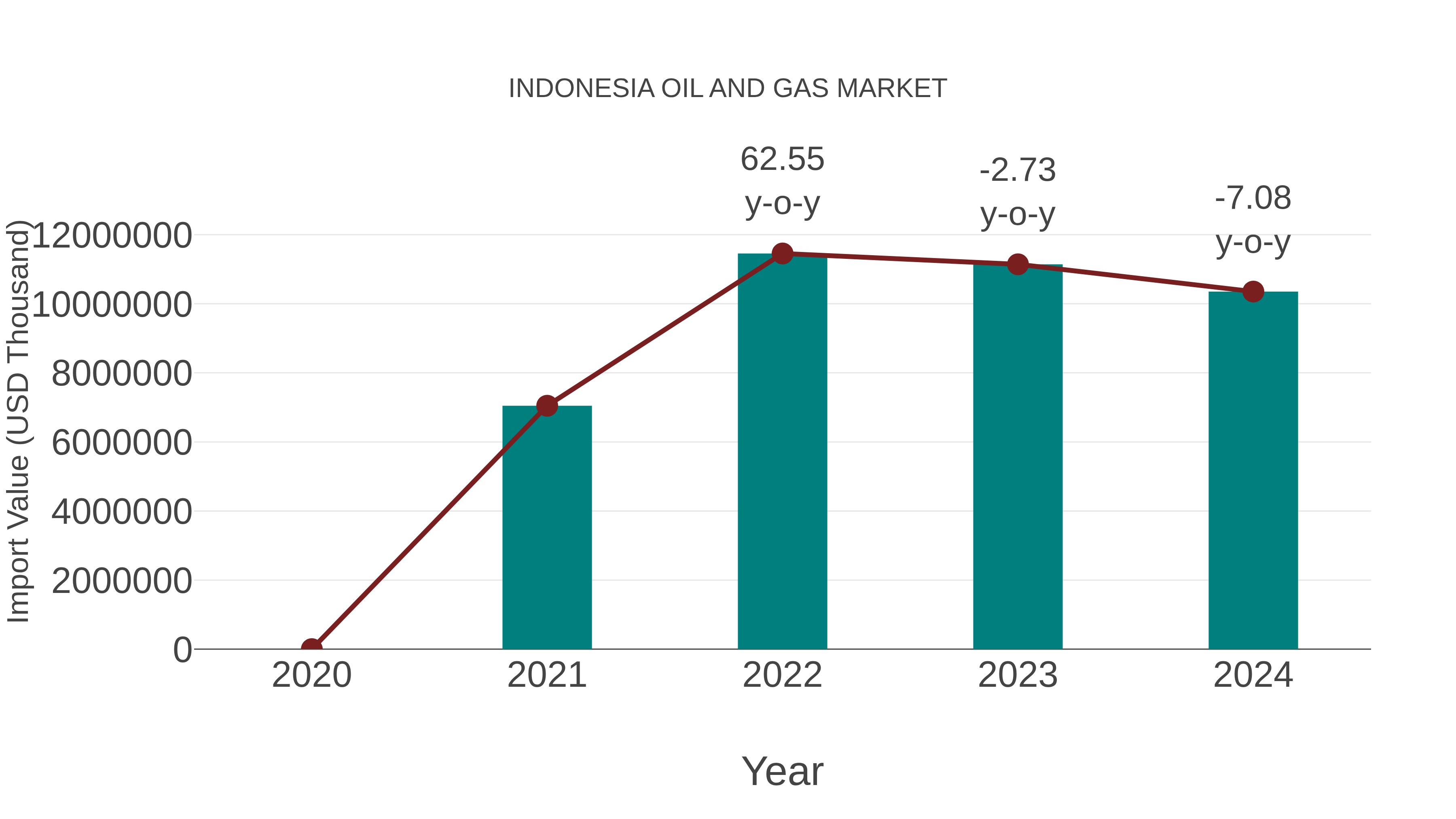
Indonesia Oil and Gas Market Growth Rate
According to 6Wresearch internal database and industry insights, the Indonesia Oil and Gas Market is projected to grow at a compound annual growth rate (CAGR) of 5.9% during the forecast period (2026-2032).
Five-Year Growth Trajectory of the Indonesia Oil and Gas Market with Core Drivers
Below mentioned are the evaluation of years-wise growth rate along with key growth drivers:
| Year | Est. Annual Growth (%) | Growth Drivers |
| 2021 | 2.6% | Stabilisation of crude oil production and gradual recovery in energy demand |
| 2022 | 3.1% | Revival of offshore exploration activities and refinery utilisation improvement |
| 2023 | 3.9% | Increased investments in upstream block development and LNG exports |
| 2024 | 4.6% | Government-backed gas infrastructure expansion and pipeline projects |
| 2025 | 5.1% | Rising domestic fuel consumption and enhanced downstream capacity |
Topics Covered in the Indonesia Oil and Gas Market Report
The Indonesia Oil and Gas Market report thoroughly covers the market by type. The market report provides an unbiased and detailed analysis of ongoing market trends, opportunities/high growth areas, and market drivers, which help stakeholders devise and align their market strategies according to the current and future market dynamics.
Indonesia Oil and Gas Market Highlights
| Report Name | Indonesia Oil and Gas Market |
| Forecast period | 2026-2032 |
| CAGR | 5.9% |
| Growing Sector | Midstream |
Indonesia Oil and Gas Market Synopsis
Indonesia Oil and Gas Industry is positioned for steady advancement supported by rising domestic energy consumption, progressive regulatory reforms, and renewed upstream investment momentum. The market is still supported by various exploration efforts in both offshore and mature basins, whereas downstream capacity expansion is making the supply of fuel more comfortable. At the same time, energy security objectives at the national level and the growing attention to the use of natural gas are making the supply more reliable, improving the state of the infrastructure, and strengthening the industry's long-term operational stability.
Evaluation of Growth Drivers in the Indonesia Oil and Gas Market
Below mentioned are some prominent drivers and their influence to the market dynamics:
| Drivers | Primary Segments Affected | Why it Matters (Evidence) |
| Increased Upstream Exploration Activity | Upstream | Revived bidding rounds attract foreign investment and improve reserve replacement. |
| Expansion of Refining Capacity | Downstream | New refineries reduce fuel imports and strengthen energy security. |
| Rising Natural Gas Demand | Midstream & Downstream | Growing power and industrial usage increases gas transmission needs. |
| Government Fiscal Incentives | All Types | Tax holidays and contract flexibility encourage capital inflows. |
| Energy Security Policies | All Types | National focus on self-sufficiency supports long-term oil and gas demand. |
Indonesia Oil and Gas Market is expected to grow at the CAGR of 5.9% during the forecast period of 2026-2032. Growth in the local market is being facilitated by increased upstream investments, continued extension of refining and gas infrastructure, and higher domestic consumption of petroleum products. Further momentum is generated through government-backed fiscal reforms, growing foreign participation, and long-term energy security initiatives focused on reducing import dependency and improving overall production efficiency.
Evaluation of Restraints in the Indonesia Oil and Gas Market
Below mentioned are some major restraints and their influence to the market dynamics:
| Restraints | Primary Segments Affected | What This Means (Evidence) |
| Declining Mature Oil Fields | Upstream | Natural production decline impacts output stability. |
| High Capital Requirements | Upstream & Downstream | Large investments delay project execution timelines. |
| Regulatory Complexity | All Types | It takes a long time for the project to be executed due to large investments. |
| Infrastructure Gaps | Midstream | Scattered and insufficient pipeline coverage limits gas distribution. |
| Price Volatility | Downstream | Fluctuating crude prices affect refinery margins. |
Indonesia Oil and Gas Market Challenges
While the Indonesia Oil and Gas Market Share is improving in various sectors, the industry is still facing significant problems associated with old oil fields, dependence on expensive developments, and uneven distribution of infrastructure in different areas. Besides that, the operational uncertainties resulting from difficult regulations, short pipelines, and vulnerability to international price changes are affecting the investment confidence, project execution, and long-term planning of the stakeholders at the leading edge.
Indonesia Oil and Gas Market Trends
Major trends driving the changing dynamics of the Indonesian Oil and Gas market are:
- Increased Natural Gas Consumption: Growing use of gas for power generation and industrial purposes aligns with clean energy goals and supports demand growth.
- Refinery Modernisation Initiatives: The modernising of the old refineries has the mixed effect, firstly, it increases the quality of the fuel, and secondly, it makes the refineries more efficient from the operational point of view.
- Transition to Digital in Upstream Operations: The use of digital instruments like data analytics and automation has a great effect on reservoir management and production optimization.
Investment Opportunities in the Indonesia Oil and Gas Market
Some areas with good potential to attract a lot of capital in the Indonesian Oil and Gas market are:
- Upstream Block Development – Investments can be made both in deep-sea and small onshore fields, which are artificially supported by enhanced recovery techniques.
- Gas Transmission Infrastructure – Installation of new inter-island pipelines and liquefied natural gas terminals to facilitate long-distance gas transportation.
- Refinery Expansion Projects – Building of additional refining units for the purpose of cutting fuel imports and providing the local market.
Top 5 Leading Players in the Indonesia Oil and Gas Market
Key companies actively shaping the competitive landscape of the Indonesia Oil and Gas Market include:
1. PT Pertamina (Persero)
| Company Name | PT Pertamina (Persero) |
| Established Year | 1957 |
| Headquarters | Jakarta, Indonesia |
| Official Website | Click Here |
PT Pertamina operates across upstream, midstream, and downstream segments, forming the backbone of Indonesia’s national energy supply system.
2. Chevron Corporation
| Company Name | Chevron Corporation |
| Established Year | 1879 |
| Headquarters | California, USA |
| Official Website | Click Here |
Chevron contributes advanced upstream exploration and production expertise in Indonesia’s oil and gas sector.
3. BP plc
| Company Name | BP plc |
| Established Year | 1909 |
| Headquarters | London, United Kingdom |
| Official Website | Click Here |
BP supports LNG and natural gas projects enhancing export capacity and domestic gas availability.
4. ExxonMobil Corporation
| Company Name | ExxonMobil Corporation |
| Established Year | 1870 |
| Headquarters | Texas, USA |
| Official Website | Click Here |
ExxonMobil is involved in large-scale gas development and offshore exploration initiatives.
5. TotalEnergies SE
| Company Name | TotalEnergies SE |
| Established Year | 1924 |
| Headquarters | Paris, France |
| Official Website | Click Here |
TotalEnergies participates in offshore gas developments and LNG infrastructure expansion programs.
Government Regulations Introduced in the Indonesia Oil and Gas Market
According to Indonesian Government Data, the Indonesia Oil and Gas Industry has been influenced by policy measures such as the Gross Split Production Sharing Contract introduced in 2017, aimed at improving efficiency and fiscal transparency. Also, the Ministry of Energy and Mineral Resources is moving ahead with the National Energy Policy implementation that is aimed at promoting refinery development through various stages, widening gas infrastructure and ensuring energy security in the long run while a part of the effort goes towards improving the domestic supply resilience.
Future Insights of the Indonesia Oil and Gas Market
Indonesia Oil and Gas Market is expected to progress steadily with balanced growth across upstream, midstream, and downstream segments, reflecting consistent Indonesia Oil and Gas Market Growth supported by regulatory reforms, infrastructure expansion, and wider adoption of advanced production technologies. These developments are likely to enhance output stability, strengthen gas distribution networks, and support refinery capacity expansion, while also improving operational efficiency, attracting long-term investments, and creating sustained growth opportunities for industry participants across the value chain.
Market Segmentation Analysis
The report offers a comprehensive study of the subsequent market segments and their leading categories.
Midstream Expansion Strengthening Supply Networks- By Type
According to Nikita, Senior Research Analyst, 6Wresearch, the midstream segment is witnessing growth driven by pipeline expansion, LNG terminals, and storage facilities that enhance energy connectivity across Indonesia island-based geography, while simultaneously improving gas accessibility for power generation, industrial clusters, and urban distribution networks, thereby reducing supply bottlenecks, strengthening inter-island energy integration, supporting downstream consumption growth, and playing a critical role in stabilizing fuel availability and ensuring efficient transportation of hydrocarbons across remote and high-demand regions.
Key Attractiveness of the Report
- 10 Years of Market Numbers.
- Historical Data Starting from 2022 to 2025.
- Base Year: 2025.
- Forecast Data until 2032.
- Key Performance Indicators Impacting the Market.
- Major Upcoming Developments and Projects.
Key Highlights of the Report:
- Indonesia Oil and Gas Market Outlook
- Market Size of Indonesia Oil and Gas Market, 2025
- Forecast of Indonesia Oil and Gas Market, 2032
- Historical Data and Forecast of Indonesia Oil and Gas Revenues & Volume for the Period 2022- 2032F
- Indonesia Oil and Gas Market Trend Evolution
- Indonesia Oil and Gas Market Drivers and Challenges
- Indonesia Oil and Gas Price Trends
- Indonesia Oil and Gas Porter's Five Forces
- Indonesia Oil and Gas Industry Life Cycle
- Historical Data and Forecast of Indonesia Oil and Gas Market Revenues & Volume By Type for the Period 2022- 2032F
- Historical Data and Forecast of Indonesia Oil and Gas Market Revenues & Volume By Upstream for the Period 2022- 2032F
- Historical Data and Forecast of Indonesia Oil and Gas Market Revenues & Volume By Midstream for the Period 2022- 2032F
- Historical Data and Forecast of Indonesia Oil and Gas Market Revenues & Volume By Downstream for the Period 2022- 2032F
- Indonesia Oil and Gas Import Export Trade Statistics
- Market Opportunity Assessment By Type
- Indonesia Oil and Gas Top Companies Market Share
- Indonesia Oil and Gas Competitive Benchmarking By Technical and Operational Parameters
- Indonesia Oil and Gas Company Profiles
- Indonesia Oil and Gas Key Strategic Recommendations
Market Covered
The report offers a comprehensive study of the subsequent market segments:
By Type
- Upstream
- Midstream
- Downstream
Indonesia Oil and Gas Market (2026-2032): FAQs
The Indonesia Oil and Gas Market is anticipated to register a CAGR of 5.9% over the period from 2026 to 2032.
Prominent participants in the Indonesia Oil and Gas Market include PT Pertamina, Chevron Corporation, BP plc, ExxonMobil Corporation, and TotalEnergies SE.
Sustained upstream investments, refinery capacity additions, and increasing utilization of natural gas across industries are key contributors to market expansion.
The Indonesia Oil and Gas Market portrays a competitive environment of a balanced nature, characterised by significant state-owned involvement and well-established international energy companies.
6Wresearch actively monitors the Indonesia Oil and Gas Market and publishes its comprehensive annual report, highlighting emerging trends, growth drivers, revenue analysis, and forecast outlook. Our insights help businesses to make data-backed strategic decisions with ongoing market dynamics. Our analysts track relevent industries related to the Indonesia Oil and Gas Market, allowing our clients with actionable intelligence and reliable forecasts tailored to emerging regional needs.
Yes, we provide customisation as per your requirements. To learn more, feel free to contact us on sales@6wresearch.com
| 1 Executive Summary |
| 2 Introduction |
| 2.1 Key Highlights of the Report |
| 2.2 Report Description |
| 2.3 Market Scope & Segmentation |
| 2.4 Research Methodology |
| 2.5 Assumptions |
| 3 Indonesia Oil and Gas Market Overview |
| 3.1 Indonesia Country Macro Economic Indicators |
| 3.2 Indonesia Oil and Gas Market Revenues & Volume, 2022 & 2032F |
| 3.3 Indonesia Oil and Gas Market - Industry Life Cycle |
| 3.4 Indonesia Oil and Gas Market - Porter's Five Forces |
| 3.5 Indonesia Oil and Gas Market Revenues & Volume Share, By Type, 2022 & 2032F |
| 4 Indonesia Oil and Gas Market Dynamics |
| 4.1 Impact Analysis |
| 4.2 Market Drivers |
| 4.2.1 Increasing energy demand in Indonesia and the Asia-Pacific region |
| 4.2.2 Government initiatives to boost oil and gas exploration and production activities |
| 4.2.3 Growing investments in renewable energy sources as a transition from fossil fuels |
| 4.3 Market Restraints |
| 4.3.1 Fluctuating global oil prices impacting investment decisions |
| 4.3.2 Regulatory uncertainties and challenges in obtaining permits for exploration and production activities |
| 4.3.3 Environmental concerns and pressure to reduce carbon emissions |
| 5 Indonesia Oil and Gas Market Trends |
| 6 Indonesia Oil and Gas Market, By Types |
| 6.1 Indonesia Oil and Gas Market, By Type |
| 6.1.1 Overview and Analysis |
| 6.1.2 Indonesia Oil and Gas Market Revenues & Volume, By Type, 2022- 2032F |
| 6.1.3 Indonesia Oil and Gas Market Revenues & Volume, By Upstream, 2022- 2032F |
| 6.1.4 Indonesia Oil and Gas Market Revenues & Volume, By Midstream, 2022- 2032F |
| 6.1.5 Indonesia Oil and Gas Market Revenues & Volume, By Downstream, 2022- 2032F |
| 7 Indonesia Oil and Gas Market Import-Export Trade Statistics |
| 7.1 Indonesia Oil and Gas Market Export to Major Countries |
| 7.2 Indonesia Oil and Gas Market Imports from Major Countries |
| 8 Indonesia Oil and Gas Market Key Performance Indicators |
| 8.1 Percentage increase in domestic oil and gas production |
| 8.2 Number of exploration and production projects initiated or approved |
| 8.3 Investment inflow into the oil and gas sector for infrastructure development |
| 9 Indonesia Oil and Gas Market - Opportunity Assessment |
| 9.1 Indonesia Oil and Gas Market Opportunity Assessment, By Type, 2022 & 2032F |
| 10 Indonesia Oil and Gas Market - Competitive Landscape |
| 10.1 Indonesia Oil and Gas Market Revenue Share, By Companies, 2025 |
| 10.2 Indonesia Oil and Gas Market Competitive Benchmarking, By Operating and Technical Parameters |
| 11 Company Profiles |
| 12 Recommendations |
| 13 Disclaimer |
Global Go To Market Strategy - 2030
Export potential enables firms to identify high-growth global markets with greater confidence by combining advanced trade intelligence with a structured quantitative methodology. The framework analyzes emerging demand trends and country-level import patterns while integrating macroeconomic and trade datasets such as GDP and population forecasts, bilateral import–export flows, tariff structures, elasticity differentials between developed and developing economies, geographic distance, and import demand projections. Using weighted trade values from 2020–2024 as the base period to project country-to-country export potential for 2030, these inputs are operationalized through calculated drivers such as gravity model parameters, tariff impact factors, and projected GDP per-capita growth. Through an analysis of hidden potentials, demand hotspots, and market conditions that are most favorable to success, this method enables firms to focus on target countries, maximize returns, and global expansion with data, backed by accuracy.
By factoring in the projected importer demand gap that is currently unmet and could be potential opportunity, it identifies the potential for the Exporter (Country) among 190 countries, against the general trade analysis, which identifies the biggest importer or exporter.
To discover high-growth global markets and optimize your business strategy:
Click Here
Pricing
- Single User License$ 1,995
- Department License$ 2,400
- Site License$ 3,120
- Global License$ 3,795

Leadership Perspectives from Industry Events
Search
Thought Leadership and Analyst Meet





Our Clients








6WResearch In News
- India Export Attractiveness Tracker 2026
- India Air Conditioner Market Set for Strong Rebound in 2026 After Weather-Led Correction and GST-Driven Recovery: 6Wresearch
- ADAS in India: How Automatic Emergency Braking, Blind Spot Detection & Driver Monitoring are Transforming Road Safety
- Doha a strategic location for EV manufacturing hub: IPA Qatar
- Demand for luxury TVs surging in the GCC, says Samsung
- Empowering Growth: The Thriving Journey of Bangladesh’s Cable Industry
Latest Reports
- Greece Insulated Sandwich Panels Market (2026-2032)
- Qatar Access and Home Network Market (2026-2032)
- Nicaragua RPG Gaming Market (2026-2032)
- New Zealand RPG Gaming Market (2026-2032)
- Netherlands RPG Gaming Market (2026-2032)
- Nauru RPG Gaming Market (2026-2032)
- Namibia RPG Gaming Market (2026-2032)
- Mozambique RPG Gaming Market (2026-2032)
- Montenegro RPG Gaming Market (2026-2032)
- Mongolia RPG Gaming Market (2026-2032)
Industry Events and Analyst Meet

EV India Expo 2026

HIMTEX 2026

India Refining Summit 2026

India EV Show 2026

EV tech India Expo 2026
Whitepaper
- Middle East & Africa Commercial Security Market Click here to view more.
- Middle East & Africa Fire Safety Systems & Equipment Market Click here to view more.
- GCC Drone Market Click here to view more.
- Middle East Lighting Fixture Market Click here to view more.
- GCC Physical & Perimeter Security Market Click here to view more.


