Singapore Hair Conditioner Market (2026-2032) | Analysis, Growth, Size, Revenue, Outlook, Trends, Value, Forecast, Share, Industry & Companies
Market Forecast By Product Type (Dry Hair, Oily Hair, Normal Hair, Professional, Non-professional), By Application (Online Retail, Offline Retail, Personal Use, Personal Use, Barber shop, Hotel) And Competitive Landscape
| Product Code: ETC064426 | Publication Date: Jul 2023 | Updated Date: Mar 2026 | Product Type: Report | |
| Publisher: 6Wresearch | Author: Ravi Bhandari | No. of Pages: 70 | No. of Figures: 35 | No. of Tables: 5 |
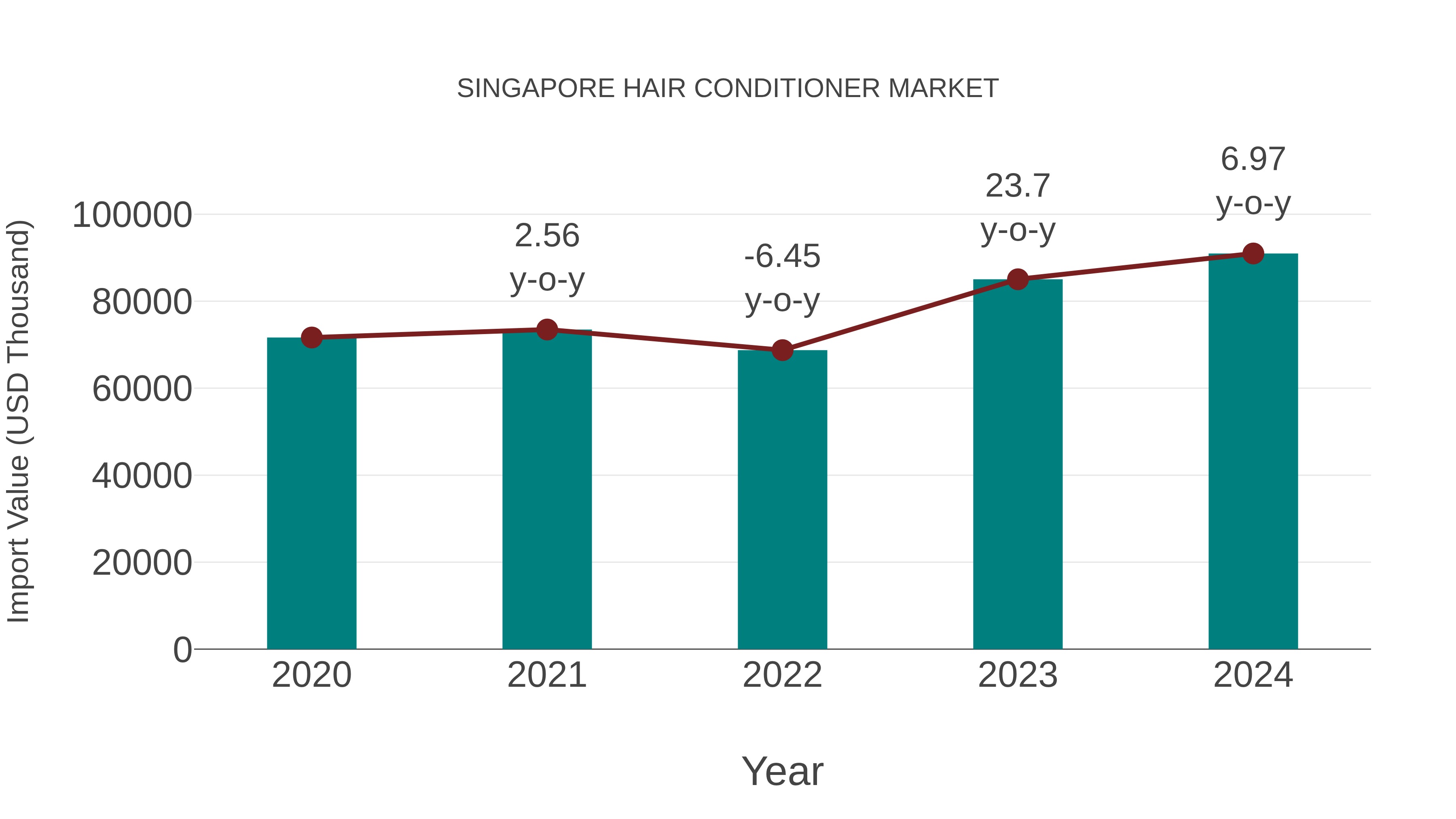
Singapore Hair Conditioner Market: Import Trend Analysis
In the Singapore hair conditioner market, the import trend saw a growth rate of 6.97% from 2023 to 2024, with a compound annual growth rate (CAGR) of 6.15% from 2020 to 2024. This positive import momentum can be attributed to a sustained demand shift towards premium hair care products in the market, indicating a stable and growing consumer interest in quality hair conditioning products during this period.
Singapore Hair Conditioner Market Highlights
| Report Name | Singapore Hair Conditioner Market |
| Forecast period | 2025-2031 |
| CAGR | 6.7% |
| Growing Sector | Offline retail |
Topics Covered in the Singapore Hair Conditioner Market Report
Singapore Hair Conditioner Market report thoroughly covers the market by product type, and by application. The market report provides an unbiased and detailed analysis of the ongoing market trends, opportunities/high growth areas, and market drivers which would help the stakeholders to devise and align their market strategies according to the current and future market dynamics.
Singapore Hair Conditioner Market Synopsis
Singapore Hair Conditioner Market Industry is characterized by a high demand for specialized conditioners tailored to different hair types and applications. Urban lifestyles, exposure to environmental pollutants, and frequent use of chemical treatments have increased the need for conditioners that offer targeted benefits like repair, hydration, and protection. The market is segmented into product types such as conditioners for dry, oily, and normal hair, as well as professional and non-professional use. Applications include personal use, barber shops, hotels, and both online and offline retail channels, each contributing significantly to market dynamics.
According to 6Wresearch, the Singapore Hair Conditioner Market is forecasted to grow at a remarkable growth rate, reaching a CAGR of 6.7% during the forecast period 2025-2031. The market is primarily fueled by the rising preference for natural and organic hair care products. Consumers in Singapore are increasingly gravitating towards conditioners that incorporate botanical ingredients and avoid harmful chemicals such as sulfates and parabens. Additionally, the growing trend of personalization in hair care is propelling the market, as consumers seek products tailored to their specific hair concerns, including frizz control, dandruff prevention, and color retention. The e-commerce sector is playing a pivotal role in market expansion, providing consumers with easy access to a wide variety of products and facilitating cross-border purchases. International brands continue to dominate the market, but local players are gaining traction by emphasizing sustainability and affordability. Singapore’s position as a global business hub has also encouraged leading brands to introduce exclusive and luxury product lines to meet the expectations of discerning consumers.
Despite robust growth, the Singapore Hair Conditioner Market faces several challenges. Intense competition among brands has created a saturated market, with consumers often overwhelmed by the sheer variety of products. This has led to price wars, particularly in the mass-market segment, affecting profit margins. Furthermore, counterfeit products remain a pressing issue, undermining consumer trust in premium brands and affecting market credibility. Environmental concerns related to packaging waste and the use of synthetic ingredients have also emerged as significant challenges. Consumers are increasingly scrutinizing brands for their sustainability practices, and companies that fail to adapt risk losing market share. Additionally, high operational costs, including rental and marketing expenses, pose barriers for smaller players trying to establish a foothold in the industry.
Singapore Hair Conditioner Market Trends
Singapore Hair Conditioner Market is shaped by several key trends that reflect evolving consumer preferences. One of the most prominent trends is the rising demand for multifunctional conditioners that offer a combination of benefits, such as hydration, damage repair, and heat protection. Products that cater to specific hair concerns, such as scalp health and anti-aging properties, are also gaining popularity.
Sustainability is another major trend influencing the market. Consumers are increasingly seeking eco-friendly products that use biodegradable packaging and sustainably sourced ingredients. Brands that emphasize transparency in their ingredient lists and adopt cruelty-free practices are resonating with environmentally conscious buyers.
The professional segment is witnessing significant growth, with consumers willing to invest in salon-quality conditioners for use at home. This is complemented by a surge in demand for gender-neutral hair care products that cater to diverse hair types and preferences. Social media and influencer marketing continue to play a crucial role in shaping product trends and driving brand engagement.
Investment Opportunities in the Singapore Hair Conditioner Market
Singapore Hair Conditioner Industry offers a plethora of investment opportunities, particularly in the premium and organic product segments. With the growing consumer shift towards natural and chemical-free products, investing in the development of organic conditioners can yield substantial returns. Companies can also explore the personalization trend by leveraging technology to create tailored hair care solutions that address individual needs.
The professional-grade product segment presents another lucrative avenue for investment. As more consumers seek salon-quality results at home, the demand for high-performance conditioners is expected to grow. E-commerce platforms provide an excellent opportunity to reach a broader audience, and investing in digital marketing strategies can enhance brand visibility and sales.
Collaborations with local salons and hotels can also help brands strengthen their presence in the professional segment. Furthermore, brands that prioritize sustainability by adopting green manufacturing processes and using eco-friendly packaging materials are likely to attract environmentally conscious consumers and secure long-term growth.
Leading Players in the Singapore Hair Conditioner Market
Singapore Hair Conditioner Market Share is dominated by leading international brands such as Unilever (Dove, Sunsilk), Procter & Gamble (Pantene, Herbal Essences), and L’Oréal (L’Oréal Paris, Garnier). These companies offer a wide range of products tailored to various hair types and concerns, leveraging advanced technologies and extensive marketing campaigns to maintain their market position.
Local brands are also making their mark by focusing on affordability and catering to the unique preferences of Singaporean consumers. Companies like Bio-Essence and Ginvera have gained popularity for their innovative and cost-effective solutions. As the market continues to evolve, companies that emphasize sustainability, innovation, and personalization are expected to lead the way, ensuring continued growth and competitiveness in the Singapore Hair Conditioner Market.
Government Regulations
The Singapore government actively supports the beauty and personal care industry through policies that encourage innovation and sustainability. Initiatives to promote digitalization have facilitated the growth of e-commerce, enabling hair care brands to reach a wider audience. The government’s focus on environmental sustainability has also encouraged companies to adopt greener practices, such as using biodegradable materials and reducing carbon emissions.
Regulations aimed at ensuring product safety and quality have enhanced consumer confidence in the Singapore Hair Conditioner Industry, creating a favorable business environment for both local and international players. Furthermore, government-backed trade initiatives and free trade agreements have opened up export opportunities for Singapore-based companies, enabling them to compete on a global scale.
Future Insights of the Singapore Hair Conditioner Market
Singapore Hair Conditioner Market size is poised for steady growth, with sustainability and innovation expected to be the key drivers. As consumers become more health-conscious, the demand for conditioners with clean and natural formulations will continue to rise. The growing emphasis on personalized solutions and multifunctional products will further shape the market, offering significant opportunities for innovation.
Technological advancements in the beauty industry, such as AI-driven hair analysis tools, are likely to revolutionize the market by enabling brands to offer highly customized products. Additionally, the increasing penetration of e-commerce platforms will make it easier for brands to reach a global audience, further boosting Singapore Hair Conditioner Market Growth.
Market Segmentation Analysis
The report offers a comprehensive study of the subsequent market segments and their leading categories.
Professional hair conditioners to Dominate the Market-By Product Type
According to Vasu, Senior Research Analyst, 6Wresearch, the Professional segment dominates this category in the Singapore Hair Conditioner Market, driven by the increasing consumer demand for high-quality, salon-grade products. Professional conditioners are specially formulated to address specific hair concerns, such as damage repair, hydration, and color protection, which are highly sought after by urban consumers.
Offline retail sector to Dominate the Market-By Application
Offline retail remains the dominating category in the application segment, thanks to the strong presence of supermarkets, hypermarkets, and specialty beauty stores in Singapore. Consumers prefer offline channels for the ability to physically evaluate products, seek expert advice, and benefit from promotional offers. These retail stores often serve as a one-stop solution for personal care needs, providing a comprehensive range of hair conditioners tailored to different hair types and concerns.
Key Attractiveness of the Report
- 10 Years of Market Numbers.
- Historical Data Starting from 2021 to 2024
- Base Year: 2024
- Forecast Data until 2031
- Key Performance Indicators Impacting the Market
- Major Upcoming Developments and Projects
Key Highlights of the Report:
- Singapore Hair Conditioner Market Outlook
- Market Size of Singapore Hair Conditioner Market, 2025
- Forecast of Singapore Hair Conditioner Market, 2032
- Historical Data and Forecast of Singapore Hair Conditioner Revenues & Volume for the Period 2022 - 2032F
- Singapore Hair Conditioner Market Trend Evolution
- Singapore Hair Conditioner Market Drivers and Challenges
- Singapore Hair Conditioner Price Trends
- Singapore Hair Conditioner Porter's Five Forces
- Singapore Hair Conditioner Industry Life Cycle
- Historical Data and Forecast of Singapore Hair Conditioner Market Revenues & Volume By Product Type for the Period 2022 - 2032F
- Historical Data and Forecast of Singapore Hair Conditioner Market Revenues & Volume By Dry Hair for the Period 2022 - 2032F
- Historical Data and Forecast of Singapore Hair Conditioner Market Revenues & Volume By Oily Hair for the Period 2022 - 2032F
- Historical Data and Forecast of Singapore Hair Conditioner Market Revenues & Volume By Normal Hair for the Period 2022 - 2032F
- Historical Data and Forecast of Singapore Hair Conditioner Market Revenues & Volume By Professional for the Period 2022 - 2032F
- Historical Data and Forecast of Singapore Hair Conditioner Market Revenues & Volume By Non-professional for the Period 2022 - 2032F
- Historical Data and Forecast of Singapore Hair Conditioner Market Revenues & Volume By Application for the Period 2022 - 2032F
- Historical Data and Forecast of Singapore Hair Conditioner Market Revenues & Volume By Online Retail for the Period 2022 - 2032F
- Historical Data and Forecast of Singapore Hair Conditioner Market Revenues & Volume By Offline Retail for the Period 2022 - 2032F
- Historical Data and Forecast of Singapore Hair Conditioner Market Revenues & Volume By Personal Use for the Period 2022 - 2032F
- Historical Data and Forecast of Singapore Hair Conditioner Market Revenues & Volume By Personal Use for the Period 2022 - 2032F
- Historical Data and Forecast of Singapore Hair Conditioner Market Revenues & Volume By Barber shop for the Period 2022 - 2032F
- Historical Data and Forecast of Singapore Hair Conditioner Market Revenues & Volume By Hotel for the Period 2022 - 2032F
- Singapore Hair Conditioner Import Export Trade Statistics
- Market Opportunity Assessment By Product Type
- Market Opportunity Assessment By Application
- Singapore Hair Conditioner Top Companies Market Share
- Singapore Hair Conditioner Competitive Benchmarking By Technical and Operational Parameters
- Singapore Hair Conditioner Company Profiles
- Singapore Hair Conditioner Key Strategic Recommendations
Market Covered
The market report has been segmented and sub segmented into the following categories:
By Product Type:
- Dry Hair
- Oily Hair
- Normal Hair
- Professional
- Non-professional
By Application:
- Online Retail
- Offline Retail
- Personal Use
- Personal Use
- Barber shop
- Hotel
Singapore Hair Conditioner Market (2026-2032): FAQs
Challenges include economic fluctuations, counterfeit products, and the growing demand for sustainable packaging.
The growth is primarily driven by rising consumer awareness of hair care, a strong focus on personal grooming, and increasing disposable income. The demand for natural and innovative hair care products also plays a significant role.
Consumers are increasingly seeking products that cater to specific hair needs, such as repairing damage, providing hydration, or improving strength and shine. The shift toward environmentally friendly and cruelty-free products is also shaping the market.
Innovation in ingredients, packaging, and product formulations has made hair conditioners more desirable. The integration of technology, such as scalp-nourishing formulas and customized solutions, has further enhanced product appeal.
6Wresearch actively monitors the Singapore Hair Conditioner Market and publishes its comprehensive annual report, highlighting emerging trends, growth drivers, revenue analysis, and forecast outlook. Our insights help businesses to make data-backed strategic decisions with ongoing market dynamics. Our analysts track relevent industries related to the Singapore Hair Conditioner Market, allowing our clients with actionable intelligence and reliable forecasts tailored to emerging regional needs.
Yes, we provide customisation as per your requirements. To learn more, feel free to contact us on sales@6wresearch.com
| 1 Executive Summary |
| 2 Introduction |
| 2.1 Key Highlights of the Report |
| 2.2 Report Description |
| 2.3 Market Scope & Segmentation |
| 2.4 Research Methodology |
| 2.5 Assumptions |
| 3 Singapore Hair Conditioner Market Overview |
| 3.1 Singapore Country Macro Economic Indicators |
| 3.2 Singapore Hair Conditioner Market Revenues & Volume, 2022 & 2032F |
| 3.3 Singapore Hair Conditioner Market - Industry Life Cycle |
| 3.4 Singapore Hair Conditioner Market - Porter's Five Forces |
| 3.5 Singapore Hair Conditioner Market Revenues & Volume Share, By Product Type, 2022 & 2032F |
| 3.6 Singapore Hair Conditioner Market Revenues & Volume Share, By Application, 2022 & 2032F |
| 4 Singapore Hair Conditioner Market Dynamics |
| 4.1 Impact Analysis |
| 4.2 Market Drivers |
| 4.3 Market Restraints |
| 5 Singapore Hair Conditioner Market Trends |
| 6 Singapore Hair Conditioner Market, By Types |
| 6.1 Singapore Hair Conditioner Market, By Product Type |
| 6.1.1 Overview and Analysis |
| 6.1.2 Singapore Hair Conditioner Market Revenues & Volume, By Product Type, 2022-2032F |
| 6.1.3 Singapore Hair Conditioner Market Revenues & Volume, By Dry Hair, 2022-2032F |
| 6.1.4 Singapore Hair Conditioner Market Revenues & Volume, By Oily Hair, 2022-2032F |
| 6.1.5 Singapore Hair Conditioner Market Revenues & Volume, By Normal Hair, 2022-2032F |
| 6.1.6 Singapore Hair Conditioner Market Revenues & Volume, By Professional, 2022-2032F |
| 6.1.7 Singapore Hair Conditioner Market Revenues & Volume, By Non-professional, 2022-2032F |
| 6.2 Singapore Hair Conditioner Market, By Application |
| 6.2.1 Overview and Analysis |
| 6.2.2 Singapore Hair Conditioner Market Revenues & Volume, By Online Retail, 2022-2032F |
| 6.2.3 Singapore Hair Conditioner Market Revenues & Volume, By Offline Retail, 2022-2032F |
| 6.2.4 Singapore Hair Conditioner Market Revenues & Volume, By Personal Use, 2022-2032F |
| 6.2.5 Singapore Hair Conditioner Market Revenues & Volume, By Personal Use, 2022-2032F |
| 6.2.6 Singapore Hair Conditioner Market Revenues & Volume, By Barber shop, 2022-2032F |
| 6.2.7 Singapore Hair Conditioner Market Revenues & Volume, By Hotel, 2022-2032F |
| 7 Singapore Hair Conditioner Market Import-Export Trade Statistics |
| 7.1 Singapore Hair Conditioner Market Export to Major Countries |
| 7.2 Singapore Hair Conditioner Market Imports from Major Countries |
| 8 Singapore Hair Conditioner Market Key Performance Indicators |
| 9 Singapore Hair Conditioner Market - Opportunity Assessment |
| 9.1 Singapore Hair Conditioner Market Opportunity Assessment, By Product Type, 2022 & 2032F |
| 9.2 Singapore Hair Conditioner Market Opportunity Assessment, By Application, 2022 & 2032F |
| 10 Singapore Hair Conditioner Market - Competitive Landscape |
| 10.1 Singapore Hair Conditioner Market Revenue Share, By Companies, 2025 |
| 10.2 Singapore Hair Conditioner Market Competitive Benchmarking, By Operating and Technical Parameters |
| 11 Company Profiles |
| 12 Recommendations |
| 13 Disclaimer |
Global Go To Market Strategy - 2030
Export potential enables firms to identify high-growth global markets with greater confidence by combining advanced trade intelligence with a structured quantitative methodology. The framework analyzes emerging demand trends and country-level import patterns while integrating macroeconomic and trade datasets such as GDP and population forecasts, bilateral import–export flows, tariff structures, elasticity differentials between developed and developing economies, geographic distance, and import demand projections. Using weighted trade values from 2020–2024 as the base period to project country-to-country export potential for 2030, these inputs are operationalized through calculated drivers such as gravity model parameters, tariff impact factors, and projected GDP per-capita growth. Through an analysis of hidden potentials, demand hotspots, and market conditions that are most favorable to success, this method enables firms to focus on target countries, maximize returns, and global expansion with data, backed by accuracy.
By factoring in the projected importer demand gap that is currently unmet and could be potential opportunity, it identifies the potential for the Exporter (Country) among 190 countries, against the general trade analysis, which identifies the biggest importer or exporter.
To discover high-growth global markets and optimize your business strategy:
Click Here
Pricing
- Single User License$ 1,995
- Department License$ 2,400
- Site License$ 3,120
- Global License$ 3,795

Leadership Perspectives from Industry Events
Search
Thought Leadership and Analyst Meet





Our Clients








6WResearch In News
- India Export Attractiveness Tracker 2026
- India Air Conditioner Market Set for Strong Rebound in 2026 After Weather-Led Correction and GST-Driven Recovery: 6Wresearch
- ADAS in India: How Automatic Emergency Braking, Blind Spot Detection & Driver Monitoring are Transforming Road Safety
- Doha a strategic location for EV manufacturing hub: IPA Qatar
- Demand for luxury TVs surging in the GCC, says Samsung
- Empowering Growth: The Thriving Journey of Bangladesh’s Cable Industry
Latest Reports
- Greece Insulated Sandwich Panels Market (2026-2032)
- Qatar Access and Home Network Market (2026-2032)
- Nicaragua RPG Gaming Market (2026-2032)
- New Zealand RPG Gaming Market (2026-2032)
- Netherlands RPG Gaming Market (2026-2032)
- Nauru RPG Gaming Market (2026-2032)
- Namibia RPG Gaming Market (2026-2032)
- Mozambique RPG Gaming Market (2026-2032)
- Montenegro RPG Gaming Market (2026-2032)
- Mongolia RPG Gaming Market (2026-2032)
Industry Events and Analyst Meet

EV India Expo 2026

HIMTEX 2026

India Refining Summit 2026

India EV Show 2026

EV tech India Expo 2026
Whitepaper
- Middle East & Africa Commercial Security Market Click here to view more.
- Middle East & Africa Fire Safety Systems & Equipment Market Click here to view more.
- GCC Drone Market Click here to view more.
- Middle East Lighting Fixture Market Click here to view more.
- GCC Physical & Perimeter Security Market Click here to view more.


