United States (US) Watch Straps Market (2025-2031) Outlook | Growth, Forecast, Value, Companies, Share, Industry, Analysis, Trends, Size & Revenue
Market Forecast By Product Type (Type, Ceramic, Fabric, Leather, Metal, Plastic, Rubber), By Distribution Channel Outlook (Revenue, USD Million, 2016 - 2027) (Online, Offline), By Application (Women, Men) And Competitive Landscape
| Product Code: ETC432957 | Publication Date: Oct 2022 | Updated Date: Nov 2025 | Product Type: Market Research Report | |
| Publisher: 6Wresearch | Author: Dhaval Chaurasia | No. of Pages: 75 | No. of Figures: 35 | No. of Tables: 20 |
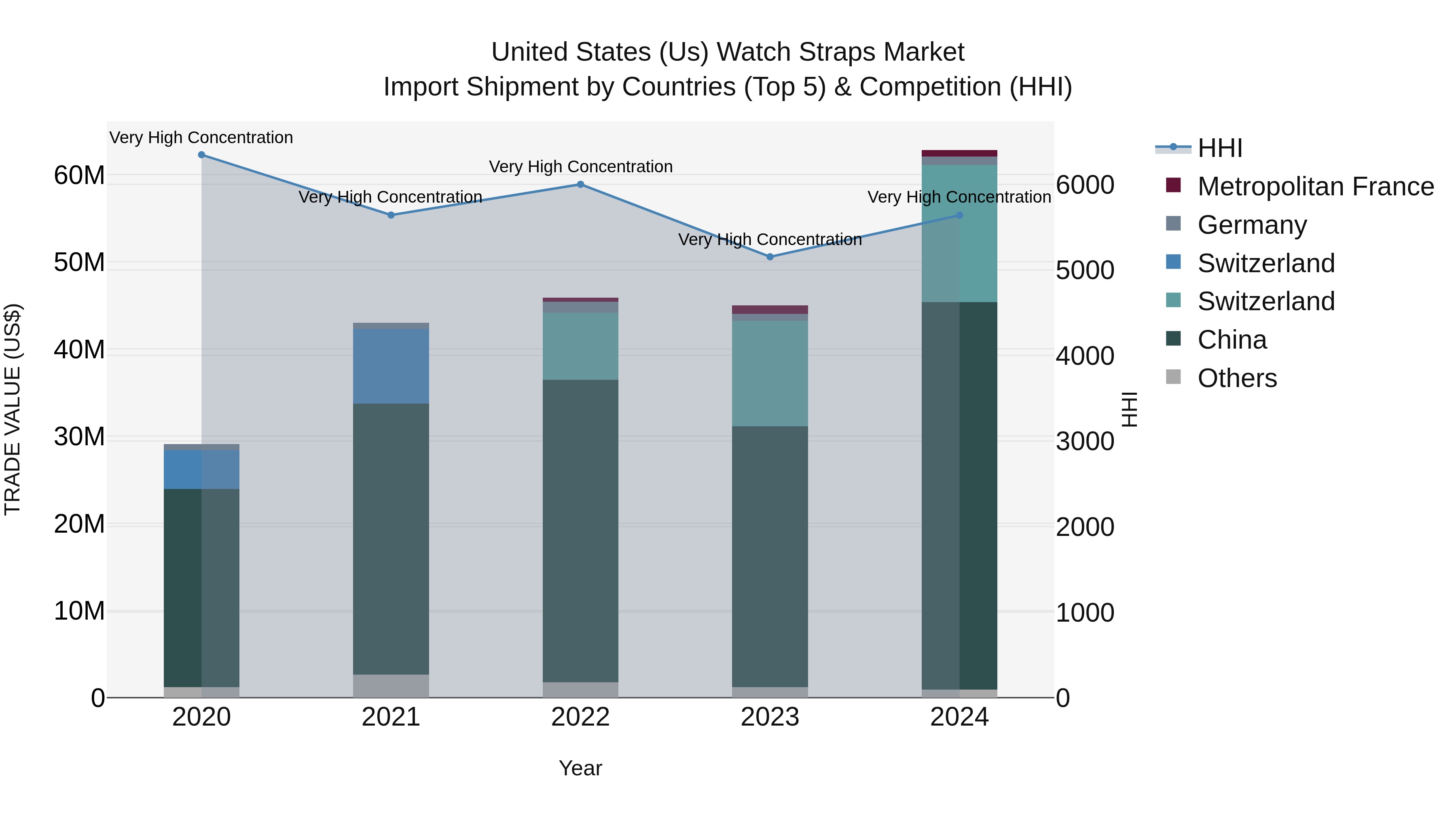
United States (US) Watch Straps Market Top 5 Importing Countries and Market Competition (HHI) Analysis
The United States saw a significant increase in watch straps import shipments in 2024, with top exporting countries being China, Switzerland, Germany, Metropolitan France, and Italy. The market remained highly concentrated, with a high Herfindahl-Hirschman Index (HHI). The compound annual growth rate (CAGR) from 2020 to 2024 was impressive at 21.23%, indicating a strong upward trend in demand. Additionally, the growth rate from 2023 to 2024 surged by 39.52%, showcasing a rapid expansion in the market for watch straps in the US.
United States (US) Watch Straps Market Synopsis
The United States watch straps market is a dynamic and competitive industry driven by a combination of fashion trends, technological advancements, and consumer preferences. Leather, metal, nylon, and silicone are the most popular materials used for watch straps in the US market. The increasing popularity of smartwatches has also influenced the demand for interchangeable and customizable watch straps. Key players in the market include well-established brands such as Fossil, Timex, and Michael Kors, as well as a growing number of niche and independent brands catering to specific consumer segments. E-commerce platforms have played a significant role in the distribution of watch straps, offering a wide range of options for consumers to choose from. Overall, the US watch straps market is expected to continue evolving with the changing preferences and lifestyles of consumers.
United States (US) Watch Straps Market Trends
The United States watch straps market is currently witnessing several trends. One prominent trend is the growing demand for customizable and interchangeable watch straps, allowing consumers to personalize their timepieces to suit different occasions and outfits. Another trend is the rising popularity of sustainable and eco-friendly watch straps made from materials such as recycled plastics, vegan leather, and organic cotton, reflecting the increasing consumer preference for environmentally conscious products. Additionally, there is a noticeable shift towards innovative and tech-enabled watch straps, integrating features like fitness tracking, NFC payments, and smart notifications. With a focus on style, sustainability, and functionality, these trends are expected to continue shaping the US watch straps market in the coming years.
United States (US) Watch Straps Market Challenges
In the US Watch Straps Market, some challenges include intense competition from both domestic and international players, leading to pricing pressures and the need for constant innovation to stand out in the market. Additionally, the shift towards smartwatches and wearable technology has impacted the demand for traditional watch straps, requiring companies to adapt their product offerings to cater to changing consumer preferences. Another challenge is the increasing trend of online shopping, which has disrupted traditional retail channels, leading to the need for companies to invest in their online presence and e-commerce capabilities. Furthermore, fluctuations in raw material prices and supply chain disruptions can also pose challenges for watch strap manufacturers in the US market.
United States (US) Watch Straps Market Investment Opportunities
The United States watch straps market presents various investment opportunities for businesses looking to capitalize on the growing demand for customization and personalization in the fashion industry. With the rise of e-commerce platforms and direct-to-consumer brands, there is a growing trend towards niche and specialty watch strap manufacturers offering unique designs, materials, and customization options. Investing in innovative materials such as sustainable and vegan leather, as well as smartwatch-compatible straps, can cater to the evolving needs of consumers. Additionally, leveraging social media marketing and influencer collaborations can help in reaching a wider audience and establishing a strong brand presence in the competitive market. Overall, the US watch straps market offers opportunities for companies to differentiate themselves through creativity, quality, and consumer engagement.
Jordan Agar Market Government Policies
Government policies related to the US Watch Straps Market primarily focus on consumer protection, safety standards, and trade regulations. The US Consumer Product Safety Commission (CPSC) oversees the safety and quality of watch straps to ensure they meet specific criteria to protect consumers from potential hazards. Additionally, trade policies such as tariffs and import/export regulations impact the pricing and availability of watch straps in the US market. The US government also closely monitors labeling requirements, warranties, and advertising guidelines to ensure transparency and fair competition among watch strap manufacturers and retailers. Overall, government policies in the US Watch Straps Market are designed to safeguard consumer interests, maintain market integrity, and foster a competitive and compliant business environment.
United States (US) Watch Straps Market Future Outlook
The United States watch straps market is anticipated to experience steady growth in the coming years due to the increasing popularity of smartwatches and fashion watches among consumers. The demand for customizable and interchangeable watch straps is expected to rise as consumers seek to personalize their timepieces to match different outfits and occasions. Additionally, the growing trend of sustainability and ethical consumerism is likely to drive the demand for eco-friendly and vegan watch straps made from materials such as recycled plastics, cork, and plant-based leathers. E-commerce platforms and online retailers will continue to play a significant role in the distribution of watch straps, offering a wide range of options to a diverse consumer base. Overall, the US watch straps market is poised for expansion as consumer preferences evolve and new trends emerge.
Key Highlights of the Report:
- United States (US) Watch Straps Market Outlook
- Market Size of United States (US) Watch Straps Market, 2024
- Forecast of United States (US) Watch Straps Market, 2031
- Historical Data and Forecast of United States (US) Watch Straps Revenues & Volume for the Period 2021 - 2031
- United States (US) Watch Straps Market Trend Evolution
- United States (US) Watch Straps Market Drivers and Challenges
- United States (US) Watch Straps Price Trends
- United States (US) Watch Straps Porter's Five Forces
- United States (US) Watch Straps Industry Life Cycle
- Historical Data and Forecast of United States (US) Watch Straps Market Revenues & Volume By Product Type for the Period 2021 - 2031
- Historical Data and Forecast of United States (US) Watch Straps Market Revenues & Volume By Type for the Period 2021 - 2031
- Historical Data and Forecast of United States (US) Watch Straps Market Revenues & Volume By Ceramic for the Period 2021 - 2031
- Historical Data and Forecast of United States (US) Watch Straps Market Revenues & Volume By Fabric for the Period 2021 - 2031
- Historical Data and Forecast of United States (US) Watch Straps Market Revenues & Volume By Leather for the Period 2021 - 2031
- Historical Data and Forecast of United States (US) Watch Straps Market Revenues & Volume By Metal for the Period 2021 - 2031
- Historical Data and Forecast of United States (US) Watch Straps Market Revenues & Volume By Plastic for the Period 2021 - 2031
- Historical Data and Forecast of United States (US) Watch Straps Market Revenues & Volume By Rubber for the Period 2021 - 2031
- Historical Data and Forecast of United States (US) Watch Straps Market Revenues & Volume By Distribution Channel Outlook (Revenue, USD Million, 2016 - 2031) for the Period 2021 - 2031
- Historical Data and Forecast of United States (US) Watch Straps Market Revenues & Volume By Online for the Period 2021 - 2031
- Historical Data and Forecast of United States (US) Watch Straps Market Revenues & Volume By Offline for the Period 2021 - 2031
- Historical Data and Forecast of United States (US) Watch Straps Market Revenues & Volume By Application for the Period 2021 - 2031
- Historical Data and Forecast of United States (US) Watch Straps Market Revenues & Volume By Women for the Period 2021 - 2031
- Historical Data and Forecast of United States (US) Watch Straps Market Revenues & Volume By Men for the Period 2021 - 2031
- United States (US) Watch Straps Import Export Trade Statistics
- Market Opportunity Assessment By Product Type
- Market Opportunity Assessment By Distribution Channel Outlook (Revenue, USD Million, 2016 - 2031)
- Market Opportunity Assessment By Application
- United States (US) Watch Straps Top Companies Market Share
- United States (US) Watch Straps Competitive Benchmarking By Technical and Operational Parameters
- United States (US) Watch Straps Company Profiles
- United States (US) Watch Straps Key Strategic Recommendations
Frequently Asked Questions About the Market Study (FAQs):
6Wresearch actively monitors the United States (US) Watch Straps Market and publishes its comprehensive annual report, highlighting emerging trends, growth drivers, revenue analysis, and forecast outlook. Our insights help businesses to make data-backed strategic decisions with ongoing market dynamics. Our analysts track relevent industries related to the United States (US) Watch Straps Market, allowing our clients with actionable intelligence and reliable forecasts tailored to emerging regional needs.
Yes, we provide customisation as per your requirements. To learn more, feel free to contact us on sales@6wresearch.com
Global Go To Market Strategy - 2030
Export potential enables firms to identify high-growth global markets with greater confidence by combining advanced trade intelligence with a structured quantitative methodology. The framework analyzes emerging demand trends and country-level import patterns while integrating macroeconomic and trade datasets such as GDP and population forecasts, bilateral import–export flows, tariff structures, elasticity differentials between developed and developing economies, geographic distance, and import demand projections. Using weighted trade values from 2020–2024 as the base period to project country-to-country export potential for 2030, these inputs are operationalized through calculated drivers such as gravity model parameters, tariff impact factors, and projected GDP per-capita growth. Through an analysis of hidden potentials, demand hotspots, and market conditions that are most favorable to success, this method enables firms to focus on target countries, maximize returns, and global expansion with data, backed by accuracy.
By factoring in the projected importer demand gap that is currently unmet and could be potential opportunity, it identifies the potential for the Exporter (Country) among 190 countries, against the general trade analysis, which identifies the biggest importer or exporter.
To discover high-growth global markets and optimize your business strategy:
Click Here
Pricing
- Single User License$ 1,995
- Department License$ 2,400
- Site License$ 3,120
- Global License$ 3,795

Leadership Perspectives from Industry Events
Search
Thought Leadership and Analyst Meet





Our Clients








6WResearch In News
- India Export Attractiveness Tracker 2026
- India Air Conditioner Market Set for Strong Rebound in 2026 After Weather-Led Correction and GST-Driven Recovery: 6Wresearch
- ADAS in India: How Automatic Emergency Braking, Blind Spot Detection & Driver Monitoring are Transforming Road Safety
- Doha a strategic location for EV manufacturing hub: IPA Qatar
- Demand for luxury TVs surging in the GCC, says Samsung
- Empowering Growth: The Thriving Journey of Bangladesh’s Cable Industry
Latest Reports
- Greece Insulated Sandwich Panels Market (2026-2032)
- Qatar Access and Home Network Market (2026-2032)
- Nicaragua RPG Gaming Market (2026-2032)
- New Zealand RPG Gaming Market (2026-2032)
- Netherlands RPG Gaming Market (2026-2032)
- Nauru RPG Gaming Market (2026-2032)
- Namibia RPG Gaming Market (2026-2032)
- Mozambique RPG Gaming Market (2026-2032)
- Montenegro RPG Gaming Market (2026-2032)
- Mongolia RPG Gaming Market (2026-2032)
Industry Events and Analyst Meet

EV India Expo 2026

HIMTEX 2026

India Refining Summit 2026

India EV Show 2026

EV tech India Expo 2026
Whitepaper
- Middle East & Africa Commercial Security Market Click here to view more.
- Middle East & Africa Fire Safety Systems & Equipment Market Click here to view more.
- GCC Drone Market Click here to view more.
- Middle East Lighting Fixture Market Click here to view more.
- GCC Physical & Perimeter Security Market Click here to view more.


