Turbojet Engines (>25 kN Thrust) Lead the United Kingdom's Existing Export Growth at USD 20.1 Billion by 2031, with Crude Petroleum Creating USD 3.73 Billion in New Market Opportunities
In 2031, the United States constitutes 28.98% (largest) of the UK's existing export potential, well over double the share of second-placed China at 11.65%, but in the smaller set of entirely new product lines, China and Japan swap to the top two spots, together accounting for close to a third of that untapped total. Gold, jet engines and crude oil dominate the numbers so thoroughly that they continue to shape United Kingdom Export Potential, making Britain's export story read less like that of a manufacturing nation and more like a trading and refining hub.
 Source: 6WExportGTM
The United States Dominates Existing Export Potential, While Asia Drives Growth in New Export Corridors
China remains the leading destination for entirely new product-line opportunities with USD 5.12 billion in export potential, closely followed by Japan at USD 5.00 billion. Mexico, South Korea, and Indonesia complete the top five, highlighting that future export growth is expected to be concentrated across both established industrial economies and rapidly expanding Asian markets. The mix of destinations suggests that new export opportunities are likely to be driven by a combination of advanced manufacturing demand, energy requirements, and strengthening regional supply chains rather than traditional trade relationships alone.
| Top 5 Current Leading Importers | Export Potential (USD Billion) | Top 5 New Potential Importers for New Product Lines | Export Potential (USD Billion) |
| United States | 147.65 | China | 5.12 |
| China | 59.34 | Japan | 5.00 |
| Canada | 26.00 | Mexico | 2.07 |
| Japan | 22.09 | South Korea | 1.76 |
| Singapore | 19.14 | Indonesia | 1.42 |
Source: 6WExportGTM
The United Kingdom's export strategy for 2031 rests on three pillars that have little in common with one another: London's role as the world's largest over-the-counter gold market, Rolls-Royce's position at the centre of global widebody aviation, and a deeply entrenched trading relationship with the United States. In established trade relationships, export potential reaches USD 509.43 billion, led by the United States at 28.98% more than double the share of second-placed China at 11.65%. Canada, Japan and Singapore round out the top five, confirming that Britain's biggest future export relationships remain overwhelmingly Western and Asian trading-hub economies rather than its immediate European neighbors.
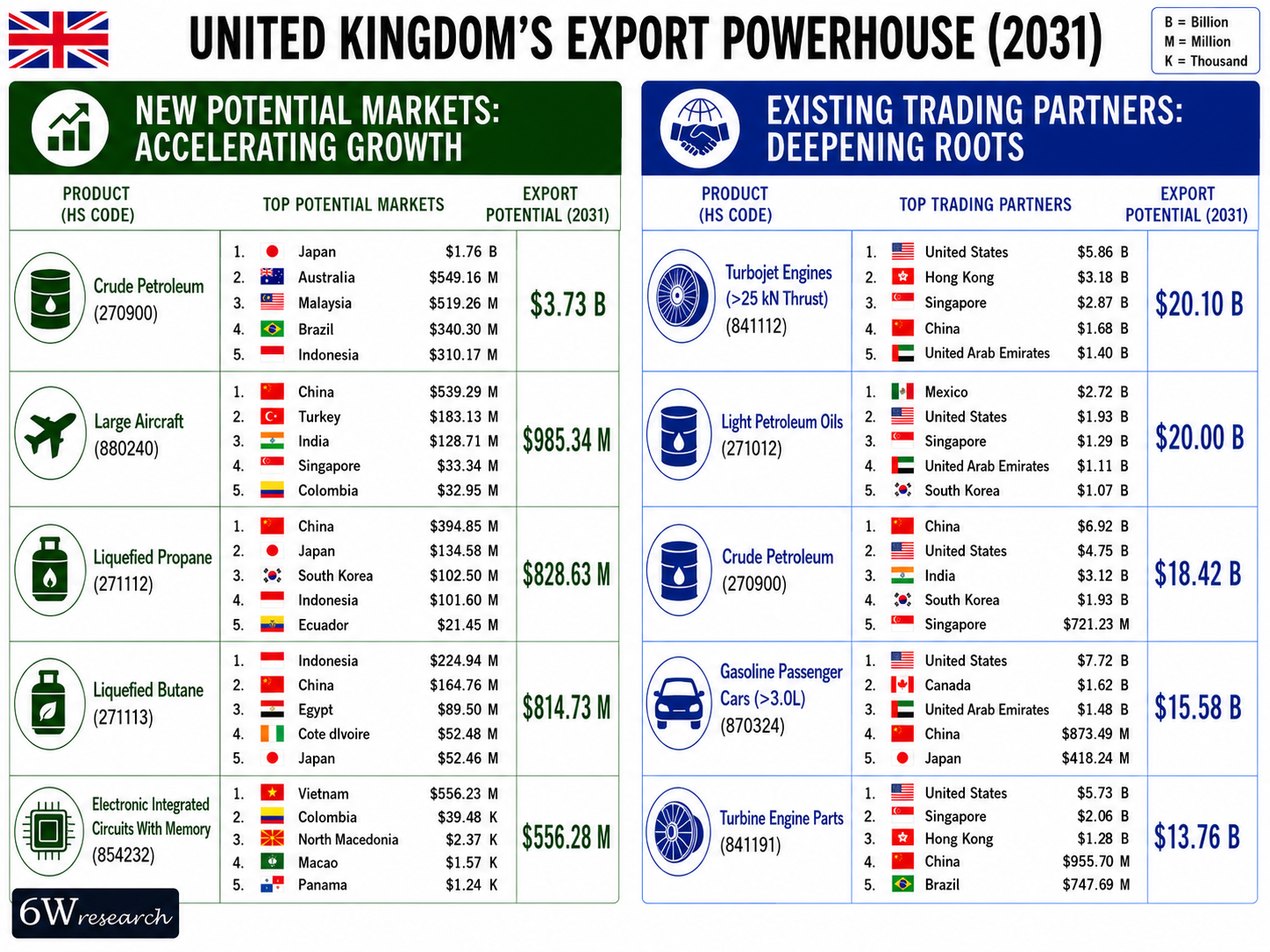
Crude Petroleum Leads the United Kingdom’s Potential in New Markets, with Aerospace, LPG and Electronics Broadening Opportunities by 2031
Crude petroleum, large aircraft, liquefied propane, liquefied butane and memory integrated circuits define the United Kingdom’s highest-value new export opportunities by 2031, creating a varied mix across energy, aerospace and advanced electronics. Japan leads the crude petroleum opportunity, China dominates demand for large aircraft and liquefied propane, Indonesia emerges strongly in liquefied butane, while Vietnam accounts for virtually the entire opportunity in memory integrated circuits.
Crude petroleum represents the United Kingdom’s largest new-corridor export opportunity at USD 3.73 billion, led by Japan (USD 1.76 billion), which accounts for nearly half of the category’s total potential. Australia (USD 549.16 million) and Malaysia (USD 519.26 million) follow, while Brazil and Indonesia add further demand, giving the opportunity a distinctly Asia-Pacific orientation. Large aircraft rank second at USD 985.34 million, led by China (USD 539.29 million) and Turkey (USD 183.13 million), with India, Singapore and Colombia completing the leading destinations. The product’s buyer mix highlights the potential for the United Kingdom to extend its aerospace presence beyond engines and components into finished aircraft across both large aviation markets and emerging fleet-expansion destinations.
Liquefied propane contributes USD 828.63 million in new export potential, with China (USD 394.85 million) representing almost half of the opportunity, followed by Japan, South Korea, Indonesia and Ecuador. Liquefied butane adds a comparable USD 814.73 million, although its destination mix differs, with Indonesia (USD 224.94 million) and China (USD 164.76 million) leading demand, followed by Egypt, Côte d’Ivoire and Japan. Electronic integrated circuits with memory round out the top five at USD 556.28 million, but the opportunity is exceptionally concentrated: Vietnam alone accounts for USD 556.23 million, while Colombia, North Macedonia, Macao and Panama contribute only marginal amounts. Together, these categories show that the United Kingdom’s new-market growth prospects span energy commodities, aerospace and advanced electronics, but also carry significant destination-concentration risk in several product lines.
Established Export Strength: Turbojet Engines, Petroleum and Passenger Vehicles
Turbojet engines, light petroleum oils, crude petroleum, high-capacity gasoline passenger cars and turbine engine parts form the backbone of the United Kingdom’s established export potential by 2031, reflecting a strong concentration in aerospace, energy and premium automotive products. The United States appears repeatedly across the leading product lines, while China, Singapore, Mexico and Hong Kong also play major roles in sustaining the UK’s existing trade base.
Turbojet engines above 25 kN thrust lead the United Kingdom’s established export potential at USD 20.10 billion, underlining the country’s strong position in high-value aerospace propulsion and engine manufacturing. The United States is the largest destination at USD 5.86 billion, followed by Hong Kong (USD 3.18 billion) and Singapore (USD 2.87 billion), with China and the United Arab Emirates also contributing meaningful demand. The geographic spread of these markets reflects the global nature of commercial aviation supply chains, where major airline hubs, aircraft-maintenance centres and re-export locations play an important role alongside direct end-user demand. Light petroleum oils follow closely at USD 20.00 billion, led by Mexico (USD 2.72 billion) and the United States (USD 1.93 billion), while Singapore, the United Arab Emirates and South Korea further broaden the buyer base. This mix highlights the United Kingdom’s continuing relevance in international fuel trading and refined-product supply, supported by demand from large consuming markets as well as regional distribution and re-export hubs.
Crude petroleum contributes a further USD 18.42 billion, led by China (USD 6.92 billion) and the United States (USD 4.75 billion), with India, South Korea and Singapore completing the leading destinations. The category demonstrates the importance of Asian demand to the United Kingdom’s established energy trade, while the United States remains a major transatlantic buyer. Gasoline passenger cars above 3.0L add USD 15.58 billion, driven primarily by the United States (USD 7.72 billion) and Canada (USD 1.62 billion), followed by the United Arab Emirates, China and Japan. This product mix reflects the United Kingdom’s established position in premium and high-performance vehicle manufacturing, particularly in affluent markets with strong demand for luxury automotive brands. Turbine engine parts round out the top five at USD 13.76 billion, led by the United States (USD 5.73 billion), Singapore and Hong Kong, with China and Brazil also featuring prominently. Together, these product lines reinforce the central role of aerospace, energy and premium automotive manufacturing in the United Kingdom’s established export base.
|
Britain's strongest export priorities remain aerospace engines and energy products into the United States, alongside a gold-trading relationship with Switzerland and China that operates almost entirely outside conventional manufacturing trade logic. 6WExportGTM Analysis |
Gold, Aerospace and Tariffs: Current Developments Supporting United Kingdom Export Growth
Three current developments help explain and reinforce the figures above: sustained gold trade with Switzerland and China, a strengthening Rolls-Royce order book, and a comparatively favorable position under new United States tariff measures.
United Kingdom Gold Trade with Switzerland and China
Semi-manufactured gold is the United Kingdom's single largest export product USD 63.75 billion of the USD 63.95 billion precious metals sector and the top line to both China (53.56%) and Switzerland (73.23%). London operates the world's largest over-the-counter gold trading market, while Switzerland's major refineries handle an estimated 70% of global gold refining capacity, and the two markets exchange bullion as institutional inventory needs shift. Swiss customs figures showed exports to the United Kingdom rising 30% month-on-month in March 2026, to 57.6 tons, as gold flowed back toward London alongside gold prices that peaked near USD 5,600 an ounce in January 2026 and were forecast to reach USD 6,000–6,300 by year-end.
|
The scale of UK-Switzerland-China gold flows means a meaningful share of this report's largest export category is really about institutional bullion positioning rather than underlying demand growth useful context for anyone reading the precious metals numbers as a conventional trade story. Manish Pant, Senior Data Scientist, Data Science & Market Intelligence, 6Wresearch |
Rolls-Royce Turbojet Engine Orders and United Kingdom Aerospace Exports
Turbojet engines and turbine engine parts together represent close to USD 34 billion of the United Kingdom's established export potential, and Rolls-Royce's order book strengthened through 2025 and into 2026. The company booked 638 large engine orders in 2025, up nearly 30%, extending its large-engine backlog to 2,207 units, including 226 orders for the Trent XWB-97 and 212 for the Trent 7000. A January 2026 order from Delta Air Lines for 30 Trent XWB-84 EP and 32 Trent 7000 engines, followed by a March 2026 order marking Rolls-Royce's first new Boeing 787 engine selection in nearly three years, points to continued momentum behind the turbojet-engine and turbine-parts figures carried in this report.
|
A backlog of over 2,200 large engines gives Rolls-Royce multi-year revenue visibility that few UK export categories can match the real risk to this report's USD 20 billion turbojet-engine forecast isn't demand, it's whether supply-chain constraints keep limiting how fast that backlog converts into shipped engines. Manisha Gupta, Data Analyst, Data Science & Market Intelligence, 6Wresearch |
Top Global Export Opportunities (2031), By Product
| Product | Export Opportunity (USD Billion) |
| Electronic Integrated Circuits | 685.7 |
| Refined Petroleum Oils | 668.4 |
| Light Petroleum Oils | 588.9 |
| Logic Electronic Integrated Circuits | 507.9 |
| Medicines | 381.2 |
| Gasoline Passenger Cars (1.5–3.0L) | 360.9 |
| Smartphones | 343.6 |
| Electronic integrated circuits with memory | 333.2 |
| Data Transmission Equipment | 216.9 |
| Immunological Products | 209.6 |
Excludes naturally occurring products (e.g., crude oil, raw gold). Source: 6WExportGTM
Globally, the largest export opportunities beyond naturally occurring products are concentrated in electronics, energy and pharmaceuticals highlighting the growing dominance of semiconductors, advanced manufacturing and high-value technology products in global trade. Japan already sits inside several of these categories, but its real priority through 2031 is defending semiconductor-equipment leadership, stabilizing its auto industry through a difficult transition, and using energy and metals diversification to reduce the geopolitical exposure that comes with a resource-poor, trade-dependent economy.
What Britain Already Sells, and to Whom
Precious metals form the largest pillar of the export portfolio at USD 74.73 billion, overwhelmingly driven by semi-manufactured gold (87.24%), with unwrought gold contributing a further 4.67%, underscoring the sector's heavy concentration in gold-related exports. Aircraft parts rank second at USD 53.28 billion, led by turbojet engines above 25 kN thrust (41.13%) and turbine engine parts (28.18%), reflecting the country's strong position in high-value aerospace manufacturing. Oil & gas contributes USD 38.67 billion, supported primarily by crude petroleum (51.17%) and light petroleum oils (17.62%), highlighting the continued importance of energy exports alongside advanced industrial products.
| Sector | Exports (USD Billion) | Leading Products / Share |
| Precious Metals | 74.73 | Semi Manufactured Gold (87.24%), Unwrought Gold (4.67%) |
| Aircraft Parts | 53.28 | Turbojet Engines (>25 kN Thrust) (41.13%), Turbine Engine Parts (28.18%) |
| Oil & Gas | 38.67 | Crude Petroleum (51.17%), Light Petroleum Oils (17.62 %) |
Source: UN Comtrade
The United States is the largest export destination at USD 73.14 billion, with hybrid petrol cars (7.03%) and immunological products (5.08%) leading the product mix, reflecting demand across both automotive and pharmaceutical categories. China ranks second at USD 47.25 billion, heavily driven by semi-manufactured gold (62.23%), while gasoline passenger cars in the 1.5–3.0L range (4.15%) provide a secondary contribution. Germany follows at USD 38.54 billion, led by aircraft structural parts (10.11%) and crude petroleum (3.21%), highlighting the importance of aerospace and energy products in the bilateral export relationship.
| Country | Exports (USD Billion) | Leading Products / Share |
| United States | 73.14 | Hybrid Petrol Cars (7.03%); Immunological Products (5.08%) |
| China | 47.25 | Semi Manufactured Gold (62.23%); Gasoline Passenger Cars, 1.5–3.0L (4.15%) |
| Germany | 38.54 | Aircraft Structural Parts (10.11%); Crude Petroleum (3.21%) |
Source: UN Comtrade
The Takeaway
Britain's next chapter of export growth will be written across three genuinely different playing fields, not one. The playbook is threefold: treat the gold trade with Switzerland and China as what it is a bullion-market relationship that moves on institutional inventory cycles and central bank buying, not conventional export demand rather than reading it as a manufacturing win; keep converting Rolls-Royce's 2,207-unit large-engine backlog into shipped Trent engines as fast as supply chains allow, since that order book is doing more to shape the USD 20 billion turbojet-engine forecast than any new market could; and make the most of a rare favorable position in America's new tariff structure, where the UK's flat 10% rate and steel/aluminum carve-out under the Economic Prosperity Deal put it ahead of most of the 60 economies caught in the same Section 301 action. Together, these three currents not the discovery of new corridors are where the next USD 32.73 billion in untapped potential, and a meaningful share of the existing USD 509.43 billion, will actually be won.

Leadership Perspectives from Industry Events
Search
6Wresearch in the News
 Forbes
Citing 6Wresearch analytics to map global infrastructure and pharmaceutical industry trajectories.
 Bloomberg Law
Direct syndication of 6Wresearch's macro data points, capturing complex supply chain shifts.
 Reuters
Tracking industrial manufacturing adjustments and electronic security ecosystem scaling.
 Mint
Mint
Utilizing deep-tech sector market sizing to analyze global automation and robotics.
 The Economic Times
Anchoring features on industrial IoT growth metrics and connected smart-grid devices.
 Business Standard
Featuring strategic evaluations of Advanced Driver Assistance Systems (ADAS) and AI road safety.
 The Hindu
Spotlighting core commercial metrics ranging from unmanned aerial vehicles (UAVs) to consumer durables.
 Financial Express
Anchoring quarterly reviews on cross-border real estate tech and structural hardware manufacturing.
 Yahoo Finance
Syndicating the tracker's $30.1 billion untapped-market findings, spotlighting Japan, the US and China as India's top new-potential importers.
 India Today
Carrying the release on smartphones leading India's export potential to $94 billion by 2031, per 6WExportGTM data.
 Dailyhunt
Distributing the tracker findings to its regional readership, framing India's export diversification into Japan and Mexico.
 PR Newswire Original release
Publishing the full India Export Attractiveness Tracker 2026, detailing new trade corridors across iron ore, LCVs and pharmaceuticals.
 The Industrial
Highlighting the tracker's read on India's semiconductor ambitions and long-term chip-assembly export potential.
 PTI News
Reporting on the $66.81 billion pharmaceuticals export opportunity flagged in the tracker, amid looming US generic-drug tariffs.
 Tribune India
Covering the tracker's tariff-versus-regulation analysis across India's mature export markets in the US, China and UAE.
 ANI News
Amplifying the report's findings on polished diamonds, refined petroleum and medicines as India's core export engines.
 International Business Magazine
Covering the report's insight into how AEB, blind spot detection, and driver monitoring are reshaping India's ADAS market.
 Focus Gaming News
Highlighting the research forecast for Egypt's gambling market, projecting steady growth through 2032.
Thought Leadership and Analyst Meet





Our Clients








Latest Reports
- Gabon Citrullinemia Type-1 Market (2026-2032)
- Finland Citrullinemia Type-1 Market (2026-2032)
- Fiji Citrullinemia Type-1 Market (2026-2032)
- Ethiopia Citrullinemia Type-1 Market (2026-2032)
- Estonia Citrullinemia Type-1 Market (2026-2032)
- Eritrea Citrullinemia Type-1 Market (2026-2032)
- Equatorial Guinea Citrullinemia Type-1 Market (2026-2032)
- El Salvador Citrullinemia Type-1 Market (2026-2032)
- Ecuador Citrullinemia Type-1 Market (2026-2032)
- Dominica Citrullinemia Type-1 Market (2026-2032)
Industry Events and Analyst Meet

EV India Expo 2026

HIMTEX 2026

India Refining Summit 2026

India EV Show 2026

EV tech India Expo 2026
Whitepaper
- Middle East & Africa Commercial Security Market Click here to view more.
- Middle East & Africa Fire Safety Systems & Equipment Market Click here to view more.
- GCC Drone Market Click here to view more.
- Middle East Lighting Fixture Market Click here to view more.
- GCC Physical & Perimeter Security Market Click here to view more.


