Algeria’s Export Outlook Through 2031 Is Anchored by USD 17.27 Billion in Crude Petroleum Across Existing Markets, While LNG Opens New Growth Corridors Across Asia
Algeria’s export potential in 2031 remains led by China, which accounts for 24.26% of established opportunities, narrowly ahead of the United States at 17.96%. Across entirely new product lines, however, South Korea emerges as the dominant market with a 41.74% share more than four times that of the next-largest destination. With crude petroleum and natural gas accounting for the majority of export potential, Algeria’s trade outlook remains fundamentally energy-driven, while its growing orientation toward Asian buyers is gradually complementing its long-standing gas relationships with Europe.
South Korea Leads New Export-Corridor Potential, While China and the US Anchor Algeria's Established Trade
South Korea leads entirely new product-line opportunities for Algeria with USD 5.96 billion in export potential more than four times second-placed China at USD 1.31 billion, driven almost entirely by LNG demand. Indonesia, Brazil and the United States round out the top five, each in the USD 0.76-0.85 billion range. According to
6WExportGTM, a part of 6Wresearch, this new-corridor list is concentrated overwhelmingly in energy products already familiar to Algeria's export base LNG, light and refined petroleum oils, natural gas and LPG meaning the opportunity here is about reaching new buyers for existing capacity rather than building entirely new industries.
| Top 5 Current Leading Importers | Export Potential (USD Billion) | Top 5 New Potential Importers for New Product Lines | Export Potential (USD Billion) |
| China | 10.41 | South Korea | 5.96 |
| United States | 7.71 | China | 1.31 |
| Japan | 6.04 | Indonesia | 0.85 |
| India | 5.27 | Brazil | 0.84 |
| Tunisia | 2.36 | United States | 0.76 |
Source: 6WExportGTM
Algeria's export strategy for 2031 remains anchored in established hydrocarbon trade. In established trade relationships, export potential reaches USD 42.91 billion, led by China at 24.26% (USD 10.41 billion), narrowly ahead of the United States at 17.96% (USD 7.71 billion). Japan, India and Tunisia round out the top five Tunisia's presence reflecting its role as a transit corridor for Algerian gas reaching European markets rather than direct Tunisian end-consumption.
Liquefied Natural Gas Leads Algeria's New Export-Corridor Potential, with Refined Fuels and LPG Broadening Asian Reach by 2031
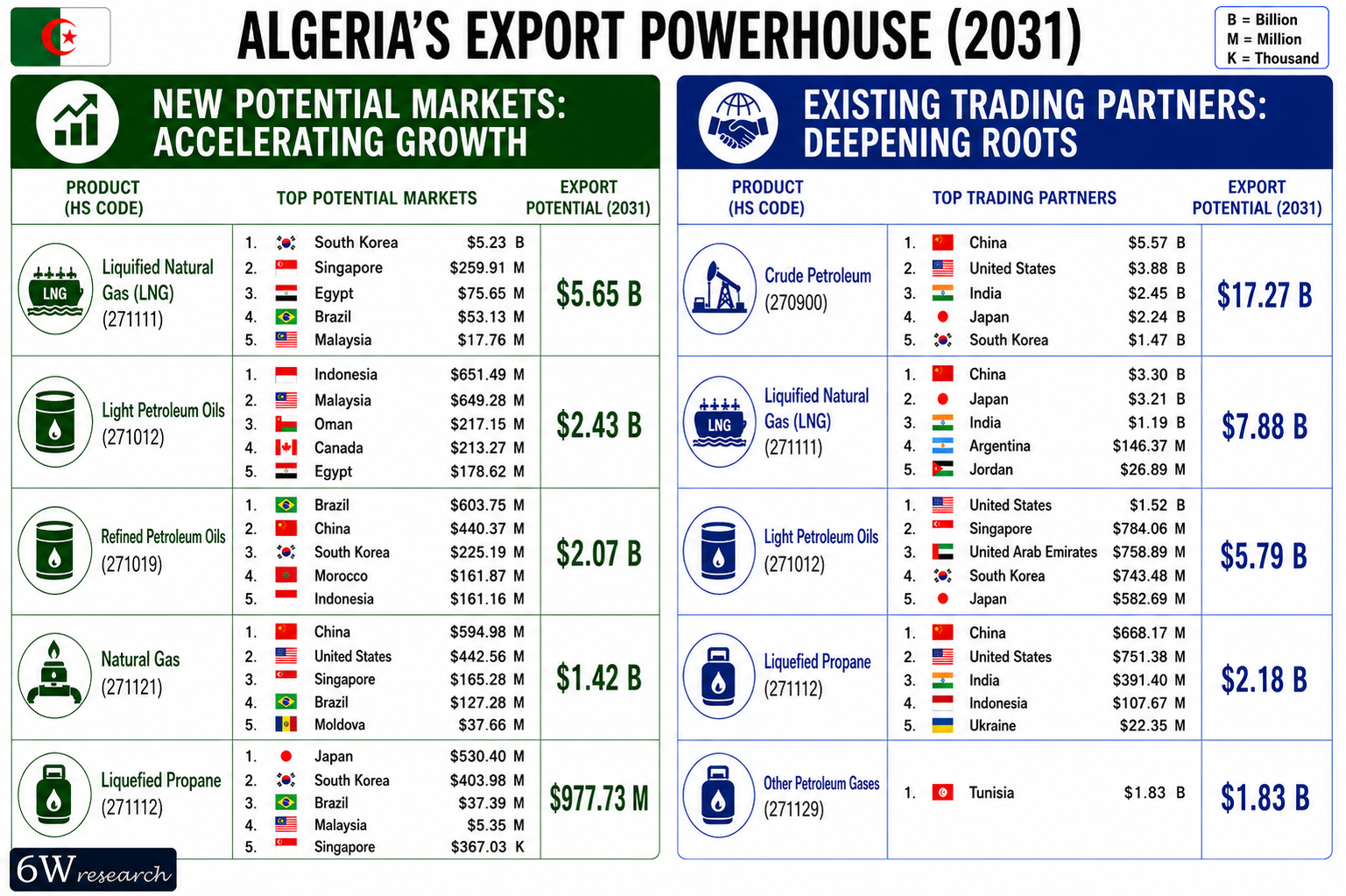
Liquefied natural gas, light petroleum oils, refined petroleum oils, natural gas and liquefied propane define Algeria’s largest new export opportunities through 2031, confirming that its diversification across markets remains rooted in products it already produces competitively at scale. The growing prominence of South Korea, Japan, China and Southeast Asian buyers reflects Asia’s continued dependence on imported fuels, efforts to diversify supply away from concentrated sources, and rising demand from refining, petrochemical, power-generation and industrial sectors. Algeria is well positioned to capture this shift because of its established hydrocarbon infrastructure, proximity to Atlantic and Mediterranean shipping routes, and Sonatrach’s efforts to expand commercial relationships beyond traditional European markets.
Liquefied natural gas represents Algeria’s largest new-market opportunity at USD 5.65 billion, with South Korea accounting for USD 5.23 billion, or more than 92% of the total. South Korea’s limited domestic energy resources, high LNG dependence and emphasis on supply security make it a logical destination for Algerian cargoes. Light petroleum oils contribute USD 2.43 billion, led jointly by Indonesia and Malaysia at USD 0.65 billion each, where expanding transport demand, refining activity and uneven domestic fuel balances support imports. Refined petroleum oils add a further USD 2.07 billion, led by Brazil (USD 0.60 billion) and China (USD 0.44 billion), reflecting strong consumption across transport, industry and petrochemical value chains.
Natural gas contributes USD 1.42 billion in new export potential, led by China (USD 0.59 billion) and the United States (USD 0.44 billion), although these opportunities are likely to depend on commercially viable LNG routes rather than conventional pipeline trade. Liquefied propane adds USD 0.98 billion, with Japan (USD 0.53 billion) and South Korea (USD 0.40 billion) accounting for more than 95% of the category, supported by strong LPG demand in petrochemicals, industrial heating and residential energy use. Overall, Algeria’s new-market growth remains overwhelmingly energy-led, but the geographic centre of incremental demand is shifting increasingly toward Asia-Pacific buyers.
Established Export Strength: Crude Oil, LNG and Refined Fuels
Crude petroleum, liquefied natural gas, light petroleum oils, liquefied propane and other petroleum gases define Algeria’s largest established export opportunities through 2031, confirming that its export structure remains overwhelmingly hydrocarbon-based. China, the United States, India and Japan recur across the leading categories because of their substantial refining capacity, industrial consumption and dependence on imported energy. Regional markets also remain relevant, supported by Algeria’s geographic proximity, established cross-border infrastructure and strategic position within Mediterranean energy trade routes.
Crude petroleum represents Algeria’s largest established export opportunity at USD 17.27 billion, more than twice the value of the next-largest product. China leads with USD 5.57 billion, supported by its extensive refining capacity and continued need to diversify crude supply, followed by the United States (USD 3.88 billion), India, Japan and South Korea. Liquefied natural gas contributes another USD 7.88 billion, led almost equally by China (USD 3.30 billion) and Japan (USD 3.21 billion). Both markets depend heavily on imported LNG for power generation, industrial use and energy-security objectives, creating a strong commercial fit for Algeria’s established gas-production and liquefaction capabilities.
Light petroleum oils add USD 5.79 billion, led by the United States (USD 1.52 billion) and Singapore (USD 0.78 billion), reflecting demand from major refining, trading and fuel-distribution markets. Liquefied propane contributes USD 2.18 billion, with China and the United States leading due to strong petrochemical, industrial and residential LPG consumption. Other petroleum gases account for a further USD 1.83 billion, supported by Algeria’s regional energy integration, cross-border infrastructure and access to Mediterranean markets. Overall, Algeria’s established export base remains concentrated in hydrocarbons, with Asian and North American buyers providing the principal sources of demand.
|
According to 6Wresearch analysis, Algeria's strongest established export priorities remain crude oil and LNG into China, the United States and Japan, while its new-corridor potential led overwhelmingly by South Korean LNG demand signals a genuine pivot toward Asia that is already visible in Sonatrach's own recent commercial activity. 6WExportGTM Analysis |
Sonatrach's Asia Pivot and Europe's Gas Corridor: Current Developments Supporting Algeria's Export Growth
Two recent developments help explain the shifts reflected in the figures above: Sonatrach's active commercial pivot toward Asian LPG and gas buyers, alongside renewed investment in regional gas infrastructure and export corridors that strengthen Algeria's position in Mediterranean and European energy markets.
Sonatrach Broadens Its Asian LPG and LNG Reach, Led by China and South Korea
Algeria’s Asian export opportunity is becoming increasingly visible across LPG and LNG markets. Sonatrach’s first regular LPG supply contract with a Chinese buyer provides concrete evidence of commercial expansion beyond Algeria’s traditional European customer base, while South Korea accounts for more than 92% of the country’s projected new-corridor LNG potential. Japan and South Korea also jointly represent over 95% of Algeria’s new liquefied propane opportunity, reinforcing Asia’s growing importance within the export mix. However, Algeria’s LNG exports declined by 8.5% year-on-year in the first quarter of 2026, indicating that capturing these opportunities will depend on expanding production rather than merely reallocating existing volumes from European buyers. Sonatrach’s Asian strategy should therefore be framed as a gradual diversification of its customer base, supported by new offtake agreements and the successful delivery of Algeria’s 2026–2030 production investment programme.
|
Algeria should convert rising Asian LNG and LPG demand into long-term offtake agreements, while expanding production capacity to ensure that new sales to China and South Korea represent additional export volumes rather than a diversion of existing European supplies. Manish Pant, Senior Data Scientist, Data Science & Market Intelligence, 6Wresearch |
Pipeline Modernization and the Trans-Saharan Project Could Expand Algeria’s Tunisia–Italy Gas Corridor
Algeria’s established gas corridor through Tunisia to Italy remains central to its European export position, supported by the Transmed pipeline and ongoing modernization of domestic transmission infrastructure. The proposed Trans-Saharan Gas Pipeline could further strengthen this role by transporting up to 30 billion cubic metres of Nigerian gas annually through Algeria and connecting it with existing routes serving Europe. This development supports the report’s conclusion that Algeria can pursue Asian LNG and LPG opportunities while retaining its strategic position in European pipeline gas markets. However, the additional export capacity remains a long-term opportunity rather than a guaranteed near-term gain, as progress depends on completing the pipeline across Niger, managing regional security risks and ensuring sufficient investment across the full corridor.
|
Algeria should prioritize modernization of the Transmed corridor while advancing the Trans-Saharan Gas Pipeline cautiously, as its ability to expand European gas exports will depend on cross-border execution, infrastructure integration and security across the Niger transit route. Manisha Gupta, Data Analyst, Data Science & Market Intelligence, 6Wresearch |
Top Global Export Opportunities (2031), By Product
| Product | Export Opportunity (USD Billion) |
| Electronic Integrated Circuits | 685.7 |
| Refined Petroleum Oils | 668.4 |
| Light Petroleum Oils | 588.9 |
| Logic Electronic Integrated Circuits | 507.9 |
| Medicines | 381.2 |
| Gasoline Passenger Cars (1.5–3.0L) | 360.9 |
| Smartphones | 343.6 |
| Electronic Integrated Circuits with Memory | 333.2 |
| Data Transmission Equipment | 216.9 |
| Immunological Products | 209.6 |
Excludes naturally occurring products (e.g., crude oil, raw gold). Source: 6WExportGTM
Globally, the largest export opportunities beyond naturally occurring products are concentrated in electronics, energy and pharmaceuticals and Algeria's established trade already sits inside the refined and light petroleum oils categories on this list, worth USD 668.4 billion and USD 588.9 billion globally. According to 6Wresearch analysis, Algeria's real priority through 2031 is less about entering entirely new global product categories and more about capturing a larger share of the refined-fuels and LNG demand it already competes for, particularly as Sonatrach's Asia pivot and the Trans-Saharan pipeline both aim to grow the volumes available for export rather than diversify Algeria's product mix.
What Algeria Already Sells, and to Whom
Oil & gas overwhelmingly dominates Algeria’s established export base at USD 47.38 billion, led by natural gas (32.00%) and crude petroleum (29.94%). Fertilizers rank second at USD 1.13 billion, with urea fertilizer contributing 83.46% and ground calcium phosphates accounting for 16.53%. Iron and steel follow at USD 738.14 million, driven by finished alloy steel bars (38.98%) and semi-finished steel billets (19.96%), indicating emerging diversification beyond hydrocarbons into fertilizer and metal products.
| Sector | Exports USD (Billion) | Leading Products / Share |
| Oil & Gas | 47.38 | Natural Gas (32.00%), Crude Petroleum (29.94%) |
| Fertilizers | 1.13 | Urea Fertilizer (83.46%), Ground Calcium Phosphates (16.53%) |
| Iron & Steel | 0.74 | Finished Alloy Steel Bars (38.98%), Semi-Finished Steel Billets (19.96%) |
Source: UN Comtrade
By trading value Italy represents Algeria’s largest export destination among the three markets at USD 12.44 billion, led by natural gas (72.83%) and crude petroleum (10.29%). France follows at USD 7.57 billion, with crude petroleum accounting for 58.13% and liquefied natural gas contributing 23.05%. Spain ranks third at USD 6.40 billion, driven predominantly by natural gas (75.07%) and LNG (13.20%). Overall, the data highlights Algeria’s strong dependence on hydrocarbon exports and the central role of European markets in absorbing its pipeline gas, LNG and crude petroleum supplies.
| Country | Exports USD (Billion) | Leading Products / Share |
| Italy | 12.44 | Natural Gas (72.83%), Crude Petroleum (10.29%) |
| France | 7.57 | Crude Petroleum (58.13%), Liquefied Natural Gas (23.05%) |
| Spain | 6.40 | Natural Gas (75.07%), Liquefied Natural Gas (13.20%) |
Source: UN Comtrade
The Takeaway
Algeria's next chapter of export growth will be shaped by how successfully Sonatrach converts an already-visible Asian pivot into durable new volumes, rather than a reallocation of existing European supply. According to 6WExportGTM, a part of 6Wresearch, the playbook is twofold: build on the momentum of Sonatrach's first Chinese LPG contract and South Korea's outsized position in the new-corridor LNG opportunity, while treating the Q1 2026 LNG export decline as a genuine capacity constraint that needs to be resolved through the 2026-2030 investment plan rather than assumed away; and reinforce the Tunisia-routed European gas corridor through the Trans-Saharan Gas Pipeline and Transmed modernization, while watching the security situation along the pipeline's Niger segment that this expansion ultimately depends on. Together, these two fronts are where the next USD 14.27 billion in untapped potential, and the far larger question of whether Algeria's USD 42.91 billion established base grows or plateaus, will actually be decided.

Leadership Perspectives from Industry Events
Search
6Wresearch in the News
 Forbes
Citing 6Wresearch analytics to map global infrastructure and pharmaceutical industry trajectories.
 Bloomberg Law
Direct syndication of 6Wresearch's macro data points, capturing complex supply chain shifts.
 Reuters
Tracking industrial manufacturing adjustments and electronic security ecosystem scaling.
 Mint
Mint
Utilizing deep-tech sector market sizing to analyze global automation and robotics.
 The Economic Times
Anchoring features on industrial IoT growth metrics and connected smart-grid devices.
 Business Standard
Featuring strategic evaluations of Advanced Driver Assistance Systems (ADAS) and AI road safety.
 The Hindu
Spotlighting core commercial metrics ranging from unmanned aerial vehicles (UAVs) to consumer durables.
 Financial Express
Anchoring quarterly reviews on cross-border real estate tech and structural hardware manufacturing.
 Yahoo Finance
Syndicating the tracker's $30.1 billion untapped-market findings, spotlighting Japan, the US and China as India's top new-potential importers.
 India Today
Carrying the release on smartphones leading India's export potential to $94 billion by 2031, per 6WExportGTM data.
 Dailyhunt
Distributing the tracker findings to its regional readership, framing India's export diversification into Japan and Mexico.
 PR Newswire Original release
Publishing the full India Export Attractiveness Tracker 2026, detailing new trade corridors across iron ore, LCVs and pharmaceuticals.
 The Industrial
Highlighting the tracker's read on India's semiconductor ambitions and long-term chip-assembly export potential.
 PTI News
Reporting on the $66.81 billion pharmaceuticals export opportunity flagged in the tracker, amid looming US generic-drug tariffs.
 Tribune India
Covering the tracker's tariff-versus-regulation analysis across India's mature export markets in the US, China and UAE.
 ANI News
Amplifying the report's findings on polished diamonds, refined petroleum and medicines as India's core export engines.
 International Business Magazine
Covering the report's insight into how AEB, blind spot detection, and driver monitoring are reshaping India's ADAS market.
 Focus Gaming News
Highlighting the research forecast for Egypt's gambling market, projecting steady growth through 2032.
Thought Leadership and Analyst Meet





Our Clients








Latest Reports
- Gabon Citrullinemia Type-1 Market (2026-2032)
- Finland Citrullinemia Type-1 Market (2026-2032)
- Fiji Citrullinemia Type-1 Market (2026-2032)
- Ethiopia Citrullinemia Type-1 Market (2026-2032)
- Estonia Citrullinemia Type-1 Market (2026-2032)
- Eritrea Citrullinemia Type-1 Market (2026-2032)
- Equatorial Guinea Citrullinemia Type-1 Market (2026-2032)
- El Salvador Citrullinemia Type-1 Market (2026-2032)
- Ecuador Citrullinemia Type-1 Market (2026-2032)
- Dominica Citrullinemia Type-1 Market (2026-2032)
Industry Events and Analyst Meet

EV India Expo 2026

HIMTEX 2026

India Refining Summit 2026

India EV Show 2026

EV tech India Expo 2026
Whitepaper
- Middle East & Africa Commercial Security Market Click here to view more.
- Middle East & Africa Fire Safety Systems & Equipment Market Click here to view more.
- GCC Drone Market Click here to view more.
- Middle East Lighting Fixture Market Click here to view more.
- GCC Physical & Perimeter Security Market Click here to view more.


