Pharmaceuticals and Petroleum Anchor Belgium's Established Export Base, While Soy, Batteries and Electrified Vehicles Open New Corridors Through 2031
The United States leads Belgium's existing export potential at 25.01%, more than double China's 11.09% share. However, in the smaller set of new export corridors, China moves into the lead with 19.69% of the identified potential, ahead of the United States at 13.13%. Petroleum products, pharmaceuticals and diamonds continue to dominate Belgium's established export portfolio, while the emergence of China as the leading new market underscores the evolving Belgium export potential as the country diversifies beyond traditional trading partners.
United States Dominates Belgium's Existing Export Potential, While China Leads Emerging Market Opportunities
The United States represents Belgium's largest existing import opportunity at USD 92.26 billion, accounting for over half of the combined opportunity across the top five importers, underscoring the depth of long-standing transatlantic trade and strong demand for Belgium's high-value industrial, pharmaceutical and chemical exports. China ranks second with USD 40.89 billion, reflecting its growing importance as a destination for advanced manufacturing inputs, specialty chemicals and technology-intensive products. Canada (USD 16.37 billion), India (USD 16.29 billion) and Japan (USD 15.87 billion) form a closely grouped second tier, highlighting Belgium's diversified export footprint across North America and Asia. According to 6WExportGTM, a part of 6Wresearch, this importer mix demonstrates that Belgium's established export base continues to be anchored by mature developed markets while simultaneously benefiting from expanding demand across major Asian economies, reducing dependence on any single regional growth engine.
| Top 5 Existing Leading Importers | Export Potential (USD Billion) | Top 5 New Potential Importers | Export Potential (USD Billion) |
| United States | 92.26 | China | 14.01 |
| China | 40.89 | United States | 9.34 |
| Canada | 16.37 | Mexico | 5.58 |
| India | 16.29 | Japan | 3.99 |
| Japan | 15.87 | India | 3.89 |
Source: 6WExportGTM
China is Belgium’s largest new potential importer, with export potential of USD 14.01 billion, followed by the United States at USD 9.34 billion. Mexico ranks third with USD 5.58 billion, while Japan and India contribute USD 3.99 billion and USD 3.89 billion, respectively. According to 6Wresearch analysis, this distribution highlights China and the United States as Belgium’s principal anchors for developing new product lines, while Mexico, Japan and India provide additional growth across North American and Asian markets. Together, the five destinations represent a diversified set of future export corridors, supporting Belgium’s ability to expand beyond its established European customer base and capture demand across advanced manufacturing, pharmaceuticals, chemicals, automotive products and technology-intensive goods.
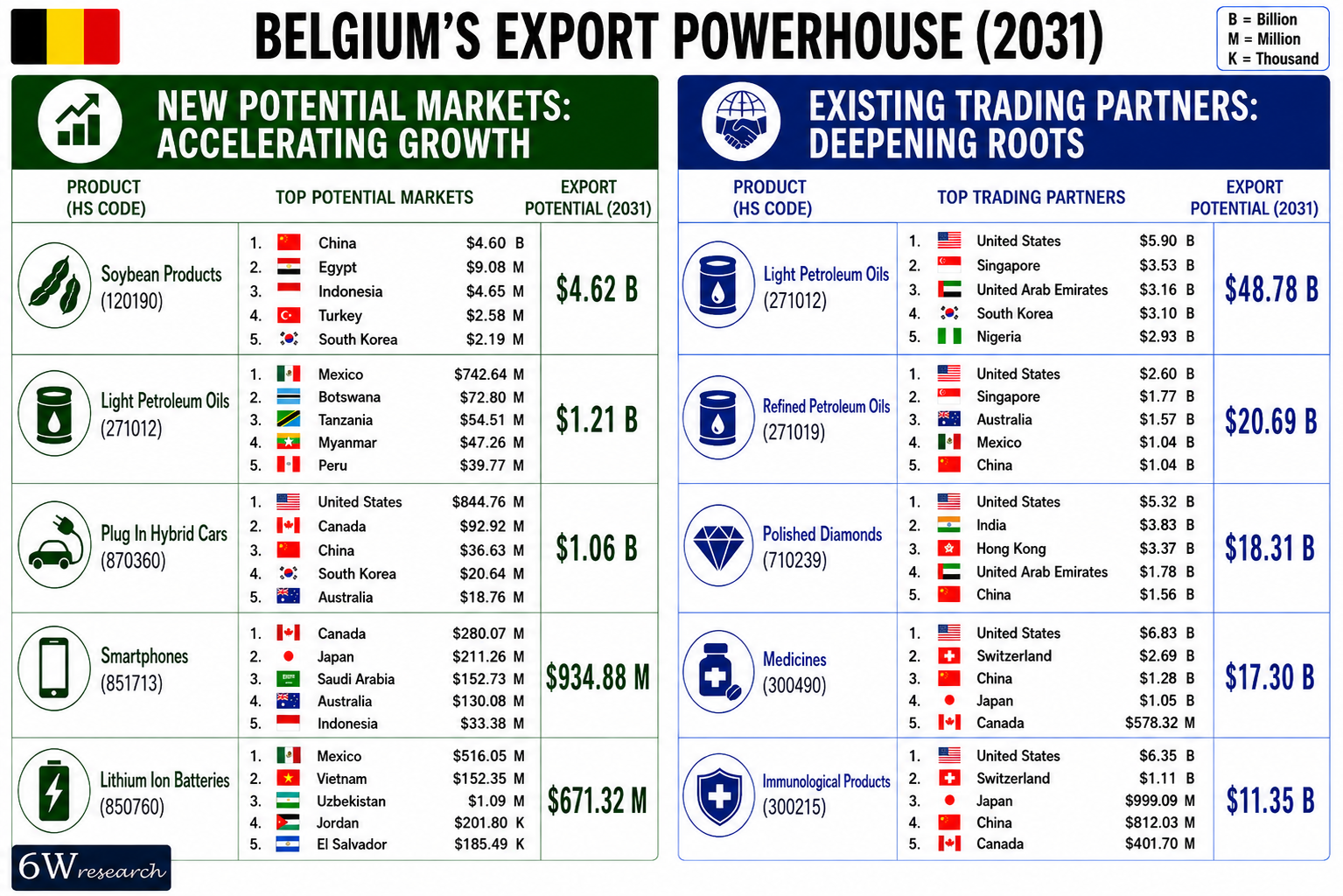
Soybeans, Refined Petroleum Products and Electric Vehicles Define Belgium's Newest Export Corridors
Soybean products, light petroleum oils, plug-in hybrid cars, smartphones and lithium-ion batteries represent Belgium's largest new export opportunities through 2031, in markets where current trade remains limited or largely untapped. Unlike Belgium's established strengths in petroleum refining and pharmaceutical manufacturing, these opportunities point to new corridors that can be developed by leveraging its role as a European agricultural-trading, vehicle-export and electronics-distribution gateway, rather than by building new domestic industries from scratch.
Soybean products represent Belgium's largest new export opportunity at USD 4.62 billion, overwhelmingly led by China (USD 4.60 billion), with Egypt, Indonesia, Turkey and South Korea accounting for much smaller opportunities. The concentration above 99% in a single destination reflects Belgium's role as a European entry and transshipment point for agricultural commodities moving through Antwerp's grain and oilseed terminals, rather than domestic soy cultivation. Light petroleum oils directed at non-traditional destinations add USD 1.21 billion, led by Mexico (USD 742.64 million), followed by Botswana, Tanzania, Myanmar and Peru because the underlying refining and blending capability already exists at scale for Belgium's established markets, making this a market-extension opportunity rather than new capability-building. Plug-in hybrid cars contribute USD 1.06 billion, led by the United States (USD 844.76 million), with Canada, China, South Korea and Australia providing additional demand a credible corridor given Belgium's existing vehicle-assembly and export infrastructure, which already positions the country as a primary European vehicle-export gateway.
Smartphones and lithium-ion batteries round out the new-corridor top five. Smartphone exports of USD 934.88 million are led by Canada (USD 280.07 million), followed by Japan, Saudi Arabia, Australia and Indonesia, reflecting Belgium's function as a European distribution and re-export hub for consumer electronics rather than domestic device manufacturing. Lithium-ion batteries add USD 671.32 million, led by Mexico (USD 516.05 million) and Vietnam (USD 152.35 million), extending Belgium's chemicals-handling and automotive supply-chain relationships even though large-scale domestic cell manufacturing is not yet established. Together, these five opportunities indicate that Belgium's next wave of export growth will come from redirecting existing trading, refining and logistics capacity toward new products and previously under-served destinations, rather than from building new industries.
Petroleum, Diamonds and Pharmaceuticals Remain the Foundation of Belgium's Established Trade
Light petroleum oils, refined petroleum oils, polished diamonds, medicines and immunological products define Belgium's highest-value export opportunities through 2031. Together, these products indicate that Belgium's future export growth will remain concentrated in hydrocarbon trading and life-sciences manufacturing, with the United States, Singapore, India, Switzerland and China emerging as the focussed destination markets.
Light petroleum oils represent Belgium's largest export opportunity at USD 48.78 billion, led by the United States (USD 5.90 billion), Singapore (USD 3.53 billion) and the United Arab Emirates (USD 3.16 billion), with South Korea and Nigeria completing the top five. This opportunity reflects Belgium's role as a trading and blending hub within the Amsterdam-Rotterdam-Antwerp petroleum complex rather than a domestic crude producer, since Belgium holds no meaningful upstream reserves of its own. Refined petroleum oils rank second at USD 20.69 billion, led by the United States (USD 2.60 billion) and Singapore (USD 1.77 billion), followed by Australia, Mexico and China, reflecting output from Belgium's coastal refining complexes that process imported crude into higher-value distillates for re-export. Polished diamonds add USD 18.31 billion, led by the United States (USD 5.32 billion) and India (USD 3.83 billion), supported primarily by Antwerp's centuries-old role as the world's leading diamond-trading and certification center, where roughly eight in ten of the world's rough diamonds are still handled at some stage.
Medicines and immunological products contribute a further USD 28.65 billion in export potential, highlighting Belgium's transition from trade-driven strengths to manufacturing-intensive industries. Medicines account for USD 17.30 billion, led by the United States (USD 6.83 billion) and Switzerland (USD 2.69 billion), followed by China, Japan and Canada. This reflects Belgium's position as a major pharmaceutical manufacturing, formulation and distribution hub serving regulated markets across North America, Europe and Asia. Immunological products, including vaccines and related biologics, add another USD 11.35 billion, with the United States contributing USD 6.35 billion, followed by Switzerland, Japan, China and Canada. Belgium's advanced biopharmaceutical manufacturing ecosystem and world-class vaccine production facilities support this strong export outlook. Together, these products demonstrate that Belgium's future export growth is supported not only by its established role in global trading networks, but also by its internationally competitive pharmaceutical and biotechnology manufacturing base.
|
Belgium's export competitiveness is anchored by two complementary strengths: globally integrated petroleum and diamond trading networks, and a world-class pharmaceutical and biotechnology manufacturing ecosystem, providing resilience across both trade-driven and high-value industrial exports. 6WExportGTM Analysis |
Vaccine Manufacturing Expansion and Antwerp’s Decarbonization Drive Reinforce Belgium’s Export Competitiveness
Belgium's projected export strengths are reinforced by two major industrial developments. Continued investment in vaccine and biologics manufacturing is strengthening the country's position in medicines, immunological products and other high-value life sciences exports, while large-scale decarbonization investments across the Antwerp petrochemical cluster are enhancing the long-term competitiveness of Belgium's petroleum refining industry. Together, these developments support the country's leadership in both advanced pharmaceutical manufacturing and energy-related exports, reinforcing the strong export potential identified through 2031.
GSK and Pfizer Deepen Belgium's Vaccine Manufacturing Base
Belgium's strong export potential in medicines and immunological products is underpinned by a well-established pharmaceutical manufacturing ecosystem. GSK's vaccine facilities in Wavre, Rixensart and Gembloux, together with Pfizer's large-scale manufacturing site in Puurs, provide advanced formulation, fill-and-finish and cold-chain capabilities that strengthen Belgium's position in global pharmaceutical supply chains. These manufacturing strengths complement the country's role as a major trading hub, creating a diversified export base across both life sciences and trade-intensive industries. As global demand for vaccines, biologics and regulated medicines continues to grow, Belgium is well positioned to expand exports through advanced production capacity, technical expertise and efficient logistics infrastructure.
|
Exporters targeting Belgium's petroleum value chain should closely track decarbonization investments in the Antwerp petrochemical cluster. As European environmental regulations become more stringent, low-carbon refining technologies will play an increasingly important role in sustaining market access and competitiveness, particularly in Germany and other key industrial markets. Manish Pant, 6Wresearch, Data Science & Market Intelligence |
Antwerp's Petrochemical Cluster Commits USD 3.7 Billion to Decarbonization While Deepening Its German Trade Backbone
Antwerp's ongoing decarbonization investments are strengthening the long-term competitiveness of Belgium's refining and petrochemical industry. Carbon capture, electrified cracking and other low-emission technologies are helping the Antwerp cluster adapt to increasingly stringent European climate regulations while maintaining its role as one of Europe's leading energy and chemical hubs. As Belgium's petroleum exports are driven by refining, processing and redistribution rather than domestic hydrocarbon production, these investments are expected to enhance the sustainability and competitiveness of its export platform. By reducing the carbon intensity of production and preserving efficient access to major industrial markets such as Germany, the Antwerp cluster is well positioned to support Belgium's petroleum export growth through 2031.
|
Exporters weighing Belgium's refined-petroleum corridor against other European refining hubs should track the pace of Antwerp's carbon-capture and electrified-cracker rollout directly decarbonization investment is increasingly a condition of continued market access to Germany's industrial buyers, not a side consideration. Manisha Gupta, 6Wresearch, Data Science & Market Intelligence |
Top Global Export Opportunities (2031), By Product
| Product | Export Opportunity (USD Billion) |
| Electronic Integrated Circuits | 685.7 |
| Refined Petroleum Oils | 668.4 |
| Light Petroleum Oils | 588.9 |
| Logic Electronic Integrated Circuits | 507.9 |
| Medicines | 381.2 |
| Gasoline Passenger Cars (1.5–3.0L) | 360.9 |
| Smartphones | 343.6 |
| Electronic Integrated Circuits with Memory | 333.2 |
| Data Transmission Equipment | 216.9 |
| Immunological Products | 209.6 |
Excludes naturally occurring products (e.g., crude oil, raw gold). Source: 6WExportGTM
Globally, the largest export opportunities beyond naturally occurring products are concentrated in electronics, energy, pharmaceuticals and automotive products, and Belgium already holds a competitive edge across several of these high-value categories. Its established strengths in petroleum refining, pharmaceuticals, immunological products, chemicals and vehicle manufacturing provide a strong foundation for capturing a larger share of future global demand. According to 6Wresearch analysis, Belgium’s priority through 2031 should therefore be to deepen its participation in industries where it already possesses production capacity, technical expertise, integrated supply chains and strong access to European and international markets, rather than pursuing entirely new product categories with limited domestic capability.
What Belgium Already Sells, and to Whom
Pharmaceuticals form Belgium's largest established trade sector at USD 61.96 billion, representing 15.30% of total sector trade, led by medicines (37.57% share) and human vaccines (24.51% share). Oil & Gas ranks second at USD 39.32 billion (12.87% share), led by refined petroleum oils (36.71% share) and light petroleum oils (30.76% share). Passenger vehicles round out the top three at USD 25.41 billion (12.86% share), led by gasoline passenger cars, 1.5–3.0L (32.78% share) and hybrid petrol cars (24.33% share).
| Sector | Exports (USD Billion) | Leading Products / Share |
| Pharmaceuticals | 61.96 | Medicines (37.57%), Human Vaccines (24.51%) |
| Oil & Gas | 39.32 | Refined Petroleum Oils (36.71%), Light Petroleum Oils (30.76%) |
| Passenger Vehicles | 25.41 | Gasoline Passenger Cars 1.5–3.0L (32.78%), Hybrid Petrol Cars (24.33%) |
Source: 6WExportGTM
By trading value, three markets stand out. Germany leads at USD 55.71 billion (15.30% share), led by natural gas (9.77% share) and refined petroleum oils (3.87% share). The Netherlands follows at USD 46.86 billion (12.87% share), led by refined petroleum oils (6.44% share) and light petroleum oils (4.84% share). France ranks third at USD 46.82 billion (12.86% share), led by refined petroleum oils (4.25% share) and natural gas (2.45% share).
| Country | Exports (USD Billion) | Leading Products / Share |
| Germany | 55.71 | Natural Gas (9.77%), Refined Petroleum Oils (3.87%) |
| Netherlands | 46.86 | Refined Petroleum Oils (6.44%), Light Petroleum Oils (4.84%) |
| France | 46.82 | Refined Petroleum Oils (4.25%), Natural Gas (2.45%) |
Source: 6WExportGTM
The Takeaway
Belgium's next phase of export growth is expected to build on its established strengths in petroleum refining, global trade and advanced pharmaceutical manufacturing. According to 6Wresearch analysis, sustaining investments in the Antwerp petrochemical cluster will be critical to maintaining the competitiveness of refined petroleum exports, particularly as environmental standards tighten across Europe. At the same time, continued expansion of vaccine and biologics manufacturing at Wavre, Rixensart, Gembloux and Puurs will strengthen Belgium's position in high-value pharmaceutical exports. Beyond its established markets, emerging opportunities in China's soybean market and the United States' demand for plug-in hybrid vehicles provide additional avenues for export diversification. By reinforcing competitive industries while expanding into high-potential new markets, Belgium is well positioned to strengthen its export performance through 2031.

Leadership Perspectives from Industry Events
Search
6Wresearch in the News
 Forbes
Citing 6Wresearch analytics to map global infrastructure and pharmaceutical industry trajectories.
 Bloomberg Law
Direct syndication of 6Wresearch's macro data points, capturing complex supply chain shifts.
 Reuters
Tracking industrial manufacturing adjustments and electronic security ecosystem scaling.
 Mint
Mint
Utilizing deep-tech sector market sizing to analyze global automation and robotics.
 The Economic Times
Anchoring features on industrial IoT growth metrics and connected smart-grid devices.
 Business Standard
Featuring strategic evaluations of Advanced Driver Assistance Systems (ADAS) and AI road safety.
 The Hindu
Spotlighting core commercial metrics ranging from unmanned aerial vehicles (UAVs) to consumer durables.
 Financial Express
Anchoring quarterly reviews on cross-border real estate tech and structural hardware manufacturing.
 Yahoo Finance
Syndicating the tracker's $30.1 billion untapped-market findings, spotlighting Japan, the US and China as India's top new-potential importers.
 India Today
Carrying the release on smartphones leading India's export potential to $94 billion by 2031, per 6WExportGTM data.
 Dailyhunt
Distributing the tracker findings to its regional readership, framing India's export diversification into Japan and Mexico.
 PR Newswire Original release
Publishing the full India Export Attractiveness Tracker 2026, detailing new trade corridors across iron ore, LCVs and pharmaceuticals.
 The Industrial
Highlighting the tracker's read on India's semiconductor ambitions and long-term chip-assembly export potential.
 PTI News
Reporting on the $66.81 billion pharmaceuticals export opportunity flagged in the tracker, amid looming US generic-drug tariffs.
 Tribune India
Covering the tracker's tariff-versus-regulation analysis across India's mature export markets in the US, China and UAE.
 ANI News
Amplifying the report's findings on polished diamonds, refined petroleum and medicines as India's core export engines.
 International Business Magazine
Covering the report's insight into how AEB, blind spot detection, and driver monitoring are reshaping India's ADAS market.
 Focus Gaming News
Highlighting the research forecast for Egypt's gambling market, projecting steady growth through 2032.
Thought Leadership and Analyst Meet





Our Clients








Latest Reports
- Gabon Citrullinemia Type-1 Market (2026-2032)
- Finland Citrullinemia Type-1 Market (2026-2032)
- Fiji Citrullinemia Type-1 Market (2026-2032)
- Ethiopia Citrullinemia Type-1 Market (2026-2032)
- Estonia Citrullinemia Type-1 Market (2026-2032)
- Eritrea Citrullinemia Type-1 Market (2026-2032)
- Equatorial Guinea Citrullinemia Type-1 Market (2026-2032)
- El Salvador Citrullinemia Type-1 Market (2026-2032)
- Ecuador Citrullinemia Type-1 Market (2026-2032)
- Dominica Citrullinemia Type-1 Market (2026-2032)
Industry Events and Analyst Meet

EV India Expo 2026

HIMTEX 2026

India Refining Summit 2026

India EV Show 2026

EV tech India Expo 2026
Whitepaper
- Middle East & Africa Commercial Security Market Click here to view more.
- Middle East & Africa Fire Safety Systems & Equipment Market Click here to view more.
- GCC Drone Market Click here to view more.
- Middle East Lighting Fixture Market Click here to view more.
- GCC Physical & Perimeter Security Market Click here to view more.


