Argentina's Crude Soya Bean Oil Exports to Existing Partners Could Reach USD 9.65 Billion, While Crude Petroleum Offers USD 2.29 Billion Across New Markets by 2031
China is Argentina's largest existing export market, accounting for 19.14% of total export potential, followed by the United States with a 17.03% share. In contrast, India emerges as the leading market for new export opportunities, representing 13.40% of the category, narrowly ahead of the United Arab Emirates at 12.75%. Crude soya bean oil, soybean oilcake and crude petroleum continue to dominate Argentina's established export portfolio, highlighting the country's strong position in agricultural processing and energy exports, while the changing composition of new export markets strengthens Argentina Export Potential through 2031.
Source: 6WExportGTM
India Overtakes China and the United States to Lead Argentina's New Potential Markets
India emerges as Argentina's largest new potential importer, with export potential of USD 2.74 billion, narrowly ahead of the United Arab Emirates' USD 2.61 billion opportunity. China ranks third at USD 2.06 billion, followed by the United States at USD 1.65 billion and Turkey at USD 1.20 billion. According to 6WExportGTM, a part of 6Wresearch, this market mix indicates that Argentina's new export growth can be anchored by deeper access to India's energy and industrial demand, while the United Arab Emirates provides a second major opportunity across precious metals and downstream petroleum products. China, the United States and Turkey add further geographic diversification, allowing Argentina to extend its competitive agricultural business, energy and automotive exports beyond its established Asia-Pacific and Americas customer base.
| Top 5 Existing Leading Importers | Export Potential (USD Billion) | Top 5 New Importers | Export Potential (USD Billion) |
| China | 14.59 | India | 2.74 |
| United States | 12.98 | United Arab Emirates | 2.61 |
| India | 5.47 | China | 2.06 |
| Brazil | 4.66 | United States | 1.65 |
| Chile | 3.51 | Turkey | 1.20 |
Source: 6WExportGTM
China is Argentina's largest existing leading importer, with export potential of USD 14.59 billion, followed by the United States at USD 12.98 billion. India ranks third with USD 5.47 billion, while Brazil and Chile contribute USD 4.66 billion and USD 3.51 billion, respectively. According to 6WExportGTM, a part of 6Wresearch, this importer mix reflects Argentina's well-diversified export footprint across Asia and the Americas, supported by its competitive base in oilseed processing, cereals, energy and light commercial vehicles. China serves as the primary growth anchor, while the United States, India, Brazil and Chile reinforce Argentina's position within global agribusiness and energy supply chains, reducing dependence on any single export destination.
Petroleum, Gold and Passenger Vehicles Define Argentina's New Export Corridors
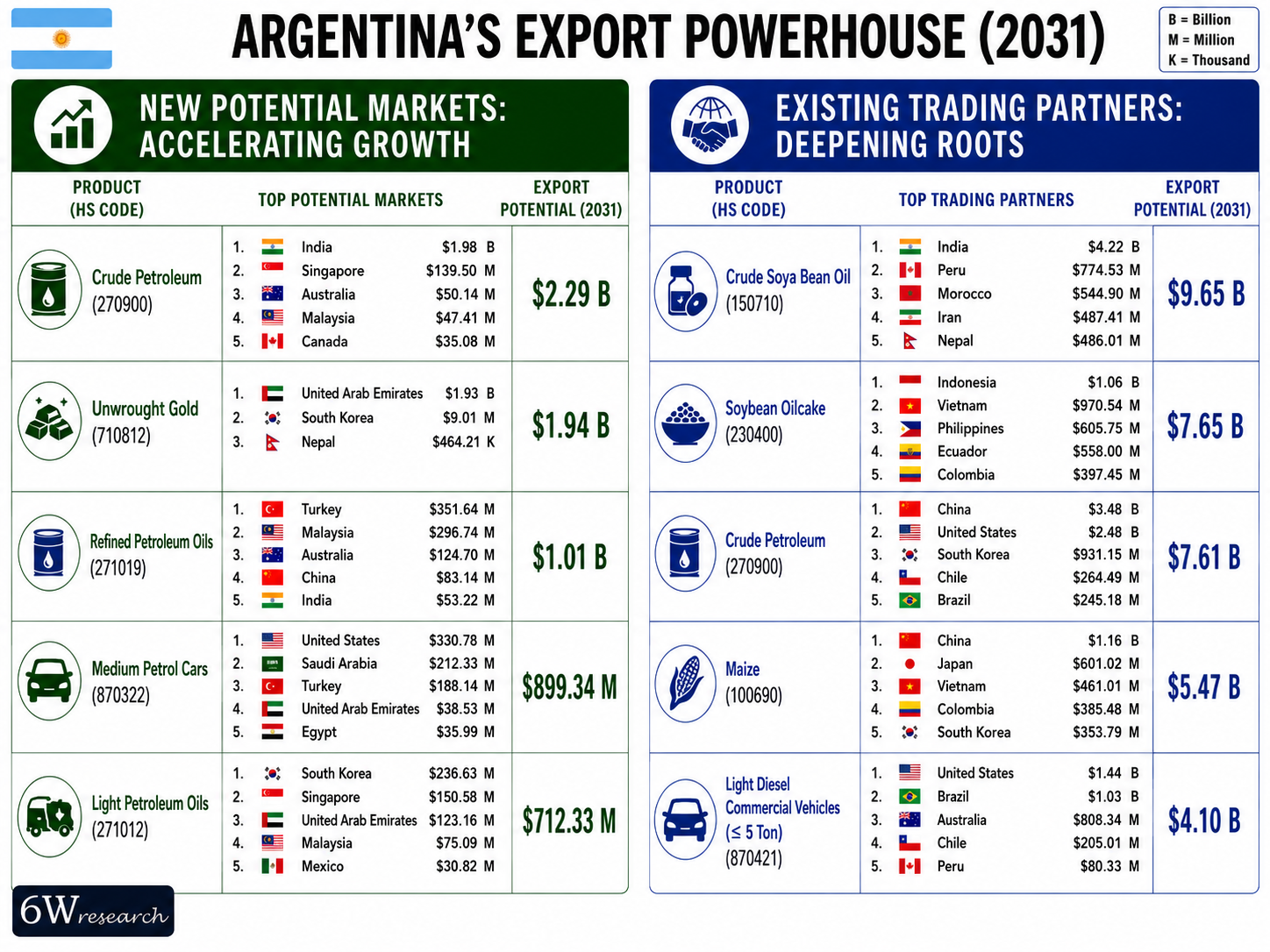
Argentina’s largest new export opportunities through 2031 are concentrated in crude petroleum, unwrought gold, refined petroleum oils, medium petrol cars, and light petroleum oils, reflecting the country’s shift from traditional agricultural-led exports toward a broader resource and industrial export base. Crude petroleum emerges as the largest opportunity at USD 2.29 billion, primarily driven by India’s potential demand of USD 1.98 billion, with additional opportunities in Singapore, Australia, Malaysia, and Canada. This expansion is closely linked to the continued development of the Vaca Muerta shale formation, which is increasing Argentina’s crude production capacity and improving export availability. As pipeline connectivity, midstream infrastructure, and port capacity continue to expand, Argentina is expected to have greater flexibility to redirect incremental crude volumes toward Asian markets where energy demand remains strong and current Argentine trade penetration is limited.
Mineral and downstream energy products represent another major opportunity area, supported by Argentina’s established resource base and increasing processing capabilities. Unwrought gold presents an export potential opportunity of USD 1.94 billion, almost entirely concentrated in the United Arab Emirates USD 1.93 billion, with additional demand from South Korea and Nepal. This aligns with Argentina’s position as a significant gold producer in the Andes region, where continued mining activity and investment in mineral extraction can support higher-value precious metal exports into global trading hubs. Similarly, refined petroleum oils offer USD 1.01 billion of opportunity, led by Turkey USD 361.64 million followed by Malaysia, Australia, China, and India. The opportunity reflects the ability to leverage existing refining infrastructure and convert growing domestic hydrocarbon availability into higher-value processed fuel exports, particularly to markets seeking diversified suppliers.
Automotive and petroleum derivatives further highlight Argentina’s potential to expand into higher-value manufactured and processed exports by 2031. Medium petrol cars represent USD 899.34 million in new export potential, led by the United States USD 330.78 million, followed by Saudi Arabia, Turkey, the UAE, and Egypt. This opportunity is supported by Argentina’s established automotive manufacturing ecosystem, particularly production clusters in Córdoba and Buenos Aires, which provide a foundation for expanding vehicle exports into additional markets beyond existing destinations. Light petroleum oils contribute another USD 712.33 million, with South Korea USD 206.63 million emerging as the largest opportunity, followed by Singapore, the UAE, Malaysia, and Mexico. Overall, the projected opportunities indicate that Argentina’s future export growth will increasingly come from utilizing its expanding shale oil production, strengthening refining capabilities, deepening mineral exports, and leveraging existing industrial capacity to access underpenetrated international markets.
Soybean Oil, Petroleum and Maize Drive Argentina's Established Export Opportunities
Argentina’s highest-value export opportunities through 2031 remain concentrated across agricultural processing, energy resources, and automotive manufacturing, reflecting the country’s existing production advantages and its ability to scale exports into markets with strong underlying demand. Crude soya bean oil emerges as the largest opportunity at USD 9.65 billion, led by India USD 4.22 billion, followed by Peru, Morocco, Iran, and Nepal. This opportunity is supported by Argentina’s globally significant soybean crushing industry, particularly concentrated around the Paraná River export corridor, which provides large-scale processing capacity and efficient access to international markets. Rising food consumption, vegetable oil demand, and import dependence across South Asia, the Middle East, and emerging markets continue to create opportunities for Argentina to expand beyond raw soybean exports into higher-value processed oil products.
Soybean derivatives and grains continue to represent Argentina’s strongest export foundation, supported by its agricultural scale, established supply chains, and global competitiveness. Soybean oilcake represents the second-largest opportunity at USD 7.65 billion, with leading potential markets including Indonesia USD 1.06 billion, Vietnam USD 970.54 million, the Philippines, Ecuador, and Colombia. Growth in livestock and aquaculture production across Asia and Latin America is increasing demand for high-protein animal feed ingredients, strengthening opportunities for Argentina’s soybean meal exports. Similarly, maize contributes USD 5.47 billion in export potential, led by China USD 1.16 billion, Japan, Vietnam, Colombia, and South Korea. Argentina’s large cultivated area, export-oriented farming system, and competitive grain logistics position it as a reliable supplier for countries seeking feed security and diversified agricultural sourcing.
Energy and industrial exports provide additional growth engines, reflecting Argentina’s expanding resource base and manufacturing capabilities. Crude petroleum represents USD 7.61 billion in export opportunity, led by China USD 3.48 billion and the United States USD 2.48 billion, followed by South Korea, Chile, and Brazil. This potential is closely linked to increasing production from the Vaca Muerta shale formation, which is strengthening Argentina’s position as a regional energy supplier and enabling greater export volumes to international markets. Meanwhile, light diesel commercial vehicles up to 5 tons contribute USD 4.10 billion, led by the United States USD 1.44 billion and Brazil USD 1.03 billion, supported by Argentina’s established automotive manufacturing ecosystem and integration into regional supply chains. Overall, the 2031 export outlook indicates that Argentina’s growth will continue to be anchored by its globally competitive agricultural-processing base while increasingly benefiting from energy expansion and higher-value industrial exports.
|
Argentina's export competitiveness is increasingly being shaped by the depth of its agro-industrial and energy processing base rather than by commodity volumes alone. The country's growing capabilities in oilseed crushing, shale hydrocarbon extraction and precious-metals refining position it to capture both established demand and emerging export corridors, reinforcing its role as one of South America's most resilient commodity-based exporters. 6WExportGTM Analysis |
What Argentina Already Sells and Where
Cereals and grains form Argentina's largest established trade sector at USD 10.01 billion, led by maize with exports of USD 6.51 billion and a 65.01% share, followed by other wheat and meslin (non-seed) at USD 1.95 billion and a 19.47% share. Oilseeds rank second at USD 8.72 billion, with crude soya bean oil contributing USD 4.64 billion and 53.21% of the sector, while soybean products add USD 1.80 billion and 20.62%. Oil and gas follow at USD 7.24 billion, led by crude petroleum at USD 4.93 billion and a 68.09% share, with light petroleum oils adding USD 0.70 billion and 9.73%, reflecting Argentina's strong base across grain production, oilseed crushing and shale-energy extraction.
| Sector | Exports (USD Billion) | Leading Products / Share |
| Cereals & Grains | 10.01 | Maize (65.01%), Other Wheat and Meslin – Non-Seed (19.47%) |
| Oilseeds | 8.72 | Crude Soya Bean Oil (53.21%), Soybean Products (20.62%) |
| Oil & Gas | 7.24 | Crude Petroleum (68.09%), Light Petroleum Oils (9.73%) |
Source: 6WExportGTM
Brazil is Argentina's largest export market at USD 13.62 billion, led by unspecified trade goods and light diesel commercial vehicles (up to 5 tons), which account for 23.89% and 21.90% of exports to the country, respectively. The United States ranks second at USD 6.48 billion, with unspecified trade goods contributing 38.33% and crude petroleum 30.76%. Chile follows closely at USD 6.34 billion, supported by crude petroleum at 31.78% and unspecified trade goods at 11.79%. According to 6Wresearch analysis, this partner mix reflects Argentina's deep integration into regional energy, automotive and diversified goods trade, with Brazil serving as the primary regional anchor and the United States and Chile providing additional cross-continental diversification.
| Country | Exports (USD Billion) | Leading Products / Share |
| Brazil | 13.62 | Unspecified Trade Goods (23.89%), Light Diesel Commercial Vehicles ≤5 Ton (21.90%) |
| United States | 6.48 | Unspecified Trade Goods (38.33%), Crude Petroleum (30.76%) |
| Chile | 6.34 | Crude Petroleum (31.78%), Unspecified Trade Goods (11.79%) |
Source: 6WExportGTM
Vaca Muerta's Shale Boom and Record Harvests: Developments Directly Shaping Argentina's Export Base
Argentina’s expanding shale oil production from the Vaca Muerta formation is strengthening the country’s position in crude petroleum and refined petroleum product exports by increasing domestic production capacity and supporting diversification into new international markets. At the same time, a record 2025-26 grains and oilseeds harvest, combined with phased reductions in export duties, is reinforcing Argentina’s competitive advantage in soybean, oilcake, and maize exports.
Argentina Strengthens Its Position as a Fast-Growing Non-OPEC Energy Exporter
Argentina’s crude petroleum and refined-products opportunity is being strengthened by the rapid expansion of the Vaca Muerta shale formation in Neuquén province, where rising production, new infrastructure and increasing upstream investment are reshaping the country’s energy export capacity. With national oil output reaching record levels above 880,000 barrels per day and shale accounting for more than 70% of production, Argentina is building the scale required to serve growing demand across India, Southeast Asia and the Gulf. The development of the Vaca Muerta Sur pipeline further expands export connectivity toward the Atlantic coast, creating additional capacity for crude and refined petroleum shipments. This aligns with the country’s growing petroleum export potential across both established markets and new corridors through 2031.
|
Argentina’s next export growth phase will be driven by scaling sectors where it already holds structural advantages energy, agriculture and industrial commodities. The combination of rising Asian demand for crude oil and agricultural products, alongside expanding refined-product and automotive opportunities, positions Argentina to strengthen its role as a reliable supplier in global resource and industrial value chains through 2031. Manish Pant, Senior Data Scientist, Data Science & Market Intelligence, 6Wresearch |
Record Harvests and Lower Export Duties Reinforce Argentina's Grain and Oilseed Base
Argentina’s soybean and grain export strength is being reinforced by a record 2025-26 agricultural campaign, with total grain and oilseed production reaching 163.2 million tons, supported by a two-decade-high corn harvest of 70 million tons and soybean production recovering to 49.9 million tons. Alongside improving output, the phased reduction of export duties on soybeans, maize, wheat and their derivatives through 2028 is strengthening the competitiveness of Argentina’s agro-industrial value chain. Higher production volumes and improved export economics reinforce the country’s position as a leading supplier of soybean oil, soybean meal and grains to global markets, allowing Argentina to expand existing trade relationships while creating additional opportunities across Asia and other demand centers.
|
Argentina’s future export opportunity is increasingly defined by its ability to connect abundant natural resources with global demand centers. Strong positions in crude oil, soybean products and agricultural commodities provide the foundation, while new opportunities across refined energy products and manufactured goods signal a gradual shift toward higher-value export growth. Manisha Gupta, Data Analyst, Data Science & Market Intelligence, 6Wresearch |
The Takeaway
Argentina should focus on scaling its existing resource-based advantages while gradually moving toward higher-value export opportunities across energy, agro-processing and industrial products. The country’s next phase of export growth will be driven by two core strengths: its expanding shale-energy capacity and its globally competitive oilseed and grain processing ecosystem. Rather than building entirely new export sectors, Argentina should prioritize improving production scale, infrastructure connectivity and market access to convert existing capabilities into long-term global trade relationships.
Key strategic priorities for Argentina include:
- Accelerate energy export expansion: With crude petroleum emerging as the largest new-corridor opportunity at USD 2.29 billion, Argentina should continue scaling Vaca Muerta’s shale production, pipeline capacity and export infrastructure to capture rising demand from India, the UAE and Asian markets.
- Protect and expand the agro-industrial export base: Crude soya bean oil (USD 9.65 billion) and soybean oilcake (USD 7.65 billion) remain the foundation of Argentina’s established export strength. Maintaining competitiveness through higher processing capacity, improved logistics and favorable export economics will be critical to sustaining demand from India, Indonesia, Vietnam and other markets.
- Develop new global trade corridors: India has emerged as Argentina’s largest new potential market at USD 2.74 billion, followed by the UAE at USD 2.61 billion, highlighting opportunities to diversify beyond traditional buyers such as China and the United States. Argentina should focus on converting these emerging relationships into sustained export partnerships across energy, metals and agricultural products.
- Move toward higher-value exports: Expanding refined petroleum, automotive and processed commodity exports can help Argentina capture more value from its natural-resource base rather than relying only on raw commodity shipments.
Overall, Argentina’s export strategy through 2031 should center on strengthening its position as a reliable supplier of energy, agricultural products and industrial commodities while using new market corridors to improve geographic diversification and long-term export resilience.

Leadership Perspectives from Industry Events
Search
6Wresearch in the News
 Forbes
Citing 6Wresearch analytics to map global infrastructure and pharmaceutical industry trajectories.
 Bloomberg Law
Direct syndication of 6Wresearch's macro data points, capturing complex supply chain shifts.
 Reuters
Tracking industrial manufacturing adjustments and electronic security ecosystem scaling.
 Mint
Mint
Utilizing deep-tech sector market sizing to analyze global automation and robotics.
 The Economic Times
Anchoring features on industrial IoT growth metrics and connected smart-grid devices.
 Business Standard
Featuring strategic evaluations of Advanced Driver Assistance Systems (ADAS) and AI road safety.
 The Hindu
Spotlighting core commercial metrics ranging from unmanned aerial vehicles (UAVs) to consumer durables.
 Financial Express
Anchoring quarterly reviews on cross-border real estate tech and structural hardware manufacturing.
 Yahoo Finance
Syndicating the tracker's $30.1 billion untapped-market findings, spotlighting Japan, the US and China as India's top new-potential importers.
 India Today
Carrying the release on smartphones leading India's export potential to $94 billion by 2031, per 6WExportGTM data.
 Dailyhunt
Distributing the tracker findings to its regional readership, framing India's export diversification into Japan and Mexico.
 PR Newswire Original release
Publishing the full India Export Attractiveness Tracker 2026, detailing new trade corridors across iron ore, LCVs and pharmaceuticals.
 The Industrial
Highlighting the tracker's read on India's semiconductor ambitions and long-term chip-assembly export potential.
 PTI News
Reporting on the $66.81 billion pharmaceuticals export opportunity flagged in the tracker, amid looming US generic-drug tariffs.
 Tribune India
Covering the tracker's tariff-versus-regulation analysis across India's mature export markets in the US, China and UAE.
 ANI News
Amplifying the report's findings on polished diamonds, refined petroleum and medicines as India's core export engines.
 International Business Magazine
Covering the report's insight into how AEB, blind spot detection, and driver monitoring are reshaping India's ADAS market.
 Focus Gaming News
Highlighting the research forecast for Egypt's gambling market, projecting steady growth through 2032.
Thought Leadership and Analyst Meet





Our Clients








Latest Reports
- Gabon Citrullinemia Type-1 Market (2026-2032)
- Finland Citrullinemia Type-1 Market (2026-2032)
- Fiji Citrullinemia Type-1 Market (2026-2032)
- Ethiopia Citrullinemia Type-1 Market (2026-2032)
- Estonia Citrullinemia Type-1 Market (2026-2032)
- Eritrea Citrullinemia Type-1 Market (2026-2032)
- Equatorial Guinea Citrullinemia Type-1 Market (2026-2032)
- El Salvador Citrullinemia Type-1 Market (2026-2032)
- Ecuador Citrullinemia Type-1 Market (2026-2032)
- Dominica Citrullinemia Type-1 Market (2026-2032)
Industry Events and Analyst Meet

EV India Expo 2026

HIMTEX 2026

India Refining Summit 2026

India EV Show 2026

EV tech India Expo 2026
Whitepaper
- Middle East & Africa Commercial Security Market Click here to view more.
- Middle East & Africa Fire Safety Systems & Equipment Market Click here to view more.
- GCC Drone Market Click here to view more.
- Middle East Lighting Fixture Market Click here to view more.
- GCC Physical & Perimeter Security Market Click here to view more.


