Mexico's Gasoline Passenger Car Exports to Existing Partners Could Reach USD 57.74 Billion, While Unwrought Gold Opens USD 4.64 Billion Across New Markets by 2031
The United States commands a lion’s share of Mexico’s existing export market, accounting for 45.29% of the total export potential, far ahead of China at 12.81%. However, new export potential opportunities show a different pattern, with Hong Kong leading at 12.08%, followed by the United Arab Emirates at 11.69%, and China, India and Turkey completing the top five. Mexico’s export strength remains concentrated in gasoline passenger cars, computing hardware, and light commercial vehicles, while emerging opportunities in unwrought gold and display technology are expected to strengthen Mexico Export Potential by supporting further diversification toward Gulf and Asian markets through 2031.
 Source: 6WExportGTM
New Trade Corridors Open for Mexico, With Hong Kong and UAE Leading Emerging Export Potential
Hong Kong leads Mexico’s new potential export corridors with USD 3.58 billion in export potential, narrowly ahead of the United Arab Emirates at USD 3.47 billion. China positions third with USD 1.94 billion, followed by India and Turkey with USD 1.79 billion and USD 1.34 billion by 2031, respectively. This emerging market mix highlights Mexico’s potential to expand beyond traditional North American trade channels, with greater opportunities across Asian trading hubs and Middle Eastern markets. This group of emerging markets shows Mexico’s capacity to grow beyond traditional North American trade corridors with expanding opportunities in Asian trading hubs and Middle Eastern markets. The presence of China, India and Turkey further indicates scope for Mexico to diversify its export destinations through stronger links with high-growth international markets.
| Top 5 Existing Importers | Export Potential (USD Billion) | Top 5 New Potential Importers | Export Potential (USD Billion) |
| United States | 278.53 | Hong Kong | 3.58 |
| China | 78.79 | United Arab Emirates | 3.47 |
| Canada | 48.26 | China | 1.94 |
| Japan | 26.55 | India | 1.79 |
| South Korea | 18.02 | Turkey | 1.34 |
Source: 6WExportGTM
The United States accounts for USD 278.53 billion of Mexico's established export potential by 2031, nearly six times the entire established total of most other countries in this series reflecting decades of USMCA-anchored manufacturing integration. China follows at USD 78.79 billion, with Canada, Japan and South Korea contributing USD 48.26 billion, USD 26.55 billion and USD 18.02 billion respectively. This concentration shows an established trade base built almost entirely around serving the North American market, with China, Japan, and South Korea providing meaningful but secondary demand across vehicles, electronics, and industrial components.
Mexico Unlocks New Export Opportunities Through Gold, Display Technology, and Specialized Vehicle Demand
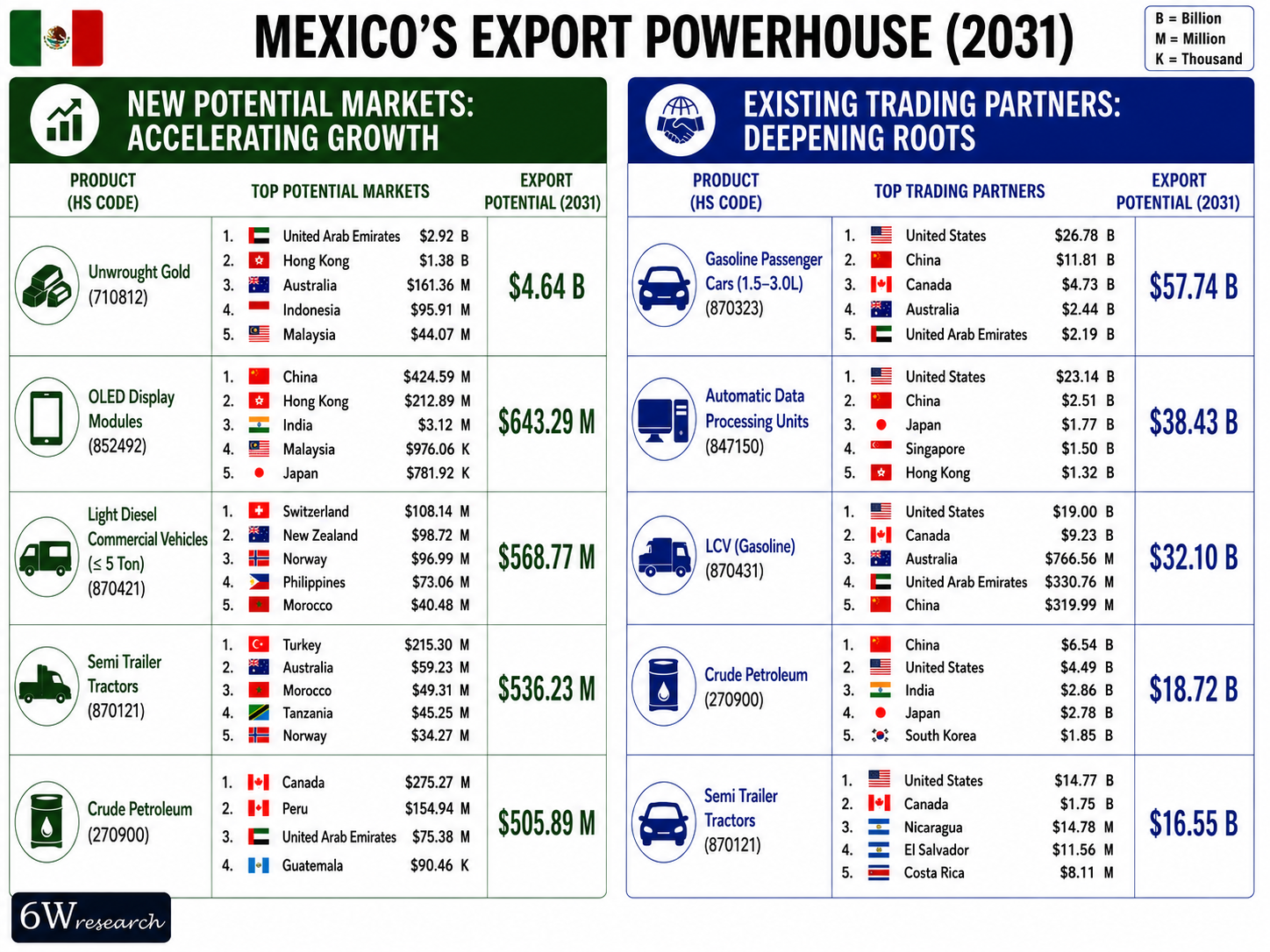
Unwrought gold leads Mexico’s emerging export opportunities through 2031, with OLED display modules, light diesel commercial vehicles, semi-trailer tractors, and crude petroleum completing the country’s five largest new potential market corridors. Unwrought gold represents Mexico's single largest untapped opportunity at USD 4.64 billion, led by the United Arab Emirates at USD 2.92 billion and Hong Kong at USD 1.38 billion, with Australia, Indonesia and Malaysia trailing far behind. This concentration reflects Mexico's standing as one of the world's larger silver and gold mining nations, with bullion increasingly flowing toward Gulf and East Asian trading hubs that serve as global centers for precious-metals refining and storage; as investors in those regions continue treating gold as a hedge against currency and economic uncertainty, Mexico's mining base is well positioned to keep supplying that demand without needing new extraction capacity.
OLED display modules add USD 643.29 million, led by China at USD 424.59 million and Hong Kong at USD 212.89 million, a corridor consistent with the growing sophistication of Mexico's Jalisco-based electronics and display-assembly cluster reaching back into Asian component and re-export markets. Light diesel commercial vehicles into new markets contribute USD 568.77 million, led by Switzerland at USD 108.14 million, followed by New Zealand, Norway, Philippines and Morocco a modest but genuine extension of Mexico's established light-vehicle manufacturing base into markets with strict emissions and safety standards that its USMCA-calibrated production lines can already meet.
Semi-trailer tractors and crude petroleum round out the new-corridors’ top five. Semi-trailer tractors into new markets add USD 536.23 million, led by Turkey at USD 215.30 million, with Australia, Morocco, Tanzania and Norway providing smaller volumes, extending a heavy-vehicle manufacturing category where Mexico already supplies the United States at far larger scale. Crude petroleum into new destinations contributes USD 505.89 million, led by Canada at USD 275.27 million and Peru at USD 154.94 million. Taken together, these five opportunities suggest Mexico's next stretch of diversification will lean on its mining, electronics and heavy-vehicle manufacturing base finding smaller but genuine footholds well outside its traditional North American trading circle.
Automotive Assembly, Computing Hardware and Energy Remain the Foundation of Mexico's Established Trade
Gasoline passenger cars, automatic data processing units, light commercial vehicles, crude petroleum and semi-trailer tractors define Mexico's highest-value established export categories through 2031. Gasoline passenger cars (1.5–3.0L) represent Mexico's largest established export opportunity at USD 57.74 billion, led by the United States at USD 26.78 billion and China at USD 11.81 billion, followed by Canada, Australia and the United Arab Emirates. This broad buyer base reaching well beyond North America into China and the Gulf reflects Mexico's position as one of the world's most efficient vehicle-assembly platforms, built on USMCA tariff-free access, a deep supplier base and decades of automaker investment that together let it compete on both cost and quality for buyers far outside its home region.
Automatic data processing units rank second at USD 38.43 billion, led overwhelmingly by the United States at USD 23.14 billion, with China, Japan, Singapore and Hong Kong providing smaller volumes, consistent with the computing-hardware assembly capacity concentrated around Jalisco and northern border states. Light commercial vehicles (gasoline) add USD 32.10 billion, led again by the United States at USD 19.00 billion and Canada at USD 9.23 billion, followed by Australia, the UAE and China a category that, together with passenger cars, confirms automotive manufacturing is Mexico's single largest export pillar by a wide margin.
Crude petroleum and semi-trailer tractors round out Mexico’s five leading established export categories. Crude petroleum accounts for USD 18.72 billion in export potential, led by China at USD 6.54 billion and the United States at USD 4.69 billion, followed by India, Japan and South Korea. This comparatively Asia-focused buyer mix highlights Pemex’s ongoing efforts to diversify Mexico’s crude petroleum export destinations, reducing reliance on traditional US refining markets while strengthening trade relationships with high-growth Asian economies. The expanding presence of Asian buyers reflects Mexico’s strategy to broaden market access, enhance export resilience and capture opportunities across a more balanced global energy trade landscape. Semi-trailer tractors add USD 16.55 billion, led overwhelmingly by the United States at USD 14.77 billion, with Canada, Nicaragua, El Salvador and Costa Rica rounding out a much smaller remainder. Collectively, these five categories confirm that Mexico's established export advantage rests on three structural pillars automotive assembly, computing-hardware manufacturing and energy exports each anchored by deep USMCA integration even as crude petroleum shows the clearest signs of diversifying toward Asian buyers.
|
Mexico’s export strength continues to be anchored by the depth of its USMCA-integrated manufacturing base rather than reliance on any single product cycle. A vehicle-assembly ecosystem serving North America, a growing computing-hardware cluster in Jalisco, and a mining sector connected to Gulf and Asian bullion markets collectively provide a strong foundation for sustaining its leading trade relationships while expanding into new export corridors. These developments reinforce Mexico’s position as one of the most structurally diversified exporters in this series. 6WExportGTM Analysis |
What Mexico Already Sells and Where
Automotive parts form Mexico's largest established trade sector at USD 58.72 billion, led by vehicle body parts at USD 8.77 billion, followed by vehicle parts at USD 6.19 billion. Passenger vehicles rank second at USD 61.43 billion, with gasoline passenger cars (1.5–3.0L) contributing USD 30.57 billion, while medium petrol cars add USD 12.16 billion. Computers and IT hardware follow at USD 40.92 billion, led by automatic data processing units at USD 24.91 billion, with computer parts adding USD 4.92 billion together confirming Mexico's manufacturing weight is concentrated almost entirely in vehicle assembly, automotive components and computing hardware.
| Sector | Exports (USD Billion) | Leading Products / Share |
| Automotive Parts | 58.72 | Vehicle Body Parts (15.07%), Vehicle Parts (10.64%) |
| Passenger Vehicles | 61.43 | Gasoline Passenger Cars 1.5–3.0L (55.95%), Medium Petrol Cars (22.25%) |
| Computers & IT Hardware | 40.92 | Automatic Data Processing Units (62.22%), Computer Parts (12.30%) |
Source: 6WExportGTM
The United States is Mexico's overwhelming largest destination market at USD 503.42 billion, led by a broad category of unspecified trade goods at 5.84% of exports to the country and gasoline passenger cars (1.5–3.0L) at 4.79%. Canada ranks a distant second at USD 18.61 billion, with unspecified trade goods contributing 37.80% and gasoline passenger cars 16.11%. Saint Helena appears as a third notable destination at USD 12.71 billion, entirely concentrated in crude petroleum a pattern that most likely reflects offshore trading or transshipment routing for petroleum cargoes rather than direct consumption on the island itself. This partner mix highlights the strong integration of Mexico’s export ecosystem with its USMCA trade partners, reflecting the importance of North American supply chains across major manufacturing categories. Petroleum exports represent a notable exception, with a broader and more geographically diverse buyer base extending beyond the region into key global energy markets.
| Country | Exports (USD Billion) | Leading Products / Share |
| United States | 503.42 | Unspecified Trade Goods (5.84%), Gasoline Passenger Cars 1.5–3.0L (4.79%) |
| Canada | 18.61 | Unspecified Trade Goods (37.80%), Gasoline Passenger Cars 1.5–3.0L (16.11%) |
| Saint Helena | 12.71 | Crude Petroleum (100.00%) |
Source: 6WExportGTM
Automotive Manufacturing Expansion and AI Server Production: Two Developments Shaping Mexico's Export Base
Two developments now underway are reinforcing Mexico’s export capabilities: ongoing automotive manufacturing expansions across the country, which strengthen Mexico’s passenger-vehicle and commercial-vehicle export base, and Foxconn’s build-out of AI server manufacturing for Nvidia’s Blackwell platform, which enhances Mexico’s computing-hardware export potential. Together, these investments deepen Mexico’s role in global automotive and technology supply chains while supporting the shift toward higher-value export opportunities.
A Strengthening Automotive Manufacturing Base Positions Mexico as a Global Vehicle Export Hub
Mexico’s automotive manufacturing ecosystem continues to strengthen through ongoing investments by global vehicle manufacturers, reinforcing the country’s position as a major export hub for passenger vehicles and commercial vehicles. Productions capacity is growing in key automotive clusters, with greater integration of suppliers and export readiness, further solidifying Mexico’s established vehicle trade corridors with the United States, Canada and other international markets. These developments are in line with the country’s strong export potential in gasoline passenger cars, light commercial vehicles and semi-trailer tractors and highlight how ongoing industrial investment is deepening Mexico’s role in global automotive supply chains.
|
Mexico’s 2031 export growth will be driven by its strong automotive and technology foundation, while emerging opportunities in gold, display modules and commercial vehicles create new pathways for diversification across global markets. Manish Pant, Senior Data Scientist, Data Science & Market Intelligence, 6Wresearch |
Foxconn's AI Server Build-Out Reinforces Mexico's Computing-Hardware Export Base
Mexico's computing-hardware export position is being reinforced by Foxconn's large-scale manufacturing project for AI server systems built on Nvidia's GB200 Blackwell platform, adding to the company's existing operations in Chihuahua and Guadalajara. The investment sits within a broader wave of electronics build-out in Jalisco, where more than USD 4.00 billion in FDI has flowed into the semiconductor and component sector alone and companies including Intel, HP, Oracle and Micron committed close to USD 890 million in fresh expansion commitments in 2026. Export opportunities for automatic data processing units to existing trading partners are projected to reach USD 38.43 billion by 2031. Given that the computers and IT hardware sector is currently worth USD 40.92 billion, the shift from conventional computer assembly toward AI server manufacturing indicates that Mexico's electronics cluster is moving up the value chain rather than simply increasing production volume.
|
Mexico’s export trajectory through 2031 will be shaped by its manufacturing depth, with automotive, electronics and industrial products maintaining the core while new opportunities in emerging markets expand its global reach beyond traditional trade corridors. Manisha Gupta, Data Analyst, Data Science & Market Intelligence, 6Wresearch |
The Takeaway
Mexico should focus on extending its existing industrial capabilities rather than building entirely new export sectors, with automotive assembly and computing-hardware manufacturing remaining the foundation of future growth. The country's next phase of export expansion will depend on converting its established vehicle-production, component-manufacturing and electronics-assembly strengths into higher-value opportunities across electrified mobility, AI-related hardware and precious-metals markets, while carefully managing the USMCA relationship that its entire established export base depends on.
Key strategic priorities for Mexico include:
- Move computing-hardware exports up the value chain: Automatic data processing units already generate USD 38.43 billion in established export potential and a 62.22% share of the Computers & IT Hardware sector. Foxconn's AI-server build-out for Nvidia's Blackwell platform, alongside fresh 2026 commitments from Intel, HP, Oracle and Micron in Jalisco, gives Mexico a credible path from conventional computer assembly toward higher-value AI and data-center hardware.
- Build out the gold and precious-metals corridor deliberately: Unwrought gold represents Mexico’s largest new-corridor opportunity at USD 4.64 billion, with the United Arab Emirates and Hong Kong emerging as the leading potential markets. Capturing this opportunity will require Mexico to strengthen direct trade relationships with major Gulf and East Asian bullion hubs, enabling the country to leverage its existing mining capabilities into a more stable and higher-value export channel.
- Protect and strengthen USMCA integration while pursuing selective diversification: The United States represents USD 278.53 billion, or 45.29%, of Mexico’s established export potential, making it the country’s most significant export market by a substantial margin. With the USMCA joint review scheduled through 2026, Mexico’s focus should remain on reinforcing the stability and competitiveness of this critical trade relationship rather than interpreting the limited presence of the US and Canada in new-corridor opportunities as a reason to shift investment away from its deeply integrated North American manufacturing ecosystem.
Overall, Mexico's export growth through 2031 should be driven by upgrading its manufacturing ecosystem moving from conventional vehicle and computer assembly toward electrified mobility, AI-related hardware and a more deliberate precious-metals export strategy while treating deep USMCA integration as the foundation to protect, not a dependency to diversify away from.

Leadership Perspectives from Industry Events
Search
6Wresearch in the News
 Forbes
Citing 6Wresearch analytics to map global infrastructure and pharmaceutical industry trajectories.
 Bloomberg Law
Direct syndication of 6Wresearch's macro data points, capturing complex supply chain shifts.
 Reuters
Tracking industrial manufacturing adjustments and electronic security ecosystem scaling.
 Mint
Mint
Utilizing deep-tech sector market sizing to analyze global automation and robotics.
 The Economic Times
Anchoring features on industrial IoT growth metrics and connected smart-grid devices.
 Business Standard
Featuring strategic evaluations of Advanced Driver Assistance Systems (ADAS) and AI road safety.
 The Hindu
Spotlighting core commercial metrics ranging from unmanned aerial vehicles (UAVs) to consumer durables.
 Financial Express
Anchoring quarterly reviews on cross-border real estate tech and structural hardware manufacturing.
 Yahoo Finance
Syndicating the tracker's $30.1 billion untapped-market findings, spotlighting Japan, the US and China as India's top new-potential importers.
 India Today
Carrying the release on smartphones leading India's export potential to $94 billion by 2031, per 6WExportGTM data.
 Dailyhunt
Distributing the tracker findings to its regional readership, framing India's export diversification into Japan and Mexico.
 PR Newswire Original release
Publishing the full India Export Attractiveness Tracker 2026, detailing new trade corridors across iron ore, LCVs and pharmaceuticals.
 The Industrial
Highlighting the tracker's read on India's semiconductor ambitions and long-term chip-assembly export potential.
 PTI News
Reporting on the $66.81 billion pharmaceuticals export opportunity flagged in the tracker, amid looming US generic-drug tariffs.
 Tribune India
Covering the tracker's tariff-versus-regulation analysis across India's mature export markets in the US, China and UAE.
 ANI News
Amplifying the report's findings on polished diamonds, refined petroleum and medicines as India's core export engines.
 International Business Magazine
Covering the report's insight into how AEB, blind spot detection, and driver monitoring are reshaping India's ADAS market.
 Focus Gaming News
Highlighting the research forecast for Egypt's gambling market, projecting steady growth through 2032.
Thought Leadership and Analyst Meet





Our Clients








Latest Reports
- Gabon Citrullinemia Type-1 Market (2026-2032)
- Finland Citrullinemia Type-1 Market (2026-2032)
- Fiji Citrullinemia Type-1 Market (2026-2032)
- Ethiopia Citrullinemia Type-1 Market (2026-2032)
- Estonia Citrullinemia Type-1 Market (2026-2032)
- Eritrea Citrullinemia Type-1 Market (2026-2032)
- Equatorial Guinea Citrullinemia Type-1 Market (2026-2032)
- El Salvador Citrullinemia Type-1 Market (2026-2032)
- Ecuador Citrullinemia Type-1 Market (2026-2032)
- Dominica Citrullinemia Type-1 Market (2026-2032)
Industry Events and Analyst Meet

EV India Expo 2026

HIMTEX 2026

India Refining Summit 2026

India EV Show 2026

EV tech India Expo 2026
Whitepaper
- Middle East & Africa Commercial Security Market Click here to view more.
- Middle East & Africa Fire Safety Systems & Equipment Market Click here to view more.
- GCC Drone Market Click here to view more.
- Middle East Lighting Fixture Market Click here to view more.
- GCC Physical & Perimeter Security Market Click here to view more.


