Brazil's Crude Petroleum Exports to Existing Partners Could Reach USD 48.22 Billion, While Unwrought Gold Opens USD 4.77 Billion Across New Markets by 2031
China is Brazil's largest export market by a wide margin in both established and new-corridor trade, holding 36.82% of existing export potential and 22.84% of new-market potential respectively. United States sits second among established partners at 15.27%, while Japan takes second place among new-corridor markets at 15.85%, well ahead of the United States' new potential market share. Crude petroleum, iron ore concentrates and soybean products continue to dominate Brazil’s export potential portfolio, underscoring its strength in energy, mining and agribusiness, while unwrought gold and a second wave of crude-petroleum demand point to where that same resource base can extend its reach through 2031.
 Source: 6WExportGTM
China Leads Brazil’s Established and New Potential Markets, While Japan Surpasses the US in Emerging Export Opportunities
China leads Brazil’s new potential export markets with USD 7.16 billion in export potential, followed by Japan at USD 4.97 billion. Hong Kong ranks third with USD 1.66 billion, while Singapore and Canada contribute USD 1.40 billion each. This destination profile shows the increasing weight of Asian markets in the future export expansion of Brazil, being China and Japan the main drivers of new opportunities. Hong Kong, Singapore and Canada further broaden Brazil’s potential reach across Asian financial and trading hubs as well as North American markets, creating a more diversified set of export corridors through 2031.
| Top 5 Existing Leading Importers | Export Potential (USD Billion) | Top 5 New Potential Importers | Export Potential (USD Billion) |
| China | 124.22 | China | 7.16 |
| United States | 51.51 | Japan | 4.97 |
| South Korea | 15.58 | Hong Kong | 1.66 |
| India | 15.11 | Singapore | 1.40 |
| Japan | 14.53 | Canada | 1.40 |
Source: 6WExportGTM
China accounts for USD 124.22 billion of Brazil's established export potential, more than double the next four markets combined. The United States follows at USD 51.51 billion, with South Korea, India and Japan contributing USD 15.58 billion, USD 15.11 billion and USD 14.53 billion respectively. This concentration reflects Brazil's role as a primary commodity supplier to Chinese steelmaking, energy and food-processing industries, with the United States, South Korea, India and Japan providing meaningful secondary demand across crude petroleum, agribusiness and industrial-metal categories.
From Gold to Energy and Minerals, Brazil’s Export Portfolio Expands Into New Global Opportunities
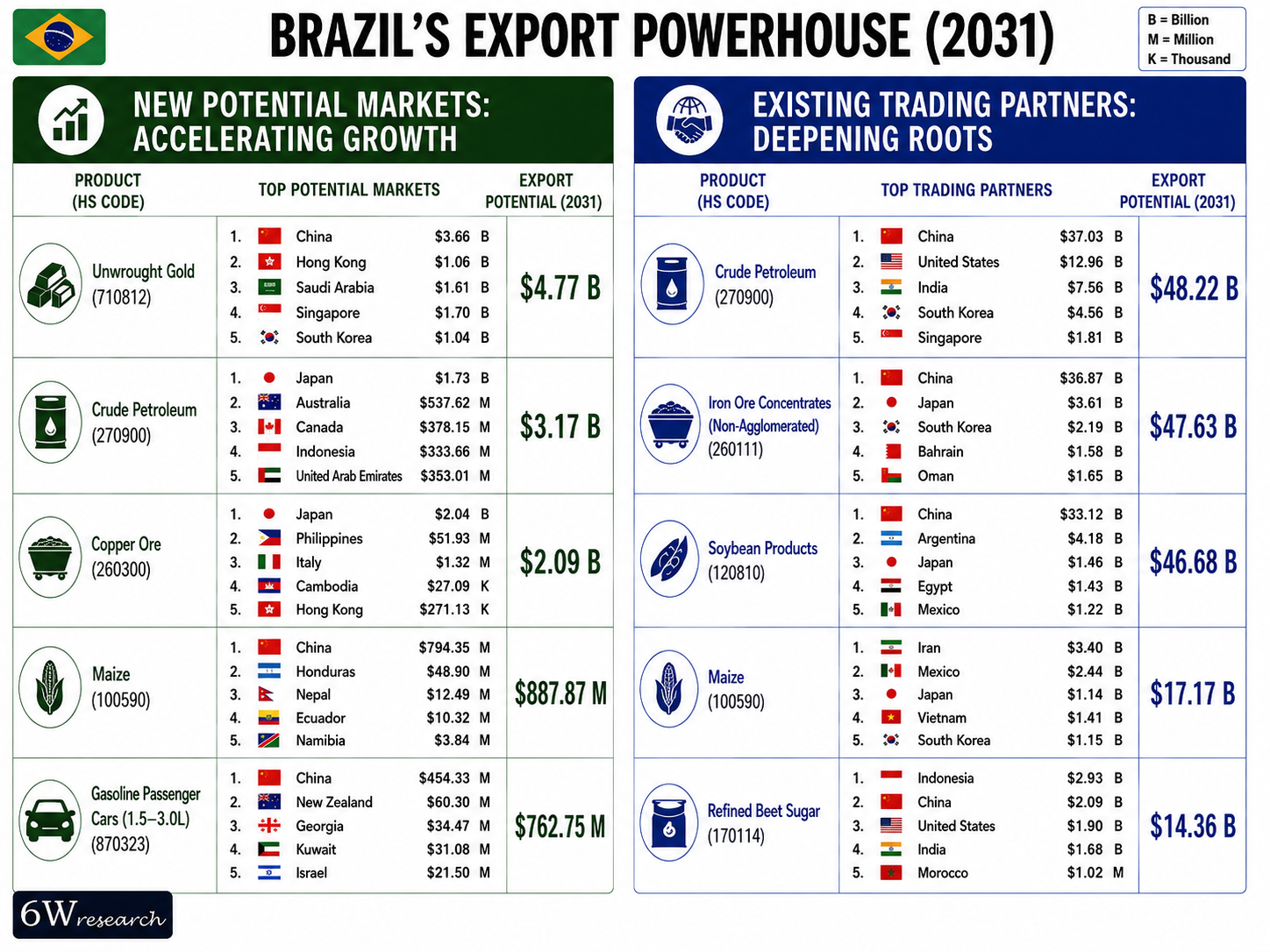
Unwrought gold, crude petroleum, copper ore, maize and gasoline passenger cars directed at non-traditional buyers make up Brazil's five largest new-corridor opportunities through 2031. Unwrought gold represents Brazil’s largest new market opportunity by 2031 at USD 4.77 billion, with demand highly concentrated in China at USD 3.66 billion and Hong Kong at USD 1.06 billion. This emphasis points to the increasing importance of Asian financial and industrial markets in captivating precious metals from resource-rich exporters. Brazil has a mature mining sector, coupled with global demand for as a safe haven and strategic asset amid economic uncertainty, creating a clear opportunity to increase bullion exports to Asian markets. The role of China and Hong Kong within this opportunity suggests that Brazil’s future success depends mostly on the further development of existing commodity supply chains and access to the world's major gold trading hubs, rather than the development of entirely new export segments.
Crude petroleum presents itself as the Brazil’s second-largest new export potential opportunity, valued at USD 3.17 billion, led by Japan USD 1.73 billion, followed by Australia USD 537.62 million, Canada USD 376.15 million, and Indonesia USD 303.65 million. This particular opportunity comes in line with Brazil’s growing offshore oil production capacities, as well as its ability to supply competitively priced crude on a global scale. With continued efforts by many Asian economies to diversify their energy sources, Japan’s leading position indicates potential to form relationships in the energy sector beyond conventional buyers. Simultaneously, copper ore worth USD 2.09 billion opportunity, largely attributed to Japan USD 2.04 billion, indicating surging demand from advanced manufacturing economies for critical minerals required in electrification, renewable energy infrastructure and high-tech industries.
In addition to minerals and energy, Brazil’s agricultural and automotive potential offers additional diversification opportunities. Maize is a significant new export opportunity for Brazil, valued at USD 887.9 million through to 2031, with China accounting for USD 790.9 million. The opportunity is backed by Brazil’s strong position in global grain supply chains as well as China’s growing focus on securing stable agricultural imports. Gasoline passenger cars 1.5–3.0L contribute another USD 762.7 million, led by China USD 456.3 million, followed by New Zealand, Georgia, Kuwait and Israel. This reflects Brazil’s established vehicle manufacturing base and the ability of its automotive sector to access smaller but growing overseas markets. Overall, Brazil’s 2031 export expansion is expected to be driven by deeper penetration of Asian markets particularly China and Japan across minerals, energy, agriculture and manufactured goods, leveraging existing industrial strengths rather than relying on new production ecosystems.
Energy, Mining, and Agriculture Remain the Pillars of Brazil’s Established Export Opportunities
Crude petroleum, iron ore concentrates, soybean products, maize and refined beet sugar define Brazil's highest-value established export categories through 2031. Crude petroleum represents Brazil’s largest established export opportunity by 2031 at USD 48.22 billion, led by China USD 17.83 billion and the United States USD 12.56 billion, followed by India, South Korea and Singapore. This broad buyer base shows that Brazil’s increasing importance as a dependable global energy supplier, proliferated by the constant expansion of its pre-salt offshore oil production and competitive upstream capabilities. The strong presence of Asian markets, particularly China and India, highlights the role of Brazil in supporting energy security for major importing economies seeking diversified crude supply sources beyond traditional Middle Eastern producers.
Iron ore concentrates non-agglomerated represent the second-largest established opportunity at USD 47.63 billion, with China accounting for USD 36.87 billion, followed by Japan, South Korea, Bahrain and Oman. This concentration reflects Brazil’s deep integration into Asian steelmaking supply chains, supported by its large-scale mining operations and high-quality iron ore reserves. China’s dominance is largely driven by its ongoing needs for raw materials to feed infrastructure, construction and industrial manufacturing, while Japan and South Korea contribute demand from their advanced steel producing ecosystems. Together, Brazil’s crude petroleum and iron ore exports demonstrate the country’s continued advantage in supplying critical industrial commodities to global markets.
Soybean products contribute another USD 46.68 billion in established export potential, led by China USD 33.12 billion, with Argentina, Japan, Egypt and Mexico providing additional demand. This reflects Brazil’s position as a major global agricultural powerhouse, supported by large-scale soybean cultivation, expanding logistics infrastructure and strong competitiveness in global food supply chains. Maize adds USD 17.17 billion, led by Iran USD 3.40 billion and Mexico USD 2.44 billion, while refined beet sugar contributes USD 14.36 billion, led by Indonesia USD 2.83 billion and China USD 2.09 billion. Collectively, these categories highlight that Brazil’s established export advantage is built around three structural pillars energy, minerals and agricultural commodities allowing the country to maintain strong global trade positions by leveraging resource availability, production scale and established international buyer relationships.
|
Brazil's export edge continues to rest on the scale of its energy, mining and agribusiness base rather than on any single commodity cycle. Record offshore oil output, expanding iron ore capacity and a soy complex that keeps growing give the country room to defend its dominant Chinese relationship while building meaningful new demand from Japan and other Asian buyers, reinforcing its position as South America's most diversified resource exporter. 6WExportGTM Analysis |
What Brazil Already Sells and Where
Oil and gas forms Brazil's largest established trade sector at USD 56.98 billion, led by crude petroleum at USD 44.84 billion and a 78.70% share, followed by refined petroleum oils at USD 10.47 billion and an 18.37% share. Oilseeds rank second at USD 45.26 billion, with soybean products contributing USD 42.93 billion and a 94.86% share, while crude soya bean oil adds USD 1.15 billion and 2.53%. Metallic ores follow at USD 35.04 billion, led by iron ore concentrates (non-agglomerated) at USD 26.55 billion and a 75.77% share, with copper ore adding USD 4.16 billion and 11.87% together underscoring Brazil's weight across offshore energy, the soy-processing complex and mineral extraction.
| Sector | Exports (USD Billion) | Leading Products / Share |
| Oil & Gas | 56.98 | Crude Petroleum (78.70%), Refined Petroleum Oils (18.37%) |
| Oilseeds | 45.26 | Soybean Products (94.86%), Crude Soya Bean Oil (2.53%) |
| Metallic Ores | 35.04 | Iron Ore Concentrates, Non-Agglomerated (75.77%), Copper Ore (11.87%) |
Source: 6WExportGTM
China is Brazil's largest destination market by a wide margin at USD 94.41 billion, led by soybean products at 33.36% of exports to the country and crude petroleum at 21.19%. The United States ranks second at USD 40.92 billion, with crude petroleum contributing 14.10% and semi-finished alloy steel 6.78%. Argentina follows as a regional destination at USD 13.78 billion, supported by gasoline passenger cars (1.5–3.0L) at 5.59% and medium petrol cars at 4.56%. This partner mix shows Brazil's exports running heavily through its soy and energy relationship with China, a diversified industrial relationship with the United States, and a close automotive-trade relationship with neighboring Argentina.
| Country | Exports (USD Billion) | Leading Products / Share |
| China | 94.41 | Soybean Products (33.36%), Crude Petroleum (21.19%) |
| United States | 40.92 | Crude Petroleum (14.10%), Semi Finished Alloy Steel (6.78%) |
| Argentina | 13.78 | Gasoline Passenger Cars (1.5–3.0L 5.59%), Medium Petrol Cars (4.56%) |
Source: 6WExportGTM
Brazil’s Commodity Advantage Deepens as Oil Output Reaches New Highs and Iron Ore Capacity Expands
Two developments are strengthening Brazil’s long-term export position: Petrobras’s record pre-salt oil production is expanding the country’s crude petroleum supply base and supporting growth across both established and emerging markets, while Vale’s iron ore capacity expansion is reinforcing Brazil’s mining competitiveness and supporting broader demand diversification beyond China.
Petrobras's Record Pre-Salt Output Reinforces Brazil's Crude-Petroleum Export Base
Brazil's crude-petroleum export potential is being reinforced by record offshore production at Petrobras. The company posted average output of 3.34 million barrels of oil equivalent per day in the second quarter of 2026, up 14.1% year-on-year, with pre-salt fields such as Búzios and Mero driving the gain as new floating production units came online ahead of schedule. Net exports of crude and refined products reached 1.075 million barrels per day in the same quarter, up more than a quarter from the first quarter, with the destination mix shifting notably: India's share of Petrobras's crude exports climbed to 22% in the second quarter, up from just 3% a year earlier, even as China's share eased. For an established petroleum export base already worth USD 48.22 billion by 2031, that kind of production growth and shifting buyer mix supports the case that Brazil's crude-petroleum corridor still has meaningful room to broaden beyond its current top buyers.
|
Brazil’s 2031 export growth will continue to be driven by its strengths in energy, mining and agriculture, with crude petroleum, iron ore, soybean products and maize anchoring global demand while emerging opportunities in metals and automotive products support greater export diversification. Manish Pant, Data Science & Market Intelligence, 6Wresearch |
Vale's Capacity Expansion Reinforces Brazil's Iron Ore and Copper Export Base
Brazil's mining export position is being reinforced by continued capacity expansion at Vale, the country's largest iron ore producer. New projects including the Vargem Grande VGR1 expansion and the Capanema mine, both in Minas Gerais, are expected to reach full operational capacity through 2026 and 2027, supporting a 2026 production target of 340 to 360 million tonnes even as the company trims longer-term guidance in response to a maturing Chinese steel market. At the same time, Vale's leadership has pointed to strengthening demand from Southeast Asia, India, Europe and the United States as a counterweight to a plateauing China, alongside a growing base-metals business that includes copper. For a copper ore new-corridor opportunity already concentrated almost entirely in Japan at USD 2.04 billion by 2031, that diversification push supports the case that Brazil's mining exports rest on expanding, multi-market capacity rather than a single buyer relationship.
|
Brazil’s future export trajectory will be shaped by its ability to convert natural-resource strength into broader global supply-chain participation. Strong positions in oil, minerals and agricultural products provide the foundation, while expanding opportunities in copper, gold and vehicles create new avenues for diversification across international markets. Manisha Gupta, Data Analyst, Data Science & Market Intelligence, 6Wresearch |
The Takeaway
Brazil should focus on strengthening and diversifying its existing resource-based export advantages across energy, minerals and agriculture rather than developing entirely new export sectors. The country’s next phase of export growth will depend on converting its scale in crude petroleum, iron ore and soybean production into deeper global supply relationships while expanding into emerging opportunities across gold, copper and new energy corridors.
Key strategic priorities for Brazil include:
- Broaden crude petroleum export capacity and diversify buyers: As crude petroleum is the biggest established export opportunity for Brazil worth USD 48.22 billion, Brazil should continue to benefit from the ability of its pre-salt offshore production strength while building diverse relationships with countries outside of traditional destinations. Increasing demand from markets such as India, Japan, and other Asian economies gives an opportunity to reduce dependence on a limited number of destinations.
- Further develop mineral supply chains beyond China dependence: Iron ore concentrates are an established export opportunity worth USD 47.63 billion with China worth USD 36.87 billion. It means that Brazil should continue increasing the volume of mining operations and build more diversified relationships with Japan, South Korea, India, and other markets in order to ensure diversification of demand for iron ore and copper exports.
- Capture rising demand for critical minerals and processed commodities: New-corridor opportunities in unwrought gold (USD 4.77 billion) and copper ore (USD 2.09 billion) highlight Brazil’s potential to benefit from demand linked to financial markets, electrification and industrial supply chains. Strengthening processing capabilities and improving access to Asian markets will be important for moving beyond traditional commodity exports.
- Sustain dominance in agricultural exports while intensifying markets: Soybean products accounted for USD 46.68 billion in established export potential, led by China at USD 33.12 billion, while maize and refined sugar provide additional opportunities. Brazil should capitalize on agricultural productivity, logistics and market access to maintain its position as a significant global food supplier.
Overall, Brazil’s export strategy through 2031 should deeply emphasize on making the best use of its existing strengths in energy, mining and agribusiness while building a broader network of buyers across Asia and other emerging markets. China will remain a critical anchor market, but expanding relationships with Japan, India, Southeast Asia and other destinations will be essential for creating a more resilient and diversified export base.

Leadership Perspectives from Industry Events
Search
6Wresearch in the News
 Forbes
Citing 6Wresearch analytics to map global infrastructure and pharmaceutical industry trajectories.
 Bloomberg Law
Direct syndication of 6Wresearch's macro data points, capturing complex supply chain shifts.
 Reuters
Tracking industrial manufacturing adjustments and electronic security ecosystem scaling.
 Mint
Mint
Utilizing deep-tech sector market sizing to analyze global automation and robotics.
 The Economic Times
Anchoring features on industrial IoT growth metrics and connected smart-grid devices.
 Business Standard
Featuring strategic evaluations of Advanced Driver Assistance Systems (ADAS) and AI road safety.
 The Hindu
Spotlighting core commercial metrics ranging from unmanned aerial vehicles (UAVs) to consumer durables.
 Financial Express
Anchoring quarterly reviews on cross-border real estate tech and structural hardware manufacturing.
 Yahoo Finance
Syndicating the tracker's $30.1 billion untapped-market findings, spotlighting Japan, the US and China as India's top new-potential importers.
 India Today
Carrying the release on smartphones leading India's export potential to $94 billion by 2031, per 6WExportGTM data.
 Dailyhunt
Distributing the tracker findings to its regional readership, framing India's export diversification into Japan and Mexico.
 PR Newswire Original release
Publishing the full India Export Attractiveness Tracker 2026, detailing new trade corridors across iron ore, LCVs and pharmaceuticals.
 The Industrial
Highlighting the tracker's read on India's semiconductor ambitions and long-term chip-assembly export potential.
 PTI News
Reporting on the $66.81 billion pharmaceuticals export opportunity flagged in the tracker, amid looming US generic-drug tariffs.
 Tribune India
Covering the tracker's tariff-versus-regulation analysis across India's mature export markets in the US, China and UAE.
 ANI News
Amplifying the report's findings on polished diamonds, refined petroleum and medicines as India's core export engines.
 International Business Magazine
Covering the report's insight into how AEB, blind spot detection, and driver monitoring are reshaping India's ADAS market.
 Focus Gaming News
Highlighting the research forecast for Egypt's gambling market, projecting steady growth through 2032.
Thought Leadership and Analyst Meet





Our Clients








Latest Reports
- Gabon Citrullinemia Type-1 Market (2026-2032)
- Finland Citrullinemia Type-1 Market (2026-2032)
- Fiji Citrullinemia Type-1 Market (2026-2032)
- Ethiopia Citrullinemia Type-1 Market (2026-2032)
- Estonia Citrullinemia Type-1 Market (2026-2032)
- Eritrea Citrullinemia Type-1 Market (2026-2032)
- Equatorial Guinea Citrullinemia Type-1 Market (2026-2032)
- El Salvador Citrullinemia Type-1 Market (2026-2032)
- Ecuador Citrullinemia Type-1 Market (2026-2032)
- Dominica Citrullinemia Type-1 Market (2026-2032)
Industry Events and Analyst Meet

EV India Expo 2026

HIMTEX 2026

India Refining Summit 2026

India EV Show 2026

EV tech India Expo 2026
Whitepaper
- Middle East & Africa Commercial Security Market Click here to view more.
- Middle East & Africa Fire Safety Systems & Equipment Market Click here to view more.
- GCC Drone Market Click here to view more.
- Middle East Lighting Fixture Market Click here to view more.
- GCC Physical & Perimeter Security Market Click here to view more.


