Egypt's Light Petroleum Oil Exports to Existing Partners Could Reach USD 3.54 Billion, While Unwrought Gold Opens USD 2.11 Billion Across New Markets by 2031
The United States remains Egypt’s leading export opportunity across both established and new potential markets, contributing 21.68% and 28.11% of potential value, respectively, followed by China in both categories. Established export strength remains built around light petroleum oils, refined petroleum oils, and urea fertilizer, underscoring Egypt’s competitive position in energy and petrochemicals. At the Same time, unwrought gold is taking shape as a significant diversification opportunity, contributing to Egypt Export Potential by reshaping the country’s export landscape and helping to power broader market expansion through 2031.
 Source: 6WExportGTM
United States and China Anchor Egypt’s Global Export Opportunities as New Potential Markets Emerge
The United States leads Egypt’s new potential export corridors with USD 5.88 billion in export potential, followed by China at USD 3.77 billion. South Korea ranks third with USD 1.69 billion, while Australia and Canada contribute USD 1.02 billion and USD 0.69 billion, respectively. This distribution of destination highlights Egypt’s opportunity to expand beyond traditional trade relationships by strengthening access to major industrial and consumer markets across North America, Asia-Pacific and other high-growth regions. The presence of China, South Korea, and Australia also reflect growing potential across diversified markets for Egypt’s energy, industrial and resource-based exports through 2031.
| Top 5 Existing Importers | Export Potential (USD Billion) | Top 5 New Potential Importers | Export Potential (USD Billion) |
| United States | 8.05 | United States | 5.88 |
| China | 3.09 | China | 3.77 |
| India | 2.56 | South Korea | 1.69 |
| Turkey | 2.15 | Australia | 1.02 |
| Saudi Arabia | 2.11 | Canada | 0.69 |
Source: 6WExportGTM
The United States accounts for USD 8.05 billion of Egypt's established export potential, well ahead of China's USD 3.09 billion. India ranks third at USD 2.56 billion, with Turkey and Saudi Arabia contributing USD 2.15 billion and USD 2.11 billion, respectively. This spread reflects an established trade base anchored by the United States' demand for refined fuels and fertilizer, with China, India, Turkey and Saudi Arabia providing meaningful regional and industrial-metal demand across Egypt's petroleum, chemicals and construction-materials categories.
Gold and Energy Exports Open New Growth Pathways for Egypt’s Global Trade Expansion
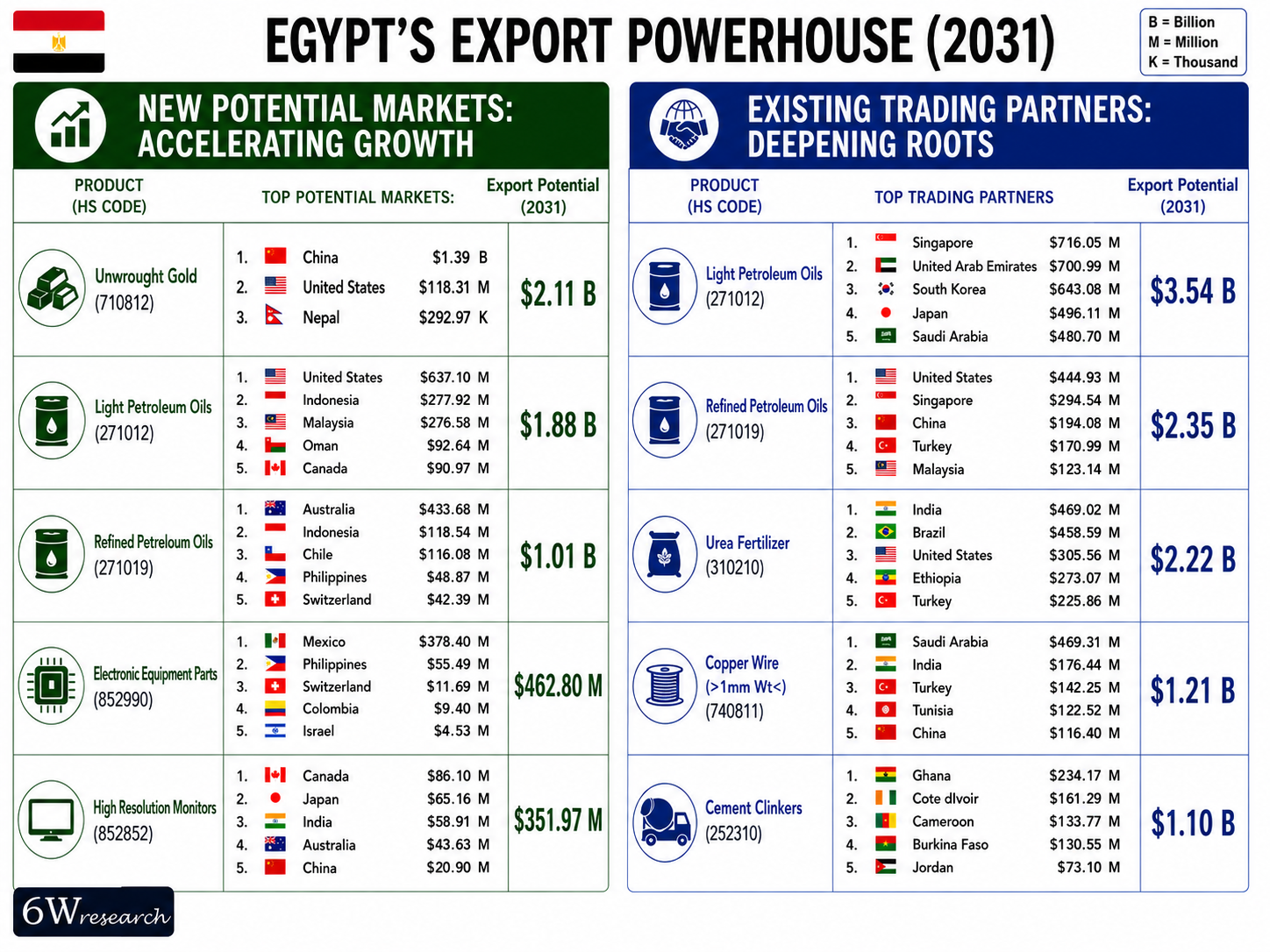
Unwrought gold represents Egypt's single largest new-corridor opportunity by a wide margin at USD 2.11 billion, led overwhelmingly by China at USD 1.99 billion, with the United States and Nepal contributing only a small remainder. This concentration is consistent with Egypt's re-emergence as a serious gold-mining jurisdiction: a decade of reforms to the country's mineral-resources law, culminating in a 30-year exploitation agreement covering the Sukari mine and a fresh wave of investment from majors such as AngloGold Ashanti, has turned Egypt into one of the more closely watched frontier gold markets on the Arabian-Nubian Shield. As Chinese buyers continue treating bullion as a hedge against currency and economic uncertainty, Egypt's expanding mining base is well positioned to keep supplying that single, highly concentrated relationship.
Light petroleum oils and refined petroleum oils present additional new-market opportunities of USD 1.88 billion and USD 1.01 billion, respectively. Light petroleum oils are led by the United States at USD 637.10 million, followed by Indonesia and Malaysia, while refined petroleum oils are primarily driven by Australia at USD 433.66 million. Both extend a refining category where Egypt already trades at much larger scale in established markets, showing that its Mediterranean and Red Sea refining capacity has room to reach a wider set of buyers rather than needing new production capability.
Electronic equipment parts and high-resolution monitors round out the new-corridor top five. Electronic equipment parts contribute USD 462.80 million, led by Mexico at USD 378.40 million, with the Philippines, Switzerland, Colombia and Israel providing smaller volumes. High-resolution monitors add USD 351.97 million, led by Canada at USD 86.10 million, followed by Japan, India, Australia and China. Overall, Egypt's 2031 new-corridor expansion looks set to be driven primarily by a single concentrated gold relationship with China, complemented by smaller but genuine extensions of its established fuel-refining and early-stage electronics-assembly base.
From Refined Fuels to Metals: The Key Products Powering Egypt’s Established Trade
Light petroleum oils represent Egypt's largest established export opportunity at USD 3.54 billion, led by Singapore at USD 716.05 million and the United Arab Emirates at USD 700.99 million, followed by South Korea, Japan and Saudi Arabia. This diverse, trading-hub-driven buyer base reflects Egypt’s strategic position as a key Mediterranean and Red Sea refining and bunkering center. Its geographic advantage enables the country to efficiently serve vessels and energy buyers operating along the Suez Canal corridor, supporting a broad export network that extends beyond dependence on any single long-distance market.
Refined petroleum oils rank second at USD 2.35 billion, led by the United States at USD 444.93 million and Singapore at USD 294.54 million, followed by China, Turkey and Malaysia. Urea fertilizer adds USD 2.22 billion, led by India at USD 469.02 million and Brazil at USD 458.99 million, followed by the United States, Ethiopia and Turkey a spread consistent with Egypt's large natural gas fed nitrogen fertilizer industry supplying major agricultural economies that need imported nitrogen at scale.
Copper wire and cement clinkers complete the established top five. Copper wire (over 6mm wide) contributes USD 1.21 billion, led by Saudi Arabia at USD 469.31 million and India at USD 176.44 million, followed by Turkey, Tunisia and China, reflecting Egypt's growing base-metals processing capacity feeding Gulf construction and electrical-infrastructure demand. Cement clinkers add USD 1.10 billion, led by Ghana at USD 234.17 million and Cote d'Ivoire at USD 161.29 million, followed by Cameroon, Burkina Faso and Jordan a distinctly African buyer base that fits Egypt's role as a regional cement exporter to fast-growing West African construction markets. Collectively, these five categories confirm that Egypt's established export advantage rests on three structural pillars: Mediterranean fuel refining, gas-based fertilizer production and industrial-metals and processing, each serving a geographically distinct set of buyers.
|
Egypt's export edge continues to rest on its position at the crossroads of the Suez Canal, the Mediterranean and the Red Sea a refining and trading base built to serve vessels and buyers moving through one of the world's busiest shipping corridors. A re-emerging gold-mining sector and a modernizing refining base together give the country room to defend its dominant relationships with the United States and China while building a genuinely new precious-metals corridor, reinforcing its position as a structurally important Mediterranean exporter. 6WExportGTM Analysis |
What Egypt Already Sells and Where
Oil and gas forms Egypt's largest established trade sector at USD 5.48 billion, led by light petroleum oils at USD 3.01 billion, followed by crude petroleum at USD 1.41 billion. Precious metals rank second at USD 3.25 billion, almost entirely made up of unwrought gold at USD 3.24 billion, with unwrought silver contributing a negligible remainder. Apparel follows at USD 2.82 billion, led by men's woven synthetic trousers at USD 0.32 billion, with cotton knit t-shirts adding USD 0.24 billion together showing Egypt's export base spans energy refining, a highly concentrated gold sector and a smaller but genuine textiles and garment-manufacturing industry.
| Sector | Exports (USD Billion) | Leading Products / Share |
| Oil & Gas | 5.48 | Light Petroleum Oils (54.98%), Crude Petroleum (25.72%) |
| Precious Metals | 3.25 | Unwrought Gold (99.86%), Unwrought Silver (0.05%) |
| Apparel | 2.82 | Men's Woven Synthetic Trousers (11.26%), Cotton Knit T-Shirts (8.63%) |
Source: 6WExportGTM
Italy is Egypt's largest destination market at USD 3.38 billion, led by light petroleum oils at 20.70% of exports to the country and crude petroleum at 17.86%. Saudi Arabia ranks second at USD 3.36 billion, with copper wire (over 6mm wide) contributing 18.80% and refined petroleum oils 6.27%. Turkey follows closely at USD 3.32 billion, supported by light petroleum oils at 9.65% and polypropylene at 8.36%. This partner mix shows Egypt's regional trade running through a mix of Mediterranean energy buyers and Gulf industrial-metals demand, with Turkey standing out as a market for both fuel and petrochemical products.
| Country | Exports (USD Billion) | Leading Products / Share |
| Italy | 3.38 | Light Petroleum Oils (20.70%), Crude Petroleum (17.86%) |
| Saudi Arabia | 3.36 | Copper Wire >6mm Wide (18.80%), Refined Petroleum Oils (6.27%) |
| Turkey | 3.32 | Light Petroleum Oils (9.65%), Polypropylene (8.36%) |
Source: 6WExportGTM
A Gold Rush and a Refining Surge: Two Developments Shaping Egypt's Export Base
Two developments now underway help explain the figures above: a wave of reform-driven investment in Egypt's gold-mining sector, which anchors the country's largest new-corridor opportunity, and a surge in refinery output and petroleum-product exports, which reinforces Egypt's established fuel-export base.
Regulatory Reforms and Mining Growth Enhance Egypt’s Gold Export Potential
Egypt's precious-metals export potential is being reinforced by a decade-long overhaul of its mineral-resources law, culminating in a final 30-year exploitation agreement that lets AngloGold Ashanti's Sukari mine which has produced more than 5.9 million ounces of gold since 2009, including roughly 500,000 ounces in 2025 continue self-financed operations without a state profit-sharing burden. A further round of reforms in 2026 introduced portal-based licensing and assay-lab approvals, while the petroleum and mining ministry has set a target of lifting mining's share of GDP from around 0.5% today toward 6% by 2030. New entrants such as Red Sea Resources are exploring adjacent greenstone belts on the Arabian-Nubian Shield with an IPO planned for 2026, and a second-quarter 2026 exploration bid round is expected to draw further major and junior mining investment. For a gold export opportunity already concentrated almost entirely in a single relationship with China at USD 1.99 billion, that kind of sustained reform and new-entrant interest supports the case that Egypt's mining base can keep expanding well beyond Sukari alone.
|
Egypt’s 2031 export growth is expected to remain supported by its established strengths in refined fuels and fertilizer. However, a decade of mining-law reforms and accelerating gold exploration across the Arabian-Nubian Shield are creating a credible pathway for precious metals to emerge as a structurally significant second pillar of the country’s export portfolio. Manish Pant, Senior Data Scientist, Data Science & Market Intelligence, 6Wresearch |
Refinery Upgrades Support Egypt’s Growing Petroleum-Product Export Capacity
Egypt's refined-fuels export position is being reinforced by a sharp acceleration in refinery output during 2026. The country exported more than 2.3 million tons of petroleum products worth roughly USD 2.3 billion in the first half of 2026 alone matching its entire 2025 export volume in just six months with the petroleum ministry expecting a further 2.5 million tons in the second half of the year. Refinery utilization has climbed to around 80%, supported by specific upgrades including a roughly 45,000-tonne monthly gasoline increase at the Mostorod complex, an Alexandria National Refining and Petrochemicals plant now running above 110% of design capacity, and a broader USD 4.5 billion package of refinery-modernization investment. For an established light and refined petroleum oils export base already worth a combined USD 5.90 billion, that scale of investment and output growth supports the case that Egypt's refining capacity, not just favorable pricing, is what is driving the export surge.
|
Egypt's export growth through 2031 looks set to stay energy-led, with refined fuels and fertilizer carrying the established base while a reforming gold-mining sector and record refinery utilization open room for exports across a broader set of Mediterranean, Gulf and Asian markets. Manisha Gupta, Data Analyst, Data Science & Market Intelligence, 6Wresearch |
The Takeaway
Egypt should focus on extending its existing refining and mineral-processing capabilities rather than building entirely new export sectors, with fuel refining and a re-emerging gold-mining industry standing out as the two pillars most likely to carry growth through 2031. The country's next phase of export expansion will depend on converting its Mediterranean refining position and its improving mining-investment climate into deeper, more durable relationships with its existing top buyers rather than chasing an entirely new set of markets.
Key strategic priorities for Egypt include:
- Convert the gold-mining reform wave into a broader precious-metals export base: Unwrought gold is Egypt's single largest new-corridor opportunity at USD 2.11 billion, almost entirely concentrated in one relationship with China. With Sukari's 30-year exploitation agreement finalized and new entrants such as Red Sea Resources targeting a 2026 IPO, Egypt should use the upcoming 2Q 2026 exploration bid round to attract additional majors and diversify gold exports beyond a single buyer relationship.
- Scale refinery output to capture more of the fuel-export opportunity: Light and refined petroleum oils together represent nearly USD 5.90 billion in established export potential. Egypt's H1 2026 petroleum-product exports of USD 2.3 billion already matched all of 2025, backed by a USD 4.5 billion refinery-modernization package momentum the country should sustain by prioritizing the Mostorod, Alexandria and Amreya upgrades already underway.
- Deepen fertilizer and industrial-metals relationships in high-growth regions: Urea fertilizer (USD 2.22 billion) and copper wire (USD 1.21 billion) already reach India, Brazil, Saudi Arabia and Turkey. Egypt should lean further into its gas-based nitrogen-fertilizer advantage and Gulf-facing copper-wire demand rather than treating these as secondary categories behind fuel and gold.
- Protect and deepen the United States and China relationships rather than diversifying away from them: The United States and China are Egypt's top two buyers in both established (USD 8.05 billion and USD 3.09 billion) and new-corridor trade (USD 5.88 billion and USD 3.77 billion) an unusually strong overlap in this series. Egypt's priority should be strengthening these two relationships across fuel, fertilizer and gold rather than spreading investment toward markets where it has no established foothold.
Overall, Egypt's export growth through 2031 should be driven by scaling two capabilities it already has in depth Mediterranean fuel refining and a reforming gold-mining sector while treating its unusually concentrated relationships with the United States and China as a foundation to deepen rather than a dependency to diversify away from.

Leadership Perspectives from Industry Events
Search
6Wresearch in the News
 Forbes
Citing 6Wresearch analytics to map global infrastructure and pharmaceutical industry trajectories.
 Bloomberg Law
Direct syndication of 6Wresearch's macro data points, capturing complex supply chain shifts.
 Reuters
Tracking industrial manufacturing adjustments and electronic security ecosystem scaling.
 Mint
Mint
Utilizing deep-tech sector market sizing to analyze global automation and robotics.
 The Economic Times
Anchoring features on industrial IoT growth metrics and connected smart-grid devices.
 Business Standard
Featuring strategic evaluations of Advanced Driver Assistance Systems (ADAS) and AI road safety.
 The Hindu
Spotlighting core commercial metrics ranging from unmanned aerial vehicles (UAVs) to consumer durables.
 Financial Express
Anchoring quarterly reviews on cross-border real estate tech and structural hardware manufacturing.
 Yahoo Finance
Syndicating the tracker's $30.1 billion untapped-market findings, spotlighting Japan, the US and China as India's top new-potential importers.
 India Today
Carrying the release on smartphones leading India's export potential to $94 billion by 2031, per 6WExportGTM data.
 Dailyhunt
Distributing the tracker findings to its regional readership, framing India's export diversification into Japan and Mexico.
 PR Newswire Original release
Publishing the full India Export Attractiveness Tracker 2026, detailing new trade corridors across iron ore, LCVs and pharmaceuticals.
 The Industrial
Highlighting the tracker's read on India's semiconductor ambitions and long-term chip-assembly export potential.
 PTI News
Reporting on the $66.81 billion pharmaceuticals export opportunity flagged in the tracker, amid looming US generic-drug tariffs.
 Tribune India
Covering the tracker's tariff-versus-regulation analysis across India's mature export markets in the US, China and UAE.
 ANI News
Amplifying the report's findings on polished diamonds, refined petroleum and medicines as India's core export engines.
 International Business Magazine
Covering the report's insight into how AEB, blind spot detection, and driver monitoring are reshaping India's ADAS market.
 Focus Gaming News
Highlighting the research forecast for Egypt's gambling market, projecting steady growth through 2032.
Thought Leadership and Analyst Meet





Our Clients








Latest Reports
- Gabon Citrullinemia Type-1 Market (2026-2032)
- Finland Citrullinemia Type-1 Market (2026-2032)
- Fiji Citrullinemia Type-1 Market (2026-2032)
- Ethiopia Citrullinemia Type-1 Market (2026-2032)
- Estonia Citrullinemia Type-1 Market (2026-2032)
- Eritrea Citrullinemia Type-1 Market (2026-2032)
- Equatorial Guinea Citrullinemia Type-1 Market (2026-2032)
- El Salvador Citrullinemia Type-1 Market (2026-2032)
- Ecuador Citrullinemia Type-1 Market (2026-2032)
- Dominica Citrullinemia Type-1 Market (2026-2032)
Industry Events and Analyst Meet

EV India Expo 2026

HIMTEX 2026

India Refining Summit 2026

India EV Show 2026

EV tech India Expo 2026
Whitepaper
- Middle East & Africa Commercial Security Market Click here to view more.
- Middle East & Africa Fire Safety Systems & Equipment Market Click here to view more.
- GCC Drone Market Click here to view more.
- Middle East Lighting Fixture Market Click here to view more.
- GCC Physical & Perimeter Security Market Click here to view more.


