Unwrought Gold Leads Hong Kong's USD 236.74 Billion Export Opportunity, While Display Modules Drive New Market Growth by 2031
China constitutes 22.02% of Hong Kong's existing export potential, narrowly ahead of the United States at 18.11%. In new product opportunities, the two markets remain closely matched, with China accounting for 17.73% and the United States 17.38% of the identified potential. The findings underscore Hong Kong's strong export concentration in precious metals, gems, and high-value products, while also highlighting emerging opportunities in electronics and advanced manufacturing.
 Source: 6WExportGTM
China and the United States Anchor Hong Kong's Export Potential Across Both Established and Emerging Markets
China leads Hong Kong’s entirely new product-line opportunities at 17.73% of the category, narrowly ahead of the United States at 17.38%, marking one of the closest first-versus-second rankings across Hong Kong’s new export corridors. China’s position is primarily supported by display modules, reflecting Hong Kong’s role within the broader electronics manufacturing and regional supply-chain ecosystem, while the United States’ opportunity is spread across a wider mix of products including smartphones, processed iron scrap and precious-metal-related categories. Japan, Mexico and Turkey complete the new-corridor top five, each contributing a smaller but meaningful share of Hong Kong’s export potential.
| Top 5 Current Leading Importers | Export Potential (USD Billion) | Top 5 New Potential Importers for New Product Lines | Export Potential (USD Billion) |
| China | 146.71 | China | 15.24 |
| United States | 120.63 | United States | 14.94 |
| Switzerland | 88.27 | Japan | 7.00 |
| United Arab Emirates | 61.66 | Mexico | 6.01 |
| India | 58.73 | Turkey | 4.91 |
Source: 6WExportGTM
China leads Hong Kong’s new potential export corridors with USD 15.24 billion in export potential, narrowly ahead of the United States at USD 14.94 billion, creating another closely matched first-and-second ranking among future destinations. Japan follows with USD 7.00 billion, while Mexico and Turkey contribute USD 6.01 billion and USD 4.91 billion, respectively. China’s position is primarily driven by its continued importance within Hong Kong’s electronics and manufacturing supply chains, while the United States reflects opportunities across a broader mix of technology, precious-metal and industrial products. Japan, Mexico and Turkey complete the leading new-corridor destinations, highlighting Hong Kong’s potential to diversify beyond traditional trading partners through expanded access to Asian, North American and emerging markets.
China's Display Module Demand and Turkey's Scrap Metal Appetite Define Hong Kong's Newest Export Corridors
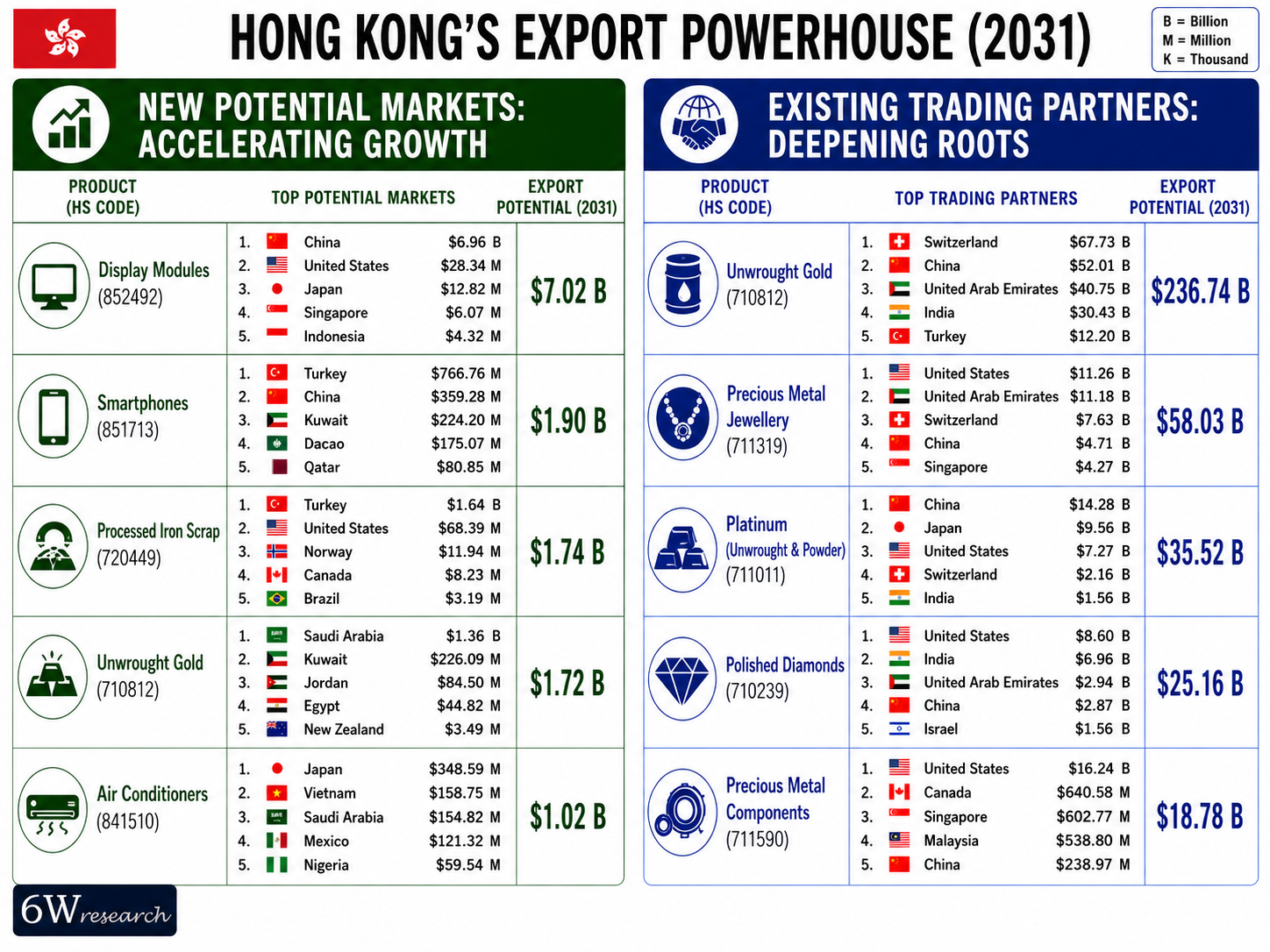
Display modules, smartphones, processed iron scrap, unwrought gold and air conditioners represent Hong Kong's largest new export opportunities through 2031 in markets where current trade remains limited or largely untapped. Unlike Hong Kong's established strengths in precious metals and jewellery, these opportunities point to new export corridors that can be developed by leveraging its role as a regional logistics, re-export and supply chain hub, particularly across electronics, consumer goods and selected industrial products.
Display modules represent Hong Kong's largest new export opportunity at USD 7.02 billion, overwhelmingly led by China (USD 6.96 billion), with the United States, Japan, Singapore and Indonesia accounting for much smaller opportunities. The category reflects Hong Kong's close integration with Mainland China's electronics manufacturing ecosystem and its role in facilitating cross-border distribution of high-value electronic components. Smartphones rank second at USD 1.90 billion, led by Turkey (USD 0.77 billion), followed by China, Kuwait, Macao and Qatar. These opportunities are supported by Hong Kong's established position as regional electronics trading and re-export gateway connecting Asian manufacturing with emerging consumer markets.
Processed iron scrap contributes USD 1.74 billion in new export potential, led overwhelmingly by Turkey (USD 1.64 billion), with the United States, Norway, Canada and Brazil providing additional opportunities. Although Hong Kong has a limited domestic industrial base, its advanced port infrastructure and regional recycling trade enable participation in cross-border scrap collection and redistribution. Unwrought gold adds USD 1.72 billion, led by Saudi Arabia (USD 1.36 billion), followed by Kuwait, Jordan, Egypt and New Zealand, extending Hong Kong's established bullion trading network into new destination markets. Air conditioners contribute a further USD 1.02 billion, with Japan (USD 0.35 billion), Vietnam, Saudi Arabia, Mexico and Nigeria emerging as the principal opportunities, reflecting Hong Kong's ability to expand exports through regional sourcing, distribution and re-export rather than domestic manufacturing.
Gold, Jewellery and Diamonds Remain the Foundation of Hong Kong's Established Trade and the Reasoning Explains Why
Unwrought gold, precious metal jewellery, platinum in unwrought and powder form, polished diamonds and precious metal components define Hong Kong’s highest-value export opportunities through 2031. Together, these categories indicate that its future export growth will remain concentrated in high-value precious metals, gemstones and jewellery-related products, with Switzerland, China, the United Arab Emirates, the United States, India and Japan emerging as the principal destination markets.
Unwrought gold represents Hong Kong’s largest export opportunity at USD 236.74 billion, led by Switzerland (USD 67.73 billion), China (USD 52.01 billion) and the United Arab Emirates (USD 40.75 billion), with India and Turkey completing the top five. This opportunity reflects Hong Kong’s role as an international bullion-trading, financing and redistribution center rather than a domestic gold producer. Precious metal jewellery ranks second at USD 58.03 billion, led by the United States (USD 11.26 billion) and the United Arab Emirates (USD 11.18 billion), followed by Switzerland, China and Singapore. Hong Kong’s established jewellery-design, sourcing, exhibition and trading ecosystem strengthens its ability to serve both mature luxury markets and expanding Asian and Middle Eastern demand. Platinum in unwrought and powder form adds USD 35.52 billion, led by China (USD 14.28 billion) and Japan (USD 9.56 billion), supported primarily by Hong Kong’s precious-metal trading networks and proximity to major industrial and jewellery consumers in Asia.
Polished diamonds contribute USD 25.16 billion in export potential, with the United States (USD 8.60 billion) and India (USD 6.96 billion) leading demand ahead of the United Arab Emirates, China and Israel. The opportunity is supported by Hong Kong’s position as a regional gemstone auction, certification, jewellery-processing and re-export hub connecting global diamond centers with Mainland Chinese and Asian buyers. Precious metal components add USD 18.78 billion, overwhelmingly led by the United States (USD 16.24 billion), while Canada, Singapore, Malaysia and China provide smaller additional opportunities. Growth in this category is linked to Hong Kong’s access to precision-manufacturing and jewellery supply chains in the Greater Bay Area, enabling it to coordinate sourcing, finishing, assembly and international distribution despite limited domestic raw-material availability.
|
According to 6Wresearch analysis, Hong Kong's export potential remains heavily concentrated in precious metals, jewellery and electronics, with established trading partners continuing to account for the majority of export opportunities through 2031, while new markets create additional avenues for product diversification. 6WExportGTM Analysis |
Top Global Export Opportunities (2031), By Product
| Product | Export Opportunity (USD Bn) |
| Electronic Integrated Circuits | 685.7 |
| Refined Petroleum Oils | 668.4 |
| Light Petroleum Oils | 588.9 |
| Logic Electronic Integrated Circuits | 507.9 |
| Medicines | 381.2 |
| Gasoline Passenger Cars (1.5–3.0L) | 360.9 |
| Smartphones | 343.6 |
| Electronic Integrated Circuits With Memory | 333.2 |
| Data Transmission Equipment | 216.9 |
| Immunological Products | 209.6 |
Excludes naturally occurring products (e.g., crude oil, raw gold). Source: 6WExportGTM
Globally, the largest export opportunities beyond naturally occurring products are concentrated in electronics, energy, pharmaceuticals and advanced technology products, and Hong Kong's established export strengths already align closely with the electronics segment through products such as display modules and smartphones. According to 6Wresearch analysis, Hong Kong's priority through 2031 is less about developing entirely new manufacturing industries and more about strengthening its position as a high-value trading, logistics and re-export hub for electronics, while expanding value-added activities in precious metals, jewellery and technology supply chains. Its close integration with Mainland China's manufacturing ecosystem and its role as an international distribution and financing centre position Hong Kong to capture a larger share of global electronics and high-value technology trade rather than compete as a large-scale producer.
Turkey's Scrap Appetite and Saudi Arabia's Resilient Gold Demand: Developments Directly Shaping Hong Kong's New Corridors
Two current developments help explain, and are directly connected to, the new-corridor figures described above: Turkey's continued dominance of global scrap steel imports, which anchors Hong Kong's processed iron scrap opportunity, and Saudi Arabia's unusually resilient gold demand, which anchors Hong Kong's new-corridor unwrought gold opportunity.
Turkey's Steel Mills Keep Buying Scrap at a Record Pace
Hong Kong's processed iron scrap new-corridor opportunity is led by Turkey at over 94% of the category, a concentration directly explained by Turkey's position as the world's largest recycled steel importer a title it has now held through 2025 and into 2026, importing 18.77 million tons in 2025 and remaining the top global buyer at 4.75 million tons in the first quarter of 2026 alone, according to Bureau of International Recycling data. Turkey's electric-arc-furnace mills rely on imported scrap to supply the country's automotive, rail and household-appliance manufacturing sectors, and while Q2 2026 buying activity slowed following a heavy March buying spree, the underlying structural demand reinforced by the EU's incoming Carbon Border Adjustment Mechanism pushing Turkish producers toward lower-carbon, scrap-based EAF steelmaking remains firmly in place.
|
Suppliers considering Hong Kong's processed iron scrap corridor into Turkey should track BIR's quarterly import data rather than assume steady demand Turkish buying has shown real month-to-month swings tied to domestic steel-market conditions, even though the underlying full-year demand has stayed structurally strong. Manish Pant, Senior Data Scientist, Data Science & Market Intelligence, 6Wresearch |
Saudi Arabia's Investment-Led Gold Demand Outperforms the Wider Gulf
Hong Kong's new-corridor unwrought gold opportunity is led by Saudi Arabia, a concentration that lines up with a genuinely distinctive pattern in Gulf gold demand through 2026. World Gold Council data shows Saudi Arabia's jewellery demand fell just 8% year-on-year in the second quarter of 2026 the smallest contraction of any Middle Eastern market tracked, and far below the UAE's 28% decline over the same period. Unlike the UAE's Dubai-centred, tourism-driven gold retail model, Saudi demand is anchored by resident buyers, including a growing middle class and investment-oriented purchasers treating gold as a hedge against geopolitical and inflationary uncertainty.
|
Exporters weighing Saudi Arabia against other Gulf gold markets should factor in this resilience gap directly a market where demand holds up even through a Gulf-wide price-driven pullback is a structurally safer bet for sustained offtake than one that depends on tourist footfall recovering. Manisha Gupta, Data Analyst, Data Science & Market Intelligence, 6Wresearch |
What Hong Kong Already Sells, and to Whom
Semiconductors form Hong Kong's largest established trade sector at USD 252.84 billion, representing 39.54% of total sector trade, led by electronic integrated circuits (35.32% share) and logic electronic integrated circuits (30.51% share). Computers & IT hardware ranks second at USD 69.46 billion (10.86% share), led by computer parts (39.99% share) and computer peripheral units (27.72% share). Precious metals round out the top three at USD 64.47 billion (10.08% share), led by unwrought gold (85.27% share) and unwrought silver (6.76% share).
| Sector | Exports (USD Billion) | Leading Products / Share |
| Semiconductors | 252.84 | Electronic Integrated Circuits (35.32%), Logic Electronic Integrated Circuits (30.51%) |
| Computers & IT Hardware | 69.46 | Computer Parts (39.99%), Computer Peripheral Units (27.72%) |
| Precious Metals | 64.47 | Unwrought Gold (85.27%), Unwrought Silver (6.76%) |
Source: UN Comtrade
By trading value, three markets stand out. China leads at USD 377.80 billion, led by electronic integrated circuits (19.60% share) and logic electronic integrated circuits (17.16% share). The United States follows at USD 40.13 billion, led by data transmission equipment (14.02% share) and smartphones (7.58% share). Vietnam ranks third at USD 19.71 billion, led by electronic integrated circuits (27.07% share) and logic electronic integrated circuits (10.83% share).
| Country | Exports (USD Billion) | Leading Products / Share |
| China | 377.80 | Electronic Integrated Circuits (19.60%), Logic Electronic Integrated Circuits (17.16%) |
| United States | 40.13 | Data Transmission Equipment (14.02%), Smartphones (7.58%) |
| Vietnam | 19.71 | Electronic Integrated Circuits (27.07%), Logic Electronic Integrated Circuits (10.83%) |
Source: UN Comtrade
The Takeaway
Hong Kong's next chapter of export growth will be shaped less by building new domestic capacity than by defending and extending its role as the trading, refining and re-export node connecting global gold, gem and electronics flows. According to 6Wresearch analysis, the playbook is threefold: continue serving China's electronics re-export demand through the display modules corridor, while recognizing that this flow reflects logistics positioning rather than end-market growth in its own right; sustain the processed iron scrap relationship with Turkey by tracking its quarterly import cycles rather than assuming flat demand, given the swings already visible through 2026; and prioritize Saudi Arabia's investment-anchored gold demand over more tourism-dependent Gulf markets, given the resilience gap already visible in this year's regional data. Together, these reasoning-backed priorities not simply the largest dollar figures are where Hong Kong's next wave of new-corridor growth will actually be won.

Leadership Perspectives from Industry Events
Search
6Wresearch in the News
 Forbes
Citing 6Wresearch analytics to map global infrastructure and pharmaceutical industry trajectories.
 Bloomberg Law
Direct syndication of 6Wresearch's macro data points, capturing complex supply chain shifts.
 Reuters
Tracking industrial manufacturing adjustments and electronic security ecosystem scaling.
 Mint
Mint
Utilizing deep-tech sector market sizing to analyze global automation and robotics.
 The Economic Times
Anchoring features on industrial IoT growth metrics and connected smart-grid devices.
 Business Standard
Featuring strategic evaluations of Advanced Driver Assistance Systems (ADAS) and AI road safety.
 The Hindu
Spotlighting core commercial metrics ranging from unmanned aerial vehicles (UAVs) to consumer durables.
 Financial Express
Anchoring quarterly reviews on cross-border real estate tech and structural hardware manufacturing.
 Yahoo Finance
Syndicating the tracker's $30.1 billion untapped-market findings, spotlighting Japan, the US and China as India's top new-potential importers.
 India Today
Carrying the release on smartphones leading India's export potential to $94 billion by 2031, per 6WExportGTM data.
 Dailyhunt
Distributing the tracker findings to its regional readership, framing India's export diversification into Japan and Mexico.
 PR Newswire Original release
Publishing the full India Export Attractiveness Tracker 2026, detailing new trade corridors across iron ore, LCVs and pharmaceuticals.
 The Industrial
Highlighting the tracker's read on India's semiconductor ambitions and long-term chip-assembly export potential.
 PTI News
Reporting on the $66.81 billion pharmaceuticals export opportunity flagged in the tracker, amid looming US generic-drug tariffs.
 Tribune India
Covering the tracker's tariff-versus-regulation analysis across India's mature export markets in the US, China and UAE.
 ANI News
Amplifying the report's findings on polished diamonds, refined petroleum and medicines as India's core export engines.
 International Business Magazine
Covering the report's insight into how AEB, blind spot detection, and driver monitoring are reshaping India's ADAS market.
 Focus Gaming News
Highlighting the research forecast for Egypt's gambling market, projecting steady growth through 2032.
Thought Leadership and Analyst Meet





Our Clients








Latest Reports
- Gabon Citrullinemia Type-1 Market (2026-2032)
- Finland Citrullinemia Type-1 Market (2026-2032)
- Fiji Citrullinemia Type-1 Market (2026-2032)
- Ethiopia Citrullinemia Type-1 Market (2026-2032)
- Estonia Citrullinemia Type-1 Market (2026-2032)
- Eritrea Citrullinemia Type-1 Market (2026-2032)
- Equatorial Guinea Citrullinemia Type-1 Market (2026-2032)
- El Salvador Citrullinemia Type-1 Market (2026-2032)
- Ecuador Citrullinemia Type-1 Market (2026-2032)
- Dominica Citrullinemia Type-1 Market (2026-2032)
Industry Events and Analyst Meet

EV India Expo 2026

HIMTEX 2026

India Refining Summit 2026

India EV Show 2026

EV tech India Expo 2026
Whitepaper
- Middle East & Africa Commercial Security Market Click here to view more.
- Middle East & Africa Fire Safety Systems & Equipment Market Click here to view more.
- GCC Drone Market Click here to view more.
- Middle East Lighting Fixture Market Click here to view more.
- GCC Physical & Perimeter Security Market Click here to view more.


