Electronic Integrated Circuits and Smartphones to Drive Nigeria's USD 7.06 Billion New Export Opportunities by 2031
Nigeria’s existing export potential in 2031 is led by China, which accounts for 26.03%, marginally ahead of the United States at 22.64%. In contrast, the United States dominates opportunities across entirely new product lines with a 33.52% share, substantially exceeding China’s 23.23%. Although crude petroleum remains the overwhelming foundation of Nigeria’s established export base, the Nigeria Export Potential outlook also points to sizeable opportunities emerging through new trade corridors, indicating a gradual shift toward a broader and more diversified export portfolio.
 Source: 6WExportGTM
The United States Leads New Export Corridor Potential, While China Anchors Nigeria's Established Trade Base
Among entirely new market opportunities, the United States offers the highest export potential for Nigeria at USD 14.86 billion, followed by China with USD 10.30 billion. Hong Kong, Singapore and South Korea round out the top five, and notably, these untapped opportunities are dominated by electronics and battery products smartphones, integrated circuits, lithium-ion batteries categories Nigeria currently has limited domestic manufacturing capacity for these products, making the identified opportunities indicative of global demand rather than immediately realizable export potential.
| Top 5 Current Leading Importers | Export Potential (USD Billion) | Top 5 New Potential Importers for New Product Lines | Export Potential (USD Billion) |
| China | 13.81 | United States | 14.86 |
| United States | 12.01 | China | 10.30 |
| India | 5.89 | Hong Kong | 3.62 |
| South Korea | 3.80 | Singapore | 2.92 |
| Cote d'Ivoire | 2.26 | South Korea | 2.37 |
Source: 6WExportGTM
Nigeria's export strategy for 2031 remains anchored in crude oil, but the balance between established and new-corridor potential is unusually close for this report series. In established trade relationships, export potential reaches USD 53.06 billion, led by China at 26.03% (USD 13.81 billion), narrowly ahead of the United States at 22.64% (USD 12.01 billion). India, South Korea and Cote d'Ivoire round out the top five Cote d'Ivoire's presence reflecting regional crude oil re-export and trading activity rather than direct end-consumption.
China and the United States to Lead Nigeria’s USD 7.06 Billion Export Opportunity in Electronic Integrated Circuits and Smartphones by 2031
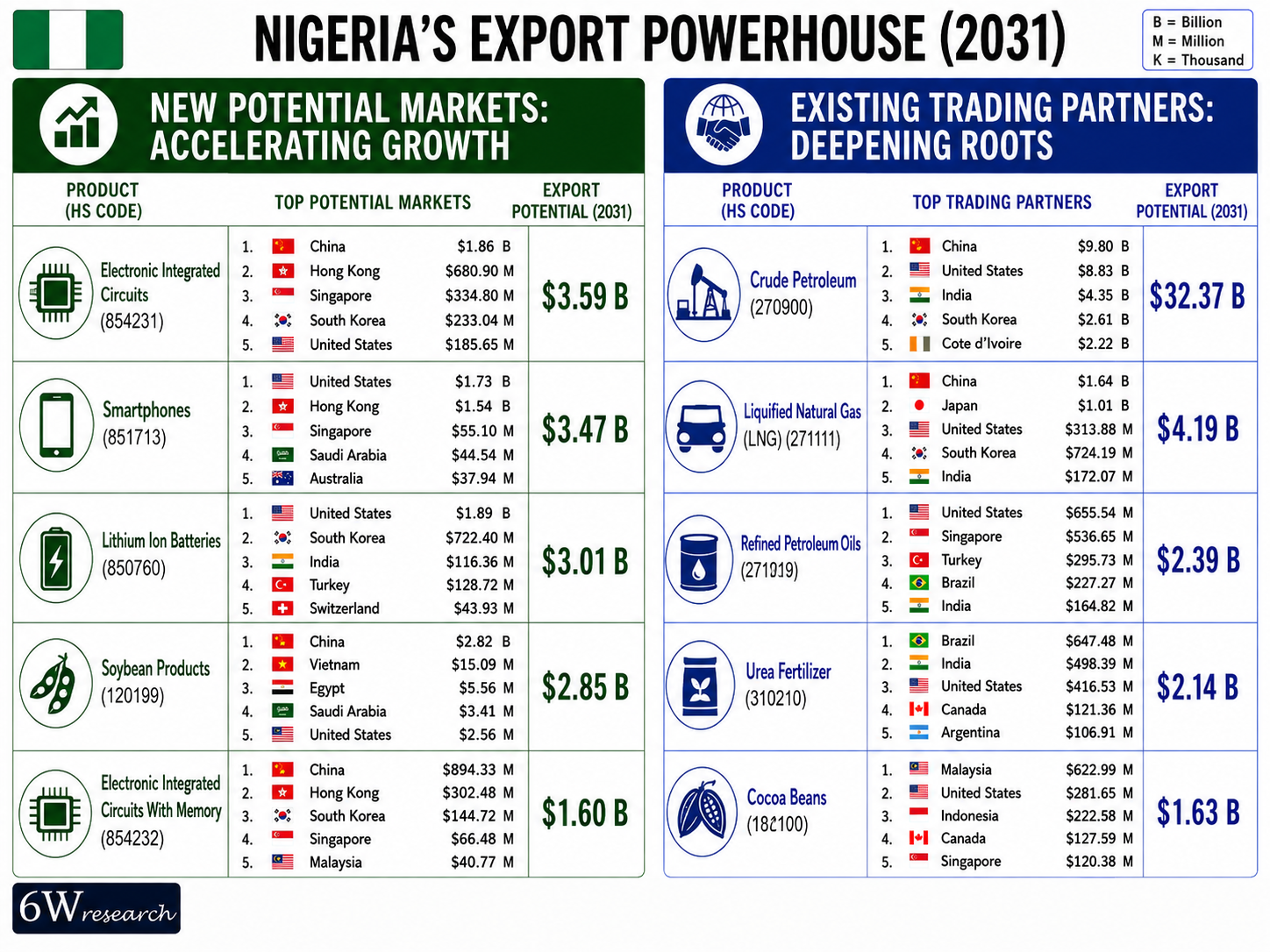
Electronic integrated circuits, smartphones, lithium-ion batteries, soybean products and electronic integrated circuits with memory define Nigeria's highest-value new export opportunities by 2031. China, Hong Kong, Singapore, South Korea and the United States dominate demand for the electronics and battery categories, while China alone accounts for over 98% of the soybean products opportunity.
Electronic integrated circuits represent the largest new-corridor figure at USD 3.59 billion, led by China (USD 1.80 billion) and Hong Kong (USD 0.86 billion). Smartphones follow at USD 3.47 billion, led by the United States (USD 1.73 billion) and Hong Kong (USD 1.54 billion). Lithium-ion batteries offer a USD 3.01 billion export opportunity, with the United States (USD 1.89 billion) and South Korea (USD 0.73 billion) emerging as the largest potential markets. However, realizing this opportunity will require significant development of Nigeria's domestic battery manufacturing capabilities.
Soybean products contribute USD 2.85 billion, almost entirely to China (USD 2.82 billion) over 98% of the total new export opportunities, Vietnam, Egypt, Saudi Arabia and the United States trailing far behind. Electronic integrated circuits with memory round out the top five at USD 1.60 billion, again led by China (USD 0.99 billion) and Hong Kong (USD 0.30 billion). Taken together, these five products illustrate a structural gap between where global demand is concentrated and where Nigeria's current export capacity actually sits useful for identifying long-term industrial priorities.
Established Export Strength: Crude Oil, Gas and Agricultural Commodities
Crude petroleum, liquefied natural gas, refined petroleum oils, urea fertilizer and cocoa beans form the backbone of Nigeria's established export potential by 2031, reflecting the country's continued dependence on hydrocarbons even as gas, fertilizer and agricultural commodities offer meaningful, if smaller, diversification. China, the United States and India appear repeatedly across the leading product lines, while Japan, South Korea, Brazil and Malaysia also feature prominently in liquefied natural gas, fertilizer and cocoa trade specifically.
Crude petroleum leads Nigeria's established export potential by a wide margin at USD 32.37 billion more than eight times the next largest product. China is the top destination at USD 9.83 billion, followed by the United States (USD 6.83 billion), India (USD 4.35 billion), South Korea (USD 2.61 billion) and Cote d'Ivoire (USD 2.22 billion). Liquefied natural gas follows at USD 4.19 billion, led by China (USD 1.04 billion) and Japan (USD 1.01 billion) in a near-even split, with the United States, South Korea and India completing the top five.
Refined petroleum oils add USD 2.39 billion, led by the United States (USD 0.86 billion) and Singapore (USD 0.53 billion), with Turkey, Brazil and India also featuring. Urea fertilizer contributes USD 2.14 billion, led by Brazil (USD 0.65 billion) and India (USD 0.61 billion), with the United States, Canada and Argentina rounding out the top five. Cocoa beans conclude top 5 at USD 1.63 billion, led by Malaysia (USD 0.62 billion) Nigeria's largest single agricultural export opportunity, and the one product line in this top five where China does not feature among the top five buyers at all.
|
Nigeria’s established export base remains concentrated in crude oil and gas supplied to China, the United States and India. However, the unusually narrow gap between established and new-market export potential highlights a sizeable diversification opportunity, even though hydrocarbons are expected to remain the principal driver of export growth. 6WExportGTM Analysis |
Refineries, Gas Trains and Cocoa Prices: Current Developments Supporting Nigeria's Export Growth
Three current developments help explain and reshape the figures above: the Dangote refinery's transformation of Nigeria from a chronic fuel importer into a net petrol exporter for the first time in its history, the near-completion of NLNG's Train 7 gas expansion, and a highly volatile cocoa price cycle that has swung from multi-year lows to renewed strength within months.
Dangote Refinery Turns Nigeria into a Net Petrol Exporter
Nigeria's refined petroleum oils export potential, worth USD 2.39 billion by 2031, sits alongside a genuinely historic shift already underway. In March 2026, the Dangote Petroleum Refinery exported 44,000 barrels a day of gasoline, positioning Nigeria as a net petrol exporter for the first time a decisive turnaround for a country that for decades imported the majority of its refined fuel despite being Africa's largest crude producer. The 650,000 barrel-a-day refinery was operating at over 93% capacity utilization by March 2026, though it has simultaneously struggled with a domestic crude feedstock shortfall of roughly 79.53 million barrels between October 2025 and mid-March 2026, forcing it to rely partly on imported crude even as Nigeria continued exporting 55.39 million barrels of crude in the first two months of 2026 alone a structural tension between Nigeria's crude export volumes and its own refinery's feedstock needs that shapes both the crude petroleum and refined petroleum oils figures in this report.
|
The gap between Nigeria exporting record crude volumes while its own flagship refinery battles a feedstock shortfall captures a genuine policy tension: maximizing crude export revenue and building refining self-sufficiency are currently pulling in different directions, not reinforcing each other. Manish Pant, Senior Data Scientist, Data Science & Market Intelligence, 6Wresearch |
NLNG's Train 7 Nears Completion, Targeting a 35% Capacity Boost
Nigeria's LNG export potential, worth USD 4.19 billion by 2031 and led by China and Japan, is set against the near-completion of Nigeria LNG's Train 7 expansion at Bonny Island. As of late July 2026, the USD 5-10 billion project had reached roughly 92-93% completion, on track to lift NLNG's production capacity by 35% from 22 million tons a year to 30 million tons while also boosting domestic LPG output by around 50%. The expansion arrives as global LNG demand is forecast to rise roughly 8.5% year-on-year in 2026, driven almost entirely by Asia, positioning Nigeria to compete more directly with Qatar, Australia and Malaysia just as new global supply from projects like Golden Pass LNG and Qatar's North Field Expansion also comes online. NLNG has already begun exploratory discussions on further Trains 8-10, having generated USD 149.6 billion in cumulative revenue and USD 47.2 billion in shareholder dividends since inception.
|
With roughly 93 million tons of new global LNG supply also entering the market across 2025-2026, Nigeria should deepen and extend long-term offtake agreements with its existing top buyers, China and Japan, before Train 7 ramps up, rather than relying on spot sales — the capacity increase is real, but locking in contracted demand with the buyers who already anchor this trade is what will protect it from the pricing pressure a more crowded market is about to bring Manisha Gupta, Data Analyst, Data Science & Market Intelligence, 6Wresearch |
Cocoa's Volatile 2026: From Multi-Year Lows to Renewed Price Strength
Nigeria's cocoa beans export potential, worth USD 1.63 billion and led by Malaysia rather than China, sits on top of one of the most volatile commodity price cycles. Cocoa prices fell to a 2.25-year low in early 2026 on ample global supply and weak grinding demand, even as Nigerian cocoa exports rose 17% year-on-year in December 2025 and 28% year-on-year in May 2026. By mid-2026, prices had firmed again as StoneX cut its 2026/27 global surplus forecast from 267,000 to 149,000 metric tons, citing El Niño risk to West African crops, while Nigeria's own cocoa production is projected to fall 11% year-on-year to 305,000 metric tons in the 2025/26 season. For Nigerian farmers specifically, a liberalized pricing framework unlike Ghana and Cote d'Ivoire's fixed farmgate systems has meant naira devaluation and global price swings both flow through more directly to farmgate returns, for better and worse.
Top Global Export Opportunities (2031), By Product
| Product | Export Opportunity (USD Billion) |
| Electronic Integrated Circuits | 685.7 |
| Refined Petroleum Oils | 668.4 |
| Light Petroleum Oils | 588.9 |
| Logic Electronic Integrated Circuits | 507.9 |
| Medicines | 381.2 |
| Gasoline Passenger Cars (1.5–3.0L) | 360.9 |
| Smartphones | 343.6 |
| Electronic Integrated Circuits with Memory | 333.2 |
| Data Transmission Equipment | 216.9 |
| Immunological Products | 209.6 |
Excludes naturally occurring products (e.g., crude oil, raw gold). Source: 6WExportGTM
Globally, the largest export opportunities beyond naturally occurring products are concentrated in electronics, refined energy products and pharmaceuticals, highlighting the growing importance of advanced manufacturing and high-value technology in global trade. Nigeria currently remains concentrated in hydrocarbons and agricultural commodities, so its priority through 2031 should be to expand domestic refining and LNG capacity, scale fertilizer and processed cocoa exports, and gradually develop the industrial capabilities required to participate in electronics and battery value chains. Diversifying export destinations and moving from raw commodities toward value-added products will be essential to reducing oil dependence and building a more resilient export base
What Nigeria Already Sells, and to Whom
Oil & gas dominates Nigeria’s established export base at USD 46.21 billion, accounting for 88.26% of the total and led by crude petroleum (80.89%) and liquefied natural gas (10.57%). This concentration reflects Nigeria’s broader trade structure, while NLNG’s six-train facility provides 22 million tons of annual LNG capacity, with Train 7 expected to raise capacity to 30 million tons. Cocoa and chocolate rank second at USD 1.92 billion, driven primarily by cocoa beans (84.83%) and cocoa butter (10.71%), supported by Nigeria’s position as the world’s fourth-largest cocoa producer and the growing role of cocoa derivatives in non-oil exports. Fertilizers follow at USD 850.36 million, with urea contributing virtually the entire sector value, backed by approximately 3 million tons of annual domestic production capacity at the Dangote Fertilizer complex.
| Sector | Export (USD Billion) | Leading Products / Share |
| Oil & Gas | 46.21 | Crude Petroleum (80.89%), Liquefied Natural Gas (10.57%) |
| Cocoa & Chocolate | 1.92 | Cocoa Beans (84.83%), Cocoa Butter (10.71%) |
| Fertilizers | 0.85 | Urea Fertilizer (100.00%) |
Source: UN Comtrade
Nigeria’s export potential across Spain, France and the Netherlands remains anchored in its large hydrocarbon base. Spain leads at USD 5.50 billion, driven by crude petroleum (71.30%) and LNG (11.60%), followed by France at USD 4.70 billion, where the two products accounts for 97.47%, and the Netherlands at USD 4.69 billion, led by crude petroleum (72.42%) and cocoa beans (14.70%). This concentration is supported by Nigeria’s 37.01 billion barrels of crude oil and condensate reserves and 215.19 trillion cubic feet of natural gas reserves, alongside NLNG’s existing 22-million-tonne annual capacity, which Train 7 is expected to increase to 30 million tons. Cocoa provides an important diversification avenue, supported by Nigeria’s position as the world’s fourth-largest cocoa producer, accounting for approximately 6.5% of global production.
| Country | Export (USD Billion) | Leading Products / Share |
| Spain | 5.50 | Crude Petroleum (71.30%), Liquefied Natural Gas (11.60%) |
| France | 4.70 | Crude Petroleum (86.20%), Liquefied Natural Gas (11.27%) |
| Netherlands | 4.69 | Crude Petroleum (72.42%), Cocoa Beans (14.70%) |
Source: UN Comtrade
The Takeaway
Nigeria should prioritize converting its resource advantage into higher-value exports by securing crude feedstock for domestic refining, completing NLNG Train 7, and expanding refined petroleum, fertilizer and processed cocoa exports. Although electronics, smartphones and lithium-ion batteries represent sizeable untapped demand, they should remain long-term industrial priorities because Nigeria currently lacks the manufacturing capacity to compete at scale. The key conclusion is that near-term export growth will remain anchored in oil and gas, while sustainable diversification will depend on downstream processing, stronger industrial capacity and wider access to Asian, European and North American markets.
ISO 9001:2015 CERTIFIED
Quality Management System for market research & advisory services
Cert. No. 3050261008135Q

Leadership Perspectives from Industry Events
Search
6Wresearch in the News
 Forbes
Citing 6Wresearch analytics to map global infrastructure and pharmaceutical industry trajectories.
 Bloomberg Law
Direct syndication of 6Wresearch's macro data points, capturing complex supply chain shifts.
 Reuters
Tracking industrial manufacturing adjustments and electronic security ecosystem scaling.
 Mint
Mint
Utilizing deep-tech sector market sizing to analyze global automation and robotics.
 The Economic Times
Anchoring features on industrial IoT growth metrics and connected smart-grid devices.
 Business Standard
Featuring strategic evaluations of Advanced Driver Assistance Systems (ADAS) and AI road safety.
 The Hindu
Spotlighting core commercial metrics ranging from unmanned aerial vehicles (UAVs) to consumer durables.
 Financial Express
Anchoring quarterly reviews on cross-border real estate tech and structural hardware manufacturing.
 Yahoo Finance
Syndicating the tracker's $30.1 billion untapped-market findings, spotlighting Japan, the US and China as India's top new-potential importers.
 India Today
Carrying the release on smartphones leading India's export potential to $94 billion by 2031, per 6WExportGTM data.
 Dailyhunt
Distributing the tracker findings to its regional readership, framing India's export diversification into Japan and Mexico.
 PR Newswire Original release
Publishing the full India Export Attractiveness Tracker 2026, detailing new trade corridors across iron ore, LCVs and pharmaceuticals.
 The Industrial
Highlighting the tracker's read on India's semiconductor ambitions and long-term chip-assembly export potential.
 PTI News
Reporting on the $66.81 billion pharmaceuticals export opportunity flagged in the tracker, amid looming US generic-drug tariffs.
 Tribune India
Covering the tracker's tariff-versus-regulation analysis across India's mature export markets in the US, China and UAE.
 ANI News
Amplifying the report's findings on polished diamonds, refined petroleum and medicines as India's core export engines.
 International Business Magazine
Covering the report's insight into how AEB, blind spot detection, and driver monitoring are reshaping India's ADAS market.
 Focus Gaming News
Highlighting the research forecast for Egypt's gambling market, projecting steady growth through 2032.
Thought Leadership and Analyst Meet





Our Clients








Latest Reports
- Vietnam Aerobridge Market (2026-2032)
- Eritrea Rare Genetic Disorder Market (2026-2032)
- Equatorial Guinea Rare Genetic Disorder Market (2026-2032)
- El Salvador Rare Genetic Disorder Market (2026-2032)
- Ecuador Rare Genetic Disorder Market (2026-2032)
- Dominica Rare Genetic Disorder Market (2026-2032)
- Djibouti Rare Genetic Disorder Market (2026-2032)
- Denmark Rare Genetic Disorder Market (2026-2032)
- Cyprus Rare Genetic Disorder Market (2026-2032)
- Cuba Rare Genetic Disorder Market (2026-2032)
Industry Events and Analyst Meet

Energy Digitalisation & AI Summit (EDAS 2026)

12th IVASS 2026

EV India Expo 2026

HIMTEX 2026

India Refining Summit 2026
Whitepaper
- Middle East & Africa Commercial Security Market Click here to view more.
- Middle East & Africa Fire Safety Systems & Equipment Market Click here to view more.
- GCC Drone Market Click here to view more.
- Middle East Lighting Fixture Market Click here to view more.
- GCC Physical & Perimeter Security Market Click here to view more.


