Poland’s Cigarette Exports to Existing Partners Could Reach USD 8.31 Billion, While Large Petrol Engines Offer USD 1.33 Billion Across New Markets by 2031
The United States is Poland's largest existing export market, accounting for 31.41% of total export potential, followed by China with a 10.58% share. In contrast, Japan emerges as the leading market for new export opportunities, representing 25.25% of the category, ahead of the United States at 11.89%. Vehicle components, light diesel commercial vehicles and refined copper continue to dominate Poland's established export portfolio, underscoring the country's strong position in high-value industrial and manufacturing exports, while the changing composition of new export markets highlights opportunities to broaden its global trade footprint through 2031.
Source: 6WExportGTM
Japan Leads Poland's New-Corridor Export Potential, a Reversal of the Established US-China Order
Japan emerges as Poland’s largest new potential importer, with export potential of USD 15.03 billion, more than double the United States’ USD 7.08 billion opportunity. China ranks third at USD 4.04 billion, followed by Canada at USD 3.35 billion and Mexico at USD 3.11 billion. According to 6WExportGTM, a part of 6Wresearch, this market mix indicates that Poland Export Potential can be further strengthened through deeper access to Japan’s high-value consumer and industrial markets, while the United States provides a second major opportunity across advanced manufacturing and automotive products. China, Canada and Mexico add further geographic diversification, allowing Poland to extend its competitive automotive, machinery, electrical-equipment and processed-goods exports beyond its established European customer base.
| Top 5 Existing Leading Importers | Export Potential (USD Billion) | Top 5 New Potential Importers | Export Potential (USD Billion) |
| United States | 108.32 | Japan | 15.03 |
| China | 36.5 | United States | 7.08 |
| Canada | 19.06 | China | 4.04 |
| Japan | 14.89 | Canada | 3.35 |
| Mexico | 14.33 | Mexico | 3.11 |
Source: 6WExportGTM
The United States is Poland’s largest existing leading importer, with export potential of USD 108.32 billion, followed by China at USD 36.50 billion. Canada ranks third with USD 19.06 billion, while Japan and Mexico contribute USD 14.89 billion and USD 14.33 billion, respectively. According to 6Wresearch analysis, this importer mix reflects Poland’s well-diversified export footprint across North America and Asia, supported by its competitive manufacturing base in automotive products, machinery, electrical equipment, metals and consumer goods. The United States serves as the primary growth anchor, while China, Canada, Japan and Mexico reinforce Poland’s position within global industrial and technology-oriented supply chains, reducing dependence on any single export destination.
Engines, Hybrid Powertrains and Electric Vehicles Define Poland's Newest Export Corridors
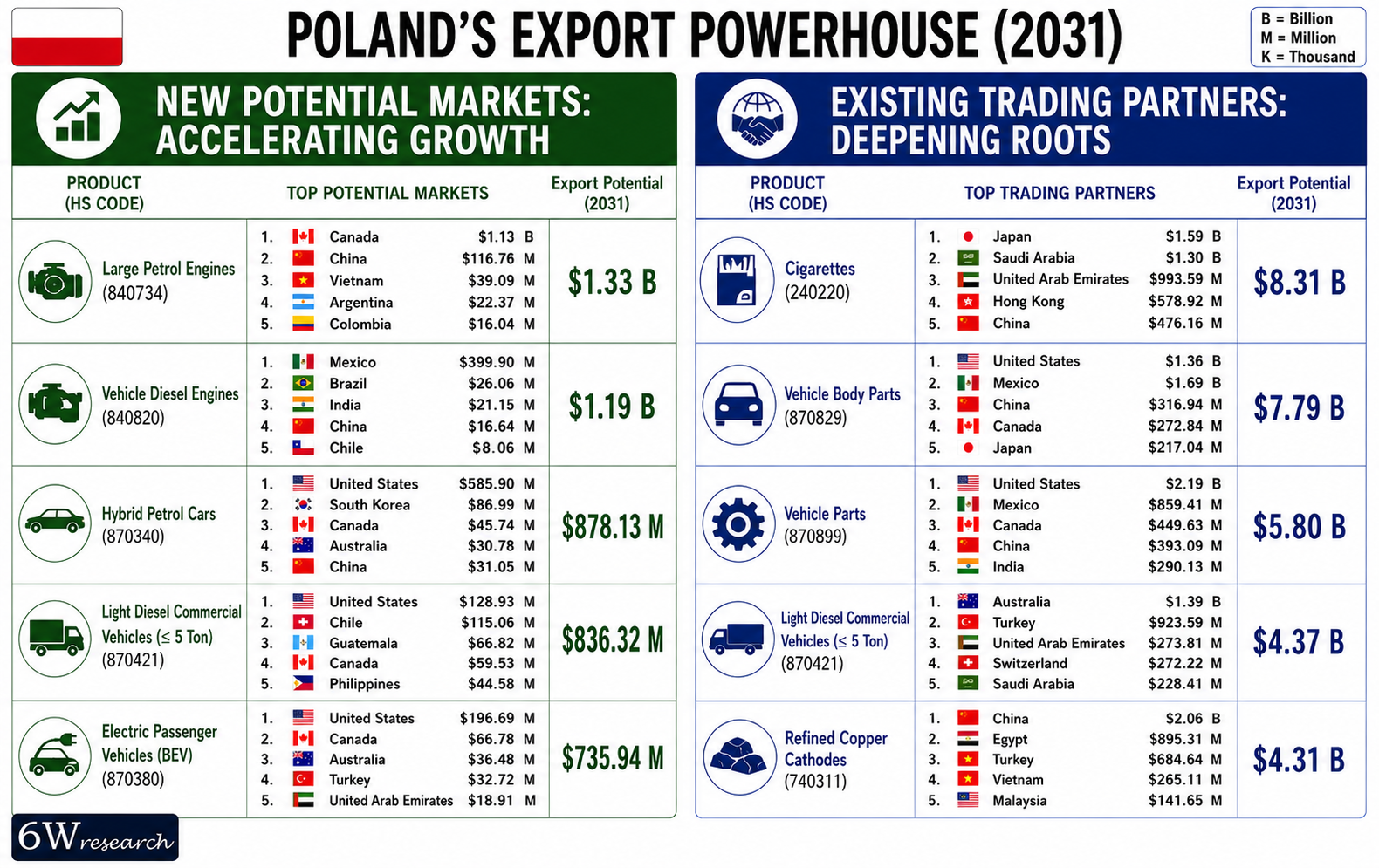
Large petrol engines, vehicle diesel engines, hybrid petrol cars, light diesel commercial vehicles into non-traditional destinations, and electric passenger vehicles represent Poland's largest new export opportunities through 2031, in markets where current trade remains limited or largely untapped. Unlike Poland's established strengths in vehicle components and copper refining, these opportunities point to new corridors built on the country's growing role as a European powertrain, hybrid-transmission and battery-manufacturing base.
Large petrol engines represent Poland's largest new export opportunity at USD 1.33 billion, led overwhelmingly by Canada (USD 1.13 billion), with China, Vietnam, Argentina and Colombia accounting for much smaller opportunities; this reflects Poland's established engine-manufacturing capacity being redirected toward new destinations rather than new production capability. Vehicles diesel engines add USD 1.19 billion, led by Mexico (USD 0.99 billion), followed by Brazil, India, China and Chile a corridor realistic precisely because Poland's diesel-engine manufacturing base, built to supply European assembly lines, can extend to new buyers through existing shipping relationships. Hybrid petrol cars contribute USD 0.88 billion, led by the United States (USD 0.58 billion), with South Korea, Canada, Australia and China providing additional demand; this is credible given Poland's hybrid-transmission manufacturing capacity at Wałbrzych, which already produces hybrid powertrains for European-built vehicles and can plausibly extend to finished hybrid vehicle exports as capacity allows.
Light diesel commercial vehicles directed at non-traditional destinations and electric passenger vehicles round out the new-corridor top five. Light diesel commercial vehicles into new markets add USD 836.32 million, led by the United States (USD 328.93 million), followed by Chile, Guatemala, Canada and the Philippines, extending a category where Poland already exports at much larger scale to its established markets. Electric passenger vehicles contribute USD 735.94 million, led by the United States (USD 508.69 million), with Canada, Australia, Turkey and the United Arab Emirates providing smaller opportunities; this is realistic given Poland's rapidly expanding lithium-ion battery cell manufacturing base, even though large-scale domestic EV assembly for these specific destinations remains at an early stage. Together, these five opportunities indicate that Poland's next wave of export growth will come from extending its automotive powertrain and battery-manufacturing capacity into new products and previously under-served destinations.
Vehicle Components, Tobacco and Refined Copper Remain the Foundation of Poland's Established Trade
Cigarettes, vehicle body parts, vehicle parts, light diesel commercial vehicles and refined copper cathodes define Poland's highest-value export opportunities through 2031. Together, these categories indicate that Poland's future export growth will remain concentrated in automotive component manufacturing, tobacco processing and copper refining, with the United States, Japan, Australia, China and Mexico emerging as principal destination markets.
Cigarettes represent Poland's largest export opportunity at USD 8.31 billion, led by Japan (USD 1.58 billion), Saudi Arabia (USD 1.00 billion) and the United Arab Emirates (USD 0.70 billion), with Hong Kong and China completing the top five, this reflects Poland's large-scale cigarette manufacturing base anchored by major international tobacco producers with Polish production facilities serving both mature Asian and Gulf markets rather than any domestic tobacco cultivation. Vehicle body parts rank second at USD 7.79 billion, led by the United States (USD 3.18 billion) and Mexico (USD 1.08 billion), followed by China, Canada and Japan, driven by Poland's dense automotive-component manufacturing base supplying both European assembly lines and, through global supply chains, North American and Asian buyers. Vehicle parts add USD 5.80 billion, again led by the United States (USD 2.19 billion) and Mexico (USD 0.65 billion), followed by Canada, China and India.
Light diesel commercial vehicles and refined copper cathodes complete the established top five. Light diesel commercial vehicles contribute USD 4.37 billion, led by Australia (USD 1.89 billion) and Turkey (USD 0.53 billion), followed by the United Arab Emirates, Switzerland and Saudi Arabia, reflecting Poland's role as a manufacturing base for light commercial vehicles built for both domestic and export-oriented European producers. Refined copper cathodes add USD 4.31 billion, led by China (USD 2.60 billion) and Egypt (USD 0.70 billion), followed by Turkey, Vietnam and Malaysia; this opportunity is rooted in genuine domestic extraction and refining capability at KGHM's Legnica-Głogów mining district, distinguishing it clearly from a trading or re-export activity. Collectively, these five products indicate that Poland's future export strength rests on a manufacturing-led structure automotive components and tobacco processing providing scale and diversified demand, and copper refining providing a genuine natural-resource-backed export anchor.
|
Poland's export competitiveness is increasingly being shaped by the evolution of its manufacturing ecosystem rather than by cost advantages alone. The country's growing capabilities in automotive components, battery technologies and copper refining position it to capture both established demand and emerging export corridors, reinforcing its role as one of Europe's most resilient industrial exporters. 6WExportGTM Analysis |
Top Global Export Opportunities (2031), By Product
| Product | Export Opportunity (USD Billion) |
| Electronic Integrated Circuits | 685.7 |
| Refined Petroleum Oils | 668.4 |
| Light Petroleum Oils | 588.9 |
| Logic Electronic Integrated Circuits | 507.9 |
| Medicines | 381.2 |
| Gasoline Passenger Cars (1.5–3.0L) | 360.9 |
| Smartphones | 343.6 |
| Electronic Integrated Circuits with Memory | 333.2 |
| Data Transmission Equipment | 216.9 |
| Immunological Products | 209.6 |
Excludes naturally occurring products (e.g., crude oil, raw gold). Source: 6WExportGTM
Globally, the largest export opportunities beyond naturally occurring products are concentrated in electronics, energy, pharmaceuticals and automotive products, and Poland already holds a competitive edge across several of these high-value categories. Its established strengths in vehicle manufacturing, automotive components, engines, electrical equipment and industrial production provide a credible base for capturing a larger share of future global demand. According to 6WExportGTM, a part of 6Wresearch, Poland’s priority through 2031 should therefore be to deepen its participation in sectors where it already possesses manufacturing scale, skilled labour, integrated European supply chains and export infrastructure, while gradually shifting toward hybrid and electric mobility rather than relying on conventional combustion-engine products alone.
What Poland Already Sells and Where
Automotive parts form Poland’s largest established trade sector at USD 28.71 billion, representing 7.55% of total sector trade, led by vehicle safety parts with exports of USD 3.76 billion and a 13.11% share, followed by vehicle parts at USD 2.93 billion and a 10.21% share. Building materials rank second at USD 15.43 billion, accounting for 4.06% of trade, with steel structural articles contributing USD 3.45 billion and 22.33% of the sector, while plastic doors add USD 2.20 billion and 14.28%. Furniture follows closely at USD 15.23 billion and a 4.00% share, led by wooden furniture units at USD 3.24 billion and upholstered chairs at USD 2.65 billion, reflecting Poland’s strong manufacturing base across automotive components, construction products and value-added furniture.
| Sector | Exports (USD Billion) | Leading Products / Share |
| Automotive Parts | 28.71 | Vehicle Safety Parts (13.11%), Vehicle Parts (10.21%) |
| Building Materials | 15.43 | Steel Structural Articles (22.33%), Plastic Doors (14.28%) |
| Furniture | 15.23 | Wooden Furniture Units (21.30%), Upholstered Chairs (17.43%) |
Source: 6WExportGTM
Germany is Poland’s largest export market at USD 102.93 billion, led by lithium-ion batteries and cigarettes, which account for 3.01% and 2.15% of exports to the country, respectively. Czechia ranks second at USD 23.19 billion, with electrical energy contributing 3.67% and seating components 3.05%. France follows closely at USD 23.13 billion, supported by lithium-ion batteries at 4.28% and light diesel commercial vehicles weighing up to five tones at 3.94%. According to 6Wresearch analysis, this partner mix reflects Poland’s deep integration into European automotive, battery, energy and consumer-goods supply chains, with Germany serving as the primary industrial anchor and Czechia and France providing additional regional diversification.
| Country | Exports (USD Billion) | Leading Products / Share |
| Germany | 102.93 | Lithium-Ion Batteries (3.01%), Cigarettes (2.15%) |
| Czechia | 23.19 | Electrical Energy (3.67%), Seating Components (3.05%) |
| France | 23.13 | Lithium-Ion Batteries (4.28%), Light Diesel Commercial Vehicles ≤5 Tones (3.94%) |
Source: 6WExportGTM
Battery Gigafactories and Copper's Record Quarter: Developments Directly Shaping Poland's Export Base
Two current developments help explain, and are directly connected to, the figures described above: Poland's emergence as Europe's leading electric-vehicle battery manufacturing hub, which anchors the country's electric-vehicle and hybrid-vehicle new-corridor opportunities, and KGHM's strong start to 2026 alongside a supportive tax change, which anchors Poland's refined-copper export opportunity.
Poland Cements Its Position as Europe's Leading EV Battery Manufacturing Hub
Poland’s emerging electric- and hybrid-vehicle export opportunities are underpinned by its expanding battery and powertrain manufacturing ecosystem. Major production facilities in Lower Silesia have strengthened domestic capabilities in lithium-ion batteries, hybrid transmissions and other electrified drivetrain components. This industrial base positions Poland to serve growing automotive demand in Japan, the United States and other non-European markets. Continued capacity expansion could further integrate the country into global electric-mobility supply chains, support higher-value automotive exports and gradually rebalance its export mix toward hybrid and electric vehicle categories.
|
Poland’s 2031 export growth will remain manufacturing-led, with established vehicle and copper exports complemented by nearly USD 5 billion in new automotive opportunities across Canada, China, Japan and the United States. Manish Pant, 6Wresearch, Data Science & Market Intelligence |
KGHM's Record Quarter and Poland's Copper Tax Cut Reinforce the Refined-Copper Export Base
Poland’s refined-copper export position is similarly reinforced by KGHM’s stronger operating performance and the reduction in the domestic copper extraction tax. Higher production, lower unit costs and a lighter fiscal burden improve the economics of continued investment in mining and refining capacity across the Legnica-Głogów Copper District. This development supports that refined copper remains a genuine resource-backed export strength, unlike products driven primarily by assembly or imported inputs. Poland’s advantage lies in processing domestically extracted copper into higher-value cathodes for buyers such as China and Egypt, enabling the country to retain more value within its export chain. Continued production discipline and refinery investment will therefore be central to sustaining this established corridor through 2031.
|
Poland’s export growth through 2031 is expected to remain industrially driven, with strong vehicle, copper and commercial transport exports supported by emerging demand for engines and passenger vehicles across a broader range of global markets. Manisha Gupta, 6Wresearch, Data Science & Market Intelligence |
The Takeaway
Poland's next chapter of export growth will be shaped less by building entirely new industries than by extending two capabilities it already has in depth: automotive powertrain and battery manufacturing, and copper mining and refining. According to 6Wresearch analysis, the playbook is threefold: continue scaling Lower Silesia's battery and hybrid-transmission manufacturing base to convert the United States' and Japan's new-corridor demand for electrified and hybrid vehicles into durable volume; protect the refined-copper relationship with China and Egypt by tracking KGHM's production targets and maintenance schedules through 2026 rather than assuming flat output; and recognize that Japan's outsized new-corridor share reflects deep automotive manufacturing integration rather than an emerging trading relationship, meaning it merits sustained investment rather than opportunistic pursuit.

Leadership Perspectives from Industry Events
Search
6Wresearch in the News
 Forbes
Citing 6Wresearch analytics to map global infrastructure and pharmaceutical industry trajectories.
 Bloomberg Law
Direct syndication of 6Wresearch's macro data points, capturing complex supply chain shifts.
 Reuters
Tracking industrial manufacturing adjustments and electronic security ecosystem scaling.
 Mint
Mint
Utilizing deep-tech sector market sizing to analyze global automation and robotics.
 The Economic Times
Anchoring features on industrial IoT growth metrics and connected smart-grid devices.
 Business Standard
Featuring strategic evaluations of Advanced Driver Assistance Systems (ADAS) and AI road safety.
 The Hindu
Spotlighting core commercial metrics ranging from unmanned aerial vehicles (UAVs) to consumer durables.
 Financial Express
Anchoring quarterly reviews on cross-border real estate tech and structural hardware manufacturing.
 Yahoo Finance
Syndicating the tracker's $30.1 billion untapped-market findings, spotlighting Japan, the US and China as India's top new-potential importers.
 India Today
Carrying the release on smartphones leading India's export potential to $94 billion by 2031, per 6WExportGTM data.
 Dailyhunt
Distributing the tracker findings to its regional readership, framing India's export diversification into Japan and Mexico.
 PR Newswire Original release
Publishing the full India Export Attractiveness Tracker 2026, detailing new trade corridors across iron ore, LCVs and pharmaceuticals.
 The Industrial
Highlighting the tracker's read on India's semiconductor ambitions and long-term chip-assembly export potential.
 PTI News
Reporting on the $66.81 billion pharmaceuticals export opportunity flagged in the tracker, amid looming US generic-drug tariffs.
 Tribune India
Covering the tracker's tariff-versus-regulation analysis across India's mature export markets in the US, China and UAE.
 ANI News
Amplifying the report's findings on polished diamonds, refined petroleum and medicines as India's core export engines.
 International Business Magazine
Covering the report's insight into how AEB, blind spot detection, and driver monitoring are reshaping India's ADAS market.
 Focus Gaming News
Highlighting the research forecast for Egypt's gambling market, projecting steady growth through 2032.
Thought Leadership and Analyst Meet





Our Clients








Latest Reports
- Gabon Citrullinemia Type-1 Market (2026-2032)
- Finland Citrullinemia Type-1 Market (2026-2032)
- Fiji Citrullinemia Type-1 Market (2026-2032)
- Ethiopia Citrullinemia Type-1 Market (2026-2032)
- Estonia Citrullinemia Type-1 Market (2026-2032)
- Eritrea Citrullinemia Type-1 Market (2026-2032)
- Equatorial Guinea Citrullinemia Type-1 Market (2026-2032)
- El Salvador Citrullinemia Type-1 Market (2026-2032)
- Ecuador Citrullinemia Type-1 Market (2026-2032)
- Dominica Citrullinemia Type-1 Market (2026-2032)
Industry Events and Analyst Meet

EV India Expo 2026

HIMTEX 2026

India Refining Summit 2026

India EV Show 2026

EV tech India Expo 2026
Whitepaper
- Middle East & Africa Commercial Security Market Click here to view more.
- Middle East & Africa Fire Safety Systems & Equipment Market Click here to view more.
- GCC Drone Market Click here to view more.
- Middle East Lighting Fixture Market Click here to view more.
- GCC Physical & Perimeter Security Market Click here to view more.


