Algeria Consent Management Market Size & Growth Rate (2026-2032)
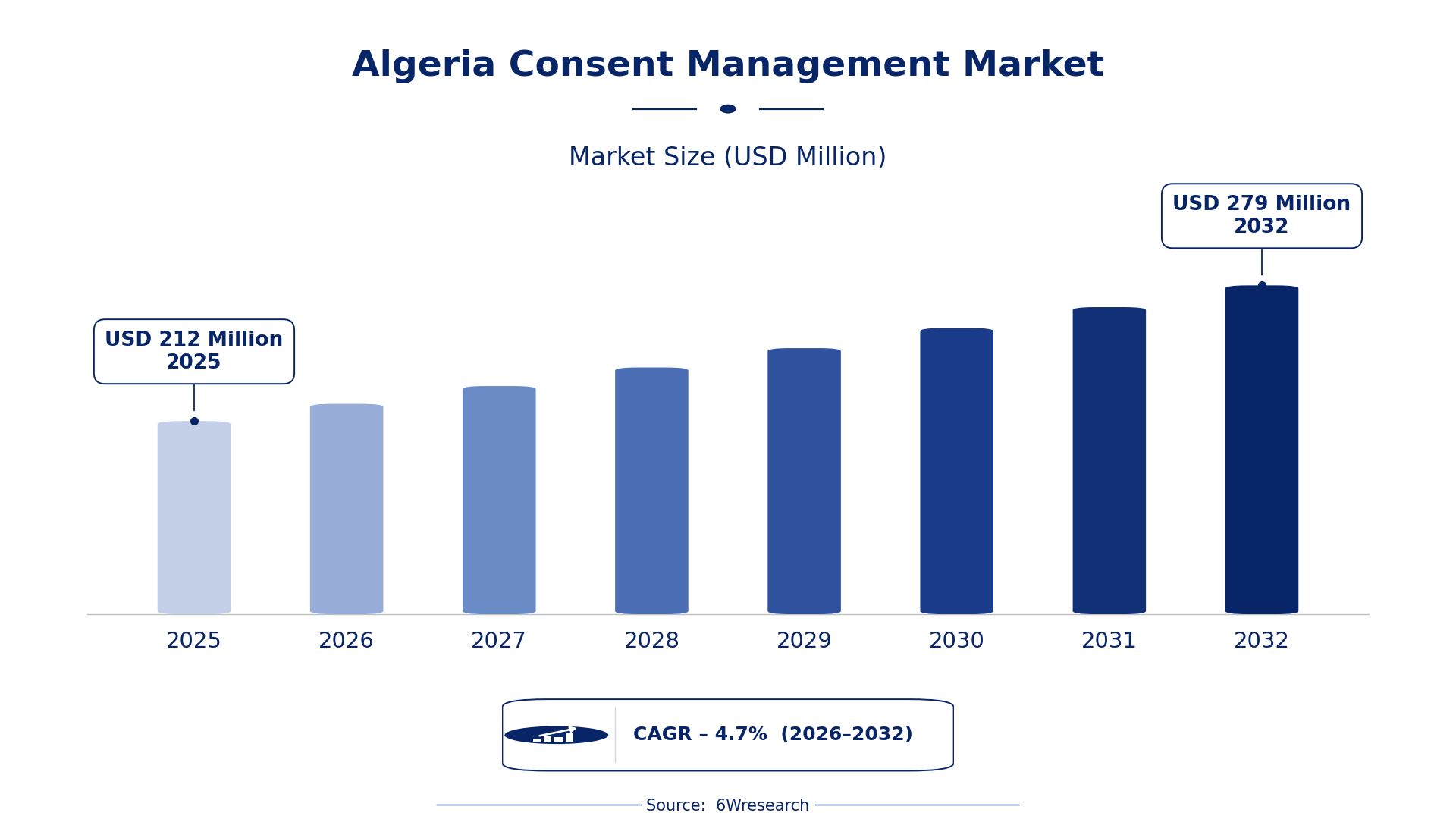
The Algeria Consent Management Market was estimated at USD 212 Million in 2025 and is projected to reach USD 279 Million by 2032, growing at a CAGR of 4.7% from 2026 to 2032.
Algeria Consent Management Market Synopsis
The demand for consent management solutions in Algeria is rapidly increasing as organizations recognize the importance of adhering to data privacy regulations like GDPR. This realization has driven companies to invest in technologies that facilitate the management of user consent, ensuring compliance and fostering customer trust.
In a market where transparency and control over personal data are paramount, businesses are seeking platforms that provide granular consent options and effective tracking mechanisms. As digital transformation accelerates across sectors, the Algeria Consent Management Market is evolving to meet these demands, signaling a shift towards more accountable data practices.
Algeria Consent Management Market Year-wise Growth Rate and Key Drivers
This graph illustrates the annual growth rates of the Algeria Consent Management Market from 2021 to 2032, highlighting a steady upward trajectory and projected expansion over the forecast period.
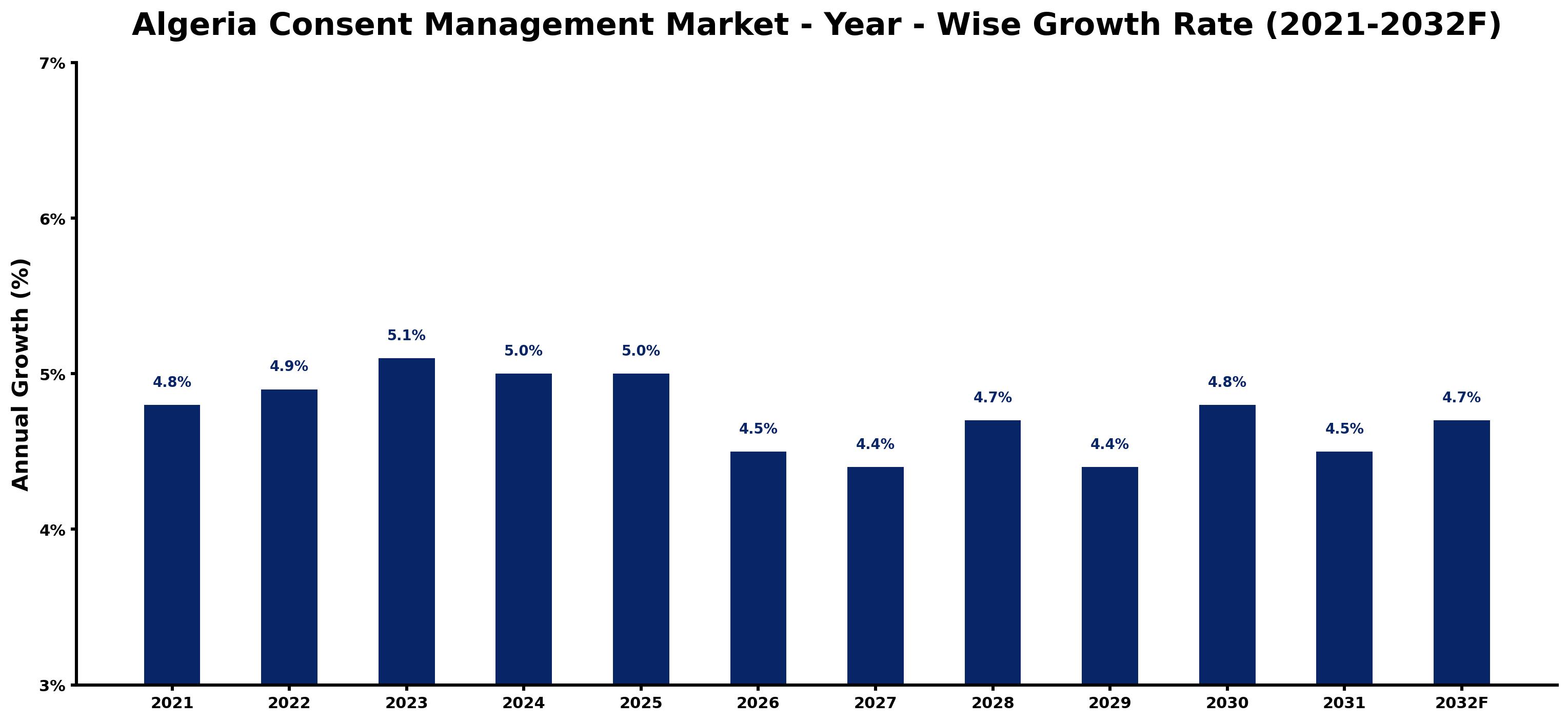
The table below presents the year‑wise growth rates along with the key drivers influencing the market
| Year | Growth Rate | Major Drivers |
| 2021 | 4.8% | New data protection law enhancing consent management requirements |
| 2022 | 4.9% | Growth in digital banking fueling customer consent focus |
| 2023 | 5.1% | Increased internet penetration improving consent management awareness |
| 2024 | 5.0% | Telecom regulations mandating clearer data consent processes |
| 2025 | 5.0% | Consumer awareness rising about personal data rights |
| 2026 | 4.5% | International partnerships boosting local consent management solutions |
| 2027 | 4.4% | Healthcare digitalization prompting consent for patient data use |
| 2028 | 4.7% | Government initiative promoting data privacy education programs |
| 2029 | 4.4% | Sustained demand for personalized marketing driving consent tools |
| 2030 | 4.8% | Local startups innovating in consent technology solutions |
| 2031 | 4.5% | Regulatory compliance driving investment in consent platforms |
| 2032 | 4.7% | Awareness campaigns highlighting importance of data consent |
Note: Market size estimations and growth projections presented in this report are based on 6Wresearch's proprietary forecasting methodology, utilizing the latest available industry data, government publications, and primary research inputs.
Algeria Consent Management Market Key Takeaways
Below are some of the specific key takeaways from the market, including:
- The market is driven by increasing regulatory compliance needs and consumer awareness regarding data privacy.
- Cloud-based solutions are gaining traction as organizations seek scalable consent management platforms.
- Healthcare, finance, and e-commerce sectors present lucrative opportunities for tailored consent management solutions.
- Emerging technologies are enhancing consent tracking and preference management capabilities.
- Companies are actively seeking consulting services to navigate complex data protection regulations.
Evaluation of Restraints in Algeria Consent Management Market
The Algeria Consent Management Market faces several real challenges that hinder its growth. A significant barrier is the general lack of awareness and understanding of data privacy regulations among many businesses and consumers. This gap leads to inadequate implementation of consent management solutions, as organizations often lack the necessary resources and expertise. on top of that, the cultural attitudes towards data privacy can vary, complicating the communication strategies required for effective consent management. The absence of standardized practices and differing interpretations of data protection laws further complicate compliance efforts, necessitating a more comprehensive approach to address these multifaceted challenges.
Algeria Consent Management Market Trends
Several trends are shaping the Algeria Consent Management Market as organizations prioritize data privacy. One key trend is the adoption of technology-driven consent management platforms that offer advanced features such as granular consent controls and transparent preference management. Additionally, there is a notable shift towards cloud-based solutions, which facilitate scalability and operational efficiency. Businesses are increasingly recognizing the value of user-centric data practices, leading to a growing demand for consent management tools that enhance customer trust and compliance.
Algeria Consent Management Market Opportunities
Genuine growth opportunities in the Algeria Consent Management Market lie in developing customized solutions for specific industries like healthcare and finance. These sectors require tailored consent management approaches to navigate stringent regulatory environments effectively. on top of that, the demand for consulting services to assist organizations in understanding and implementing compliance measures presents another avenue for investment. As consumer awareness regarding data rights continues to rise, businesses that prioritize transparent data practices will likely gain a competitive edge.
Government Initiatives in the Algeria Consent Management Market
The Algerian government's approach to data protection is significantly influencing the Consent Management Market. With a legal framework focused on personal data protection, organizations must adapt to various regulations that promote transparency and accountability. This regulatory environment is crucial as it shapes how businesses handle user data, making compliance a top priority in their operations.
- A new Personal Data Protection Law introduced in late 2024 mandates stricter controls on data handling and user consent.
- Ongoing awareness campaigns launched by the government are aimed at educating businesses and consumers about data privacy rights and responsibilities.
- A national initiative to align local data protection laws with international standards is currently underway, enhancing compliance frameworks.
- Plans for a comprehensive regulatory review process expected to commence in early 2026 will assess the effectiveness of existing data protection measures.
Future Insights of the Algeria Consent Management Market
Looking ahead to 2026-2032, the Algeria Consent Management Market is expected to experience steady growth driven by heightened regulatory compliance demands and increasing consumer expectations for data privacy. As more organizations recognize the necessity of effective consent management in securing user trust, investments in innovative solutions will likely surge. The intersection of digital transformation and regulatory adherence will shape market dynamics, creating opportunities for companies that prioritize compliance and customer-centric practices.
Algeria Consent Management Market Latest Developments
Recent developments in the Algeria Consent Management Market indicate a proactive shift towards improved data privacy practices. Over the past 12-14 months, organizations have begun to adopt more sophisticated consent management solutions, highlighting a growing commitment to compliance and user trust.
- A major technology vendor launched an upgraded consent management platform in Q1 2025, featuring enhanced tracking and user preference management capabilities.
- An initiative that began in early 2025 is currently underway, focusing on integrating consent management tools into existing digital marketing strategies across various sectors.
- A public-private partnership aimed at developing standardized consent management practices was announced in mid-2025 and is now in the planning phase.
- A regulatory framework review process commenced in late 2025, focusing on refining data protection measures and enhancing compliance protocols.
Algeria Consent Management Market - Key Attractiveness of the Report
- 10 Years of Market Numbers
- Historical Data Starting from 2022 to 2025
- Base Year: 2025
- Forecast Data until 2032
- Key Performance Indicators Impacting the Market
- Major Upcoming Developments and Projects
Key Highlights of the Report:
- Algeria Consent Management Market Outlook
- Market Size of Algeria Consent Management Market, 2025
- Forecast of Algeria Consent Management Market, 2032
- Historical Data and Forecast of Algeria Consent Management Revenues & Volume for the Period 2022-2032F
- Algeria Consent Management Market Trend Evolution
- Algeria Consent Management Market Drivers and Challenges
- Algeria Consent Management Price Trends
- Algeria Consent Management Porter's Five Forces
- Algeria Consent Management Industry Life Cycle
- Historical Data and Forecast of Algeria Consent Management Market Revenues & Volume By Component for the Period 2022-2032F
- Historical Data and Forecast of Algeria Consent Management Market Revenues & Volume By Software for the Period 2022-2032F
- Historical Data and Forecast of Algeria Consent Management Market Revenues & Volume By Services for the Period 2022-2032F
- Historical Data and Forecast of Algeria Consent Management Market Revenues & Volume By Deployment Type for the Period 2022-2032F
- Historical Data and Forecast of Algeria Consent Management Market Revenues & Volume By Cloud for the Period 2022-2032F
- Historical Data and Forecast of Algeria Consent Management Market Revenues & Volume By On-premises for the Period 2022-2032F
- Historical Data and Forecast of Algeria Consent Management Market Revenues & Volume By Touchpoint for the Period 2022-2032F
- Historical Data and Forecast of Algeria Consent Management Market Revenues & Volume By Mobile App for the Period 2022-2032F
- Historical Data and Forecast of Algeria Consent Management Market Revenues & Volume By Web App for the Period 2022-2032F
- Historical Data and Forecast of Algeria Consent Management Market Revenues & Volume By Organization Size for the Period 2022-2032F
- Historical Data and Forecast of Algeria Consent Management Market Revenues & Volume By Large Enterprises for the Period 2022-2032F
- Historical Data and Forecast of Algeria Consent Management Market Revenues & Volume By Small and Medium-sized Enterprises (SMEs) for the Period 2022-2032F
- Algeria Consent Management Import Export Trade Statistics
- Market Opportunity Assessment By Component
- Market Opportunity Assessment By Deployment Type
- Market Opportunity Assessment By Touchpoint
- Market Opportunity Assessment By Organization Size
- Algeria Consent Management Top Companies Market Share
- Algeria Consent Management Competitive Benchmarking By Technical and Operational Parameters
- Algeria Consent Management Company Profiles
- Algeria Consent Management Key Strategic Recommendations






































