Angola Bath Salt Market Growth Rate Analysis (2021-2031)
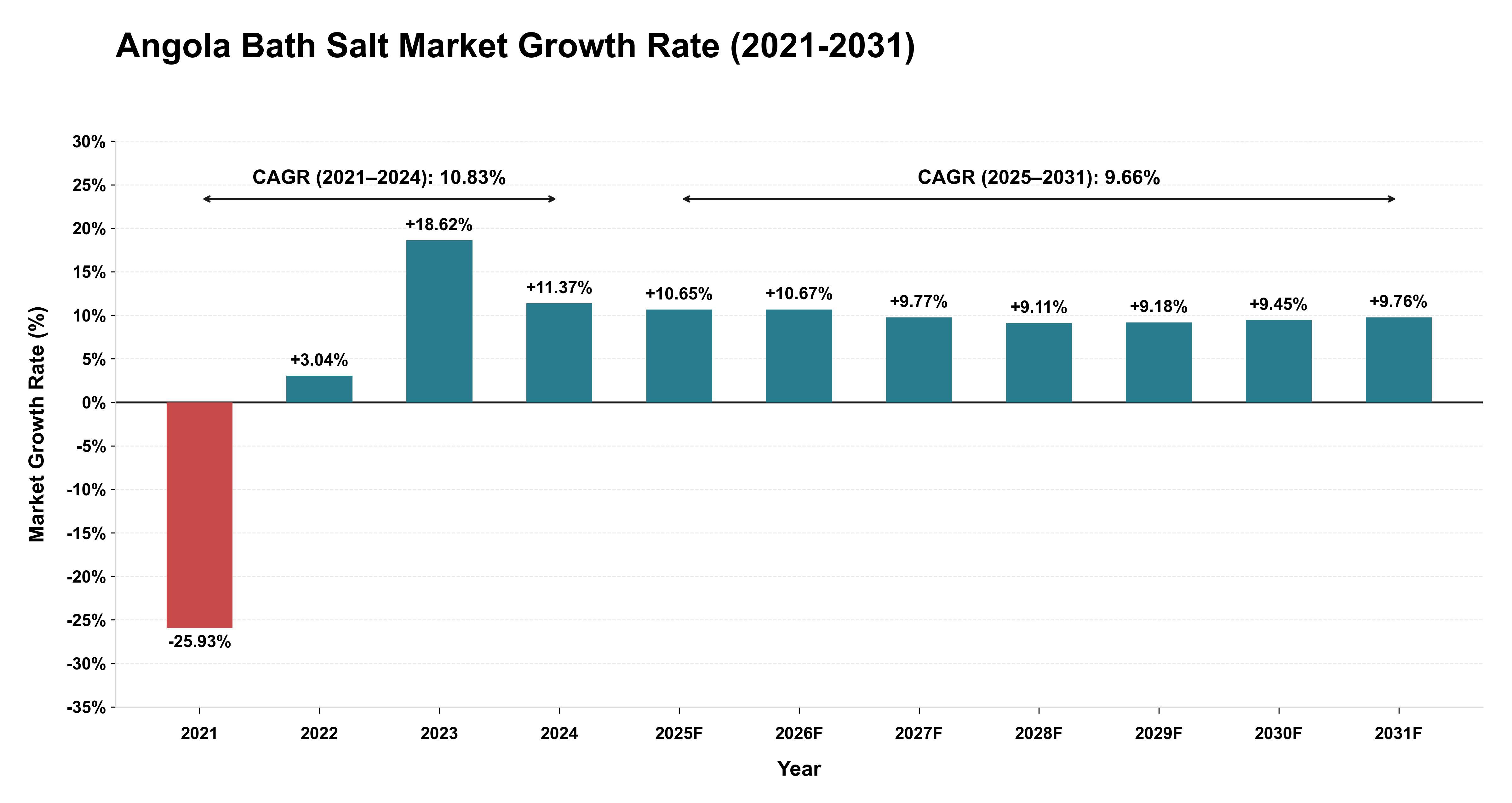
The Angola Bath Salt market experienced a tumultuous period in 2021, contracting by -25.93%, likely influenced by economic uncertainties or supply chain disruptions. However, the market swiftly recovered in 2022, showing a modest growth of 3.04%, reflecting resilience. Subsequently, from 2023 to 2031, the market demonstrated steady positive growth rates between 9.11% and 18.62%, indicating a robust recovery and sustained expansion. The historical CAGR of 10.83% for 2021-2024 signifies rapid market development and increasing consumer demand. The forecasted CAGR of 9.66% from 2025 to 2031 suggests a stable yet healthy growth trajectory, possibly driven by rising disposable incomes and evolving consumer preferences for self-care products in Angola's market.
Key Highlights of the Report:
- Angola Bath Salt Market Outlook
- Market Size of Angola Bath Salt Market, 2024
- Forecast of Angola Bath Salt Market, 2031
- Historical Data and Forecast of Angola Bath Salt Revenues & Volume for the Period 2021-2031
- Angola Bath Salt Market Trend Evolution
- Angola Bath Salt Market Drivers and Challenges
- Angola Bath Salt Price Trends
- Angola Bath Salt Porter`s Five Forces
- Angola Bath Salt Industry Life Cycle
- Historical Data and Forecast of Angola Bath Salt Market Revenues & Volume By Type for the Period 2021-2031
- Historical Data and Forecast of Angola Bath Salt Market Revenues & Volume By Atlantic Salt for the Period 2021-2031
- Historical Data and Forecast of Angola Bath Salt Market Revenues & Volume By Crystal Salt for the Period 2021-2031
- Historical Data and Forecast of Angola Bath Salt Market Revenues & Volume By Dead Sea Salt for the Period 2021-2031
- Historical Data and Forecast of Angola Bath Salt Market Revenues & Volume By Epsom Salt for the Period 2021-2031
- Historical Data and Forecast of Angola Bath Salt Market Revenues & Volume By Others for the Period 2021-2031
- Historical Data and Forecast of Angola Bath Salt Market Revenues & Volume By Form for the Period 2021-2031
- Historical Data and Forecast of Angola Bath Salt Market Revenues & Volume By Granular for the Period 2021-2031
- Historical Data and Forecast of Angola Bath Salt Market Revenues & Volume By Powder for the Period 2021-2031
- Historical Data and Forecast of Angola Bath Salt Market Revenues & Volume By Coarse for the Period 2021-2031
- Historical Data and Forecast of Angola Bath Salt Market Revenues & Volume By Others for the Period 2021-2031
- Historical Data and Forecast of Angola Bath Salt Market Revenues & Volume By Distribution Channel for the Period 2021-2031
- Historical Data and Forecast of Angola Bath Salt Market Revenues & Volume By Store Based for the Period 2021-2031
- Historical Data and Forecast of Angola Bath Salt Market Revenues & Volume By Non Store Based for the Period 2021-2031
- Angola Bath Salt Import Export Trade Statistics
- Market Opportunity Assessment By Type
- Market Opportunity Assessment By Form
- Market Opportunity Assessment By Distribution Channel
- Angola Bath Salt Top Companies Market Share
- Angola Bath Salt Competitive Benchmarking By Technical and Operational Parameters
- Angola Bath Salt Company Profiles
- Angola Bath Salt Key Strategic Recommendations






































