Angola Marble Market Growth Rate Analysis (2021-2031)
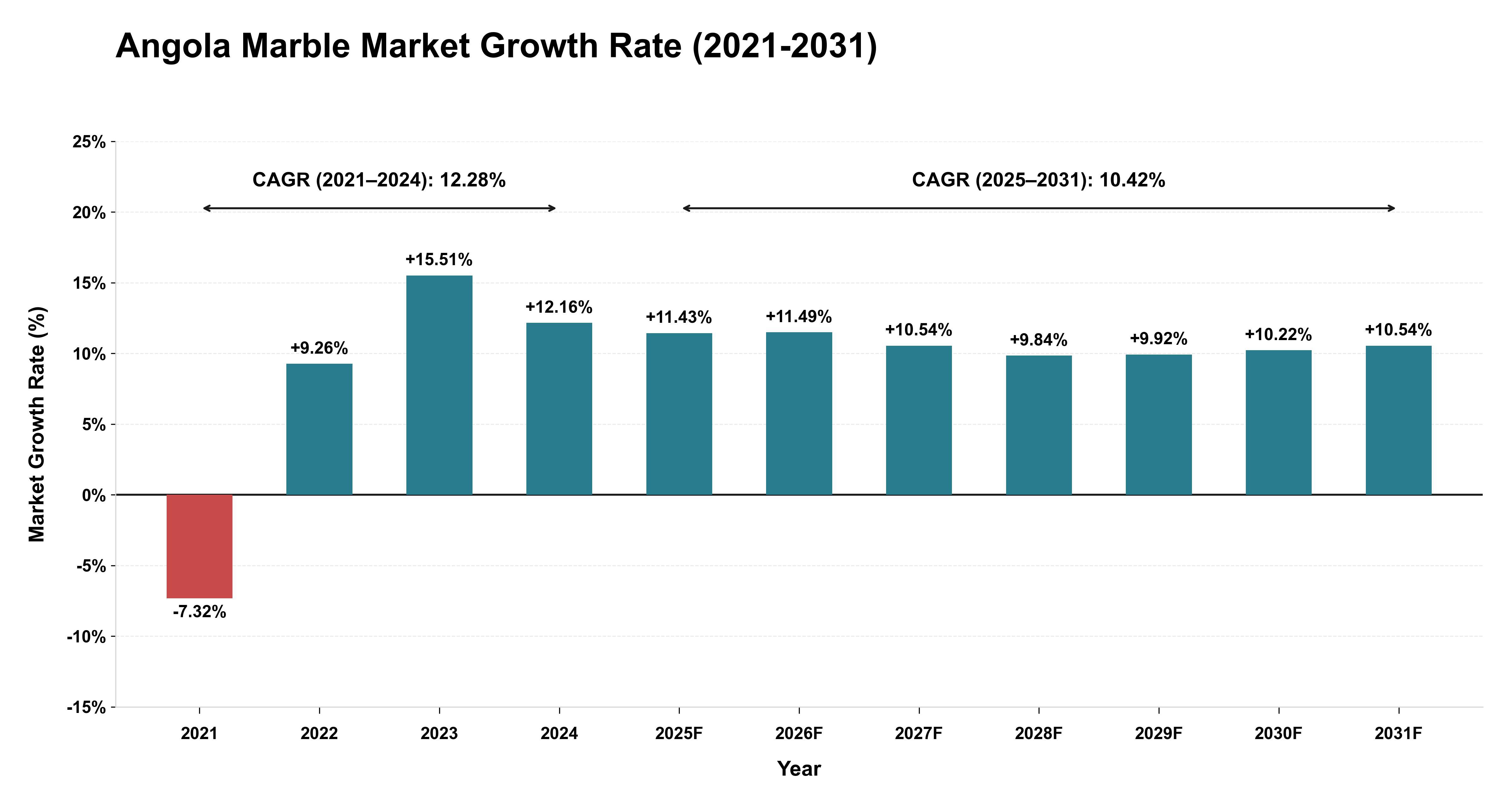
The Angola Marble Market underwent a tumultuous period from 2021 to 2024, starting with a significant -7.32% contraction in 2021 but rebounding strongly in the following years, showing resilience with growth rates of 9.26%, 15.51%, and 12.16% for 2022 to 2024. Looking forward to 2025-2031, the market is projected to continue expanding at a slightly slower pace, with a CAGR of 10.42%, indicating a phase of stabilization post-pandemic recovery. This trajectory suggests a maturing and normalizing market, sustained by factors like infrastructure development, construction activities, and potential export demand for Angolan marble products.
Key Highlights of the Report:
- Angola Marble Market Outlook
- Market Size of Angola Marble Market, 2024
- Forecast of Angola Marble Market, 2031
- Historical Data and Forecast of Angola Marble Revenues & Volume for the Period 2021-2031
- Angola Marble Market Trend Evolution
- Angola Marble Market Drivers and Challenges
- Angola Marble Price Trends
- Angola Marble Porter`s Five Forces
- Angola Marble Industry Life Cycle
- Historical Data and Forecast of Angola Marble Market Revenues & Volume By Colour Type for the Period 2021-2031
- Historical Data and Forecast of Angola Marble Market Revenues & Volume By White for the Period 2021-2031
- Historical Data and Forecast of Angola Marble Market Revenues & Volume By Black for the Period 2021-2031
- Historical Data and Forecast of Angola Marble Market Revenues & Volume By Yellow for the Period 2021-2031
- Historical Data and Forecast of Angola Marble Market Revenues & Volume By Red for the Period 2021-2031
- Historical Data and Forecast of Angola Marble Market Revenues & Volume By Others for the Period 2021-2031
- Historical Data and Forecast of Angola Marble Market Revenues & Volume By Application for the Period 2021-2031
- Historical Data and Forecast of Angola Marble Market Revenues & Volume By Building & Construction for the Period 2021-2031
- Historical Data and Forecast of Angola Marble Market Revenues & Volume By Statues and Monuments for the Period 2021-2031
- Historical Data and Forecast of Angola Marble Market Revenues & Volume By Furniture for the Period 2021-2031
- Historical Data and Forecast of Angola Marble Market Revenues & Volume By Others for the Period 2021-2031
- Angola Marble Import Export Trade Statistics
- Market Opportunity Assessment By Colour Type
- Market Opportunity Assessment By Application
- Angola Marble Top Companies Market Share
- Angola Marble Competitive Benchmarking By Technical and Operational Parameters
- Angola Marble Company Profiles
- Angola Marble Key Strategic Recommendations






































