Angola Pharmaceutical Market (2026-2032) | Outlook, Size & Revenue, Companies, Segmentation, Industry, Analysis, Forecast, Value, Growth, Trends, Competitive Landscape, Share
Market Forecast By Prescription Type (Prescription Drugs, Over-the-Counter Drugs), By Drug Type (Branded Drugs, Generic Drugs, Branded Generic Drugs), By Drug Class (Small Molecules, Biologics, Biosimilars), By Indication (Cardiovascular Diseases, Immunology, Respiratory Diseases, Neurological Diseases, Infectious Diseases, Skin Diseases), By Mode of Administration (Topical, Oral, Injectable, Intra-nasal, Others), By Distribution Channel (Hospital Pharmacies, Retail Pharmacies, Drug Stores, Online Pharmacies) And Competitive Landscape
| Product Code: ETC6101618 | Publication Date: Sep 2024 | Updated Date: Jul 2026 | Product Type: Market Research Report | |
| Publisher: 6Wresearch | Author: Shubham Padhi | No. of Pages: 70 | No. of Figures: 35 | No. of Tables: 5 |
Angola Pharmaceutical Market Growth Rate
According to 6Wresearch internal database and industry insights, the Angola pharmaceutical market is projected to grow at a compound annual growth rate (CAGR) of 8.9% during the forecast period 2026-2032.
Angola pharmaceutical market Year-wise Growth Rate and Key Drivers (2022-2032)
This graph illustrates the annual growth rates of the Angola pharmaceutical market from 2022 to 2032, highlighting a steady upward trajectory and projected market expansion over the forecast period.
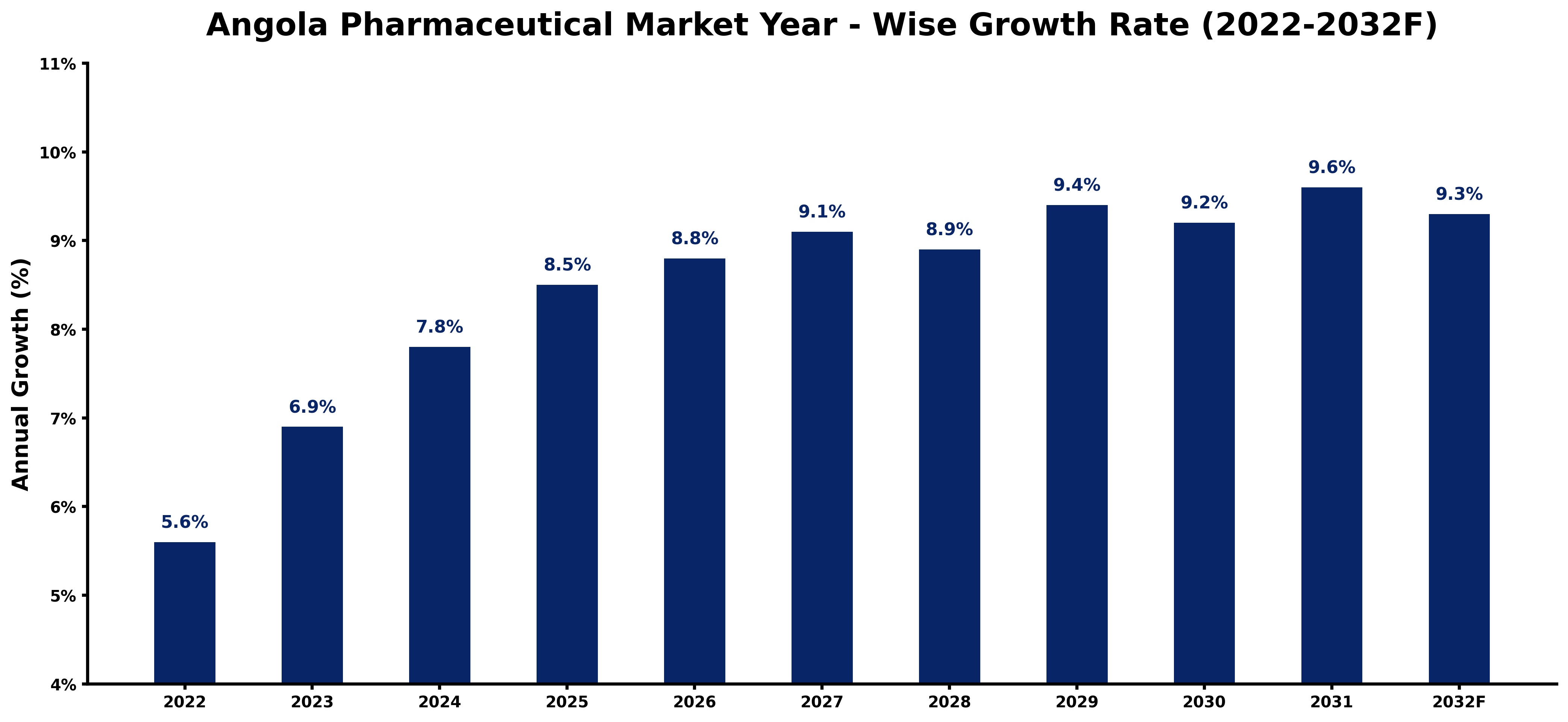
The following table summarizes the historical and forecasted growth rates of Angola pharmaceutical market, along with the rationale behind each year’s performance.
| Year | Estimated Growth | Market Rationale |
| 2022 | 5.6% | Recovery in pharmaceutical imports and healthcare services supported market expansion. |
| 2023 | 6.9% | Rising government healthcare expenditure and medicine demand accelerated growth. |
| 2024 | 7.8% | Expansion of hospital infrastructure and improved drug accessibility boosted the market. |
| 2025 | 8.5% | Increased investments by pharmaceutical distributors and private healthcare providers strengthened demand. |
| 2026 | 8.8% | Growth in chronic disease treatment and generic medicine adoption supported market expansion. |
| 2027 | 9.1% | Higher healthcare spending and improved pharmaceutical supply chains fueled market growth. |
| 2028 | 8.9% | Stable demand for prescription medicines and vaccines maintained healthy expansion. |
| 2029 | 9.4% | Expansion of local distribution networks and healthcare coverage increased pharmaceutical consumption. |
| 2030 | 9.2% | Continued investments in healthcare infrastructure supported sustained market growth. |
| 2031 | 9.6% | Rising demand for specialty drugs and imported medicines strengthened the industry. |
| 2032 | 9.3% | Ongoing healthcare modernization and expanding access to medicines supported long-term growth. |
Topics Covered in the Angola Pharmaceutical Market Report
The Angola Pharmaceutical Market report thoroughly covers the market by Drug Type, Distribution Channel, Therapeutic Area, Formulation, and End User. The market report provides an unbiased and detailed analysis of ongoing market trends, opportunities/high growth areas, market drivers, competitive landscape, regulatory examples, which help stakeholders devise and align their market strategies according to the current and future market dynamics.
Japan 360-Degree Camera Market Highlights
| Report Name | Angola Pharmaceutical Market |
| Forecast Period | 2026–2032 |
| CAGR | 8.9% |
| Growing Sector | Generic Drugs & Essential Therapeutics |
Angola Pharmaceutical Market Synopsis
The Angola pharmaceutical market is expected to witness steady growth, supported by demographic expansion, healthcare policy momentum, and the continued prevalence of infectious diseases. Angola’s population increased, adding around high potential healthcare consumers within four years and expanding demand for medicines across the country. Furthermore, a significant share of the population falls within the pediatric age group, creating sustained long-term demand for pediatric medicines, vaccines, and essential healthcare products. The market is also supported by the high burden of infectious diseases, highlighted by recent cholera outbreaks, reinforcing the need for anti-infectives, vaccines, and public health treatments.
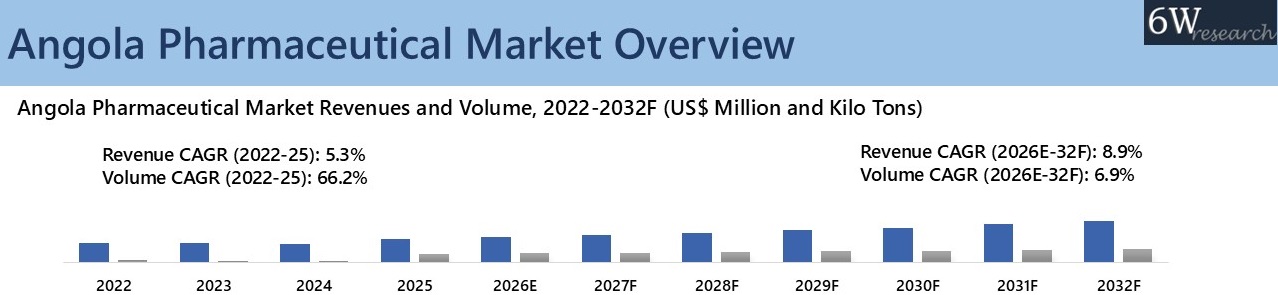
According to 6Wresearch, Angola Pharmaceutical Market is projected to grow at a revenue CAGR of 8.9% respectively during 2026-2032. The outlook for Angola’s pharmaceutical market remains positive, supported by expanding healthcare infrastructure, regulatory improvements, and continued government efforts to enhance healthcare access. Angola’s growing healthcare needs are being addressed through ongoing reforms aimed at strengthening both the healthcare delivery system and the pharmaceutical regulatory environment. As part of broader healthcare development initiatives, regulatory authorities are working toward achieving higher international regulatory standards by 2027, supported by institutional capacity-building programs and international partnerships, which are expected to improve regulatory efficiency and facilitate market access for pharmaceutical manufacturers.
Evaluation of Growth Drivers in the Angola Pharmaceutical Market
Below mentioned are some prominent drivers and their influence to the market dynamics:
| Drivers | Primary Segments Affected | Why it Matters (Evidence) |
| Rising Healthcare Expenditure | Essential Medicines; Chronic Drugs | Increasing public and private healthcare spending boosts pharmaceutical consumption and improves long-term treatment adherence. |
| Growing Population & Middle Class | OTC Medicines; Branded Drugs | Population growth and rising disposable incomes expand demand for outpatient treatments and self-care medications. |
| Regulatory Strengthening | Quality Medicines; Imported Products | WHO-supported regulatory improvements enhance confidence in medicine safety, efficacy, and compliance standards. |
| Investment in Local Production | Tablet & Injectable Manufacturing | New domestic manufacturing facilities reduce dependency on imports and improve supply-chain resilience. |
| Expansion of Pharmacy Networks | Retail Pharmacies; OTC Drugs | Growth of community and retail pharmacies improves medicine accessibility, particularly in urban and semi-urban areas. |
Angola Pharmaceutical Market is expected to grow at a CAGR of 8.9% during the forecast period of 2026-2032. Growing healthcare costs, the expense of chronic diseases, modernizing regulations with WHO support, and strategic investments to increase local production capacity which all contribute to the market growth. Expanding networks of retail pharmacies and keeping up partnerships with importers make it easier for more people to get the medicines they need and make the pharmaceutical market more reliable.
Evaluation of Restraints in the Angola Pharmaceutical Market
Below mentioned are some major restraints and their influence to the market dynamics:
| Restraints | Primary Segments Affected | What This Means (Evidence) |
| High Import Dependence | Generic & Branded Drugs | Heavy reliance on imports exposes the market to supply chain disruptions and foreign price fluctuations. |
| Limited Local Manufacturing | Injectables; Tablets | Insufficient domestic production capacity restricts supply availability and increases medicine costs. |
| Inadequate Healthcare Infrastructure | Hospitals; Clinics | Low infrastructure development reduces drug distribution efficiency, especially in rural regions. |
| Counterfeit Drug Risks | Retail Pharmacies | Weak regulatory enforcement increases the circulation risk of low-quality and counterfeit medicines. |
| Skilled Workforce Shortages | Pharmacy Services | Lack of trained professionals compromises service quality and regulatory compliance. |
Angola Pharmaceutical Industry Challenges
Despite growth prospects, the Angola Pharmaceutical Industry faces challenges such as heavy demand of imported pharmaceutical products, limited local manufacturing capacity and risks associated with counterfeit drugs. Additionally, gaps in skilled workforce and distribution inefficiencies delay the effective medicine delivery in rural populations. The improved regulatory frameworks, investing in manufacturing infrastructure, and enhancing professional training are essential to overcome these challenges.
Angola Pharmaceutical Market Trends
Past Trends: Angola's pharmaceutical market depended heavily on imported medicines due to limited domestic manufacturing capacity. Distribution networks were concentrated in urban centers, leaving rural and remote areas severely underserved. The healthcare system remained underfunded, relying on foreign expertise and products, with the sector operating for decades without proper oversight.
A formal regulatory framework was only introduced in 2010, marking a significant turning point for the sector. Following these landmark changes, the sector experienced measurable improvements in healthcare infrastructure, supply chain management, and regulatory oversight.
Present Trends: Angola is actively streamlining its pharmaceutical sector by utilizing a centralized regulatory agency (ARMED) and recent 2024 legislation to increase transparency and attract foreign investment. This shift replaces a historically fragmented system under the Ministry of Health with a more structured and predictable oversight model.
Angola's domestic pharmaceutical production remains limited, with local manufacturers supplying only a small fraction of national medicine demand. The government has been actively engaging international partners to establish local production facilities, prioritizing essential medicines and vaccines to strengthen self-sufficiency.
Future Trends: The market is expected to move toward greater local pharmaceutical manufacturing, reducing reliance on imported medicines and encouraging partnerships, technology transfer, and domestic production capabilities. This shift is likely to improve medicine availability, supply security, and industrial development within the country.
Future growth is expected to be supported by stronger regulatory systems, increased adoption of digital health technologies, advanced pharmaceutical supply-chain management, and growing investment in innovative healthcare solutions. The market is also likely to see greater focus on quality assurance, patient-centered healthcare, and sustainable pharmaceutical development.
Investment Opportunities in the Angola Pharmaceutical Market
Various investment opportunities present in the Angola Pharmaceutical Industry are:
- Pharmaceutical import and distribution partnerships: Collaborations with licensed Angolan distributors ensure market entry and growth.
- Local manufacturing infrastructure projects: Investing in injectable and tablet production facilities helps localize the supply chain.
- Regulatory compliance and quality assurance services: There will be an increasing demand for experts in regulatory navigation and quality control.
- Building retail pharmacy chains: Expanding drugstore networks are addressing the need for easily accessible pharmaceuticals in urban areas.
- Health IT and digital prescription platforms: Solutions that enhance pharmacy productivity and transparency indicate high-growth in the market.
Top 5 Leading Players in the Angola Pharmaceutical Market
Below is the list of leading players dominating the Angola pharmaceutical market:
1. Prince Farma, Lda
| Company Name | Prince Farma, Lda |
| Established Year | 2005 |
| Headquarters | Luanda, Angola |
| Official Website | Click Here |
Prince Farma is a well-integrated pharmaceutical company involved in the distribution and sales of high-quality medicines and healthcare products across Angola.
2. Neofarma (VMD Group)
| Company Name | Neofarma (VMD Group) |
| Established Year | 2002 |
| Headquarters | Luanda, Angola |
| Official Website | Click Here |
Neofarma is the first wholesale distributor of medicines in Angola, serving an extensive network of pharmacies and working as a key distribution partner for major health programs.
3. Shalina Angola (Africa Pharmacy Limitada)
| Company Name | Shalina Angola (Africa Pharmacy Limitada) |
| Established Year | 2002 |
| Headquarters | Luanda, Angola |
| Official Website | Click Here |
Shalina Angola operates a wide pharmaceutical distribution network with multiple depots, providing quality healthcare products throughout the country.
4. Australpharma
| Company Name | Australpharma |
| Established Year | Data not publicly verified |
| Headquarters | Luanda, Angola |
| Official Website | Click Here |
Australpharma supplies medicines, health products, diagnostic solutions, and clinical-related healthcare offerings to Angolan customers.
5. Miafarma (Mafricom Group)
| Company Name | Miafarma (Mafricom Group) |
| Established Year | Data not publicly verified |
| Headquarters | Luanda, Angola |
| Official Website | Click Here |
Miafarma is a pharmaceutical importer and distributor with a nationwide presence, sourcing medicines from Europe, India, and China for the Angolan market.
Government Regulations Introduced in the Angola Pharmaceutical Market
According to Angolan government data, the regulatory initiatives include improved national medicinal regulation with ARMED capacity building to align with international standards, mandatory registration and quality testing via the Ministry of Health, and supportive policies which encouraging local production through tax incentives and infrastructure investments. Therefore, these measures aim to improve medicine quality, enhance access to essential therapeutics, and reduce fake drug risks while promoting a more resilient healthcare system.
Future Insights of the Angola Pharmaceutical Market
The outlook for the Angola Pharmaceutical Market is positive as regulatory modernization, expanding pharmacy networks, and investments in local production converge to support demand growth. Better quality control and efforts to make things in the US are expected to make supply chains less vulnerable, but the US will still depend on imports. More people getting chronic diseases and spending more on healthcare will increase demand and make the pharmaceutical industry more diverse and durable.
Market Segmentation Analysis
The report offers a comprehensive study of the subsequent market segments and their leading categories.
Market Segmentation by Prescription Type
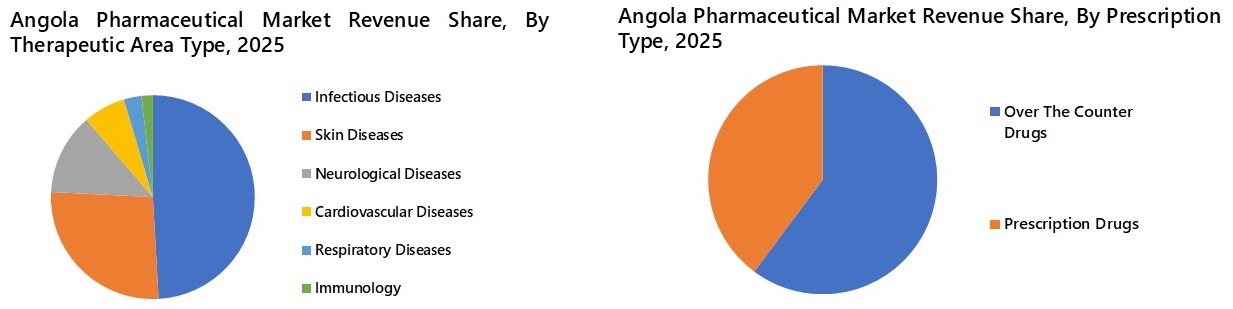
Over-the-counter (OTC) drugs are projected to register the fastest growth in the Angola pharmaceutical market in 2032, driven by rising demand for affordable and easily accessible medicines. Growth would be supported by increasing self-medication practices, wider pharmacy availability, and strong consumption of products for fever, pain relief, cold and flu, digestion, and basic healthcare needs. Expanding healthcare access and growing consumer preference for quick treatment options are expected to further strengthen OTC drug adoption across Angola.
Market Segmentation by Therapeutic Area Type
Infectious diseases are projected to register the fastest growth in the Angola pharmaceutical market in 2032, driven by the continued burden of communicable diseases and recurrent disease outbreaks. Growth would be supported by strong demand for anti-malarials, antibiotics, vaccines, oral rehydration solutions, and other essential treatment products. Expanding public health programs, improving disease surveillance, and rising access to treatment are expected to further strengthen pharmaceutical demand in this segment.
Market Segmentation by Distribution Channel
Hospital pharmacies are expected to witness the fastest growth in the Angola pharmaceutical market in 2032, by distribution channel, supported by their central role in prescription medicine dispensing and inpatient treatment. Growth would be driven by rising hospital admissions, expanding public healthcare infrastructure, and strong demand for medicines used in infectious diseases, chronic care, emergency treatment, and specialized therapies. Continued investment in hospitals and improved healthcare access are expected to strengthen the dominance of hospital pharmacies across Angola.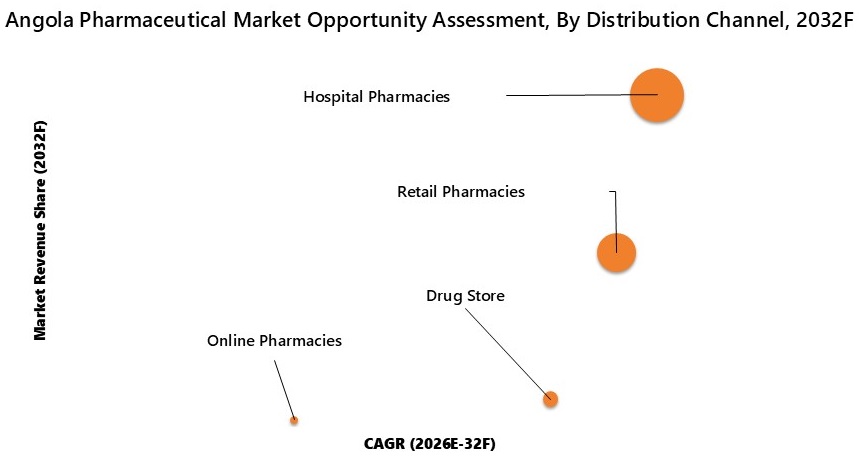
Key Attractiveness of the Report
- 10 Years of Market Numbers.
- Historical Data Starting from 2022 to 2025.
- Base Year: 2025.
- Forecast Data until 2032.
- Key Performance Indicators Impacting the Market.
- Major Upcoming Developments and Projects.
Key Highlights of the Report:
- Angola Pharmaceutical Market Overview
- Angola Pharmaceutical Market Outlook
- Angola Pharmaceutical Market Forecast
- Historical Data and Forecast of Angola Pharmaceutical Market Revenues for the Period 2022-2032F
- Historical Data and Forecast of Market Revenues, By Prescription Type, for the Period 2022-2032F
- Historical Data and Forecast of Market Revenues and Volume, By Therapeutic Area, for the Period 2022-2032F
- Historical Data and Forecast of Market Revenues, By Distribution Channel, for the Period 2022-2032F
- Industry Life Cycle
- Porter’s Five Force Analysis
- Angola Pharmaceutical Market Trends & Evolution
- Angola Pharmaceutical Market Trends & Evolution
- Market Opportunity Assessment
- Angola Pharmaceutical Market Revenue Ranking, By Top 3 Companies
- Competitive Benchmarking
- Company Profiles
- Key Strategic Recommendations
Market Scope and Segmentation
The report provides a detailed analysis of the following market segments:
By Prescription Type
- Prescription Drugs
- Over The Counter Drugs
By Therapeutic Area
- Cardiovascular Diseases
- Immunology
- Respiratory Diseases
- Neurological Diseases
- Infectious Diseases
- Skin Diseases
By Distribution Channel
- Hospital Pharmacies
- Retail Pharmacies
- Drug Store
- Online Pharmacies
Angola Pharmaceutical Market (2026-2032): FAQs
Angola Pharmaceutical Market is projected to grow at a CAGR of 8.9% from 2026-2032F.
Demographic Expansion & Policy Momentum and High Prevalence of Infectious Diseases are driving the growth of market.
The market faces restraints due to High Dependence on Pharmaceutical Imports.
Angola Pharmaceutical Market Report thoroughly covers the market by prescription type, by therapeutic area type and by distribution channel.
6Wresearch actively monitors the Angola Pharmaceutical Market and publishes its comprehensive annual report, highlighting emerging trends, growth drivers, revenue analysis, and forecast outlook. Our insights help businesses to make data-backed strategic decisions with ongoing market dynamics. Our analysts track relevent industries related to the Angola Pharmaceutical Market, allowing our clients with actionable intelligence and reliable forecasts tailored to emerging regional needs.
Yes, we provide customisation as per your requirements. To learn more, feel free to contact us on sales@6wresearch.com
| 1 Executive Summary |
| 2 Introduction |
| 2.1 Key Highlights of the Report |
| 2.2 Report Description |
| 2.3 Market Scope & Segmentation |
| 2.4 Research Methodology |
| 2.5 Assumptions |
| 3 Angola Pharmaceutical Market Overview |
| 3.1 Angola Country Macro Economic Indicators |
| 3.2 Angola Pharmaceutical Market Revenues & Volume, 2022 & 2032F |
| 3.3 Angola Pharmaceutical Market - Industry Life Cycle |
| 3.4 Angola Pharmaceutical Market - Porter's Five Forces |
| 3.5 Angola Pharmaceutical Market Revenues & Volume Share, By Prescription Type, 2022 & 2032F |
| 3.6 Angola Pharmaceutical Market Revenues & Volume Share, By Drug Type, 2022 & 2032F |
| 3.7 Angola Pharmaceutical Market Revenues & Volume Share, By Drug Class, 2022 & 2032F |
| 3.8 Angola Pharmaceutical Market Revenues & Volume Share, By Indication, 2022 & 2032F |
| 3.9 Angola Pharmaceutical Market Revenues & Volume Share, By Mode of Administration, 2022 & 2032F |
| 3.10 Angola Pharmaceutical Market Revenues & Volume Share, By Distribution Channel, 2022 & 2032F |
| 4 Angola Pharmaceutical Market Dynamics |
| 4.1 Impact Analysis |
| 4.2 Market Drivers |
| 4.2.1 Increasing healthcare expenditure in Angola |
| 4.2.2 Growing awareness about healthcare and wellness |
| 4.2.3 Government initiatives to improve healthcare infrastructure |
| 4.3 Market Restraints |
| 4.3.1 Limited access to quality healthcare services in remote areas |
| 4.3.2 High prevalence of counterfeit drugs in the market |
| 5 Angola Pharmaceutical Market Trends |
| 6 Angola Pharmaceutical Market, By Types |
| 6.1 Angola Pharmaceutical Market, By Prescription Type |
| 6.1.1 Overview and Analysis |
| 6.1.2 Angola Pharmaceutical Market Revenues & Volume, By Prescription Type, 2022 & 2032F |
| 6.1.3 Angola Pharmaceutical Market Revenues & Volume, By Prescription Drugs, 2022 & 2032F |
| 6.1.4 Angola Pharmaceutical Market Revenues & Volume, By Over-the-Counter Drugs, 2022 & 2032F |
| 6.2 Angola Pharmaceutical Market, By Drug Type |
| 6.2.1 Overview and Analysis |
| 6.2.2 Angola Pharmaceutical Market Revenues & Volume, By Branded Drugs, 2022 & 2032F |
| 6.2.3 Angola Pharmaceutical Market Revenues & Volume, By Generic Drugs, 2022 & 2032F |
| 6.2.4 Angola Pharmaceutical Market Revenues & Volume, By Branded Generic Drugs, 2022 & 2032F |
| 6.3 Angola Pharmaceutical Market, By Drug Class |
| 6.3.1 Overview and Analysis |
| 6.3.2 Angola Pharmaceutical Market Revenues & Volume, By Small Molecules, 2022 & 2032F |
| 6.3.3 Angola Pharmaceutical Market Revenues & Volume, By Biologics, 2022 & 2032F |
| 6.3.4 Angola Pharmaceutical Market Revenues & Volume, By Biosimilars, 2022 & 2032F |
| 6.4 Angola Pharmaceutical Market, By Indication |
| 6.4.1 Overview and Analysis |
| 6.4.2 Angola Pharmaceutical Market Revenues & Volume, By Cardiovascular Diseases, 2022 & 2032F |
| 6.4.3 Angola Pharmaceutical Market Revenues & Volume, By Immunology, 2022 & 2032F |
| 6.4.4 Angola Pharmaceutical Market Revenues & Volume, By Respiratory Diseases, 2022 & 2032F |
| 6.4.5 Angola Pharmaceutical Market Revenues & Volume, By Neurological Diseases, 2022 & 2032F |
| 6.4.6 Angola Pharmaceutical Market Revenues & Volume, By Infectious Diseases, 2022 & 2032F |
| 6.4.7 Angola Pharmaceutical Market Revenues & Volume, By Skin Diseases, 2022 & 2032F |
| 6.5 Angola Pharmaceutical Market, By Mode of Administration |
| 6.5.1 Overview and Analysis |
| 6.5.2 Angola Pharmaceutical Market Revenues & Volume, By Topical, 2022 & 2032F |
| 6.5.3 Angola Pharmaceutical Market Revenues & Volume, By Oral, 2022 & 2032F |
| 6.5.4 Angola Pharmaceutical Market Revenues & Volume, By Injectable, 2022 & 2032F |
| 6.5.5 Angola Pharmaceutical Market Revenues & Volume, By Intra-nasal, 2022 & 2032F |
| 6.5.6 Angola Pharmaceutical Market Revenues & Volume, By Others, 2022 & 2032F |
| 6.6 Angola Pharmaceutical Market, By Distribution Channel |
| 6.6.1 Overview and Analysis |
| 6.6.2 Angola Pharmaceutical Market Revenues & Volume, By Hospital Pharmacies, 2022 & 2032F |
| 6.6.3 Angola Pharmaceutical Market Revenues & Volume, By Retail Pharmacies, 2022 & 2032F |
| 6.6.4 Angola Pharmaceutical Market Revenues & Volume, By Drug Stores, 2022 & 2032F |
| 6.6.5 Angola Pharmaceutical Market Revenues & Volume, By Online Pharmacies, 2022 & 2032F |
| 7 Angola Pharmaceutical Market Import-Export Trade Statistics |
| 7.1 Angola Pharmaceutical Market Export to Major Countries |
| 7.2 Angola Pharmaceutical Market Imports from Major Countries |
| 8 Angola Pharmaceutical Market Key Performance Indicators |
| 8.1 Percentage increase in the number of healthcare facilities in Angola |
| 8.2 Average wait time for patients in pharmacies and hospitals |
| 8.3 Percentage of population covered by health insurance |
| 8.4 Number of regulatory actions taken against counterfeit drug manufacturers |
| 8.5 Percentage of healthcare professionals trained in the latest pharmaceutical practices |
| 9 Angola Pharmaceutical Market - Opportunity Assessment |
| 9.1 Angola Pharmaceutical Market Opportunity Assessment, By Prescription Type, 2022 & 2032F |
| 9.2 Angola Pharmaceutical Market Opportunity Assessment, By Drug Type, 2022 & 2032F |
| 9.3 Angola Pharmaceutical Market Opportunity Assessment, By Drug Class, 2022 & 2032F |
| 9.4 Angola Pharmaceutical Market Opportunity Assessment, By Indication, 2022 & 2032F |
| 9.5 Angola Pharmaceutical Market Opportunity Assessment, By Mode of Administration, 2022 & 2032F |
| 9.6 Angola Pharmaceutical Market Opportunity Assessment, By Distribution Channel, 2022 & 2032F |
| 10 Angola Pharmaceutical Market - Competitive Landscape |
| 10.1 Angola Pharmaceutical Market Revenue Share, By Companies, 2025 |
| 10.2 Angola Pharmaceutical Market Competitive Benchmarking, By Operating and Technical Parameters |
| 11 Company Profiles |
| 12 Recommendations |
| 13 Disclaimer |
Global Go To Market Strategy - 2030
Export potential enables firms to identify high-growth global markets with greater confidence by combining advanced trade intelligence with a structured quantitative methodology. The framework analyzes emerging demand trends and country-level import patterns while integrating macroeconomic and trade datasets such as GDP and population forecasts, bilateral import–export flows, tariff structures, elasticity differentials between developed and developing economies, geographic distance, and import demand projections. Using weighted trade values from 2020–2024 as the base period to project country-to-country export potential for 2030, these inputs are operationalized through calculated drivers such as gravity model parameters, tariff impact factors, and projected GDP per-capita growth. Through an analysis of hidden potentials, demand hotspots, and market conditions that are most favorable to success, this method enables firms to focus on target countries, maximize returns, and global expansion with data, backed by accuracy.
By factoring in the projected importer demand gap that is currently unmet and could be potential opportunity, it identifies the potential for the Exporter (Country) among 190 countries, against the general trade analysis, which identifies the biggest importer or exporter.
To discover high-growth global markets and optimize your business strategy:
Click Here
Request Primary Research & Report
- Single User License$ 1,995
- Department License$ 2,400
- Site License$ 3,120
- Global License$ 3,795

Leadership Perspectives from Industry Events
Search
6Wresearch in the News
 Forbes
Citing 6Wresearch analytics to map global infrastructure and pharmaceutical industry trajectories.
 Bloomberg Law
Direct syndication of 6Wresearch's macro data points, capturing complex supply chain shifts.
 Reuters
Tracking industrial manufacturing adjustments and electronic security ecosystem scaling.
 Mint
Mint
Utilizing deep-tech sector market sizing to analyze global automation and robotics.
 The Economic Times
Anchoring features on industrial IoT growth metrics and connected smart-grid devices.
 Business Standard
Featuring strategic evaluations of Advanced Driver Assistance Systems (ADAS) and AI road safety.
 The Hindu
Spotlighting core commercial metrics ranging from unmanned aerial vehicles (UAVs) to consumer durables.
 Financial Express
Anchoring quarterly reviews on cross-border real estate tech and structural hardware manufacturing.
 Yahoo Finance
Syndicating the tracker's $30.1 billion untapped-market findings, spotlighting Japan, the US and China as India's top new-potential importers.
 India Today
Carrying the release on smartphones leading India's export potential to $94 billion by 2031, per 6WExportGTM data.
 Dailyhunt
Distributing the tracker findings to its regional readership, framing India's export diversification into Japan and Mexico.
 PR Newswire Original release
Publishing the full India Export Attractiveness Tracker 2026, detailing new trade corridors across iron ore, LCVs and pharmaceuticals.
 The Industrial
Highlighting the tracker's read on India's semiconductor ambitions and long-term chip-assembly export potential.
 PTI News
Reporting on the $66.81 billion pharmaceuticals export opportunity flagged in the tracker, amid looming US generic-drug tariffs.
 Tribune India
Covering the tracker's tariff-versus-regulation analysis across India's mature export markets in the US, China and UAE.
 ANI News
Amplifying the report's findings on polished diamonds, refined petroleum and medicines as India's core export engines.
 International Business Magazine
Covering the report's insight into how AEB, blind spot detection, and driver monitoring are reshaping India's ADAS market.
 Focus Gaming News
Highlighting the research forecast for Egypt's gambling market, projecting steady growth through 2032.
Thought Leadership and Analyst Meet





Our Clients








Latest Reports
- Austria X-ray Imaging Devices Market (2026-2032)
- Armenia X-ray Imaging Devices Market (2026-2032)
- Antigua and Barbuda X-ray Imaging Devices Market (2026-2032)
- Angola X-ray Imaging Devices Market (2026-2032)
- Andorra X-ray Imaging Devices Market (2026-2032)
- Albania X-ray Imaging Devices Market (2026-2032)
- Afghanistan X-ray Imaging Devices Market (2026-2032)
- United States (US) X-ray Imaging Devices Market (2026-2032)
- United Kingdom (UK) X-ray Imaging Devices Market (2026-2032)
- United Arab Emirates (UAE) X-ray Imaging Devices Market (2026-2032)
Industry Events and Analyst Meet

EV India Expo 2026

HIMTEX 2026

India Refining Summit 2026

India EV Show 2026

EV tech India Expo 2026
Whitepaper
- Middle East & Africa Commercial Security Market Click here to view more.
- Middle East & Africa Fire Safety Systems & Equipment Market Click here to view more.
- GCC Drone Market Click here to view more.
- Middle East Lighting Fixture Market Click here to view more.
- GCC Physical & Perimeter Security Market Click here to view more.


