Argentina Business Intelligence Market Size & Growth Rate (2026-2032)
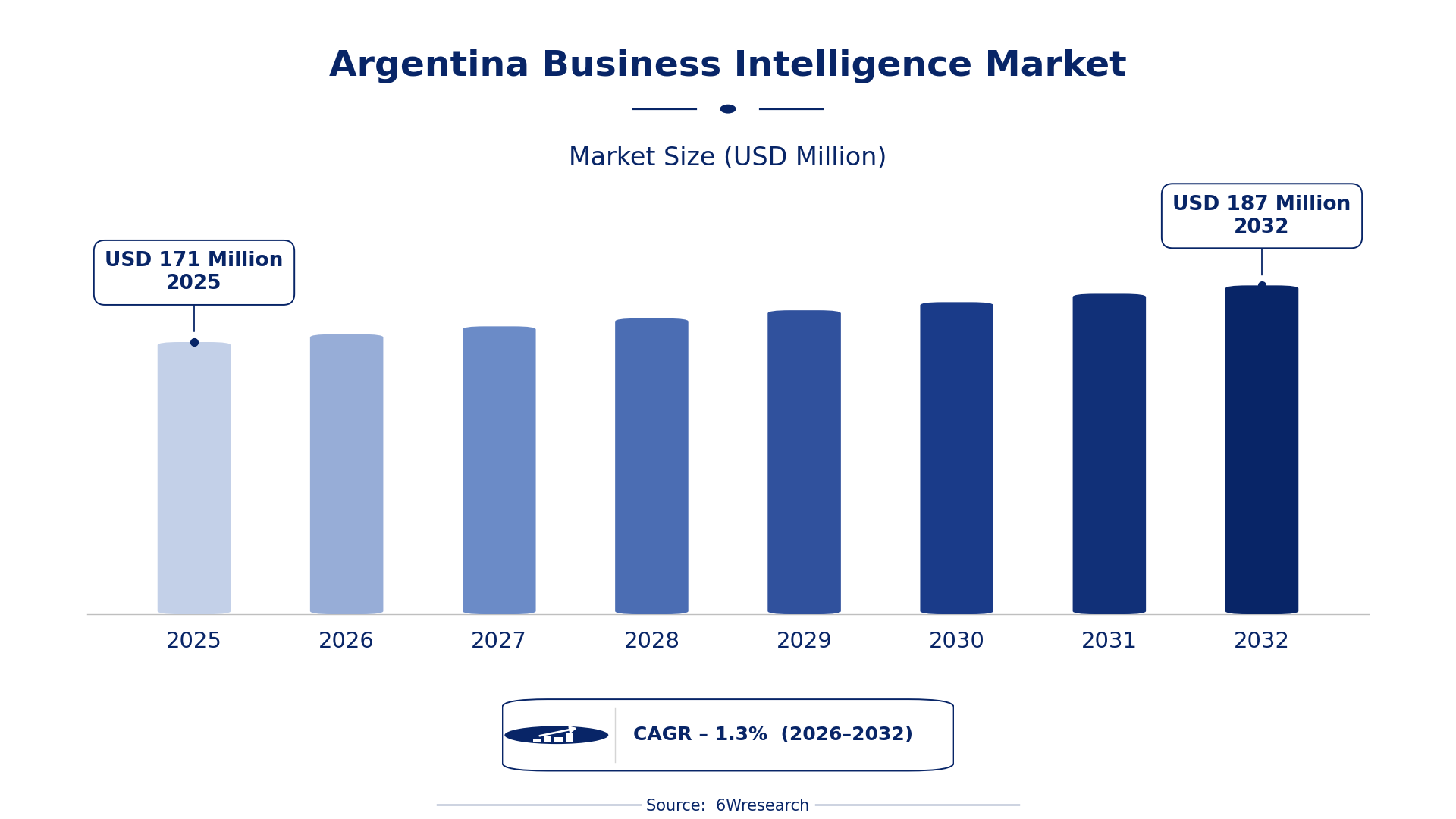
The Argentina Business Intelligence Market was estimated at USD 171 Million in 2025 and is projected to reach USD 187 Million by 2032, growing at a CAGR of 1.3% from 2026 to 2032.
Argentina Business Intelligence Market Synopsis
The Argentina Business Intelligence market is rapidly gaining traction as organizations increasingly recognize the value of data in decision-making processes. With sectors such as finance, retail, and healthcare leading the charge, companies are investing in BI tools that provide actionable insights to enhance their operational efficiency.
As businesses strive for competitive advantage, the emphasis on data-driven strategies is more pronounced than ever. This trend is bolstered by government initiatives that promote digital transformation, making the Argentina Business Intelligence market a focal point for technological investment and growth.
Argentina Business Intelligence Market Year-wise Growth Rate and Key Drivers
This graph illustrates the annual growth rates of the Argentina Business Intelligence Market from 2021 to 2032, highlighting a steady upward trajectory and projected expansion over the forecast period.
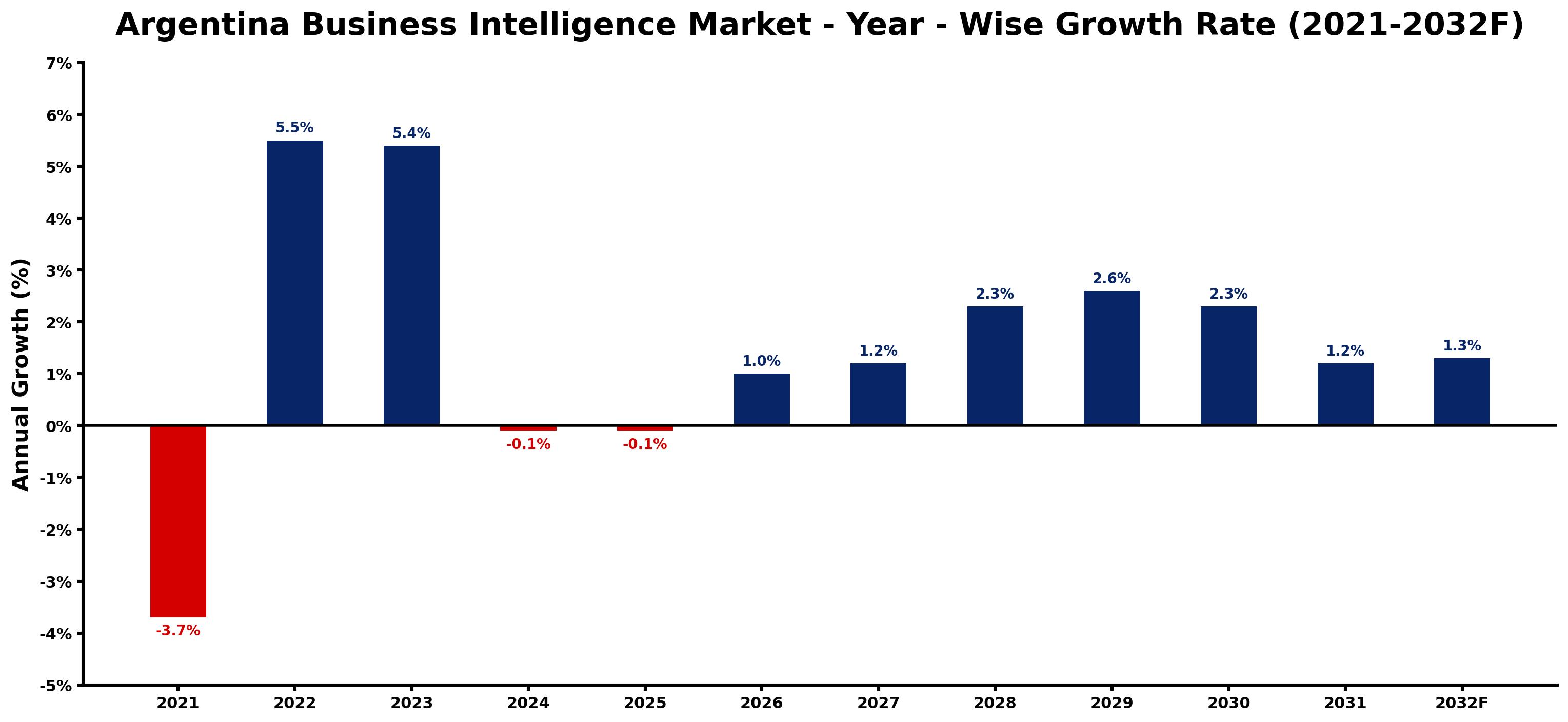
The table below presents the year‑wise growth rates along with the key drivers influencing the market
| Year | Growth Rate | Major Drivers |
| 2021 | -3.7% | High inflation eroded corporate IT budgets significantly. |
| 2022 | 5.5% | Government incentives for data-driven business intelligence projects. |
| 2023 | 5.4% | Increased local investment in AI analytics startups. |
| 2024 | -0.1% | New data privacy laws limited business analytics tools. |
| 2025 | -0.1% | Decline in foreign investment restricted software development. |
| 2026 | 1.0% | Growing focus on data security and compliance regulations. |
| 2027 | 1.2% | Adoption of cloud-based BI tools by SMEs in Argentina. |
| 2028 | 2.3% | Rise of remote work boosting data analysis needs. |
| 2029 | 2.6% | Expanding internet coverage enhancing analytics accessibility. |
| 2030 | 2.3% | Greater awareness of data-driven decision-making importance. |
| 2031 | 1.2% | Partnerships with local universities for data science education. |
| 2032 | 1.3% | Emergence of local BI consulting firms supporting businesses. |
Note: Market size estimations and growth projections presented in this report are based on 6Wresearch's proprietary forecasting methodology, utilizing the latest available industry data, government publications, and primary research inputs.
Argentina Business Intelligence Market Key Takeaways
Below are some of the specific key takeaways from the market, including:
- Increasing adoption of cloud-based BI solutions is enhancing scalability and flexibility for businesses.
- Integration of advanced analytics tools is enabling real-time insights across various sectors.
- Data privacy regulations are shaping how companies approach data management and BI implementations.
- Local businesses are seeking tailored BI solutions that address specific industry needs and compliance requirements.
- Government policies are fostering an environment conducive to digital innovation in business intelligence.
Evaluation of Restraints in Argentina Business Intelligence Market
Despite the promising growth trajectory, several challenges hinder the Argentina Business Intelligence market. Limited access to high-quality data sources remains a critical issue, as many businesses struggle to integrate disparate data efficiently. Additionally, concerns surrounding data privacy and compliance with regulations like GDPR create apprehension among organizations considering BI investments. The scarcity of skilled professionals in data analytics further complicates the landscape, as businesses find it increasingly difficult to harness the full potential of BI technologies.
Argentina Business Intelligence Market Trends
The demand for Argentina Business Intelligence solutions is being shaped by several key trends. Organizations are increasingly adopting advanced analytics tools that facilitate real-time decision-making. There's a marked shift toward cloud-based BI platforms, driven by the need for flexibility and scalability. Additionally, the integration of artificial intelligence and machine learning is revolutionizing predictive analytics, allowing businesses to make proactive decisions based on data insights.
Argentina Business Intelligence Market Opportunities
Opportunities within the Argentina Business Intelligence market are abundant, particularly for companies willing to tailor their offerings to local businesses. There’s a clear demand for industry-specific solutions, especially in agriculture and energy sectors. on top of that, providing language support and ensuring compliance with data privacy regulations can further enhance the attractiveness of BI products. With the market poised for innovation, companies can tap into these opportunities to bolster their competitive edge.
Government Initiatives in the Argentina Business Intelligence Market
The Argentine government is actively fostering an environment that supports the growth of the Business Intelligence market. Policies aimed at promoting transparency, efficiency, and technological innovation are at the forefront of this effort. Initiatives designed to enhance data protection and privacy further underpin the regulatory framework that businesses must navigate.
- A recent initiative focused on enhancing the digital infrastructure to support data analytics capabilities was launched in late 2023.
- The government is currently implementing a nationwide program aimed at improving data literacy among professionals in various sectors.
- Planned legislation expected to be introduced in 2025 will strengthen data privacy protections, impacting how businesses manage BI tools.
- Ongoing collaborations between public and private sectors are aiming to boost technological innovation and investment in the BI space.
- The National Institute of Statistics and Census (INDEC) is enhancing its data collection methods to provide more reliable data for market analysis.
Future Insights of the Argentina Business Intelligence Market
Looking ahead to 2026-2032, the Argentina Business Intelligence market is set for continued expansion. The growing emphasis on data-driven decision-making will drive demand for advanced analytics and BI solutions. As businesses increasingly rely on real-time insights to maintain competitiveness, innovation in BI technologies will be critical. The government's ongoing support for digital transformation and local businesses' evolving needs will create further opportunities for growth in this sector.
Argentina Business Intelligence Market Latest Developments
In the past year, activity in the Argentina Business Intelligence market has intensified, with a notable surge in investments and technological advancements. Companies are increasingly focused on enhancing their BI capabilities to stay ahead of the competition.
- A major technology vendor launched a new cloud-based BI platform in early 2024, designed to cater to the specific needs of Argentine businesses.
- A partnership between local universities and technology firms is currently underway, aimed at developing training programs for aspiring data analysts.
- Several businesses are implementing upgraded data visualization tools, with deployments expected to be completed by mid-2025.
- In Q4 2024, a leading regional operator is expected to roll out a new predictive analytics feature to enhance customer engagement strategies.
- A planned conference for late 2025 will showcase innovations in BI technologies and facilitate networking among industry stakeholders.
Argentina Business Intelligence Market - Key Attractiveness of the Report
- 10 Years of Market Numbers
- Historical Data Starting from 2022 to 2025
- Base Year: 2025
- Forecast Data until 2032
- Key Performance Indicators Impacting the Market
- Major Upcoming Developments and Projects
Key Highlights of the Report:
- Argentina Business Intelligence Market Outlook
- Market Size of Argentina Business Intelligence Market, 2025
- Forecast of Argentina Business Intelligence Market, 2032
- Historical Data and Forecast of Argentina Business Intelligence Revenues & Volume for the Period 2022-2032F
- Argentina Business Intelligence Market Trend Evolution
- Argentina Business Intelligence Market Drivers and Challenges
- Argentina Business Intelligence Price Trends
- Argentina Business Intelligence Porter's Five Forces
- Argentina Business Intelligence Industry Life Cycle
- Historical Data and Forecast of Argentina Business Intelligence Market Revenues & Volume By Component for the Period 2022-2032F
- Historical Data and Forecast of Argentina Business Intelligence Market Revenues & Volume By Solutions for the Period 2022-2032F
- Historical Data and Forecast of Argentina Business Intelligence Market Revenues & Volume By Services for the Period 2022-2032F
- Historical Data and Forecast of Argentina Business Intelligence Market Revenues & Volume By Business Function for the Period 2022-2032F
- Historical Data and Forecast of Argentina Business Intelligence Market Revenues & Volume By Human Resource for the Period 2022-2032F
- Historical Data and Forecast of Argentina Business Intelligence Market Revenues & Volume By Finance for the Period 2022-2032F
- Historical Data and Forecast of Argentina Business Intelligence Market Revenues & Volume By Operations for the Period 2022-2032F
- Historical Data and Forecast of Argentina Business Intelligence Market Revenues & Volume By Sales and Marketing for the Period 2022-2032F
- Historical Data and Forecast of Argentina Business Intelligence Market Revenues & Volume By Deployment Mode for the Period 2022-2032F
- Historical Data and Forecast of Argentina Business Intelligence Market Revenues & Volume By On-premises for the Period 2022-2032F
- Historical Data and Forecast of Argentina Business Intelligence Market Revenues & Volume By Cloud for the Period 2022-2032F
- Historical Data and Forecast of Argentina Business Intelligence Market Revenues & Volume By Organization Size for the Period 2022-2032F
- Historical Data and Forecast of Argentina Business Intelligence Market Revenues & Volume By SMEs for the Period 2022-2032F
- Historical Data and Forecast of Argentina Business Intelligence Market Revenues & Volume By Large Enterprises for the Period 2022-2032F
- Historical Data and Forecast of Argentina Business Intelligence Market Revenues & Volume By Vertical for the Period 2022-2032F
- Historical Data and Forecast of Argentina Business Intelligence Market Revenues & Volume By Retail for the Period 2022-2032F
- Historical Data and Forecast of Argentina Business Intelligence Market Revenues & Volume By Manufacturing for the Period 2022-2032F
- Historical Data and Forecast of Argentina Business Intelligence Market Revenues & Volume By Government and Public Services for the Period 2022-2032F
- Historical Data and Forecast of Argentina Business Intelligence Market Revenues & Volume By Media and Entertainment for the Period 2022-2032F
- Historical Data and Forecast of Argentina Business Intelligence Market Revenues & Volume By Transportation and Logistics for the Period 2022-2032F
- Historical Data and Forecast of Argentina Business Intelligence Market Revenues & Volume By BFSI for the Period 2022-2032F
- Historical Data and Forecast of Argentina Business Intelligence Market Revenues & Volume By Telecom and IT for the Period 2022-2032F
- Historical Data and Forecast of Argentina Business Intelligence Market Revenues & Volume By Healthcare and Life Sciences for the Period 2022-2032F
- Argentina Business Intelligence Import Export Trade Statistics
- Market Opportunity Assessment By Component
- Market Opportunity Assessment By Business Function
- Market Opportunity Assessment By Deployment Mode
- Market Opportunity Assessment By Organization Size
- Market Opportunity Assessment By Vertical
- Argentina Business Intelligence Top Companies Market Share
- Argentina Business Intelligence Competitive Benchmarking By Technical and Operational Parameters
- Argentina Business Intelligence Company Profiles
- Argentina Business Intelligence Key Strategic Recommendations






































