Argentina Oven Market: Import Trend Analysis
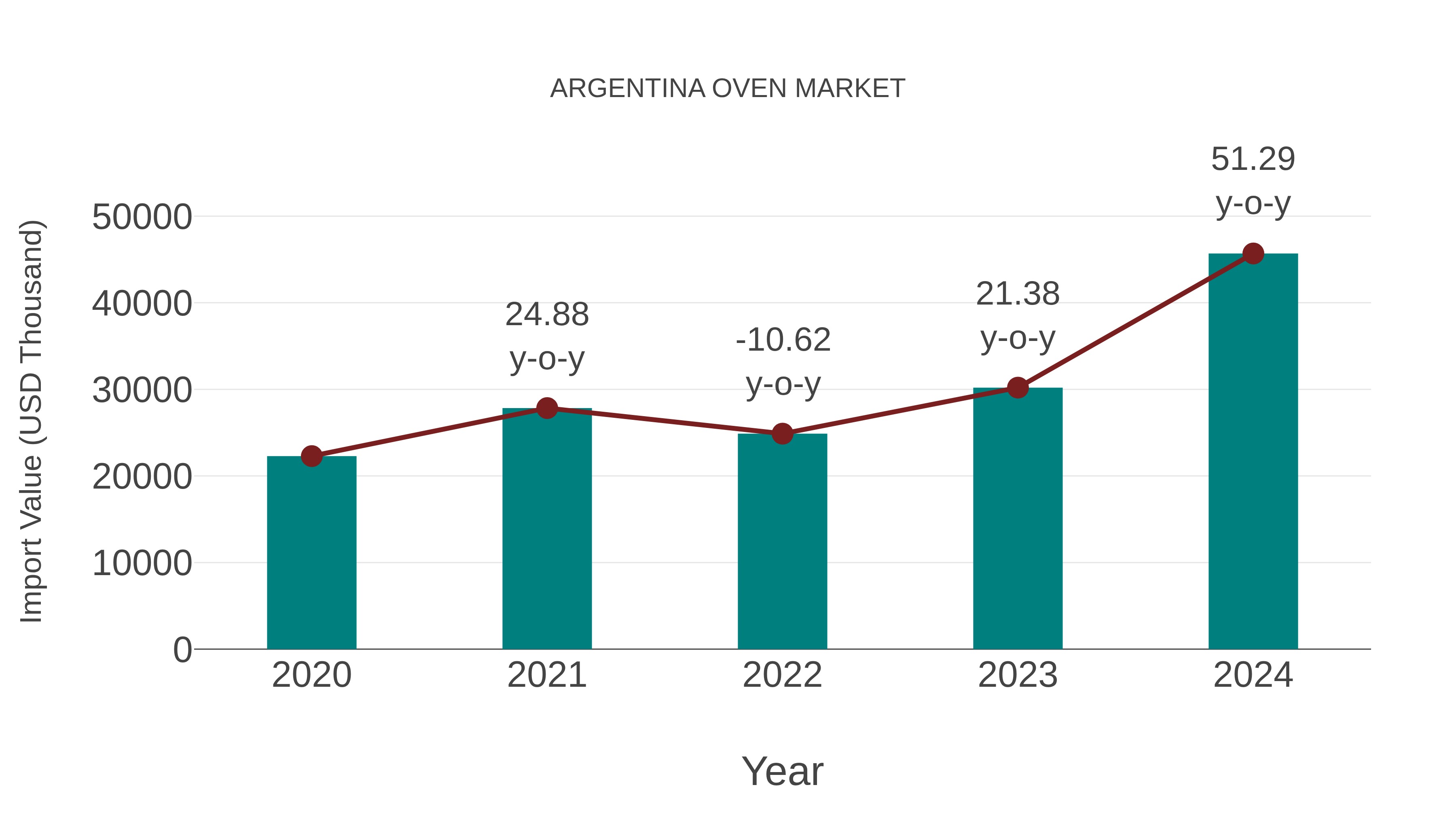
The Argentina oven market witnessed a notable increase in imports from 2020 to 2024, with a Compound Annual Growth Rate (CAGR) of 19.65%. Particularly, in 2023-2024, there was a significant year-on-year growth rate of 51.29%, indicating a substantial rise in imported ovens during that period.
Argentina Oven Market Overview
The Argentina oven market is a dynamic and evolving industry characterized by a growing demand for advanced and energy-efficient cooking appliances. The market offers a wide range of oven types, including gas ovens, electric ovens, convection ovens, and microwave ovens, catering to diverse consumer preferences. Factors such as urbanization, changing lifestyles, and increasing disposable incomes are driving the market growth. Key players in the Argentina oven market are focusing on product innovation, incorporating smart technology features, and enhancing energy efficiency to stay competitive. Additionally, rising awareness about health and wellness is influencing consumer choices towards ovens that offer healthier cooking options. As a result, the Argentina oven market is projected to continue its growth trajectory, with a strong emphasis on innovation and sustainability.
Argentina Oven Market Trends and Opportunities
The Argentina oven market is experiencing a growing demand for energy-efficient and multifunctional ovens. Consumers are increasingly looking for ovens that offer advanced features such as convection cooking, self-cleaning capabilities, and smart technology integration. There is also a trend towards compact and space-saving oven designs, catering to the needs of urban dwellers with limited kitchen space. Additionally, the rise of home baking and cooking as a hobby during the COVID-19 pandemic has boosted sales of ovens in Argentina. Manufacturers have the opportunity to innovate and differentiate their products by focusing on sustainability, convenience, and user-friendly interfaces. Collaborations with technology companies for smart home integration and the introduction of eco-friendly cooking options could further drive growth in the Argentina oven market.
Argentina Oven Market Challenges
In the Argentina Oven Market, several challenges are faced by manufacturers and retailers. One of the main challenges is the economic instability in the country, leading to fluctuations in consumer purchasing power and overall market demand. Additionally, high inflation rates can impact production costs and pricing strategies, making it difficult for businesses to maintain profitability. Another challenge is the presence of international competition, as imported ovens can sometimes offer lower prices or higher quality, posing a threat to domestic manufacturers. Furthermore, changing consumer preferences and trends towards healthier cooking methods or smart kitchen appliances require companies to constantly innovate and adapt their product offerings. Overall, navigating these challenges requires strategic planning, flexibility, and a deep understanding of the market dynamics in Argentina.
Argentina Oven Market Drivers
The Argentina Oven Market is primarily driven by factors such as the growing demand for convenience and time-saving cooking appliances, increasing disposable income levels, and changing consumer preferences towards modern kitchen appliances. The rising trend of home cooking and baking, influenced by cooking shows and social media platforms, has also contributed to the market growth. Additionally, technological advancements in oven design and features, such as energy efficiency, multi-functionality, and smart connectivity, are driving consumer interest in upgrading their existing ovens. Furthermore, the expanding urban population and the trend of kitchen renovations and remodeling projects are fueling the demand for ovens in Argentina. Overall, these drivers are shaping the growth trajectory of the Argentina Oven Market.
Argentina Oven Market Government Policy
Government policies related to the Argentina Oven Market focus on promoting energy efficiency and consumer safety. The government has implemented regulations to ensure that ovens meet specific energy efficiency standards to reduce electricity consumption and environmental impact. Additionally, safety standards are enforced to protect consumers from potential hazards associated with the use of ovens. The government also provides incentives for manufacturers to invest in research and development of more sustainable and innovative oven technologies. Overall, the policies aim to balance the market competitiveness with sustainability goals and consumer protection in the Argentina Oven Market.
Argentina Oven Market Future Outlook
The Argentina Oven Market is expected to witness steady growth in the coming years, driven by factors such as rising disposable income levels, changing consumer preferences towards home-cooked meals, and increasing urbanization. The market is likely to see a shift towards more technologically advanced ovens with features such as smart connectivity and energy efficiency. Additionally, the trend of healthy eating and baking at home is expected to further boost the demand for ovens in the country. However, challenges such as economic uncertainties and fluctuating raw material prices may impact the market growth to some extent. Overall, the Argentina Oven Market is anticipated to expand as consumers continue to prioritize convenience and quality in their cooking appliances.
Key Highlights of the Report:
- Argentina Oven Market Outlook
- Market Size of Argentina Oven Market, 2025
- Forecast of Argentina Oven Market, 2032
- Historical Data and Forecast of Argentina Oven Revenues & Volume for the Period 2022 - 2032F
- Argentina Oven Market Trend Evolution
- Argentina Oven Market Drivers and Challenges
- Argentina Oven Price Trends
- Argentina Oven Porter's Five Forces
- Argentina Oven Industry Life Cycle
- Historical Data and Forecast of Argentina Oven Market Revenues & Volume By Type for the Period 2022 - 2032F
- Historical Data and Forecast of Argentina Oven Market Revenues & Volume By Convection for the Period 2022 - 2032F
- Historical Data and Forecast of Argentina Oven Market Revenues & Volume By Grill for the Period 2022 - 2032F
- Historical Data and Forecast of Argentina Oven Market Revenues & Volume By Solo for the Period 2022 - 2032F
- Historical Data and Forecast of Argentina Oven Market Revenues & Volume By Distribution Channel for the Period 2022 - 2032F
- Historical Data and Forecast of Argentina Oven Market Revenues & Volume By Multi-brand Stores for the Period 2022 - 2032F
- Historical Data and Forecast of Argentina Oven Market Revenues & Volume By Exclusive Stores for the Period 2022 - 2032F
- Historical Data and Forecast of Argentina Oven Market Revenues & Volume By E-commerce for the Period 2022 - 2032F
- Historical Data and Forecast of Argentina Oven Market Revenues & Volume By Other Distribution Channels for the Period 2022 - 2032F
- Historical Data and Forecast of Argentina Oven Market Revenues & Volume By Structure for the Period 2022 - 2032F
- Historical Data and Forecast of Argentina Oven Market Revenues & Volume By Built-in for the Period 2022 - 2032F
- Historical Data and Forecast of Argentina Oven Market Revenues & Volume By Countertop for the Period 2022 - 2032F
- Historical Data and Forecast of Argentina Oven Market Revenues & Volume By End Users for the Period 2022 - 2032F
- Historical Data and Forecast of Argentina Oven Market Revenues & Volume By Residential for the Period 2022 - 2032F
- Historical Data and Forecast of Argentina Oven Market Revenues & Volume By Commercial for the Period 2022 - 2032F
- Argentina Oven Import Export Trade Statistics
- Market Opportunity Assessment By Type
- Market Opportunity Assessment By Distribution Channel
- Market Opportunity Assessment By Structure
- Market Opportunity Assessment By End Users
- Argentina Oven Top Companies Market Share
- Argentina Oven Competitive Benchmarking By Technical and Operational Parameters
- Argentina Oven Company Profiles
- Argentina Oven Key Strategic Recommendations






































