Armenia Caviar Market Size Growth Rate
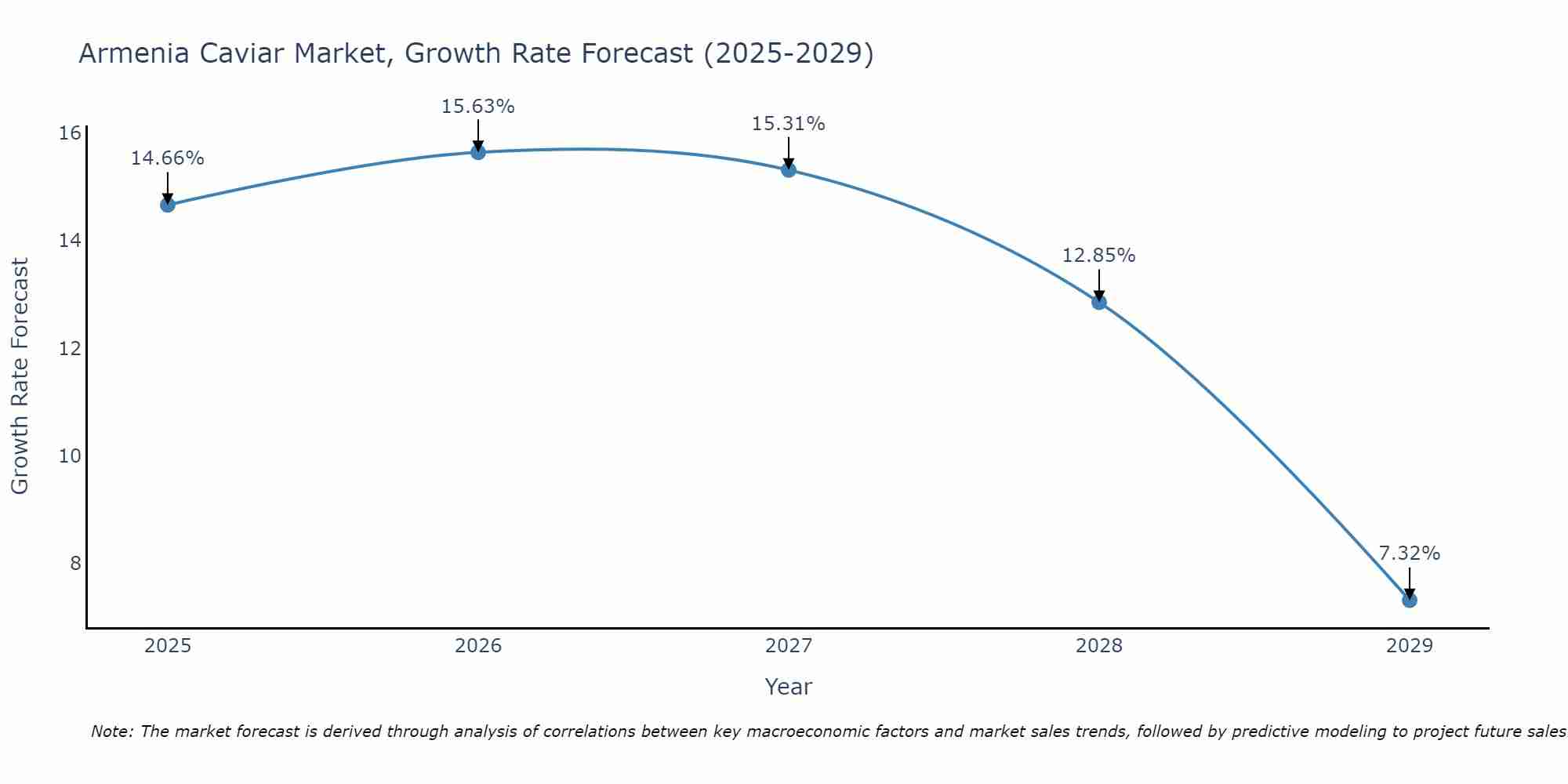
The Armenia Caviar Market is projected to witness mixed growth rate patterns during 2025 to 2029. The growth rate begins at 14.66% in 2025, climbs to a high of 15.63% in 2026, and moderates to 7.32% by 2029.
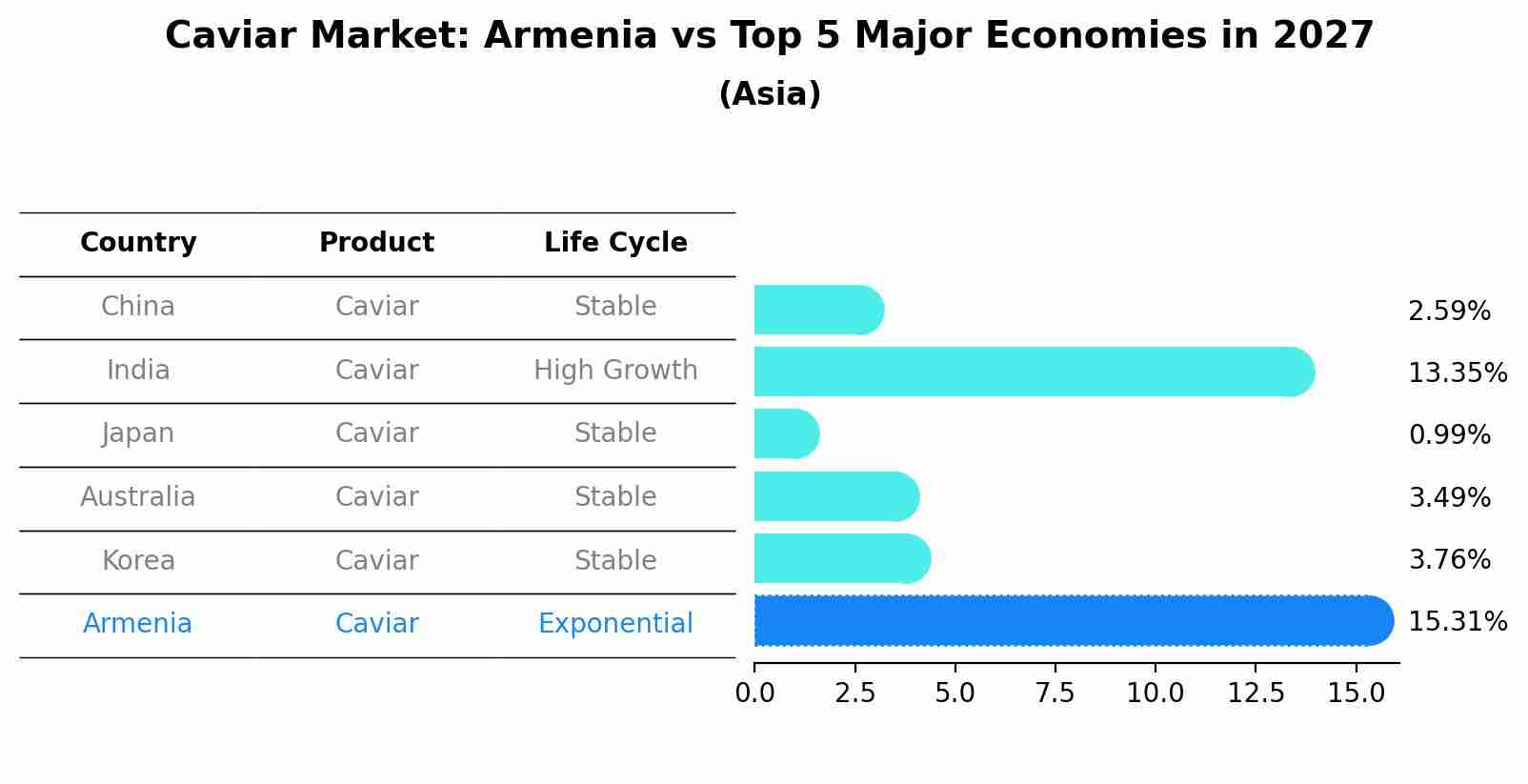
Caviar Market: Armenia vs Top 5 Major Economies in 2027 (Asia)
The Caviar market in Armenia is projected to grow at a exponential growth rate of 15.31% by 2027, within the Asia region led by China, along with other countries like India, Japan, Australia and South Korea, collectively shaping a dynamic and evolving market environment driven by innovation and increasing adoption of emerging technologies.
Armenia Caviar Market Overview
Armenia`s caviar market caters to luxury food segments and international exports. Production is influenced by aquaculture practices, environmental conservation efforts, and global demand trends.
Drivers of the market
The Armenia caviar market benefits from the country`s reputation for producing high-quality caviar from sturgeon species native to the region. Armenia`s favorable climate and pristine water conditions support sustainable aquaculture practices, ensuring premium caviar production. Increasing global demand for luxury food products and gourmet cuisine further drives the growth of Armenia`s caviar market, positioning it as a significant player in the international market.
Challenges of the market
The caviar market in Armenia encounters challenges primarily due to the limited production capacity and the high cost of caviar farming. The market is relatively niche, with low domestic demand and significant competition from well-established international producers. The high cost of maintaining aquaculture facilities and ensuring the quality and sustainability of caviar production can be prohibitive. Additionally, regulatory challenges and the need for specialized knowledge and technology further complicate the market landscape. Economic instability and limited consumer purchasing power also affect the market`s growth potential, as caviar remains a luxury product with limited local demand.
Government Policy of the market
The Armenia Caviar Market benefits from government policies that support the growth of aquaculture and high-value food products. The government provides funding and technical assistance to fish farms to enhance caviar production and ensure sustainable practices. Additionally, regulations are in place to prevent overfishing and protect natural fish populations. The government also promotes the export of Armenian caviar through trade agreements and marketing support, aiming to position Armenia as a key player in the global caviar market.
Key Highlights of the Report:
- Armenia Caviar Market Outlook
- Market Size of Armenia Caviar Market, 2024
- Forecast of Armenia Caviar Market, 2031
- Historical Data and Forecast of Armenia Caviar Revenues & Volume for the Period 2021-2031
- Armenia Caviar Market Trend Evolution
- Armenia Caviar Market Drivers and Challenges
- Armenia Caviar Price Trends
- Armenia Caviar Porter`s Five Forces
- Armenia Caviar Industry Life Cycle
- Historical Data and Forecast of Armenia Caviar Market Revenues & Volume By Product for the Period 2021-2031
- Historical Data and Forecast of Armenia Caviar Market Revenues & Volume By Sevruga for the Period 2021-2031
- Historical Data and Forecast of Armenia Caviar Market Revenues & Volume By Osetra for the Period 2021-2031
- Historical Data and Forecast of Armenia Caviar Market Revenues & Volume By Salmon for the Period 2021-2031
- Historical Data and Forecast of Armenia Caviar Market Revenues & Volume By Sushi for the Period 2021-2031
- Historical Data and Forecast of Armenia Caviar Market Revenues & Volume By Others for the Period 2021-2031
- Historical Data and Forecast of Armenia Caviar Market Revenues & Volume By Form for the Period 2021-2031
- Historical Data and Forecast of Armenia Caviar Market Revenues & Volume By Fresh for the Period 2021-2031
- Historical Data and Forecast of Armenia Caviar Market Revenues & Volume By Dried for the Period 2021-2031
- Historical Data and Forecast of Armenia Caviar Market Revenues & Volume By Preserved & Frozen for the Period 2021-2031
- Historical Data and Forecast of Armenia Caviar Market Revenues & Volume By Application for the Period 2021-2031
- Historical Data and Forecast of Armenia Caviar Market Revenues & Volume By Restaurants for the Period 2021-2031
- Historical Data and Forecast of Armenia Caviar Market Revenues & Volume By Household for the Period 2021-2031
- Armenia Caviar Import Export Trade Statistics
- Market Opportunity Assessment By Product
- Market Opportunity Assessment By Form
- Market Opportunity Assessment By Application
- Armenia Caviar Top Companies Market Share
- Armenia Caviar Competitive Benchmarking By Technical and Operational Parameters
- Armenia Caviar Company Profiles
- Armenia Caviar Key Strategic Recommendations






































