Australia Aggregates Market: Import Trend Analysis
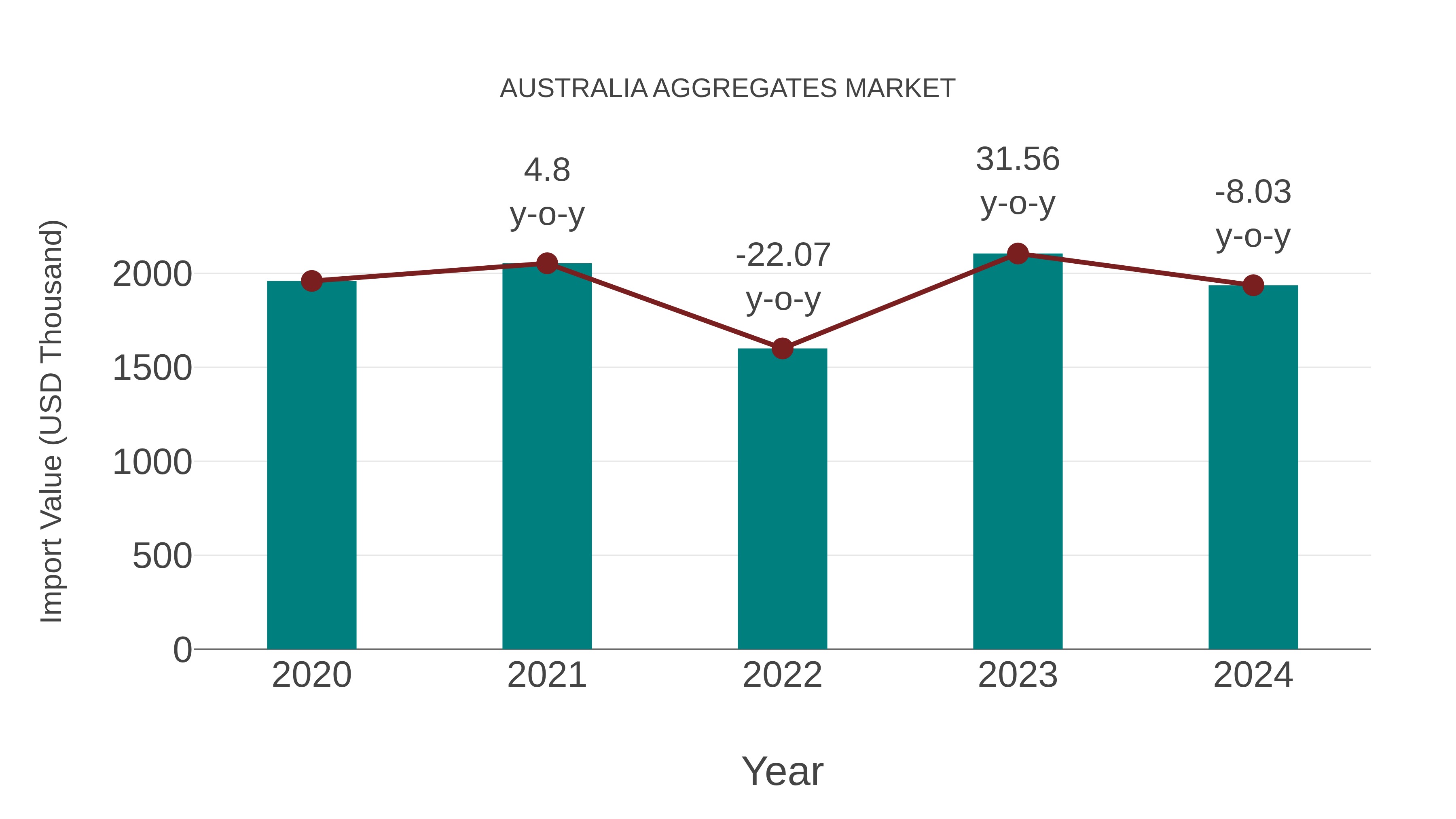
In the Australia aggregates market, the import trend experienced a decline, with a growth rate of -8.03% from 2023 to 2024. The compound annual growth rate (CAGR) for imports over the period 2020-2024 stood at -0.29%. This downward trajectory may be attributed to shifting demand dynamics or changes in trade policies affecting market stability.
Australia Aggregates Market Overview
The Australia aggregates market is a crucial sector within the construction industry, driven by infrastructure development and urbanization projects. Aggregates such as sand, gravel, and crushed stone are essential raw materials used in the production of concrete and asphalt for various construction applications. The market is characterized by a strong demand from residential, commercial, and infrastructure projects, with government investments playing a significant role in driving growth. Major players in the industry include Boral Limited, Hanson Australia, and Holcim Australia, with a focus on sustainable practices and technological advancements. The market is expected to witness steady growth in the coming years, supported by ongoing construction activities and a focus on infrastructure development across the country.
Australia Aggregates Market Trends
In the Australia aggregates market, there is a growing emphasis on sustainability and environmental impact. Companies are increasingly focusing on utilizing recycled materials and sustainable practices in the production of aggregates to reduce their carbon footprint. Additionally, there is a trend towards technological advancements in aggregate production processes, such as the use of digital tools for monitoring and optimizing operations, leading to improved efficiency and cost savings. Infrastructure development projects in Australia are driving the demand for aggregates, particularly in the construction and transportation sectors. Market players are also exploring innovative solutions to address supply chain challenges and meet the evolving needs of customers. Overall, the Australia aggregates market is witnessing a shift towards greener practices and technological innovations to meet the demands of a sustainable future.
Australia Aggregates Market Challenges
In the Australia aggregates market, some key challenges include fluctuating demand due to economic uncertainties, environmental regulations impacting extraction processes, transportation costs, and competition from alternative materials. The industry also faces challenges related to limited availability of high-quality reserves, which can lead to supply constraints and price volatility. Additionally, infrastructure development projects heavily influence demand for aggregates, making the market susceptible to fluctuations in government investment. To remain competitive and sustainable, companies in the Australia aggregates market need to adapt to changing market conditions, invest in technology for efficient production and transportation, and prioritize sustainability practices to meet environmental regulations and consumer preferences.
Australia Aggregates Market Investment Opportunities
Investment opportunities in the Australia aggregates market include the growing demand for construction materials driven by infrastructure development, urbanization, and residential construction projects. With a focus on sustainable practices and environmental regulations, there are opportunities for investments in innovative technologies for aggregate production, such as recycled aggregates and alternative materials. Additionally, strategic acquisitions or partnerships with local suppliers can provide access to a diverse range of aggregate sources and distribution networks. Investors should also consider the potential for export opportunities to regions with high demand for construction materials. Overall, the Australia aggregates market presents opportunities for investors to capitalize on the industry`s growth trajectory and evolving market dynamics.
Australia Aggregates Market Government Policy
The Australian government plays a significant role in regulating the aggregates market through various policies and regulations. Key policies include environmental protection laws that govern quarrying activities to minimize impacts on ecosystems and water resources. The government also has guidelines in place to ensure occupational health and safety standards are met in aggregate extraction and processing operations. Additionally, there are regulations governing the use of aggregates in infrastructure projects to maintain quality and safety standards. The government may also implement procurement policies that prioritize the use of locally sourced aggregates to support domestic suppliers and reduce carbon emissions associated with transportation. Overall, government policies in Australia aim to balance the demand for aggregates with environmental sustainability and public safety considerations.
Australia Aggregates Market Future Outlook
The future outlook for the Australia aggregates market appears positive, driven by ongoing infrastructure development projects, urbanization, and construction activities across the country. The demand for aggregates, including sand, gravel, and crushed stone, is expected to remain strong due to the government`s focus on infrastructure spending and the growing population. Additionally, the increasing trend towards sustainable construction practices and the emphasis on using recycled aggregates are likely to shape the market in the coming years. Overall, the Australia aggregates market is poised for steady growth, with opportunities for market players to innovate and cater to the evolving needs of the construction sector while addressing environmental concerns.
Key Highlights of the Report:
- Australia Aggregates Market Outlook
- Market Size of Australia Aggregates Market, 2025
- Forecast of Australia Aggregates Market, 2032
- Historical Data and Forecast of Australia Aggregates Revenues & Volume for the Period 2022-2032F
- Australia Aggregates Market Trend Evolution
- Australia Aggregates Market Drivers and Challenges
- Australia Aggregates Price Trends
- Australia Aggregates Porter's Five Forces
- Australia Aggregates Industry Life Cycle
- Historical Data and Forecast of Australia Aggregates Market Revenues & Volume By Product Type for the Period 2022-2032F
- Historical Data and Forecast of Australia Aggregates Market Revenues & Volume By Crushed Stone for the Period 2022-2032F
- Historical Data and Forecast of Australia Aggregates Market Revenues & Volume By Sand for the Period 2022-2032F
- Historical Data and Forecast of Australia Aggregates Market Revenues & Volume By Gravel for the Period 2022-2032F
- Historical Data and Forecast of Australia Aggregates Market Revenues & Volume By Recycled Aggregates for the Period 2022-2032F
- Historical Data and Forecast of Australia Aggregates Market Revenues & Volume By Application for the Period 2022-2032F
- Historical Data and Forecast of Australia Aggregates Market Revenues & Volume By Construction Materials for the Period 2022-2032F
- Historical Data and Forecast of Australia Aggregates Market Revenues & Volume By Road Construction for the Period 2022-2032F
- Historical Data and Forecast of Australia Aggregates Market Revenues & Volume By Concrete Production for the Period 2022-2032F
- Historical Data and Forecast of Australia Aggregates Market Revenues & Volume By Landscaping for the Period 2022-2032F
- Historical Data and Forecast of Australia Aggregates Market Revenues & Volume By End User for the Period 2022-2032F
- Historical Data and Forecast of Australia Aggregates Market Revenues & Volume By Construction Industry for the Period 2022-2032F
- Historical Data and Forecast of Australia Aggregates Market Revenues & Volume By Residential for the Period 2022-2032F
- Historical Data and Forecast of Australia Aggregates Market Revenues & Volume By Commercial for the Period 2022-2032F
- Australia Aggregates Import Export Trade Statistics
- Market Opportunity Assessment By Product Type
- Market Opportunity Assessment By Application
- Market Opportunity Assessment By End User
- Australia Aggregates Top Companies Market Share
- Australia Aggregates Competitive Benchmarking By Technical and Operational Parameters
- Australia Aggregates Company Profiles
- Australia Aggregates Key Strategic Recommendations






































