Australia Automotive Chassis Market Size, Share & Growth Rate
The Australia Automotive Chassis Market was estimated at USD 226 Million in 2025 and is projected to reach USD 266 Million by 2032, growing at a CAGR of 2.4% from 2026 to 2032. This growth is primarily driven by the increasing demand for lightweight and durable chassis components, which are essential for improving fuel efficiency in an era where sustainability is paramount. Furthermore, the shift towards electric and hybrid vehicles is creating new avenues for advanced chassis design, contributing significantly to market expansion.
Australia Automotive Chassis Market Year-wise Growth Rate and Key Drivers
This graph highlights how the Australia Automotive Chassis Market has steadily grown over the years, supported by major growth factors.
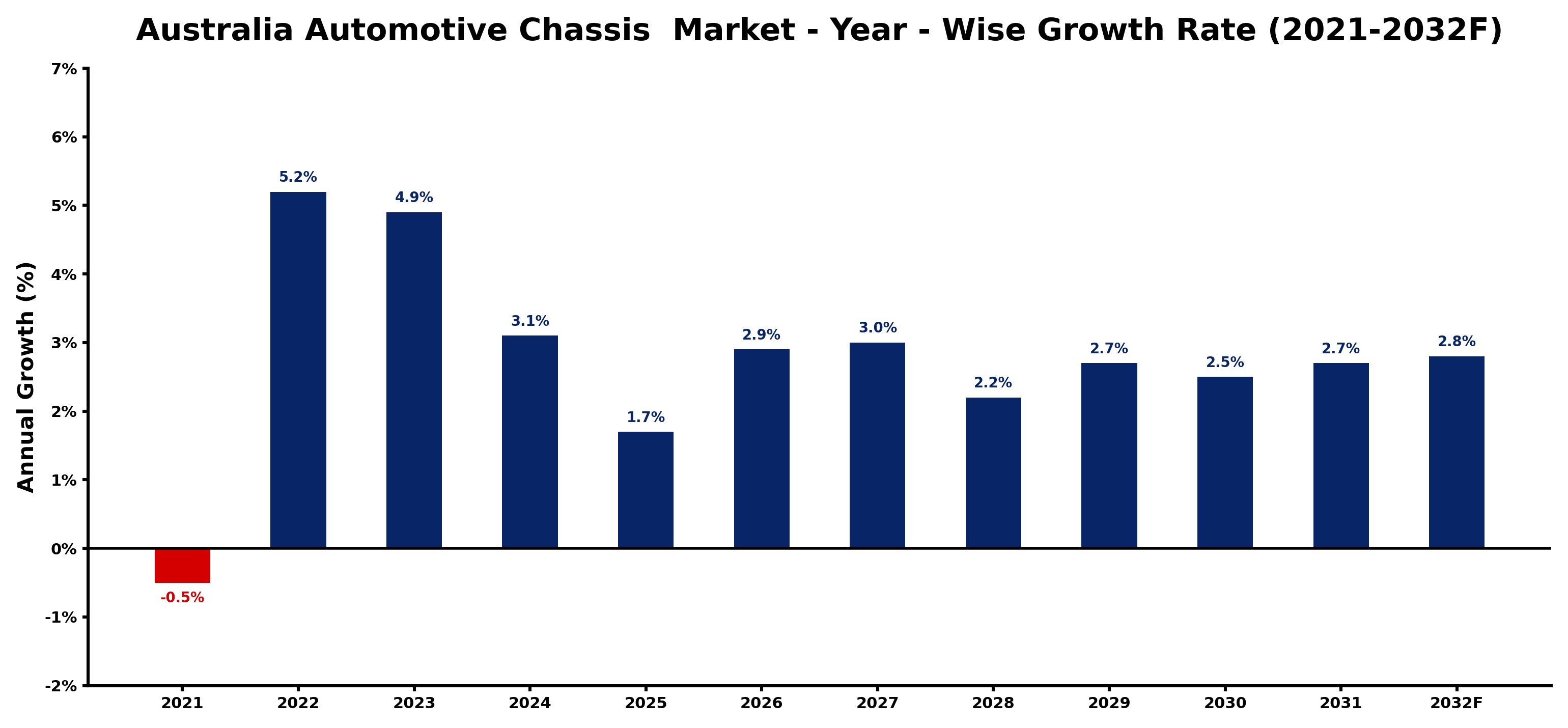
The table below presents the year‑wise growth rates along with the key drivers influencing the market
| Year | Growth Rate | Major Drivers |
| 2021 | -0.5% | Supply chain disruptions affected production |
| 2022 | 5.2% | Electric vehicle adoption accelerated growth |
| 2023 | 4.9% | Technological advancements enhanced performance |
| 2024 | 3.1% | Sustainability initiatives drove market expansion |
| 2025 | 1.7% | Increased demand for lightweight materials |
| 2026 | 2.9% | Rising consumer preference for safety |
| 2027 | 3.0% | Automated manufacturing processes improved efficiency |
| 2028 | 2.2% | Growing interest in customization options |
| 2029 | 2.7% | Expansion of aftermarket services increased |
| 2030 | 2.5% | Industrial activity supported growth |
| 2031 | 2.7% | Increased investment in research development |
| 2032 | 2.8% | Global partnerships expanded market reach |
Note - Market size estimations and growth projections presented in this report are based on 6Wresearch’s advanced forecasting approach, validated with industry datasets as of June 2026.
Australia Automotive Chassis Market Synopsis
While the Australian automotive chassis market has witnessed steady momentum due to technological advancements, it is poised for further transformation. The growing emphasis on lightweight materials such as aluminum and composites is revolutionizing chassis design, enabling manufacturers to enhance fuel efficiency and meet consumer demand for sustainable automotive solutions.
However, despite the positive outlook, the market must navigate challenges stemming from limited large-scale vehicle manufacturing domestically. As automakers shift their focus towards electric and hybrid technologies, the demand for innovative chassis solutions continues to rise, promising a robust future for the industry.
Australia Automotive Chassis Market Key Takeaways
- Increasing demand for lightweight and durable chassis components is reshaping the industry landscape.
- The transition to electric and hybrid vehicles is driving innovation in chassis design and material usage.
- Aluminum and composite materials are becoming the preferred choices for manufacturers seeking fuel efficiency.
- Investment opportunities in advanced chassis technology are abundant as sustainability remains a priority.
- Regulatory policies support the development of environmentally friendly chassis solutions.
Evaluation of Restraints in Australia Automotive Chassis Market
The Australian automotive chassis market grapples with significant restraints that hinder its growth potential. Chief among these is the lack of large-scale vehicle manufacturing, which limits domestic production and innovation. Additionally, the high costs associated with raw materials, particularly steel and aluminum, pose financial challenges for manufacturers striving to maintain competitiveness. The transition towards lightweight and electric vehicles necessitates substantial investments in new technologies, which can deter smaller firms and stifle overall market growth.
Australia Automotive Chassis Market Trends
The automotive chassis market in Australia is witnessing transformative trends driven by technological advancements and consumer preferences. The ongoing shift towards electric vehicles is creating demand for lighter, more efficient chassis designs that can accommodate new powertrains. Additionally, the adoption of composite materials is gaining traction, offering manufacturers enhanced design flexibility and improved performance. Moreover, sustainability initiatives are prompting the industry to explore innovative manufacturing techniques that reduce environmental impact, aligning with global eco-friendly trends.
Australia Automotive Chassis Market Opportunities
Significant growth opportunities exist in the Australian automotive chassis market, particularly in the development of lightweight materials tailored for electric vehicles. Companies can capitalize on this trend by investing in advanced material technologies and forming strategic partnerships with automakers to ensure integration into supply chains. Furthermore, the increasing emphasis on sustainability opens avenues for innovations that promote both efficiency and environmental stewardship, encouraging investment in research and development in this promising sector.
Government Initiatives in the Australia Automotive Chassis Market
The Australian government plays a crucial role in shaping the automotive chassis market through stringent vehicle safety standards and environmental regulations. These policies incentivize the development of lightweight, durable chassis materials while ensuring compliance with international safety requirements. Public spending on sustainable transportation initiatives is also on the rise, fostering innovation in the automotive sector. Furthermore, trade regulations governing the import and export of chassis components help maintain market integrity and competitiveness.
Future Insights of the Australia Automotive Chassis Market
Looking ahead to the period from 2026 to 2032, the Australia Automotive Chassis Market is expected to continue its upward trajectory, driven by technological advancements and changing consumer preferences. As the demand for electric and hybrid vehicles grows, manufacturers will increasingly prioritize lightweight materials and innovative design solutions. Additionally, the integration of smart technologies within chassis systems may redefine safety and performance standards, further propelling market growth and opening new avenues for investment.
Australia Automotive Chassis Market Latest Developments (May 2025 - June 2026)
In recent months, the Australian automotive chassis market has experienced a wave of innovation as companies strive to meet the evolving demands of the industry. Emerging technologies focused on lightweight materials and advanced manufacturing techniques are gaining attention. Industry stakeholders are increasingly collaborating on research projects aimed at developing sustainable chassis solutions, reflecting a broader commitment to environmental responsibility. These trends indicate a dynamic industry landscape, ripe for further transformation as companies adapt to changing market demands.
Australia Automotive Chassis Market - Key Attractiveness of the Report
- 10 Years of Market Numbers
- Historical Data Starting from 2022 to 2025
- Base Year: 2025
- Forecast Data until 2032
- Key Performance Indicators Impacting the Market
- Major Upcoming Developments and Projects
Key Highlights of the Report:
- Australia Automotive Chassis Market Outlook
- Market Size of Australia Automotive Chassis Market, 2025
- Forecast of Australia Automotive Chassis Market, 2032
- Historical Data and Forecast of Australia Automotive Chassis Revenues & Volume for the Period 2022-2032F
- Australia Automotive Chassis Market Trend Evolution
- Australia Automotive Chassis Market Drivers and Challenges
- Australia Automotive Chassis Price Trends
- Australia Automotive Chassis Porter's Five Forces
- Australia Automotive Chassis Industry Life Cycle
- Historical Data and Forecast of Australia Automotive Chassis Market Revenues & Volume By ChassisType for the Period 2022-2032F
- Historical Data and Forecast of Australia Automotive Chassis Market Revenues & Volume By Backbone for the Period 2022-2032F
- Historical Data and Forecast of Australia Automotive Chassis Market Revenues & Volume By Ladder for the Period 2022-2032F
- Historical Data and Forecast of Australia Automotive Chassis Market Revenues & Volume By Monocoque for the Period 2022-2032F
- Historical Data and Forecast of Australia Automotive Chassis Market Revenues & Volume By Modular for the Period 2022-2032F
- Historical Data and Forecast of Australia Automotive Chassis Market Revenues & Volume By Material for the Period 2022-2032F
- Historical Data and Forecast of Australia Automotive Chassis Market Revenues & Volume By Steel for the Period 2022-2032F
- Historical Data and Forecast of Australia Automotive Chassis Market Revenues & Volume By Aluminum Alloy for the Period 2022-2032F
- Historical Data and Forecast of Australia Automotive Chassis Market Revenues & Volume By Carbon Fiber Composite for the Period 2022-2032F
- Historical Data and Forecast of Australia Automotive Chassis Market Revenues & Volume By Electric Vehicle for the Period 2022-2032F
- Historical Data and Forecast of Australia Automotive Chassis Market Revenues & Volume By BEV for the Period 2022-2032F
- Historical Data and Forecast of Australia Automotive Chassis Market Revenues & Volume By PHEV for the Period 2022-2032F
- Historical Data and Forecast of Australia Automotive Chassis Market Revenues & Volume By HEV for the Period 2022-2032F
- Historical Data and Forecast of Australia Automotive Chassis Market Revenues & Volume By Vehicle Type for the Period 2022-2032F
- Historical Data and Forecast of Australia Automotive Chassis Market Revenues & Volume By PC for the Period 2022-2032F
- Historical Data and Forecast of Australia Automotive Chassis Market Revenues & Volume By CV for the Period 2022-2032F
- Australia Automotive Chassis Import Export Trade Statistics
- Market Opportunity Assessment By ChassisType
- Market Opportunity Assessment By Material
- Market Opportunity Assessment By Electric Vehicle
- Market Opportunity Assessment By Vehicle Type
- Australia Automotive Chassis Top Companies Market Share
- Australia Automotive Chassis Competitive Benchmarking By Technical and Operational Parameters
- Australia Automotive Chassis Company Profiles
- Australia Automotive Chassis Key Strategic Recommendations






































