Australia Biostimulants Market: Import Trend Analysis
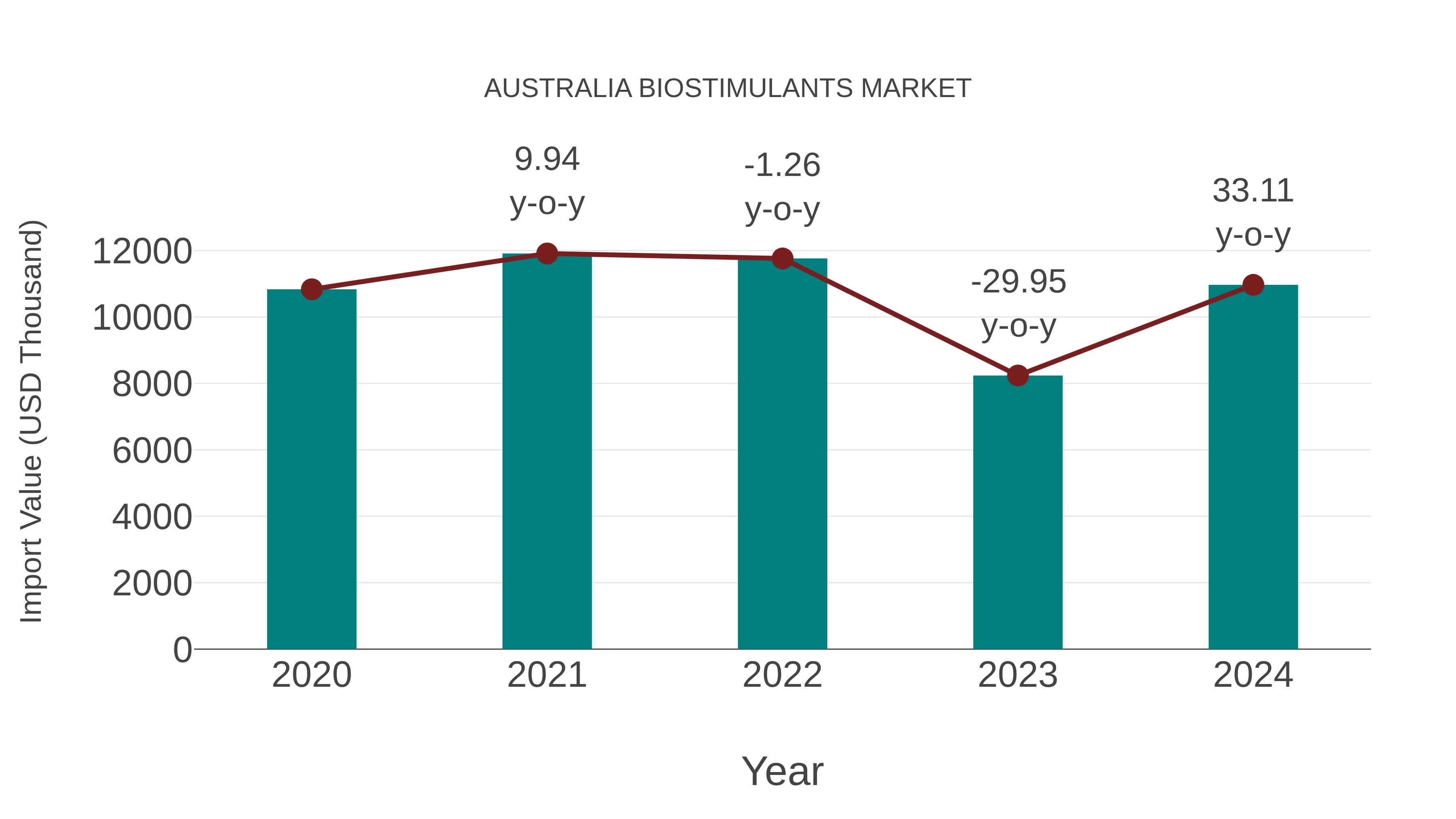
In the Australia biostimulants market, the import trend showed significant growth from 2023 to 2024, with a rate of 33.11%. The compound annual growth rate (CAGR) for imports between 2020 and 2024 stood at 0.3%. This uptrend could be attributed to a noticeable shift in demand for biostimulants, potentially driven by increased awareness of sustainable agricultural practices or regulatory changes affecting the market.
Australia Biostimulants Market Overview
The biostimulants market in Australia is experiencing growth driven by increasing adoption of sustainable agriculture practices, climate change challenges, and the need for improving crop productivity and resilience. Biostimulants, which include microbial inoculants, seaweed extracts, and humic substances, offer plant growth promotion, stress tolerance, and nutrient uptake enhancement for optimizing crop yields and quality. With supportive regulations, market education efforts, and technological innovations, the biostimulants market is evolving to address Australia agricultural sustainability goals and climate resilience strategies.
Drivers of the market
The biostimulants market in Australia is witnessing rapid growth, driven by several key drivers. Firstly, increasing awareness of sustainable agriculture practices, soil health management, and crop productivity optimization is propelling the adoption of biostimulant products. Biostimulants contain substances and microorganisms that enhance plant growth, nutrient uptake, stress tolerance, and yield potential, thereby improving crop performance and resilience to environmental stresses such as drought, salinity, and disease pressure. Secondly, government initiatives supporting organic farming, environmental stewardship, and agricultural innovation are driving market demand and incentivizing investment in biostimulant research, development, and commercialization. Additionally, collaborations between agribusiness companies, research institutions, and agricultural extension services are driving market expansion and fostering technology adoption among farmers and growers in Australia diverse cropping systems and climatic conditions.
Challenges of the market
Challenges in the Australia biostimulants market includeproduct efficacy and market education. Adapting to changes in agricultural practices and addressing concerns regarding product consistency are ongoing challenges for biostimulant manufacturers.
Government Policy of the market
Australia agriculture industry is embracing biostimulants as tools to enhance crop productivity and resilience. Government support for sustainable farming practices and environmental stewardship is driving demand for biostimulants, which promote plant growth, nutrient uptake, and stress tolerance. Research and development investments are expanding the range of biostimulant products available to growers, providing tailored solutions for diverse cropping systems and environmental conditions.
Key Highlights of the Report:
- Australia Biostimulants Market Outlook
- Market Size of Australia Biostimulants Market, 2025
- Forecast of Australia Biostimulants Market, 2032
- Historical Data and Forecast of Australia Biostimulants Revenues & Volume for the Period 2022-2032F
- Australia Biostimulants Market Trend Evolution
- Australia Biostimulants Market Drivers and Challenges
- Australia Biostimulants Price Trends
- Australia Biostimulants Porter's Five Forces
- Australia Biostimulants Industry Life Cycle
- Historical Data and Forecast of Australia Biostimulants Market Revenues & Volume By Active Ingredient for the Period 2022-2032F
- Historical Data and Forecast of Australia Biostimulants Market Revenues & Volume By Humic Substances for the Period 2022-2032F
- Historical Data and Forecast of Australia Biostimulants Market Revenues & Volume By Amino Acids for the Period 2022-2032F
- Historical Data and Forecast of Australia Biostimulants Market Revenues & Volume By Seaweed Extracts for the Period 2022-2032F
- Historical Data and Forecast of Australia Biostimulants Market Revenues & Volume By Microbial Amendments for the Period 2022-2032F
- Historical Data and Forecast of Australia Biostimulants Market Revenues & Volume By Mode of Application for the Period 2022-2032F
- Historical Data and Forecast of Australia Biostimulants Market Revenues & Volume By Foliar for the Period 2022-2032F
- Historical Data and Forecast of Australia Biostimulants Market Revenues & Volume By Soil Treatment for the Period 2022-2032F
- Historical Data and Forecast of Australia Biostimulants Market Revenues & Volume By Seed Treatment for the Period 2022-2032F
- Historical Data and Forecast of Australia Biostimulants Market Revenues & Volume By Form for the Period 2022-2032F
- Historical Data and Forecast of Australia Biostimulants Market Revenues & Volume By Liquid for the Period 2022-2032F
- Historical Data and Forecast of Australia Biostimulants Market Revenues & Volume By Dry for the Period 2022-2032F
- Australia Biostimulants Import Export Trade Statistics
- Market Opportunity Assessment By Active Ingredient
- Market Opportunity Assessment By Mode of Application
- Market Opportunity Assessment By Form
- Australia Biostimulants Top Companies Market Share
- Australia Biostimulants Competitive Benchmarking By Technical and Operational Parameters
- Australia Biostimulants Company Profiles
- Australia Biostimulants Key Strategic Recommendations






































