Australia Compact Disc Market Size, Share & Growth Rate
The Australia Compact Disc Market was estimated at USD 136 Million in 2025 and is projected to reach USD 159 Million by 2032, growing at a CAGR of 2.3% from 2026 to 2032. This modest growth reflects a complex interplay between nostalgia for physical media and a gradual stabilization of demand among certain consumer segments. Despite the overarching decline driven by digital alternatives, the compact disc continues to find traction among audiophiles and collectors who appreciate the tactile experience and superior sound quality.
Australia Compact Disc Market Year-wise Growth Rate and Key Drivers
This graph highlights how the Australia Compact Disc Market has steadily grown over the years, supported by major growth factors.
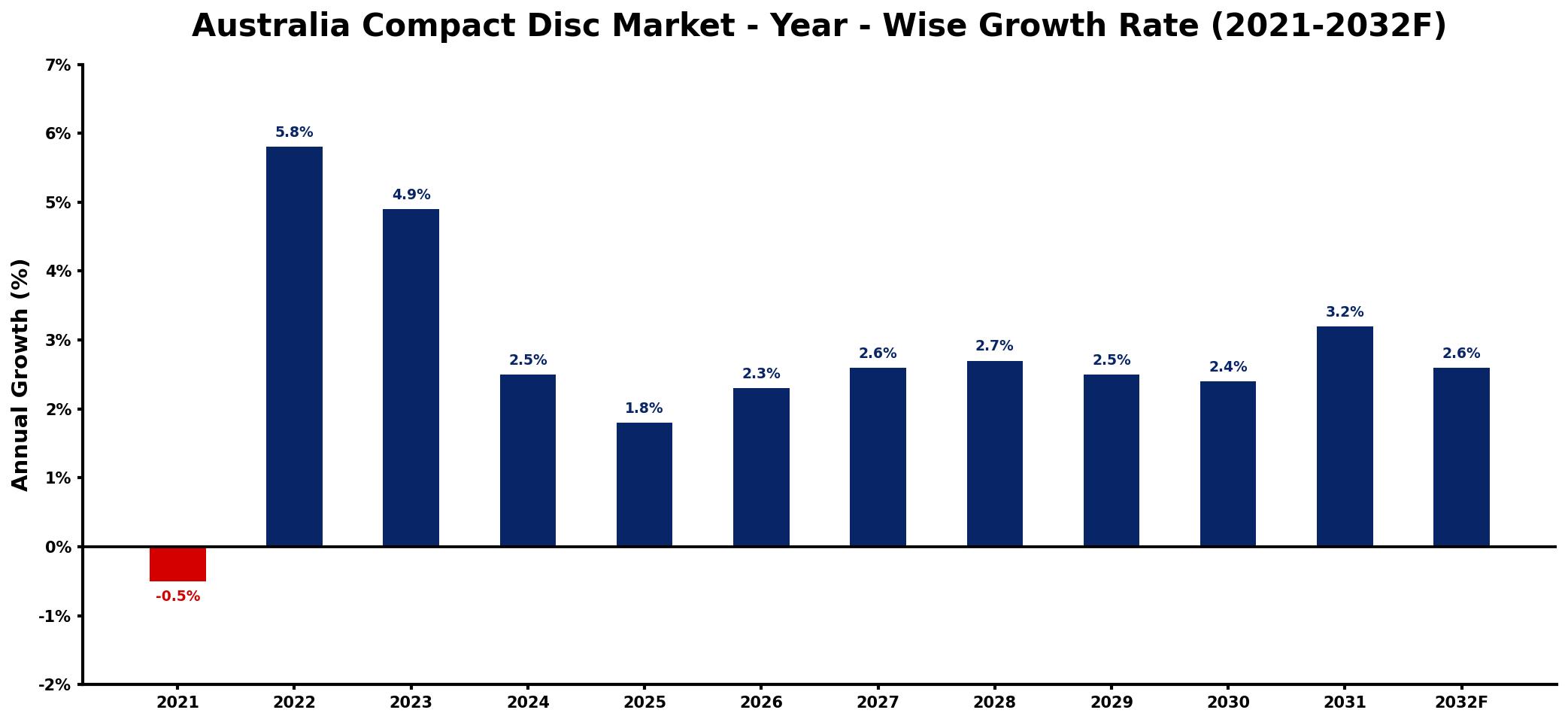
The table below presents the year‑wise growth rates along with the key drivers influencing the market
| Year | Growth Rate | Major Drivers |
| 2021 | -0.5% | Shift towards digital consumption |
| 2022 | 5.8% | Rising interest in physical media |
| 2023 | 4.9% | Growing collector community engagement |
| 2024 | 2.5% | Increased vinyl and merchandise sales |
| 2025 | 1.8% | Expansion of independent retailers |
| 2026 | 2.3% | Boost in nostalgia-driven purchases |
| 2027 | 2.6% | Emergence of exclusive releases |
| 2028 | 2.7% | Enhancement of audio quality standards |
| 2029 | 2.5% | Collaboration with streaming platforms |
| 2030 | 2.4% | Support from music festivals resurgence |
| 2031 | 3.2% | Investment in artisanal production methods |
| 2032 | 2.6% | Strengthening of local artist presence |
Note: Market size estimations and growth projections presented in this report are based on 6Wresearch's proprietary forecasting methodology, utilizing the latest available industry data, government publications, and primary research inputs.
Australia Compact Disc Market Synopsis
In an era dominated by streaming platforms, the Australia Compact Disc market maintains a surprising degree of relevance. Recent trends indicate that while overall consumption of compact discs is diminishing, niche markets centered around collectors and audiophiles have begun to carve out a stable demand for high-quality physical media.
Moreover, the durability and longevity of compact discs, alongside their perceived value as collectibles, has fostered a community that still champions this traditional format. The market, though shrinking, is bolstered by targeted demographics that continue to find significance in owning physical copies of their favorite music and films.
Australia Compact Disc Market Key Takeaways
- Despite a declining trend, the market still holds potential due to dedicated collector bases.
- The nostalgic appeal of compact discs contributes to stable demand in certain demographics.
- Technological advancements in CD production enhance quality, maintaining interest among audiophiles.
- Government policies are gradually shifting focus toward digital formats, impacting the compact disc market.
- Concerns regarding piracy and copyright issues create a challenging environment for physical media sales.
Evaluation of Restraints in Australia Compact Disc Market
The Australia Compact Disc market faces substantial restraints that are heavily influenced by evolving consumer preferences. The overwhelming shift to digital streaming and downloads represents a significant challenge, as traditional media formats are increasingly sidelined. This trend is particularly pronounced among younger consumers who prioritize accessibility over ownership. Additionally, the prevalence of piracy and copyright infringement exacerbates financial pressures on the industry, undermining potential revenue. As competition from streaming platforms intensifies, compact discs are forced to vie for relevance in an ever-narrowing landscape.
Australia Compact Disc Market Trends
A notable trend in the Australia Compact Disc market is the resurgence of vinyl records, which has inadvertently spurred interest in CDs among collectors. This retro revival has sparked a renewed appreciation for physical media, leading some consumers to explore CDs as a complement to their vinyl collections. Furthermore, limited edition releases and artist-driven initiatives are enhancing consumer engagement, motivating purchases from dedicated fans. The convergence of technology and nostalgia is creating unique opportunities for targeted marketing campaigns aimed at enhancing the visibility of compact discs.
Australia Compact Disc Market Opportunities
Amidst the challenges, genuine growth opportunities exist within niche segments of the Australia Compact Disc market. The persistent interest in high-quality audio formats provides a pathway for innovation in production and distribution. Collaborations with artists for exclusive releases or special editions can drive sales and create buzz. Moreover, leveraging the increasing trend towards home entertainment and DIY culture could open avenues for personalized compact disc offerings, catering to both audio and data storage needs.
Government Initiatives in the Australia Compact Disc Market
Government policies play a crucial role in shaping the landscape of the Australia Compact Disc market. With a focus on transitioning towards digital content distribution, public spending is increasingly directed towards copyright protection and consumer rights within the entertainment industry. Initiatives aimed at combating piracy and strengthening intellectual property laws are pivotal in fostering a fair environment for all content creators. Additionally, regulations related to electronic waste management underscore the importance of sustainability in the production and disposal of physical media, including compact discs.
Future Insights of the Australia Compact Disc Market
Looking ahead to 2026-2032, the Australia Compact Disc market is expected to navigate a complex terrain marked by both challenges and opportunities. While the overarching trend points towards a decline in physical media consumption, the emergence of targeted niches suggests a stabilization of demand in the medium term. Engaging with audiophiles, collectors, and enthusiasts through innovative offerings and community-driven initiatives will be essential for sustaining market relevance. Emphasizing quality, sustainability, and consumer engagement will be key in adapting to the evolving preferences of Australian consumers.
Australia Compact Disc Market Latest Developments (2025 - 2026)
Recent developments in the Australia Compact Disc market indicate a continued interest in limited edition and artist-specific releases, which have sparked renewed consumer engagement. Initiatives by record labels to reissue classic albums on CD have been well-received, creating buzz within enthusiast communities. Additionally, advancements in production technology are enhancing the quality of compact discs, appealing to a niche audience that values superior sound. These trends suggest a dynamic landscape where physical media, while challenged, continues to resonate with dedicated consumers.
Australia Compact Disc Market - Key Attractiveness of the Report
- 10 Years of Market Numbers
- Historical Data Starting from 2022 to 2025
- Base Year: 2025
- Forecast Data until 2032
- Key Performance Indicators Impacting the Market
- Major Upcoming Developments and Projects
Key Highlights of the Report:
- Australia Compact Disc Market Outlook
- Market Size of Australia Compact Disc Market, 2025
- Forecast of Australia Compact Disc Market, 2032
- Historical Data and Forecast of Australia Compact Disc Revenues & Volume for the Period 2022-2032F
- Australia Compact Disc Market Trend Evolution
- Australia Compact Disc Market Drivers and Challenges
- Australia Compact Disc Price Trends
- Australia Compact Disc Porter's Five Forces
- Australia Compact Disc Industry Life Cycle
- Historical Data and Forecast of Australia Compact Disc Market Revenues & Volume By ?? for the Period 2022-2032F
- Historical Data and Forecast of Australia Compact Disc Market Revenues & Volume By D-R?? for the Period 2022-2032F
- Historical Data and Forecast of Australia Compact Disc Market Revenues & Volume By DVD-R?? for the Period 2022-2032F
- Historical Data and Forecast of Australia Compact Disc Market Revenues & Volume By D-RW for the Period 2022-2032F
- Historical Data and Forecast of Australia Compact Disc Market Revenues & Volume By DVD-R?? for the Period 2022-2032F
- Historical Data and Forecast of Australia Compact Disc Market Revenues & Volume By ?thr? for the Period 2022-2032F
- Historical Data and Forecast of Australia Compact Disc Market Revenues & Volume By ???l??t?n for the Period 2022-2032F
- Historical Data and Forecast of Australia Compact Disc Market Revenues & Volume By ?nfrmt?n ?trg for the Period 2022-2032F
- Historical Data and Forecast of Australia Compact Disc Market Revenues & Volume By mmun??t?n for the Period 2022-2032F
- Historical Data and Forecast of Australia Compact Disc Market Revenues & Volume By ?du?t?n for the Period 2022-2032F
- Historical Data and Forecast of Australia Compact Disc Market Revenues & Volume By ?u???l for the Period 2022-2032F
- Historical Data and Forecast of Australia Compact Disc Market Revenues & Volume By ?thr? for the Period 2022-2032F
- Australia Compact Disc Import Export Trade Statistics
- Market Opportunity Assessment By ??
- Market Opportunity Assessment By ???l??t?n
- Australia Compact Disc Top Companies Market Share
- Australia Compact Disc Competitive Benchmarking By Technical and Operational Parameters
- Australia Compact Disc Company Profiles
- Australia Compact Disc Key Strategic Recommendations






































