Australia Limonene Market: Import Trend Analysis
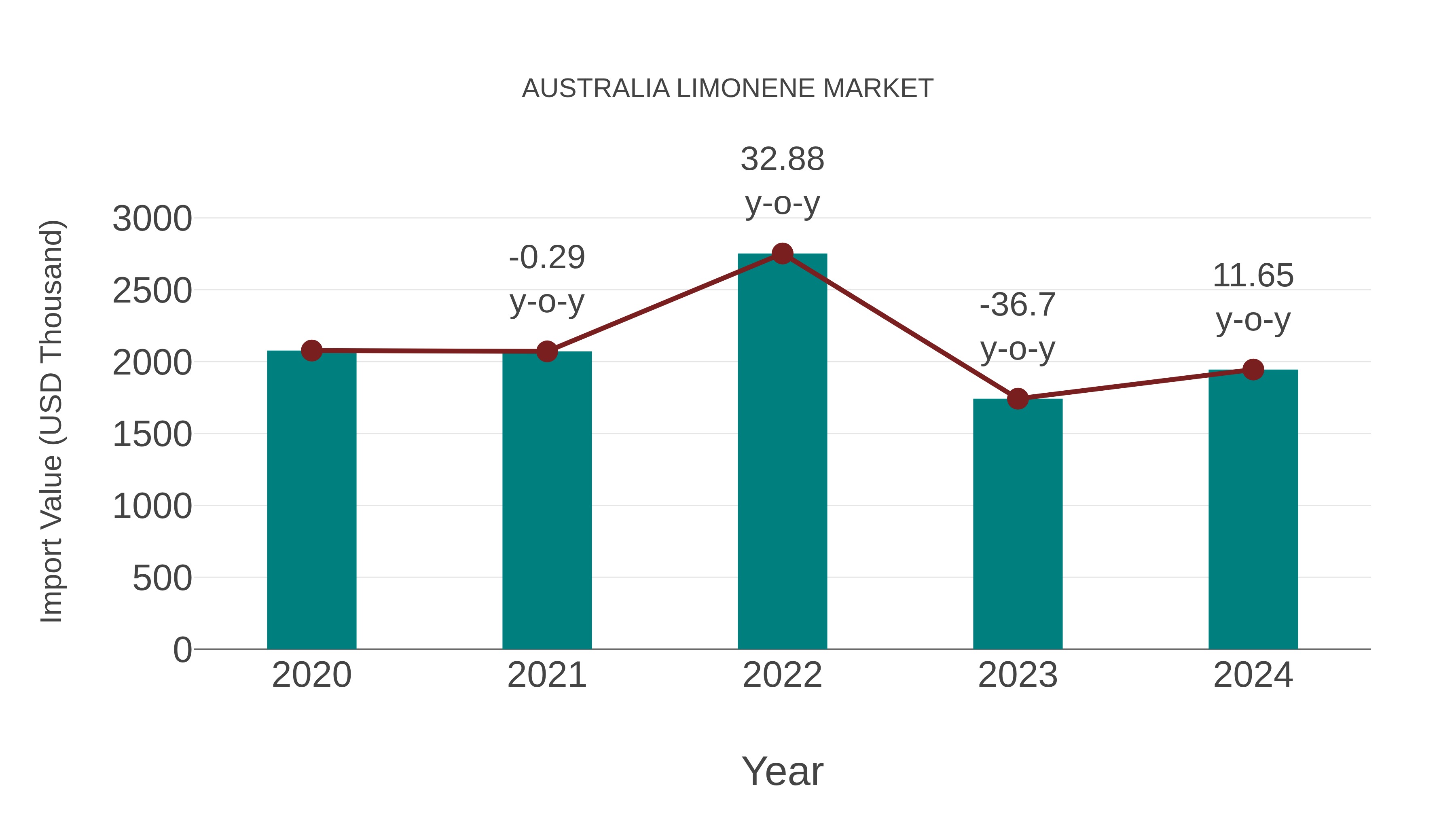
Australia`s limonene import trend showed a growth rate of 11.65% from 2023 to 2024, contrasting with a -1.63% compound annual growth rate (CAGR) for 2020-2024. This shift may be attributed to changing consumer preferences or evolving market dynamics impacting import momentum and demand patterns.
Australia Limonene Market Overview
The Limonene Market in Australia is seeing steady growth due to increasing demand in food flavoring, cosmetics, cleaning products, and pharmaceuticals. Derived from citrus peels, limonene is valued for its pleasant scent and solvent properties, making it popular in eco-friendly and organic products. Australia`s strong citrus industry ensures a steady raw material supply, while rising consumer preference for natural ingredients further boosts the market. Regulatory support for bio-based solvents and increasing R&D in alternative chemical production strengthen the sector`s prospects. As industries move toward sustainability, limonene`s market share is expected to expand across various applications.
Trends of the market
The limonene market in Australia is seeing rising demand from personal care, cleaning products, and food flavoring industries. This citrus-derived terpene is favored for its pleasant aroma and natural origin. Local citrus producers are exploring limonene extraction as a byproduct of juice processing, creating new economic opportunities. Natural and organic trends are fueling limonene-based product development. Regulatory approval for food and cosmetic applications supports market growth, although sensitivity to allergies is a consideration. The market is poised for further expansion with clean-label product innovations.
Challenges of the market
The limonene market in Australia is expanding as the demand for natural and plant-based ingredients in food, cosmetics, and cleaning products rises. Limonene, a terpene derived from citrus peels, is valued for its pleasant fragrance and its applications as a natural solvent and flavoring agent. However, the market faces challenges related to the supply and cost of raw materials, particularly with fluctuations in citrus fruit yields due to seasonal factors. Additionally, the market must contend with competition from synthetic alternatives, which are often cheaper and more readily available. Despite these challenges, the growing trend toward clean label products and natural ingredients is expected to drive the limonene market forward, especially in the food and cosmetic sectors.
Investment opportunities in the Market
The limonene market in Australia is gaining traction due to its applications in cleaning products, cosmetics, and as a solvent. Derived from citrus peels, limonene aligns with the demand for natural and biodegradable ingredients. Investors can explore opportunities in setting up extraction facilities utilizing citrus waste from the juice industry. Developing value-added limonene-based products can cater to the growing eco-conscious consumer base. Partnerships with agricultural sectors can ensure a consistent supply of raw materials. Regulatory support for natural product usage can further bolster market growth.
Government Policy of the market
Limonene, a naturally occurring compound found in citrus peels, is utilized in various industries, including cleaning products and fragrances. Australia`s government regulates the use of limonene through safety and environmental standards to ensure consumer protection. The National Industrial Chemicals Notification and Assessment Scheme (NICNAS) oversees the assessment and management of industrial chemicals like limonene. Manufacturers are required to comply with labeling and safety data sheet requirements. The government promotes the use of environmentally friendly and sustainable ingredients in consumer products. Research into the potential health effects of limonene exposure is supported to inform regulatory decisions. These policies aim to balance industrial use with public health and environmental considerations.?
Key Highlights of the Report:
- Australia Limonene Market Outlook
- Market Size of Australia Limonene Market, 2025
- Forecast of Australia Limonene Market, 2032
- Historical Data and Forecast of Australia Limonene Revenues & Volume for the Period 2022 - 2032F
- Australia Limonene Market Trend Evolution
- Australia Limonene Market Drivers and Challenges
- Australia Limonene Price Trends
- Australia Limonene Porter's Five Forces
- Australia Limonene Industry Life Cycle
- Historical Data and Forecast of Australia Limonene Market Revenues & Volume By Source for the Period 2022 - 2032F
- Historical Data and Forecast of Australia Limonene Market Revenues & Volume By Oranges for the Period 2022 - 2032F
- Historical Data and Forecast of Australia Limonene Market Revenues & Volume By Lemons for the Period 2022 - 2032F
- Historical Data and Forecast of Australia Limonene Market Revenues & Volume By Mandarin for the Period 2022 - 2032F
- Historical Data and Forecast of Australia Limonene Market Revenues & Volume By Others for the Period 2022 - 2032F
- Historical Data and Forecast of Australia Limonene Market Revenues & Volume By Application for the Period 2022 - 2032F
- Historical Data and Forecast of Australia Limonene Market Revenues & Volume By Food & beverages for the Period 2022 - 2032F
- Historical Data and Forecast of Australia Limonene Market Revenues & Volume By Pharmaceutical for the Period 2022 - 2032F
- Historical Data and Forecast of Australia Limonene Market Revenues & Volume By Cosmetics & Personal care for the Period 2022 - 2032F
- Historical Data and Forecast of Australia Limonene Market Revenues & Volume By Others for the Period 2022 - 2032F
- Australia Limonene Import Export Trade Statistics
- Market Opportunity Assessment By Source
- Market Opportunity Assessment By Application
- Australia Limonene Top Companies Market Share
- Australia Limonene Competitive Benchmarking By Technical and Operational Parameters
- Australia Limonene Company Profiles
- Australia Limonene Key Strategic Recommendations






































