Australia Managed Mobility Services Market Size & Growth Rate (2026-2032)
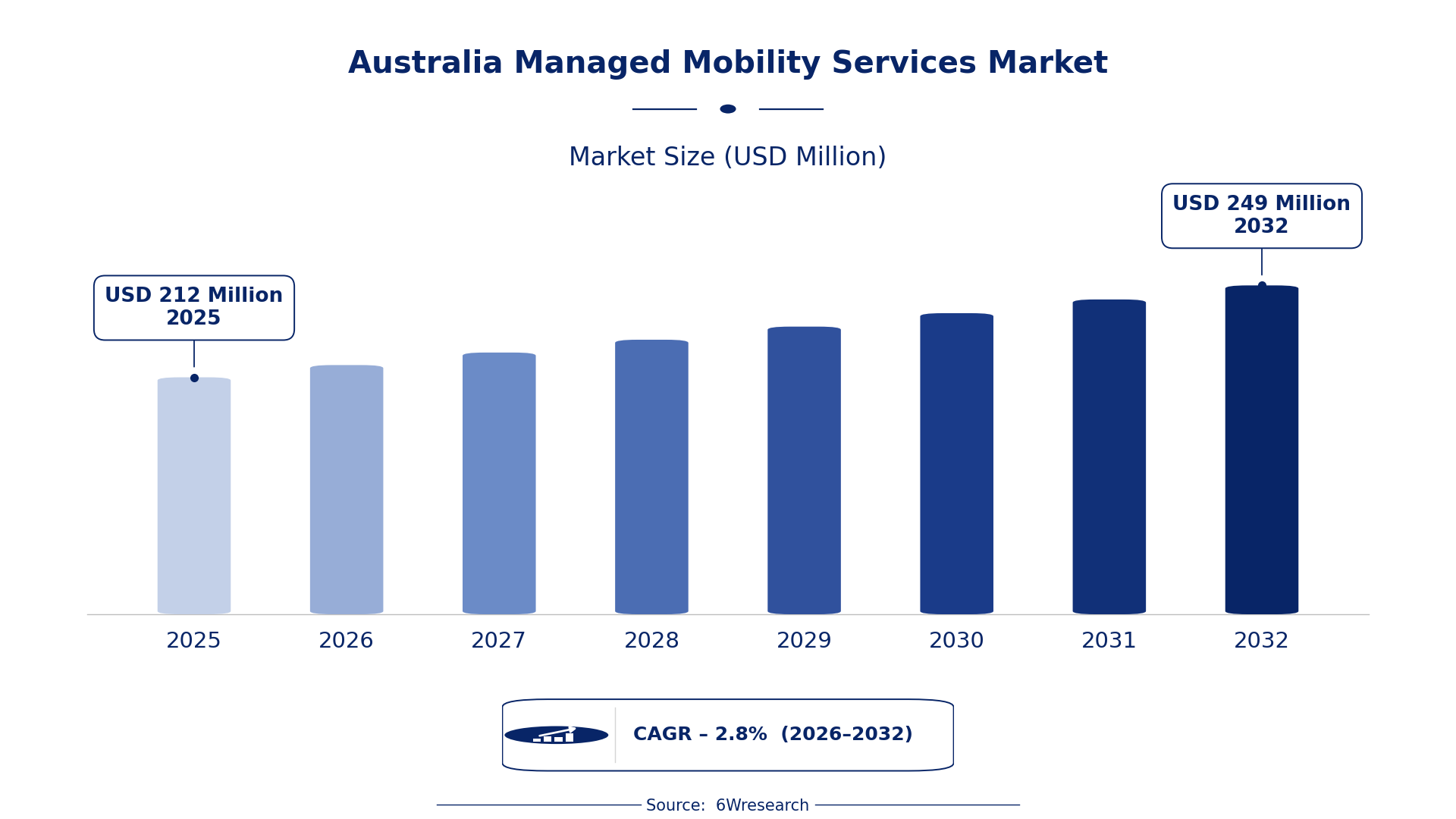
The Australia Managed Mobility Services Market was estimated at USD 212 Million in 2025 and is projected to reach USD 249 Million by 2032, growing at a CAGR of 2.8% from 2026 to 2032.
Australia Managed Mobility Services Market Synopsis
The Australia Managed Mobility Services Market is witnessing a surge as organizations increasingly turn to mobility solutions to boost employee performance and streamline operations. Companies are recognizing the benefits of managed mobility services, which encompass device management, application deployment, and critical security solutions tailored for various industry needs.
As remote working becomes more entrenched, the demand for secure mobile workforce management rises. The adoption of Bring Your Own Device (BYOD) policies has led to a proliferation of mobile devices, necessitating advanced management and security frameworks to protect sensitive corporate data.
Australia Managed Mobility Services Market Year-wise Growth Rate and Key Drivers
This graph illustrates the annual growth rates of the Australia Managed Mobility Services Market from 2021 to 2032, highlighting a steady upward trajectory and projected expansion over the forecast period.
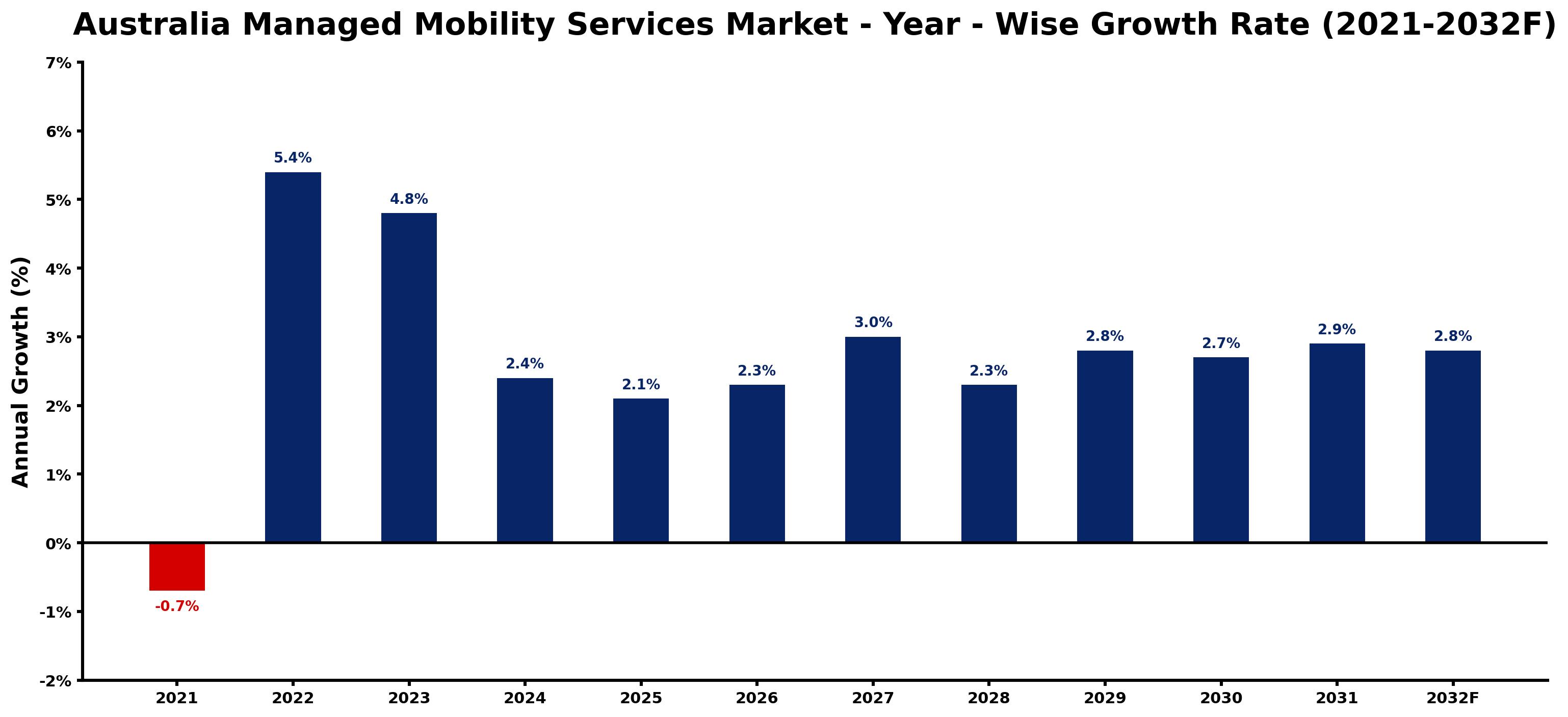
The table below presents the year‑wise growth rates along with the key drivers influencing the market
| Year | Growth Rate | Major Drivers |
| 2021 | -0.7% | Telstra's network reliability issues affected customer retention. |
| 2022 | 5.4% | Increased remote work policies driving managed mobility adoption. |
| 2023 | 4.8% | Government digital transformation strategy boosting mobile solutions demand. |
| 2024 | 2.4% | Rise in hybrid working models enhancing mobility service needs. |
| 2025 | 2.1% | Telecommunications infrastructure upgrades fostering managed mobility services. |
| 2026 | 2.3% | Enhanced cybersecurity regulations pushing for managed mobile solutions. |
| 2027 | 3.0% | Growing reliance on mobile applications in business operations. |
| 2028 | 2.3% | Aged care sector's demand for mobility services increasing. |
| 2029 | 2.8% | Increasing smartphone penetration fueling demand for managed mobility. |
| 2030 | 2.7% | Local enterprises investing in mobility for operational efficiency. |
| 2031 | 2.9% | Support from Australian tech startups innovating mobility services. |
| 2032 | 2.8% | Focus on sustainability driving eco-friendly mobile solutions. |
Note: Market size estimations and growth projections presented in this report are based on 6Wresearch's proprietary forecasting methodology, utilizing the latest available industry data, government publications, and primary research inputs.
Australia Managed Mobility Services Market Key Takeaways
Below are some of the specific key takeaways from the market, including:
- The increasing proliferation of mobile devices is a primary growth driver for managed mobility services.
- Adoption of BYOD policies poses challenges for data security and device management.
- The demand for mobile application management (MAM) and mobile device management (MDM) is rapidly rising.
- Regulatory compliance and data privacy concerns are pushing organizations to adopt managed services.
- Government initiatives aimed at promoting digital transformation are expected to support market growth.
Evaluation of Restraints in Australia Managed Mobility Services Market
Several key factors are limiting the full potential of the Australia Managed Mobility Services Market. Complexity in managing diverse mobile devices and operating systems leads to inefficiencies and vulnerabilities. Organizations face increased risks of data breaches, especially with the growing popularity of BYOD policies. Ensuring a consistent user experience while adhering to data privacy regulations adds another layer of complexity for service providers, which can hinder adoption rates across various sectors.
Australia Managed Mobility Services Market Trends
A shift towards automation in mobile device management is gaining traction, as organizations seek more efficient processes. The integration of Artificial Intelligence (AI) is emerging as a transformative trend, enhancing predictive capabilities in device maintenance and security monitoring. Cloud-based mobility solutions are also rising in popularity, offering scalability and flexibility in managing mobile resources.
Australia Managed Mobility Services Market Opportunities
With the increasing emphasis on data security, there is a substantial opportunity for specialized service providers to offer tailored mobility solutions that enhance security and compliance. Furthermore, the rise of mobile applications across industries opens avenues for innovative MAM solutions. Companies looking to enhance employee productivity through streamlined mobility management will find considerable growth prospects in this sector.
Government Initiatives in the Australia Managed Mobility Services Market
Government policies are playing an essential role in shaping the Australia Managed Mobility Services Market. Regulatory frameworks around data privacy and telecommunications are influencing how organizations adopt mobility services. Initiatives to promote digital transformation within public and private sectors are driving demand for more robust managed mobility solutions.
- A recently completed national digital infrastructure upgrade program aimed at enhancing connectivity across urban and rural areas.
- A current initiative by the Australian Communications and Media Authority (ACMA) focusing on enhancing data protection measures in mobile communications.
- A planned public-private partnership expected to commence by late 2026 to improve mobile service access in underserved regions.
- Ongoing regulatory reviews intended to streamline compliance requirements for managed mobility service providers.
Future Insights of the Australia Managed Mobility Services Market
Looking ahead to 2026-2032, the Australia Managed Mobility Services Market is set to evolve significantly. As organizations increasingly recognize the importance of mobility in driving productivity, demand for managed services will only intensify. The integration of advanced technologies like AI and machine learning will facilitate more effective management solutions. Additionally, the continued focus on data privacy and regulatory compliance will keep service providers on their toes, ensuring that they adapt quickly to new challenges and opportunities.
Australia Managed Mobility Services Market Latest Developments
In the past year, the Australia Managed Mobility Services Market has seen a flurry of activity as businesses strive to modernize their mobile management capabilities. Recent advancements highlight the sector's responsiveness to emerging technological and regulatory demands.
- A leading regional operator launched a new mobile application management platform in Q2 2025, aimed at enhancing user experience and security.
- An initiative that began in early 2025 focuses on expanding cybersecurity measures for mobile device management across multiple industries.
- A new partnership was announced in mid-2025 between two technology vendors to develop advanced analytics tools for better device management.
- A rollout of enhanced cloud-based mobility services is scheduled for the second half of 2026, addressing scalability concerns for enterprises.
Australia Managed Mobility Services Market - Key Attractiveness of the Report
- 10 Years of Market Numbers
- Historical Data Starting from 2022 to 2025
- Base Year: 2025
- Forecast Data until 2032
- Key Performance Indicators Impacting the Market
- Major Upcoming Developments and Projects
Key Highlights of the Report:
- Australia Managed Mobility Services Market Outlook
- Market Size of Australia Managed Mobility Services Market, 2025
- Forecast of Australia Managed Mobility Services Market, 2032
- Historical Data and Forecast of Australia Managed Mobility Services Revenues & Volume for the Period 2022-2032F
- Australia Managed Mobility Services Market Trend Evolution
- Australia Managed Mobility Services Market Drivers and Challenges
- Australia Managed Mobility Services Price Trends
- Australia Managed Mobility Services Porter's Five Forces
- Australia Managed Mobility Services Industry Life Cycle
- Historical Data and Forecast of Australia Managed Mobility Services Market Revenues & Volume By Function for the Period 2022-2032F
- Historical Data and Forecast of Australia Managed Mobility Services Market Revenues & Volume By Device Management for the Period 2022-2032F
- Historical Data and Forecast of Australia Managed Mobility Services Market Revenues & Volume By Application Management for the Period 2022-2032F
- Historical Data and Forecast of Australia Managed Mobility Services Market Revenues & Volume By Security Management for the Period 2022-2032F
- Historical Data and Forecast of Australia Managed Mobility Services Market Revenues & Volume By Maintenance & Support for the Period 2022-2032F
- Historical Data and Forecast of Australia Managed Mobility Services Market Revenues & Volume By Organization Size for the Period 2022-2032F
- Historical Data and Forecast of Australia Managed Mobility Services Market Revenues & Volume By SMEs for the Period 2022-2032F
- Historical Data and Forecast of Australia Managed Mobility Services Market Revenues & Volume By Large Enterprises for the Period 2022-2032F
- Historical Data and Forecast of Australia Managed Mobility Services Market Revenues & Volume By Industry Vertical for the Period 2022-2032F
- Historical Data and Forecast of Australia Managed Mobility Services Market Revenues & Volume By Healthcare for the Period 2022-2032F
- Historical Data and Forecast of Australia Managed Mobility Services Market Revenues & Volume By Manufacturing for the Period 2022-2032F
- Historical Data and Forecast of Australia Managed Mobility Services Market Revenues & Volume By Logistics and Transportation for the Period 2022-2032F
- Historical Data and Forecast of Australia Managed Mobility Services Market Revenues & Volume By Retail for the Period 2022-2032F
- Historical Data and Forecast of Australia Managed Mobility Services Market Revenues & Volume By Financial Services for the Period 2022-2032F
- Historical Data and Forecast of Australia Managed Mobility Services Market Revenues & Volume By Telecom and IT for the Period 2022-2032F
- Historical Data and Forecast of Australia Managed Mobility Services Market Revenues & Volume By Media and Entertainment for the Period 2022-2032F
- Historical Data and Forecast of Australia Managed Mobility Services Market Revenues & Volume By Travel and Hospitality for the Period 2022-2032F
- Australia Managed Mobility Services Import Export Trade Statistics
- Market Opportunity Assessment By Function
- Market Opportunity Assessment By Organization Size
- Market Opportunity Assessment By Industry Vertical
- Australia Managed Mobility Services Top Companies Market Share
- Australia Managed Mobility Services Competitive Benchmarking By Technical and Operational Parameters
- Australia Managed Mobility Services Company Profiles
- Australia Managed Mobility Services Key Strategic Recommendations






































