Australia Meal Replacement Shakes Market: Import Trend Analysis
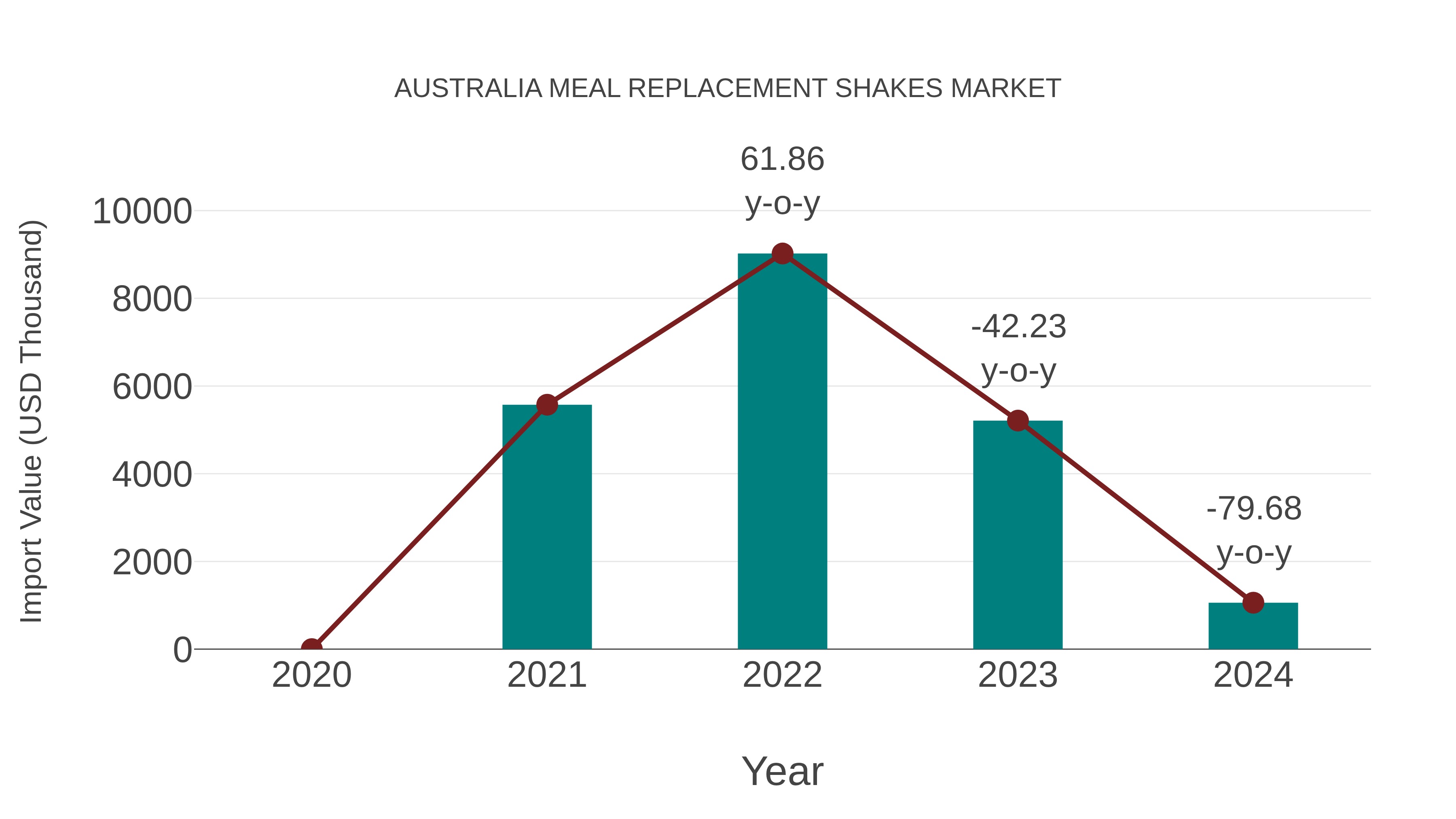
Australia`s import trend for the meal replacement shakes market experienced a notable decline, with a growth rate of -79.68% from 2023 to 2024 and a CAGR of -42.51% from 2020 to 2024. This significant decrease could be attributed to shifting consumer preferences towards more traditional food options or changes in import regulations impacting the market stability.
Australia Meal Replacement Shakes Market Overview
The meal replacement shakes market in Australia has witnessed substantial growth, driven by the rising focus on health, fitness, and convenience. These shakes are popular among busy professionals, athletes, and health-conscious consumers looking for nutritious, low-calorie options. The market includes a wide range of products tailored for weight management, dietary restrictions, and nutritional supplementation. Product innovation, including plant-based and organic options, is a key trend supported by increasing awareness around balanced nutrition.
Trends of the market
The meal replacement shakes market in Australia is expanding as busy lifestyles and health consciousness grow among consumers. There is a noticeable shift towards plant-based, low-sugar, and protein-rich formulations. Functional ingredients such as adaptogens, probiotics, and superfoods are increasingly being incorporated. Online sales channels and subscription-based models are contributing significantly to market penetration, especially among fitness enthusiasts and weight-conscious consumers.
Challenges of the market
One of the central challenges in the meal replacement shakes market in Australia is consumer skepticism about nutritional value and long-term health benefits. Many consumers perceive these products as artificial or inadequate substitutes for whole meals. Moreover, market saturation with numerous brands and limited product differentiation creates intense competition, making it difficult for smaller or newer entrants to gain a foothold. Regulatory scrutiny regarding health claims and the use of specific ingredients also adds to the complexity of product development and marketing.
Investment opportunities in the Market
With health, fitness, and convenience driving consumer choices, this market offers strong potential for investment in brands that deliver plant-based, high-protein, and clean-label shakes. Strategic investments can also target direct-to-consumer (DTC) platforms and influencer-driven marketing models. Opportunities also lie in private label manufacturing and distribution partnerships with supermarkets, gyms, and e-commerce platforms.
Government Policy of the market
The Australian government enforces strict health and safety regulations on food and beverage products, including meal replacement shakes. These policies ensure that nutritional claims made by meal replacement products are backed by scientific evidence and that labeling is clear and accurate. The Food Standards Australia New Zealand (FSANZ) sets guidelines on the formulation of such products, particularly around ingredients like vitamins and minerals. Furthermore, government initiatives aimed at reducing obesity and promoting balanced diets may influence public perception and demand for meal replacements, pushing companies to align with health-focused policies.
Key Highlights of the Report:
- Australia Meal Replacement Shakes Market Outlook
- Market Size of Australia Meal Replacement Shakes Market, 2025
- Forecast of Australia Meal Replacement Shakes Market, 2032
- Historical Data and Forecast of Australia Meal Replacement Shakes Revenues & Volume for the Period 2022 - 2032F
- Australia Meal Replacement Shakes Market Trend Evolution
- Australia Meal Replacement Shakes Market Drivers and Challenges
- Australia Meal Replacement Shakes Price Trends
- Australia Meal Replacement Shakes Porter's Five Forces
- Australia Meal Replacement Shakes Industry Life Cycle
- Historical Data and Forecast of Australia Meal Replacement Shakes Market Revenues & Volume By Product Type for the Period 2022 - 2032F
- Historical Data and Forecast of Australia Meal Replacement Shakes Market Revenues & Volume By Ready-to-Drink Products for the Period 2022 - 2032F
- Historical Data and Forecast of Australia Meal Replacement Shakes Market Revenues & Volume By Powdered Supplements for the Period 2022 - 2032F
- Historical Data and Forecast of Australia Meal Replacement Shakes Market Revenues & Volume By Distribution Channel for the Period 2022 - 2032F
- Historical Data and Forecast of Australia Meal Replacement Shakes Market Revenues & Volume By Convenience Stores for the Period 2022 - 2032F
- Historical Data and Forecast of Australia Meal Replacement Shakes Market Revenues & Volume By Hypermarkets/Supermarkets for the Period 2022 - 2032F
- Historical Data and Forecast of Australia Meal Replacement Shakes Market Revenues & Volume By Specialty Stores for the Period 2022 - 2032F
- Historical Data and Forecast of Australia Meal Replacement Shakes Market Revenues & Volume By Online Retail Stores for the Period 2022 - 2032F
- Historical Data and Forecast of Australia Meal Replacement Shakes Market Revenues & Volume By Other Distribution Channels for the Period 2022 - 2032F
- Australia Meal Replacement Shakes Import Export Trade Statistics
- Market Opportunity Assessment By Product Type
- Market Opportunity Assessment By Distribution Channel
- Australia Meal Replacement Shakes Top Companies Market Share
- Australia Meal Replacement Shakes Competitive Benchmarking By Technical and Operational Parameters
- Australia Meal Replacement Shakes Company Profiles
- Australia Meal Replacement Shakes Key Strategic Recommendations






































