Australia Multichannel Order Management Market Size & Growth Rate (2026-2032)
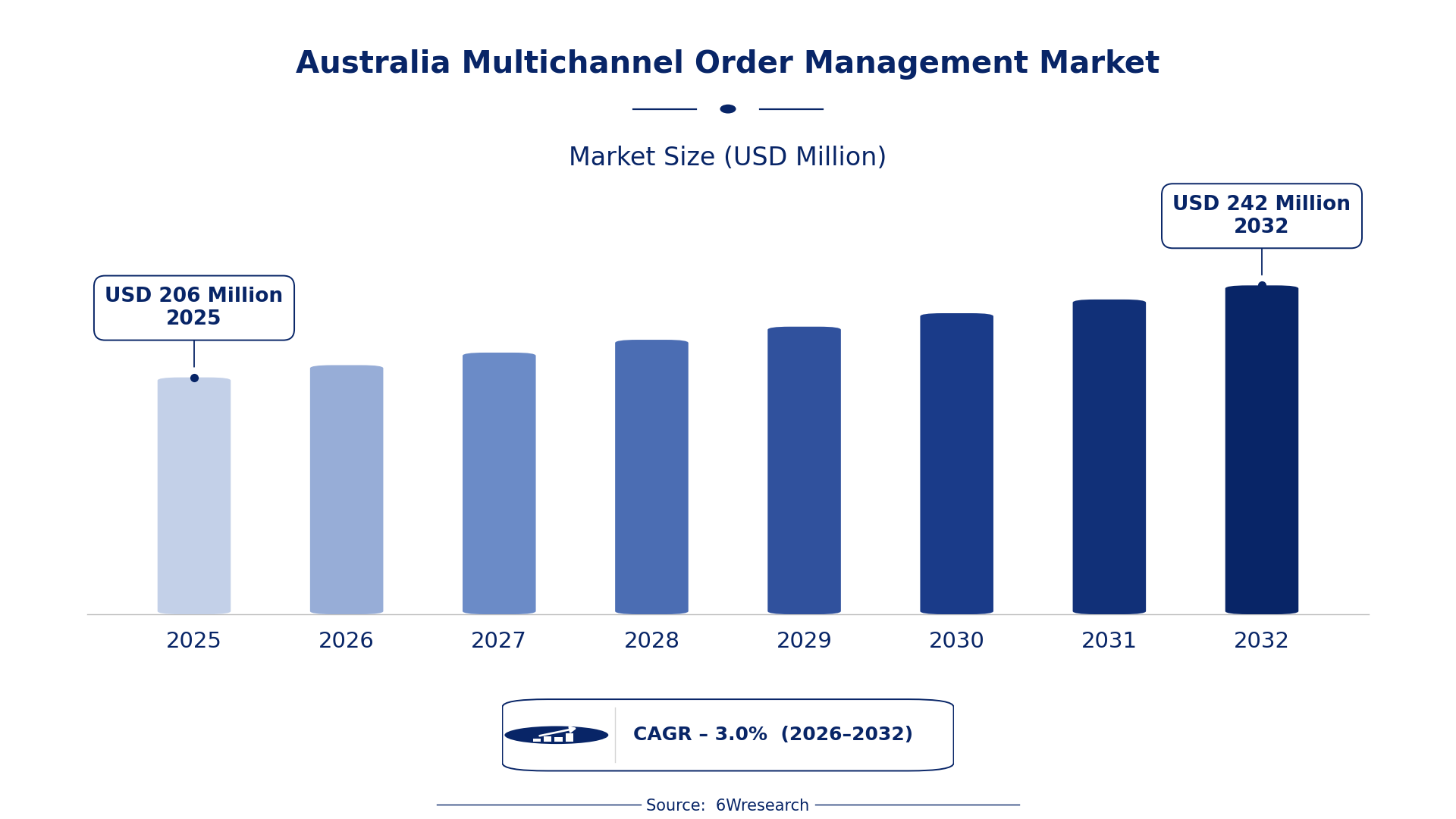
The Australia Multichannel Order Management Market was estimated at USD 206 Million in 2025 and is projected to reach USD 242 Million by 2032, growing at a CAGR of 3.0% from 2026 to 2032.
Australia Multichannel Order Management Market Synopsis
The surge in e-commerce is the primary force driving the Australia Multichannel Order Management Market. As consumers increasingly expect a cohesive shopping experience across platforms, businesses are compelled to invest in systems that facilitate efficient order processing and inventory management.
To stay competitive, Australian retailers are integrating technology that offers real-time visibility into inventory and order status. This growing emphasis on automation and data-driven insights is enhancing supply chain efficiency, ultimately leading to improved customer satisfaction.
Australia Multichannel Order Management Market Year-wise Growth Rate and Key Drivers
This graph illustrates the annual growth rates of the Australia Multichannel Order Management Market from 2021 to 2032, highlighting a steady upward trajectory and projected expansion over the forecast period.
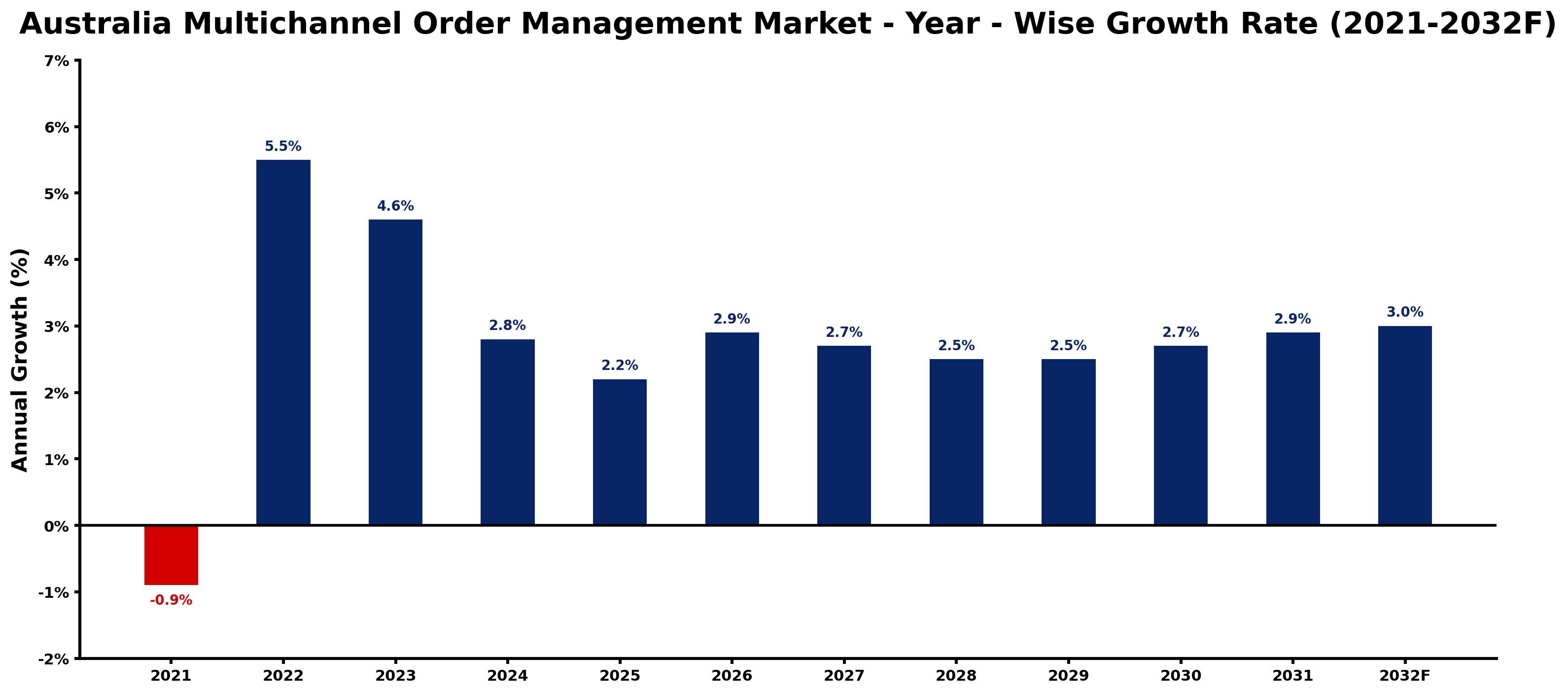
The table below presents the year‑wise growth rates along with the key drivers influencing the market
| Year | Growth Rate | Major Drivers |
| 2021 | -0.9% | Border restrictions hindered e-commerce fulfillment capabilities. |
| 2022 | 5.5% | Increased online retail sales amidst pandemic recovery. |
| 2023 | 4.6% | Launch of Australia's Digital Economy Strategy boosting e-commerce. |
| 2024 | 2.8% | Demand for efficient logistics solutions by retailers. |
| 2025 | 2.2% | Growing consumer preference for omnichannel shopping experiences. |
| 2026 | 2.9% | Investment in AI-powered inventory management technologies. |
| 2027 | 2.7% | Surge in D2C brands enhancing order fulfillment capabilities. |
| 2028 | 2.5% | Integration of local payment systems in online platforms. |
| 2029 | 2.5% | Regulatory support for small retailers in digital transitions. |
| 2030 | 2.7% | Enhancements in shipping infrastructure across major cities. |
| 2031 | 2.9% | Collaborations between retailers and tech firms for innovation. |
| 2032 | 3.0% | Adoption of sustainable practices in order management systems. |
Note: Market size estimations and growth projections presented in this report are based on 6Wresearch's proprietary forecasting methodology, utilizing the latest available industry data, government publications, and primary research inputs.
Australia Multichannel Order Management Market Key Takeaways
Below are some of the specific key takeaways from the market, including:
- The market is experiencing steady growth fueled by rising e-commerce activities and omnichannel strategies.
- Increased demand for real-time order tracking and inventory visibility is reshaping operational priorities.
- Investment in AI-driven solutions is critical for enhancing efficiency and customer engagement.
- Integration with logistics providers is essential for streamlining fulfillment processes.
- Regulatory compliance remains a crucial consideration for businesses operating in this space.
Evaluation of Restraints in Australia Multichannel Order Management Market
Despite the opportunities, the Australia Multichannel Order Management Market faces considerable challenges. Supply chain disruptions, particularly from global events, have forced many retailers to rethink their operational strategies. Additionally, the integration of modern order management systems with outdated legacy systems can be prohibitively expensive and complex. Fluctuating consumer demand further complicates forecasting and inventory management, making it difficult for businesses to maintain optimal stock levels.
Australia Multichannel Order Management Market Trends
A shift towards AI and machine learning is becoming increasingly apparent, with businesses leveraging these technologies for smarter inventory management. Enhanced analytics tools are being adopted to provide deeper insights into consumer behavior, allowing for more informed decision-making. The trend of personalization in customer service is also emerging, with companies tailoring their offerings based on real-time data. As consumers continue to expect faster and more flexible fulfillment options, the demand for integrated solutions will only intensify.
Australia Multichannel Order Management Market Opportunities
Investment opportunities are abundant in this market, particularly in the development of AI-driven inventory management systems and enhanced order tracking capabilities. Companies that can innovate in cross-border trade stand to benefit significantly, especially as global e-commerce expands. on top of that, partnerships with logistics and supply chain companies are likely to provide a competitive edge, facilitating smoother operations and improved customer experiences.
Government Initiatives in the Australia Multichannel Order Management Market
Government policies are shaping the Australia Multichannel Order Management Market by focusing on consumer rights and regulatory compliance. The Australian Consumer Law (ACL) and the Competition and Consumer Act 2010 ensure that businesses uphold consumer protections across all sales channels. This regulatory environment is crucial for fostering consumer trust and ensuring fair practices within the marketplace.
- A recently completed initiative involved a comprehensive review of the ACL to improve transparency in online transactions.
- A current initiative focuses on enhancing data protection measures under the Australian Consumer Data Right (CDR), ensuring secure handling of consumer information.
- A planned regulatory framework is set to be introduced in 2026, mandating standardized returns and refund processes across all retail channels.
- The government is also developing a national logistics strategy aimed at improving supply chain resilience over the next five years.
Future Insights of the Australia Multichannel Order Management Market
Looking ahead to 2026-2032, the Australia Multichannel Order Management Market is expected to evolve significantly. As technology continues to advance, the integration of advanced analytics and AI will become standard practice for retailers. The focus will shift increasingly toward providing personalized customer experiences, supported by data insights. on top of that, as cross-border e-commerce grows, companies will need to adapt their strategies to meet international compliance standards and consumer expectations.
Australia Multichannel Order Management Market Latest Developments
Recent developments in the Australia Multichannel Order Management Market indicate a dynamic shift towards automation and enhanced customer service capabilities. Over the past year, companies have been actively seeking innovative solutions to streamline operations and improve consumer engagement.
- A major technology vendor launched a new AI-driven inventory management solution in Q1 2025, aimed at optimizing stock levels across multiple channels.
- An ongoing initiative is focused on implementing real-time order tracking systems, with several retailers currently in pilot phases as of mid-2025.
- A partnership was formed in late 2024 between leading logistics firms to create a shared platform for improving last-mile delivery efficiency.
- Upcoming regulatory changes expected in early 2026 will enhance guidelines for consumer data handling and protection within e-commerce.
Australia Multichannel Order Management Market - Key Attractiveness of the Report
- 10 Years of Market Numbers
- Historical Data Starting from 2022 to 2025
- Base Year: 2025
- Forecast Data until 2032
- Key Performance Indicators Impacting the Market
- Major Upcoming Developments and Projects
Key Highlights of the Report:
- Australia Multichannel Order Management Market Outlook
- Market Size of Australia Multichannel Order Management Market, 2025
- Forecast of Australia Multichannel Order Management Market, 2032
- Historical Data and Forecast of Australia Multichannel Order Management Revenues & Volume for the Period 2022-2032F
- Australia Multichannel Order Management Market Trend Evolution
- Australia Multichannel Order Management Market Drivers and Challenges
- Australia Multichannel Order Management Price Trends
- Australia Multichannel Order Management Porter's Five Forces
- Australia Multichannel Order Management Industry Life Cycle
- Historical Data and Forecast of Australia Multichannel Order Management Market Revenues & Volume By Component for the Period 2022-2032F
- Historical Data and Forecast of Australia Multichannel Order Management Market Revenues & Volume By Software for the Period 2022-2032F
- Historical Data and Forecast of Australia Multichannel Order Management Market Revenues & Volume By Services for the Period 2022-2032F
- Historical Data and Forecast of Australia Multichannel Order Management Market Revenues & Volume By Vertical for the Period 2022-2032F
- Historical Data and Forecast of Australia Multichannel Order Management Market Revenues & Volume By Retail for the Period 2022-2032F
- Historical Data and Forecast of Australia Multichannel Order Management Market Revenues & Volume By e-commerce for the Period 2022-2032F
- Historical Data and Forecast of Australia Multichannel Order Management Market Revenues & Volume By Wholesale for the Period 2022-2032F
- Historical Data and Forecast of Australia Multichannel Order Management Market Revenues & Volume By Manufacturing for the Period 2022-2032F
- Historical Data and Forecast of Australia Multichannel Order Management Market Revenues & Volume By Transportation & Logistics for the Period 2022-2032F
- Historical Data and Forecast of Australia Multichannel Order Management Market Revenues & Volume By Application for the Period 2022-2032F
- Historical Data and Forecast of Australia Multichannel Order Management Market Revenues & Volume By Order Fulfillment for the Period 2022-2032F
- Historical Data and Forecast of Australia Multichannel Order Management Market Revenues & Volume By Inventory Management for the Period 2022-2032F
- Historical Data and Forecast of Australia Multichannel Order Management Market Revenues & Volume By Channel Integration for the Period 2022-2032F
- Historical Data and Forecast of Australia Multichannel Order Management Market Revenues & Volume By Workflow Automation for the Period 2022-2032F
- Historical Data and Forecast of Australia Multichannel Order Management Market Revenues & Volume By Integrated POS for the Period 2022-2032F
- Historical Data and Forecast of Australia Multichannel Order Management Market Revenues & Volume By Deployment Mode for the Period 2022-2032F
- Historical Data and Forecast of Australia Multichannel Order Management Market Revenues & Volume By On-premises for the Period 2022-2032F
- Historical Data and Forecast of Australia Multichannel Order Management Market Revenues & Volume By Cloud for the Period 2022-2032F
- Historical Data and Forecast of Australia Multichannel Order Management Market Revenues & Volume By Organization Size for the Period 2022-2032F
- Historical Data and Forecast of Australia Multichannel Order Management Market Revenues & Volume By Large Enterprises for the Period 2022-2032F
- Historical Data and Forecast of Australia Multichannel Order Management Market Revenues & Volume By SMEs for the Period 2022-2032F
- Australia Multichannel Order Management Import Export Trade Statistics
- Market Opportunity Assessment By Component
- Market Opportunity Assessment By Vertical
- Market Opportunity Assessment By Application
- Market Opportunity Assessment By Deployment Mode
- Market Opportunity Assessment By Organization Size
- Australia Multichannel Order Management Top Companies Market Share
- Australia Multichannel Order Management Competitive Benchmarking By Technical and Operational Parameters
- Australia Multichannel Order Management Company Profiles
- Australia Multichannel Order Management Key Strategic Recommendations






































