Australia Non-linear Editing (NLE) Market Size, Share & Growth Rate
The Australia Non-linear Editing (NLE) Market was estimated at USD 110 Million in 2025 and is projected to reach USD 129 Million by 2032, growing at a CAGR of 2.3% from 2026 to 2032. This growth trajectory is largely driven by the increasing demand for professional video editing solutions across various sectors, including media, entertainment, and corporate training. The proliferation of digital content consumption, alongside a surge in social media video production, underscores a pivotal shift towards high-quality video output, positioning NLE as a critical enabler of this evolution.
Australia Non-linear Editing (NLE) Market Year-wise Growth Rate and Key Drivers
This graph highlights how the Australia Non-linear Editing (NLE) Market has steadily grown over the years, supported by major growth factors.
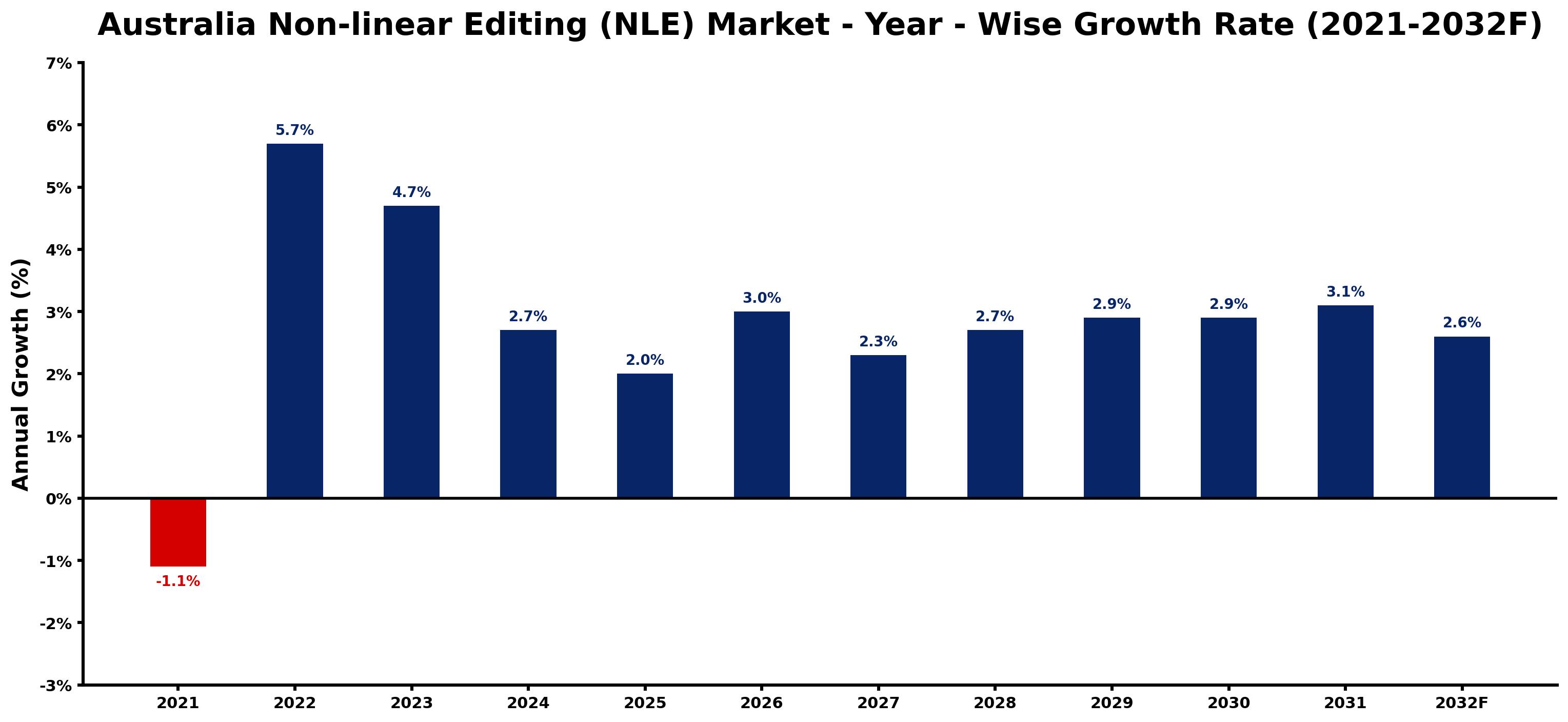
The table below presents the year‑wise growth rates along with the key drivers influencing the market
| Year | Growth Rate | Major Drivers |
| 2021 | -1.1% | Expansion of transportation and logistics networks |
| 2022 | 5.7% | Expansion of commercial construction activities |
| 2023 | 4.7% | Expansion of commercial construction activities |
| 2024 | 2.7% | Increasing adoption of advanced technologies |
| 2025 | 2.0% | Increasing adoption of advanced technologies |
| 2026 | 3.0% | Growing urbanization and commercial development |
| 2027 | 2.3% | Government infrastructure modernization initiatives |
| 2028 | 2.7% | Rapid growth in telecom and data center sectors |
| 2029 | 2.9% | Increasing industrial automation investments |
| 2030 | 2.9% | Increasing industrial automation investments |
| 2031 | 3.1% | Government infrastructure modernization initiatives |
| 2032 | 2.6% | Growing renewable energy integration projects |
Note - Market size estimations and growth projections presented in this report are based on 6Wresearch’s advanced forecasting approach, validated with industry datasets as of June 2026.
Australia Non-linear Editing (NLE) Market Synopsis
Currently, the Australian non-linear editing market is experiencing robust expansion fueled by technological advancements and a heightened need for video content. The convergence of AI-driven editing tools and cloud-based solutions is revolutionizing editing workflows, making them more efficient and accessible.
In Australia, the media and entertainment industries are at the forefront of adopting these advanced editing solutions, reflecting a broader trend toward high-quality production values. The rise in online education and corporate training videos further amplifies the necessity for sophisticated editing capabilities, ensuring that content creators remain competitive in an increasingly digital landscape.
Australia Non-linear Editing (NLE) Market Key Takeaways
- The market is driven by the growing demand for high-quality video content in various sectors.
- Technological advancements, such as AI and cloud-based solutions, are shaping market dynamics.
- Investment in NLE tools presents significant opportunities, particularly in the media and corporate sectors.
- Government incentives and policies are supporting growth in the creative industries.
- There are emerging trends toward collaborative editing solutions that enhance efficiency.
Evaluation of Restraints in Australia Non-linear Editing (NLE) Market
Despite the promising landscape, the Australian NLE market faces notable restraints that could hinder growth. The high costs associated with both software and hardware can be prohibitive for smaller firms and independent creators, often limiting access to advanced tools. Additionally, compatibility issues with varying video formats can create challenges for seamless editing experiences. The reliance on continuous software updates can also pose operational hurdles, making it essential for businesses to keep pace with the rapid technological advancements in this sector.
Australia Non-linear Editing (NLE) Market Trends
A significant trend in the Australia NLE market is the increasing incorporation of AI technologies that automate repetitive editing tasks, allowing editors to focus on creative decisions. Cloud-based solutions are also gaining traction, enabling real-time collaboration among teams, regardless of geographic barriers. Moreover, the rise of user-generated content on social media platforms is influencing the demand for NLE tools, pushing developers to innovate user-friendly interfaces that cater to a broader audience.
Australia Non-linear Editing (NLE) Market Opportunities
The evolving landscape of content creation presents a myriad of opportunities within the NLE market. As businesses increasingly shift towards digital training and educational resources, there is a distinct need for advanced editing solutions tailored to these applications. Additionally, the growing interest in live streaming and on-demand content creates avenues for investment in NLE technologies that support quick turnaround times and high-quality output. Companies that focus on integrating AI and enhancing collaborative features are poised to capitalize on these trends.
Government Initiatives in the Australia Non-linear Editing (NLE) Market
The Australian government plays a crucial role in fostering the non-linear editing landscape through various policies and support mechanisms. Intellectual property laws are designed to protect the rights of digital content creators, ensuring a sustainable environment for the industry. Furthermore, the government offers grants and tax incentives targeted at the creative sector, stimulating investments in film and media production. These initiatives contribute to an ecosystem that nurtures innovation and growth in the NLE market.
Future Insights of the Australia Non-linear Editing (NLE) Market
Looking ahead to 2026-2032, the Australia non-linear editing market is expected to continue its upward trajectory. The increasing demand for high-definition and immersive video content will necessitate ongoing advancements in editing technologies. As more organizations adopt digital solutions, the importance of seamless, collaborative workflows will drive the adoption of cloud-based editing platforms. With the integration of AI becoming more mainstream, the future will likely see greater efficiency and creativity in the editing process, positioning NLE as a vital component of content production across multiple sectors.
Australia Non-linear Editing (NLE) Market Latest Developments (May 2025 - June 2026)
In the recent months, the Australian NLE market has witnessed notable advancements, particularly in the integration of AI tools that enhance editing workflows. Companies are investing more in cloud-based solutions that facilitate real-time collaboration and efficient project management. Moreover, there is an uptick in user-friendly software aimed at independent creators and small businesses, reflecting a response to the growing demand for accessible editing tools. Additionally, industry stakeholders are increasingly focusing on data security measures in light of rising concerns surrounding cloud-based content management.
Australia Non-linear Editing (NLE) Market - Key Attractiveness of the Report
- 10 Years of Market Numbers
- Historical Data Starting from 2022 to 2025
- Base Year: 2025
- Forecast Data until 2032
- Key Performance Indicators Impacting the Market
- Major Upcoming Developments and Projects
Key Highlights of the Report:
- Australia Non-linear Editing (NLE) Market Outlook
- Market Size of Australia Non-linear Editing (NLE) Market, 2025
- Forecast of Australia Non-linear Editing (NLE) Market, 2032
- Historical Data and Forecast of Australia Non-linear Editing (NLE) Revenues & Volume for the Period 2022-2032F
- Australia Non-linear Editing (NLE) Market Trend Evolution
- Australia Non-linear Editing (NLE) Market Drivers and Challenges
- Australia Non-linear Editing (NLE) Price Trends
- Australia Non-linear Editing (NLE) Porter's Five Forces
- Australia Non-linear Editing (NLE) Industry Life Cycle
- Historical Data and Forecast of Australia Non-linear Editing (NLE) Market Revenues & Volume By Type for the Period 2022-2032F
- Historical Data and Forecast of Australia Non-linear Editing (NLE) Market Revenues & Volume By Non-linear Video Editing for the Period 2022-2032F
- Historical Data and Forecast of Australia Non-linear Editing (NLE) Market Revenues & Volume By Non-linear Audio Editing for the Period 2022-2032F
- Historical Data and Forecast of Australia Non-linear Editing (NLE) Market Revenues & Volume By Non-linear Image Editing for the Period 2022-2032F
- Historical Data and Forecast of Australia Non-linear Editing (NLE) Market Revenues & Volume By Application for the Period 2022-2032F
- Historical Data and Forecast of Australia Non-linear Editing (NLE) Market Revenues & Volume By Commercial for the Period 2022-2032F
- Historical Data and Forecast of Australia Non-linear Editing (NLE) Market Revenues & Volume By Personal for the Period 2022-2032F
- Historical Data and Forecast of Australia Non-linear Editing (NLE) Market Revenues & Volume By Others for the Period 2022-2032F
- Australia Non-linear Editing (NLE) Import Export Trade Statistics
- Market Opportunity Assessment By Type
- Market Opportunity Assessment By Application
- Australia Non-linear Editing (NLE) Top Companies Market Share
- Australia Non-linear Editing (NLE) Competitive Benchmarking By Technical and Operational Parameters
- Australia Non-linear Editing (NLE) Company Profiles
- Australia Non-linear Editing (NLE) Key Strategic Recommendations






































