Australia Orphan Drugs Market Size, Share & Growth Rate
The Australia Orphan Drugs Market was estimated at USD 225 Million in 2025 and is projected to reach USD 265 Million by 2032, growing at a CAGR of 2.4% from 2026 to 2032. This anticipated growth can be attributed to a rising prevalence of rare diseases coupled with increased government incentives for the development of orphan drugs. Furthermore, advancements in biotechnology and enhanced diagnostic capabilities are significantly contributing to the market's upward trajectory, addressing previously unmet medical needs.
Australia Orphan Drugs Market Year-wise Growth Rate and Key Drivers
This graph highlights how the Australia Orphan Drugs Market has steadily grown over the years, supported by major growth factors.
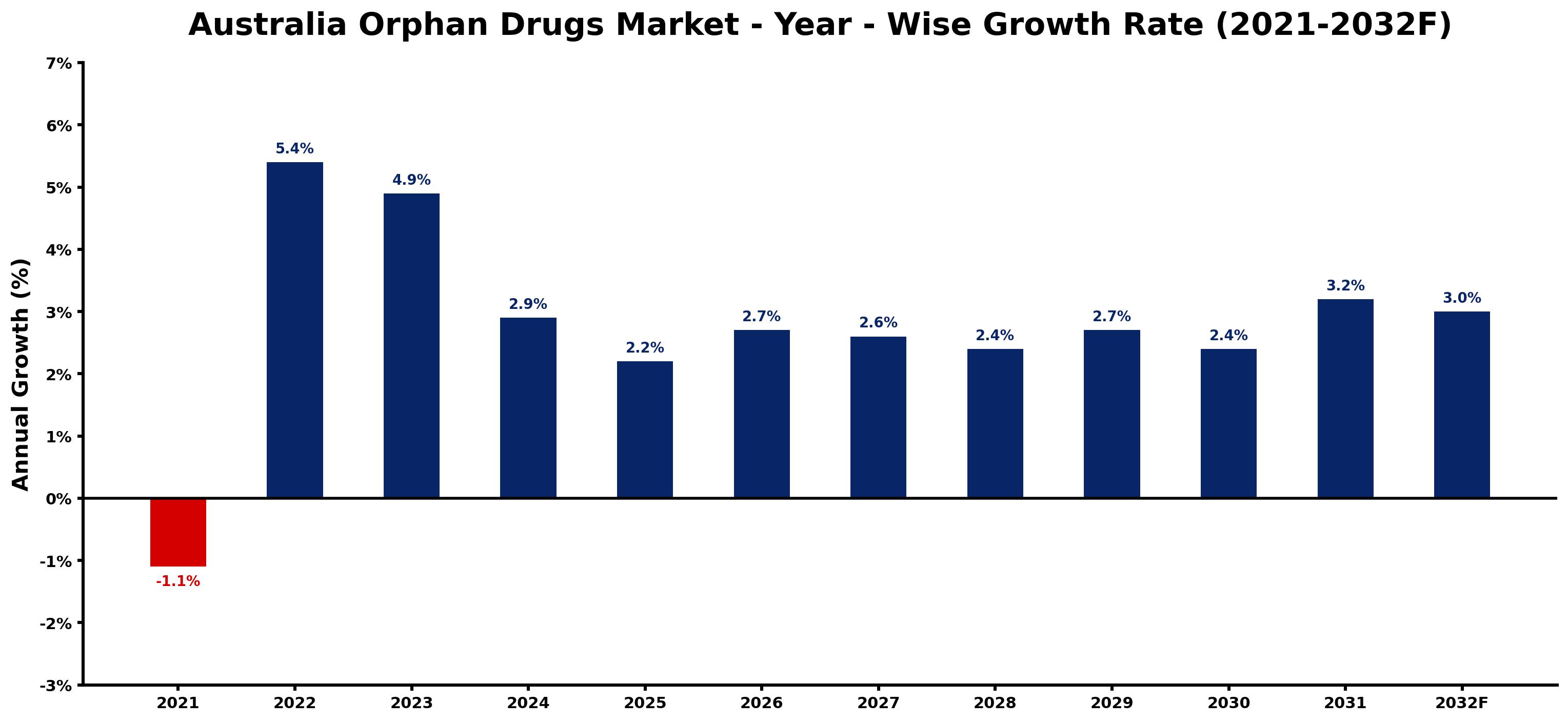
The table below presents the year‑wise growth rates along with the key drivers influencing the market
| Year | Growth Rate | Major Drivers |
| 2021 | -1.1% | Rapid growth in telecom and data center sectors |
| 2022 | 5.4% | Expansion of manufacturing activities |
| 2023 | 4.9% | Expansion of commercial construction activities |
| 2024 | 2.9% | Increasing adoption of advanced technologies |
| 2025 | 2.2% | Government infrastructure modernization initiatives |
| 2026 | 2.7% | Increasing smart city development projects |
| 2027 | 2.6% | Increasing industrial automation investments |
| 2028 | 2.4% | Increasing adoption of advanced technologies |
| 2029 | 2.7% | Growing renewable energy integration projects |
| 2030 | 2.4% | Growing urbanization and commercial development |
| 2031 | 3.2% | Growing urbanization and commercial development |
| 2032 | 3.0% | Expansion of transportation and logistics networks |
Note - Market size estimations and growth projections presented in this report are based on 6Wresearch's advanced forecasting approach, validated with industry datasets as of June 2026.
Australia Orphan Drugs Market Synopsis
The Australia Orphan Drugs Market is currently experiencing positive momentum driven by heightened awareness of rare diseases and proactive governmental measures. This energy is translating into increased investments in research and development, as pharmaceutical companies seek to capitalize on the opportunities presented by this specialized segment.
Looking ahead, the market is poised for further expansion. Continued regulatory support, along with the ongoing commitment of biotech firms to innovate, positions Australia as a promising landscape for orphan drug development. However, the market must navigate challenges such as high development costs and regulatory hurdles that could impact its growth.
Australia Orphan Drugs Market Key Takeaways
- The Australian orphan drugs sector is backed by strong government incentives, promoting R&D for rare diseases.
- Technological advancements in biotechnology are paving the way for innovative orphan drug therapies.
- Regulatory frameworks are evolving to support faster approvals and market access for orphan drugs.
- Investment opportunities exist in emerging biotech startups focusing on rare disease treatments.
- Heightened awareness and improved diagnostics are driving patient demand for orphan medications.
Evaluation of Restraints in Australia Orphan Drugs Market
Despite its growth prospects, the Australia Orphan Drugs Market faces significant restraints. High drug development costs remain a persistent issue, limiting the ability of many pharmaceutical companies to invest in rare disease treatments. Moreover, the small patient populations associated with these conditions often lead to a challenging economic model for developers. Compounded by slow regulatory approval processes, these factors create barriers to entry that can stifle innovation and market expansion.
Australia Orphan Drugs Market Trends
Several current and emerging trends are shaping the Australia Orphan Drugs Market. The integration of artificial intelligence in clinical trials is gaining traction, enabling more efficient patient recruitment and data analysis. Additionally, collaborations between biotech firms and academic institutions are becoming commonplace, fostering a robust pipeline of innovative therapies. As patient advocacy groups grow more influential, there is a push for greater awareness and funding, further driving demand for orphan drugs.
Australia Orphan Drugs Market Opportunities
Significant investment opportunities lie in biotech startups focused on developing therapies for rare diseases. The Australian government's initiatives, including grants and the Orphan Drug Program, enhance the market's appeal for investors. Additionally, partnerships between pharmaceutical companies for collaborative drug development are emerging as a strategic avenue for navigating the high costs associated with orphan drug research, positioning these collaborations as potential growth catalysts.
Government Initiatives in the Australia Orphan Drugs Market
The Australian government plays a vital role in the orphan drugs landscape through various supportive initiatives. The Orphan Drug Program provides essential incentives for companies engaged in developing treatments for rare diseases, including streamlined regulatory processes and financial benefits. The Therapeutic Goods Administration (TGA) has established guidelines to facilitate expedited approval pathways for orphan drugs, enhancing patient access to critical therapies and underscoring the government's commitment to addressing unmet medical needs.
Future Insights of the Australia Orphan Drugs Market
As we look toward 2026-2032, the Australia Orphan Drugs Market is expected to evolve significantly. The combination of favorable regulatory frameworks, increasing investments in R&D, and rising patient advocacy will likely drive market growth. Enhanced focus on personalized medicine and innovative treatment modalities will further shape the future landscape, ensuring that rare disease therapies remain a focal point of the pharmaceutical industry in Australia.
Australia Orphan Drugs Market Latest Developments (May 2025 - June 2026)
Recent developments in the Australia Orphan Drugs Market indicate a growing emphasis on collaborative frameworks between academic and industry stakeholders. This partnership approach is facilitating innovation and accelerating the path to market for promising orphan therapies. Additionally, there has been a notable increase in public awareness campaigns aimed at rare diseases, further boosting engagement and interest in treatment options.
Australia Orphan Drugs Market - Key Attractiveness of the Report
- 10 Years of Market Numbers
- Historical Data Starting from 2022 to 2025
- Base Year: 2025
- Forecast Data until 2032
- Key Performance Indicators Impacting the Market
- Major Upcoming Developments and Projects
Key Highlights of the Report:
- Australia Orphan Drugs Market Outlook
- Market Size of Australia Orphan Drugs Market, 2025
- Forecast of Australia Orphan Drugs Market, 2032
- Historical Data and Forecast of Australia Orphan Drugs Revenues & Volume for the Period 2022-2032F
- Australia Orphan Drugs Market Trend Evolution
- Australia Orphan Drugs Market Drivers and Challenges
- Australia Orphan Drugs Price Trends
- Australia Orphan Drugs Porter's Five Forces
- Australia Orphan Drugs Industry Life Cycle
- Historical Data and Forecast of Australia Orphan Drugs Market Revenues & Volume By Drugs for the Period 2022-2032F
- Historical Data and Forecast of Australia Orphan Drugs Market Revenues & Volume By Revlimid for the Period 2022-2032F
- Historical Data and Forecast of Australia Orphan Drugs Market Revenues & Volume By Rituxan for the Period 2022-2032F
- Historical Data and Forecast of Australia Orphan Drugs Market Revenues & Volume By Opdivo for the Period 2022-2032F
- Historical Data and Forecast of Australia Orphan Drugs Market Revenues & Volume By Keytruda for the Period 2022-2032F
- Historical Data and Forecast of Australia Orphan Drugs Market Revenues & Volume By Imbruvica for the Period 2022-2032F
- Historical Data and Forecast of Australia Orphan Drugs Market Revenues & Volume By Soliris for the Period 2022-2032F
- Historical Data and Forecast of Australia Orphan Drugs Market Revenues & Volume By Other Orphan Drugs for the Period 2022-2032F
- Historical Data and Forecast of Australia Orphan Drugs Market Revenues & Volume By Drug Type for the Period 2022-2032F
- Historical Data and Forecast of Australia Orphan Drugs Market Revenues & Volume By Biologics for the Period 2022-2032F
- Historical Data and Forecast of Australia Orphan Drugs Market Revenues & Volume By Non-Biologics for the Period 2022-2032F
- Historical Data and Forecast of Australia Orphan Drugs Market Revenues & Volume By Therapy Class for the Period 2022-2032F
- Historical Data and Forecast of Australia Orphan Drugs Market Revenues & Volume By Oncology for the Period 2022-2032F
- Historical Data and Forecast of Australia Orphan Drugs Market Revenues & Volume By Blood for the Period 2022-2032F
- Historical Data and Forecast of Australia Orphan Drugs Market Revenues & Volume By Endocrine for the Period 2022-2032F
- Historical Data and Forecast of Australia Orphan Drugs Market Revenues & Volume By Central Nervous Systems for the Period 2022-2032F
- Historical Data and Forecast of Australia Orphan Drugs Market Revenues & Volume By Cardiovascular for the Period 2022-2032F
- Historical Data and Forecast of Australia Orphan Drugs Market Revenues & Volume By Respiratory for the Period 2022-2032F
- Australia Orphan Drugs Import Export Trade Statistics
- Market Opportunity Assessment By Drugs
- Market Opportunity Assessment By Drug Type
- Market Opportunity Assessment By Therapy Class
- Australia Orphan Drugs Top Companies Market Share
- Australia Orphan Drugs Competitive Benchmarking By Technical and Operational Parameters
- Australia Orphan Drugs Company Profiles
- Australia Orphan Drugs Key Strategic Recommendations






































