Australia Parking Management Market Size & Growth Rate (2026-2032)
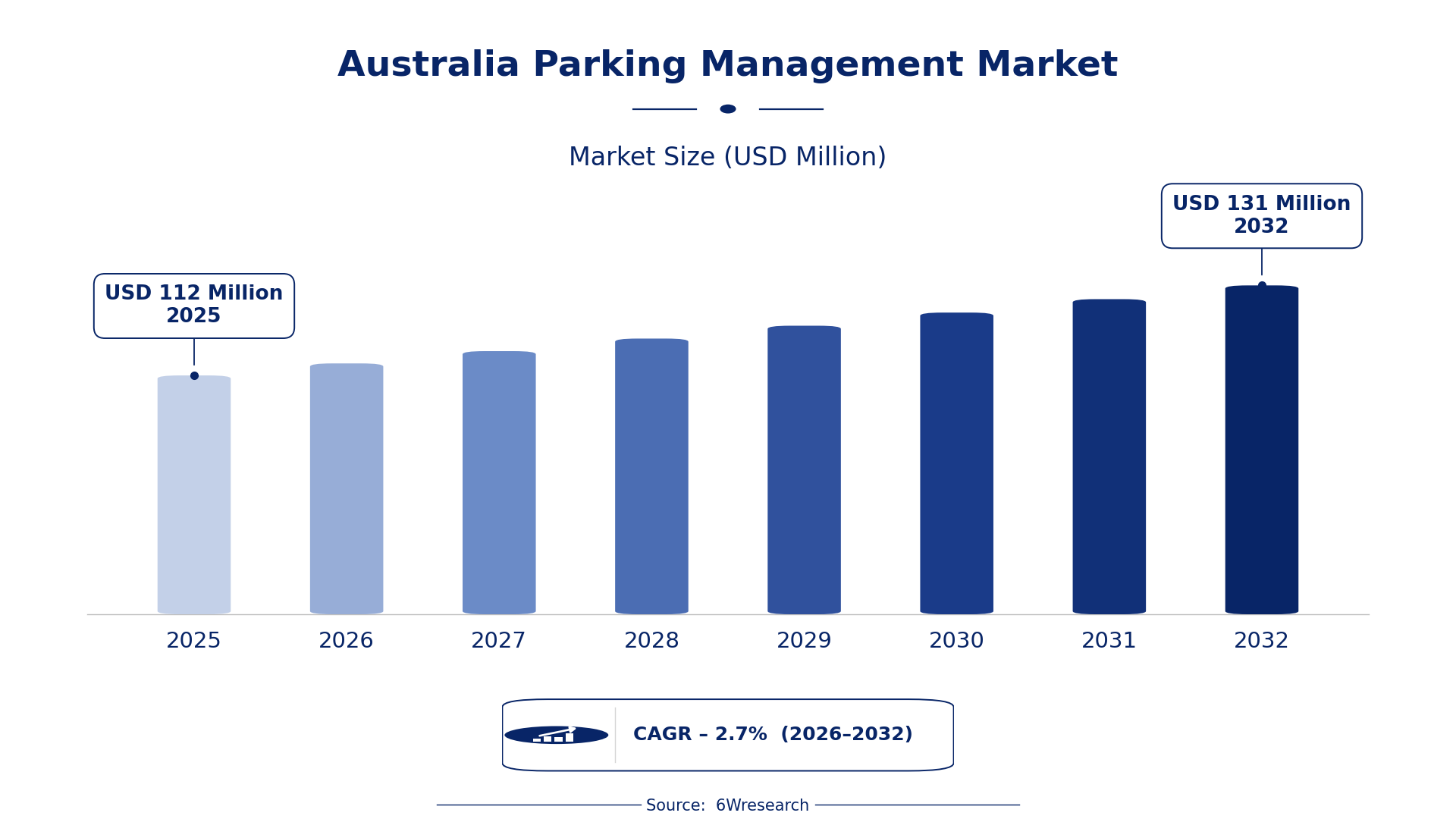
The Australia Parking Management Market was estimated at USD 112 Million in 2025 and is projected to reach USD 131 Million by 2032, growing at a CAGR of 2.7% from 2026 to 2032.
Australia Parking Management Market Synopsis
The demand for efficient parking solutions in Australia is escalating due to rapid urbanization and an increasing number of vehicles on the road. Municipalities are actively exploring advanced parking management systems that can streamline operations and enhance user experience.
Cities across Australia are implementing AI-driven technologies and real-time data tracking to optimize parking resources. This shift not only addresses congestion but also elevates the convenience factor for users, paving the way for smarter urban mobility.
Australia Parking Management Market Year-wise Growth Rate and Key Drivers
This graph illustrates the annual growth rates of the Australia Parking Management Market from 2021 to 2032, highlighting a steady upward trajectory and projected expansion over the forecast period.
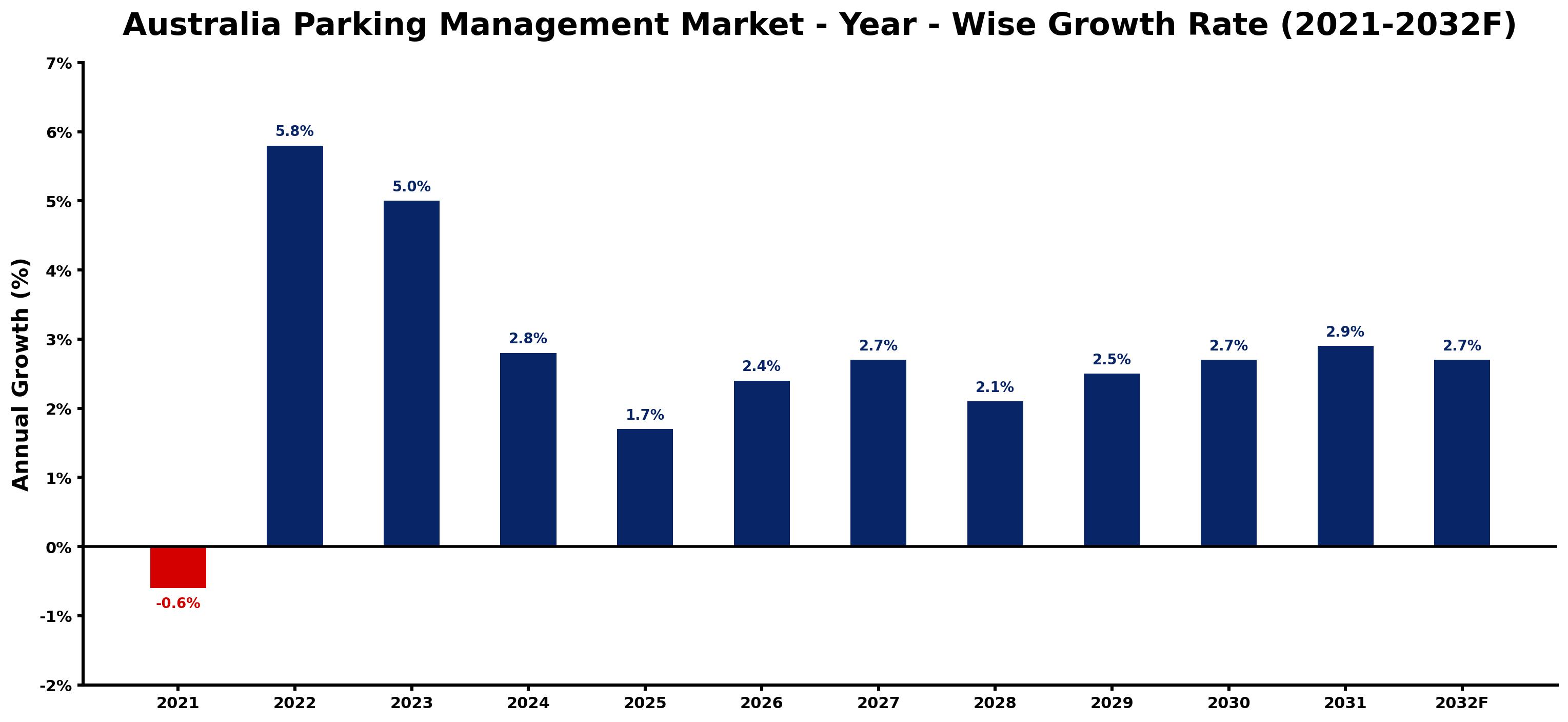
The table below presents the year‑wise growth rates along with the key drivers influencing the market
| Year | Growth Rate | Major Drivers |
| 2021 | -0.6% | COVID-19 restrictions limited urban parking demand. |
| 2022 | 5.8% | Local government initiatives promoting smart parking solutions. |
| 2023 | 5.0% | Increased urbanization leading to higher demand for parking. |
| 2024 | 2.8% | Implementation of emissions reduction policies enhances EV parking. |
| 2025 | 1.7% | Sydney's infrastructure upgrades introduce more parking facilities. |
| 2026 | 2.4% | Growing preference for mobile payment options in parking. |
| 2027 | 2.7% | Rise in major events driving short-term parking demand. |
| 2028 | 2.1% | Regulatory support for sustainable urban transport policies. |
| 2029 | 2.5% | Advancements in parking technology improving space utilization. |
| 2030 | 2.7% | Government incentives for electric vehicle charging stations. |
| 2031 | 2.9% | Population growth in metropolitan areas increases parking needs. |
| 2032 | 2.7% | Developments in data analytics optimizing parking management. |
Note: Market size estimations and growth projections presented in this report are based on 6Wresearch's proprietary forecasting methodology, utilizing the latest available industry data, government publications, and primary research inputs.
Australia Parking Management Market Key Takeaways
Below are some of the specific key takeaways from the market, including:
- Urbanization is driving the need for intelligent parking solutions in metropolitan areas.
- AI and IoT technologies are being integrated to enhance operational efficiency.
- Government policies are shaping the regulatory framework around parking management systems.
- Investment opportunities are emerging in developing smart parking platforms.
- Real-time tracking systems are becoming a standard expectation among users.
Evaluation of Restraints in Australia Parking Management Market
The Australia Parking Management Market faces several constraints that impede its full potential. High installation costs associated with automated systems often deter municipalities from adopting new technologies. on top of that, the integration of these advanced systems with existing infrastructure can be complex, leading to additional financial and operational burdens. Limited urban space for parking development also poses a significant challenge, as cities struggle to accommodate growing vehicle populations without sacrificing essential public spaces.
Australia Parking Management Market Trends
The market is witnessing a trend towards the adoption of smart parking technologies, which utilize AI and cloud-based platforms to enhance user experience. Real-time parking availability tracking is gaining traction, allowing drivers to locate spaces effortlessly. Additionally, there is a growing focus on sustainability, with municipalities exploring eco-friendly parking solutions to align with broader environmental goals.
Australia Parking Management Market Opportunities
Opportunities abound for investors and developers in the Australia Parking Management Market. The escalating demand for smart parking solutions presents a ripe environment for innovation. Companies can focus on enhancing AI-based platforms and expanding real-time tracking capabilities. on top of that, urban centers are increasingly open to partnerships that can modernize parking infrastructures, providing ample prospects for growth.
Government Initiatives in the Australia Parking Management Market
Government policy is significantly influencing the Australia Parking Management Market, with regulations aimed at ensuring consumer protection and operational transparency. Local governments are prioritizing the development of smart parking infrastructures to alleviate congestion and improve overall urban mobility. These policies create a framework that promotes the adoption of advanced technologies while addressing the challenges faced by cities.
- A national digital infrastructure upgrade programme was recently launched to enhance parking management capabilities across major urban centers.
- Current initiatives include the rollout of AI-powered parking systems aimed at improving real-time space availability tracking in metropolitan areas.
- A regulatory framework introduced in 2025 mandates transparent fee structures for parking services, ensuring consumer protection.
- Upcoming plans involve a public-private partnership expected to expand smart parking solutions in suburban regions by 2028.
Future Insights of the Australia Parking Management Market
Looking ahead to 2026-2032, the Australia Parking Management Market is set to evolve significantly. The integration of emerging technologies will redefine user experiences, making parking not just a necessity but a seamless part of urban life. As cities continue to grapple with congestion, the focus will shift towards solutions that not only optimize parking but also contribute to smarter, greener cities. The landscape will become increasingly competitive, with companies that prioritize innovation and customer-centric solutions standing out in the market.
Australia Parking Management Market Latest Developments
Over the past 12-14 months, the Australia Parking Management Market has seen a surge in technological advancements and infrastructure development. Stakeholders are actively engaging in innovative solutions to enhance operational efficiency and user convenience. The momentum in smart parking initiatives is indicative of a broader trend towards modernization in urban management.
- A leading regional operator launched a new mobile app in early 2025 to facilitate easier access to real-time parking availability data.
- In mid-2025, a major technology vendor initiated a partnership with local governments to implement AI-driven parking management systems.
- A pilot project involving automated payment solutions is currently underway in key urban areas, aimed at streamlining the parking payment process.
- By mid-2026, a rollout of enhanced data analytics tools is planned to improve decision-making for parking operators.
Australia Parking Management Market - Key Attractiveness of the Report
- 10 Years of Market Numbers
- Historical Data Starting from 2022 to 2025
- Base Year: 2025
- Forecast Data until 2032
- Key Performance Indicators Impacting the Market
- Major Upcoming Developments and Projects
Key Highlights of the Report:
- Australia Parking Management Market Outlook
- Market Size of Australia Parking Management Market, 2025
- Forecast of Australia Parking Management Market, 2032
- Historical Data and Forecast of Australia Parking Management Revenues & Volume for the Period 2022-2032F
- Australia Parking Management Market Trend Evolution
- Australia Parking Management Market Drivers and Challenges
- Australia Parking Management Price Trends
- Australia Parking Management Porter's Five Forces
- Australia Parking Management Industry Life Cycle
- Historical Data and Forecast of Australia Parking Management Market Revenues & Volume By Offering for the Period 2022-2032F
- Historical Data and Forecast of Australia Parking Management Market Revenues & Volume By Solutions for the Period 2022-2032F
- Historical Data and Forecast of Australia Parking Management Market Revenues & Volume By Services for the Period 2022-2032F
- Historical Data and Forecast of Australia Parking Management Market Revenues & Volume By Parking Site for the Period 2022-2032F
- Historical Data and Forecast of Australia Parking Management Market Revenues & Volume By Off-street Parking for the Period 2022-2032F
- Historical Data and Forecast of Australia Parking Management Market Revenues & Volume By On-street Parking for the Period 2022-2032F
- Historical Data and Forecast of Australia Parking Management Market Revenues & Volume By Deployment Type for the Period 2022-2032F
- Historical Data and Forecast of Australia Parking Management Market Revenues & Volume By Cloud for the Period 2022-2032F
- Historical Data and Forecast of Australia Parking Management Market Revenues & Volume By On-premises for the Period 2022-2032F
- Australia Parking Management Import Export Trade Statistics
- Market Opportunity Assessment By Offering
- Market Opportunity Assessment By Parking Site
- Market Opportunity Assessment By Deployment Type
- Australia Parking Management Top Companies Market Share
- Australia Parking Management Competitive Benchmarking By Technical and Operational Parameters
- Australia Parking Management Company Profiles
- Australia Parking Management Key Strategic Recommendations






































