Australia Personal Computers Market Size, Share & Growth Rate
The Australia Personal Computers Market was estimated at USD 199 Million in 2025 and is projected to reach USD 234 Million by 2032, growing at a CAGR of 2.3% from 2026 to 2032. This steady growth trajectory is driven primarily by the increasing demand for personal computers in remote work, e-learning environments, and the burgeoning gaming culture within the country. With more Australians adopting digital technologies and seeking high-performance devices, the market is well-positioned to meet these evolving consumer needs.
Australia Personal Computers Market Year-wise Growth Rate and Key Drivers
This graph highlights how the Australia Personal Computers Market has steadily grown over the years, supported by major growth factors.
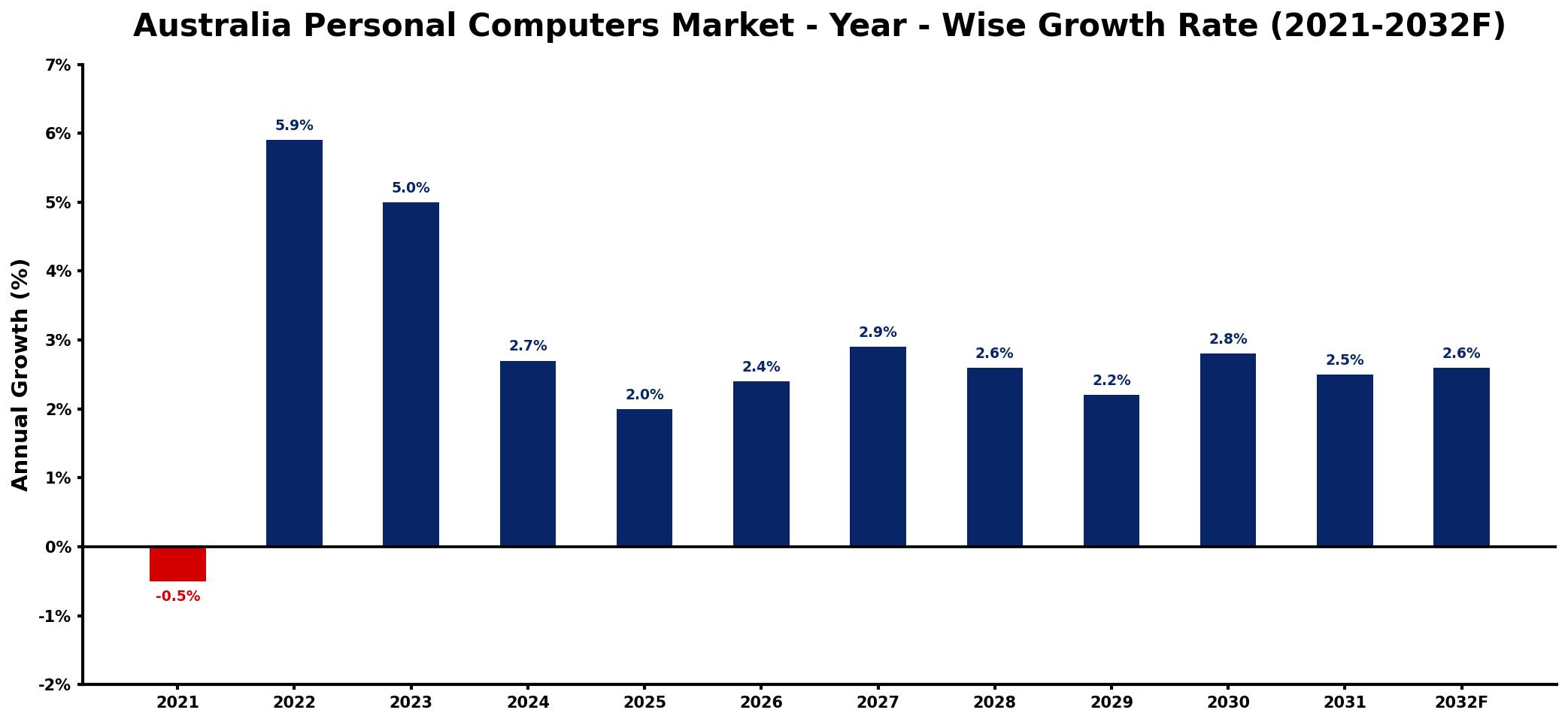
The table below presents the year‑wise growth rates along with the key drivers influencing the market
| Year | Growth Rate | Major Drivers |
| 2021 | -0.5% | shifts in consumer spending habits |
| 2022 | 5.9% | emergence of remote work culture |
| 2023 | 5.0% | increase in digital education initiatives |
| 2024 | 2.7% | growing demand for gaming accessories |
| 2025 | 2.0% | expansion of cloud computing services |
| 2026 | 2.4% | rise in AI integration solutions |
| 2027 | 2.9% | increased focus on cybersecurity measures |
| 2028 | 2.6% | growth in e-commerce platforms |
| 2029 | 2.2% | advancements in software development tools |
| 2030 | 2.8% | surge in content creation platforms |
| 2031 | 2.5% | enhancements in virtual collaboration tools |
| 2032 | 2.6% | development of sustainable technology solutions |
Note: Market size estimations and growth projections presented in this report are based on 6Wresearch's proprietary forecasting methodology, utilizing the latest available industry data, government publications, and primary research inputs.
Australia Personal Computers Market Synopsis
The most significant force shaping the Australia Personal Computers Market right now is the continued trend towards remote work and online education. As more businesses and educational institutions embrace digital platforms, the demand for reliable, portable computing solutions has surged, giving laptops a clear advantage over traditional desktops.
Moreover, the growing gaming culture further fuels the demand for high-performance PCs, as enthusiasts seek out equipment that can handle the latest titles. Coupled with advancements in artificial intelligence and cloud computing, the market is experiencing an influx of innovative products tailored to diverse consumer needs.
Australia Personal Computers Market Key Takeaways
- Strong demand driven by remote work, e-learning, and gaming culture.
- Laptop sales are significantly outpacing desktops, reflecting consumer preferences for portability.
- High-performance PCs are increasingly favored by professionals and gamers alike.
- Cloud computing and AI advancements are redefining product capabilities and consumer expectations.
- Investment in e-commerce strategies can help manufacturers reach a broader audience.
Evaluation of Restraints in Australia Personal Computers Market
Despite the market's growth, several key restraints are limiting its potential. The competition from smartphones and tablets is fierce, as many consumers now prefer multi-functional devices that can meet their daily needs. Additionally, there is a noticeable shift towards ultra-light and portable options, which is eroding the demand for traditional, bulkier desktops and laptops. Supply chain disruptions, particularly the ongoing semiconductor shortages, have also created challenges for manufacturers in meeting consumer demand, impacting both pricing and availability.
Australia Personal Computers Market Trends
Current trends in the Australia Personal Computers Market include a significant shift towards cloud-based computing solutions. As businesses invest in digital transformation, the integration of AI-driven hardware improvements is becoming standard, enhancing performance and functionality. Furthermore, the rise of e-sports and gaming continues to boost interest in high-performance PCs, leading to innovative designs tailored for gamers. Sustainability is also becoming a focus, as manufacturers look to meet regulatory standards on energy efficiency and product safety.
Australia Personal Computers Market Opportunities
Genuine growth opportunities within the Australia Personal Computers Market are abundant. High-performance laptops and custom-built gaming PCs are particularly appealing to both consumers and investors, providing ample room for market expansion. Additionally, as online learning and remote work solidify their presence, investments in workstations tailored for professional use could yield significant returns. The rise of e-commerce platforms presents an effective avenue for brands to enhance their market reach, catering to the growing online consumer base.
Government Initiatives in the Australia Personal Computers Market
The regulatory landscape in Australia plays a crucial role in shaping the personal computers market. Government policies ensure product safety and electromagnetic compatibility, compelling manufacturers and importers to adhere to strict standards. These regulations enhance consumer confidence and drive innovations that meet energy efficiency goals. Additionally, government initiatives aimed at promoting digital literacy and access to technology support the overall market growth by encouraging adoption across various demographics.
Future Insights of the Australia Personal Computers Market
Looking ahead to the 2026-2032 period, the Australia Personal Computers Market is poised for continued evolution. As remote work and online education remain entrenched in everyday life, demand for versatile and powerful computing solutions will persist. Additionally, as advancements in AI and cloud computing become more integrated into personal devices, consumers can expect even more innovation and personalization in their computing experiences. With growing attention to sustainability, manufacturers are likely to prioritize eco-friendly products, aligning with both consumer values and regulatory expectations.
Australia Personal Computers Market Latest Developments (2025 - 2026)
In recent months, the Australia Personal Computers Market has seen a surge in product launches focusing on portable devices that cater to remote working professionals and students. Manufacturers are also increasingly adopting direct-to-consumer sales strategies, enhancing customer engagement. The gaming segment is experiencing notable growth, with companies investing in tailored solutions designed for the competitive gaming community. Moreover, ongoing advancements in cloud technology and AI integration are paving the way for future innovations.
Australia Personal Computers Market - Key Attractiveness of the Report
- 10 Years of Market Numbers
- Historical Data Starting from 2022 to 2025
- Base Year: 2025
- Forecast Data until 2032
- Key Performance Indicators Impacting the Market
- Major Upcoming Developments and Projects
Key Highlights of the Report:
- Australia Personal Computers Market Outlook
- Market Size of Australia Personal Computers Market, 2025
- Forecast of Australia Personal Computers Market, 2032
- Historical Data and Forecast of Australia Personal Computers Revenues & Volume for the Period 2022-2032F
- Australia Personal Computers Market Trend Evolution
- Australia Personal Computers Market Drivers and Challenges
- Australia Personal Computers Price Trends
- Australia Personal Computers Porter's Five Forces
- Australia Personal Computers Industry Life Cycle
- Historical Data and Forecast of Australia Personal Computers Market Revenues & Volume By Product Type for the Period 2022-2032F
- Historical Data and Forecast of Australia Personal Computers Market Revenues & Volume By Desktop for the Period 2022-2032F
- Historical Data and Forecast of Australia Personal Computers Market Revenues & Volume By Notebook for the Period 2022-2032F
- Historical Data and Forecast of Australia Personal Computers Market Revenues & Volume By Workstation for the Period 2022-2032F
- Historical Data and Forecast of Australia Personal Computers Market Revenues & Volume By Others for the Period 2022-2032F
- Historical Data and Forecast of Australia Personal Computers Market Revenues & Volume By Distribution Channel for the Period 2022-2032F
- Historical Data and Forecast of Australia Personal Computers Market Revenues & Volume By Business-To-Business (B2B) for the Period 2022-2032F
- Historical Data and Forecast of Australia Personal Computers Market Revenues & Volume By Business-To-Consumer (B2C) for the Period 2022-2032F
- Historical Data and Forecast of Australia Personal Computers Market Revenues & Volume By Application for the Period 2022-2032F
- Historical Data and Forecast of Australia Personal Computers Market Revenues & Volume By Consumer for the Period 2022-2032F
- Historical Data and Forecast of Australia Personal Computers Market Revenues & Volume By Commercial for the Period 2022-2032F
- Historical Data and Forecast of Australia Personal Computers Market Revenues & Volume By Industrial for the Period 2022-2032F
- Australia Personal Computers Import Export Trade Statistics
- Market Opportunity Assessment By Product Type
- Market Opportunity Assessment By Distribution Channel
- Market Opportunity Assessment By Application
- Australia Personal Computers Top Companies Market Share
- Australia Personal Computers Competitive Benchmarking By Technical and Operational Parameters
- Australia Personal Computers Company Profiles
- Australia Personal Computers Key Strategic Recommendations






































