Australia Physical Security Market Size & Growth Rate (2026-2032)
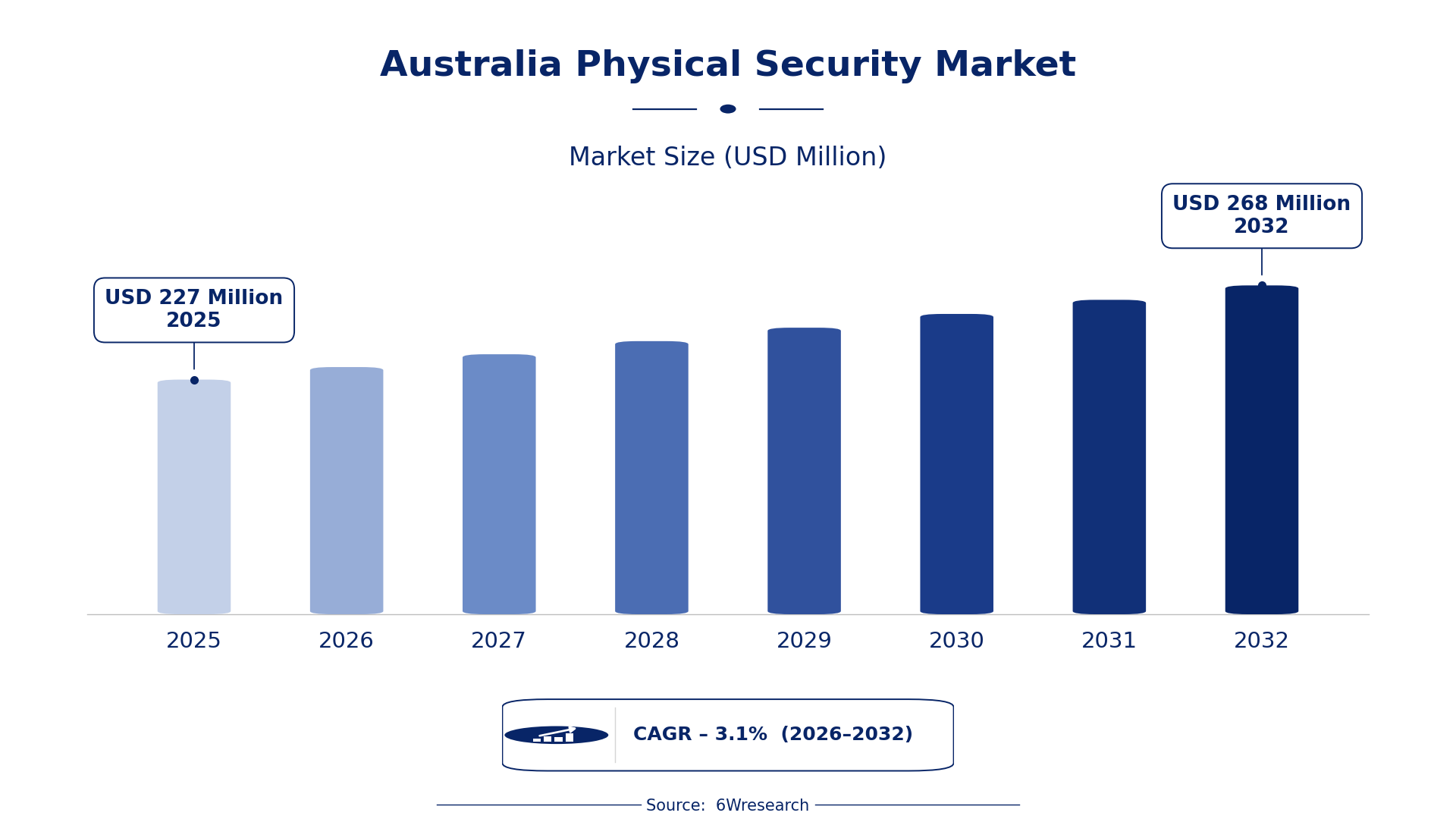
The Australia Physical Security Market was estimated at USD 227 Million in 2025 and is projected to reach USD 268 Million by 2032, growing at a CAGR of 3.1% from 2026 to 2032.
Australia Physical Security Market Synopsis
The Australia Physical Security Market has gained significant traction recently, fueled by an uptick in crime rates and corporate security needs. The trend towards more advanced surveillance and access control technologies signals a shift towards integrating smart security systems that offer real-time monitoring capabilities.
As Australia continues to bolster its physical security infrastructure, the market is expected to evolve, with AI technologies and biometric systems taking center stage. This transition is being driven by both government support and increased investments from the private sector.
Australia Physical Security Market Year-wise Growth Rate and Key Drivers
This graph illustrates the annual growth rates of the Australia Physical Security Market from 2021 to 2032, highlighting a steady upward trajectory and projected expansion over the forecast period.
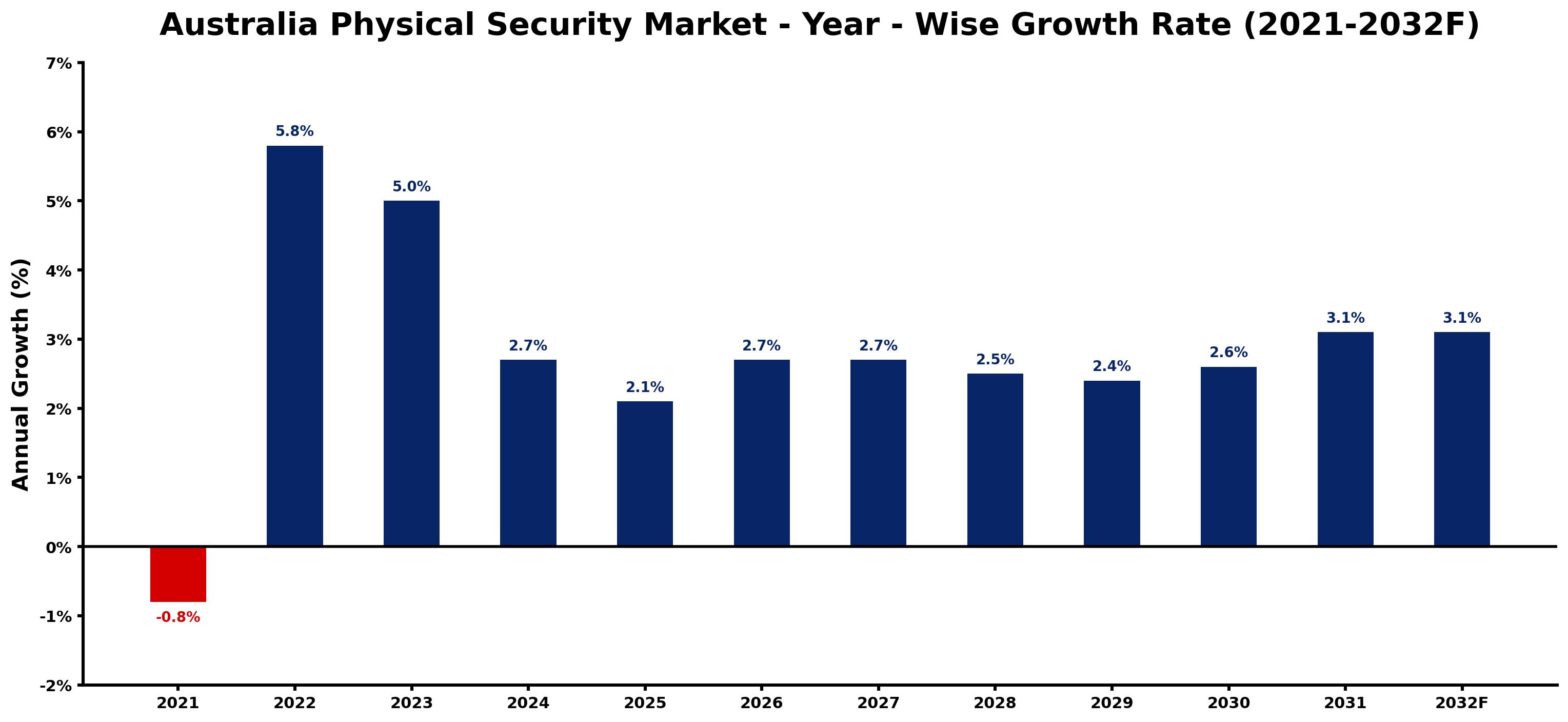
The table below presents the year‑wise growth rates along with the key drivers influencing the market
| Year | Growth Rate | Major Drivers |
| 2021 | -0.8% | Increased reliance on DIY security solutions in Australia. |
| 2022 | 5.8% | Increased government funding for cyber-physical security initiatives. |
| 2023 | 5.0% | Growth in residential security system installations post-pandemic. |
| 2024 | 2.7% | Rising concerns over urban crime rates driving investments. |
| 2025 | 2.1% | New regulations mandating enhanced data protection measures. |
| 2026 | 2.7% | Adoption of AI technology in surveillance systems. |
| 2027 | 2.7% | Demands for security upgrades from aging infrastructure. |
| 2028 | 2.5% | Implementation of national security policy enhancing private sector engagement. |
| 2029 | 2.4% | Rising insurance premiums prompting security system upgrades. |
| 2030 | 2.6% | Growing awareness of personal safety fuels market demand. |
| 2031 | 3.1% | Increased focus on event security due to major sports. |
| 2032 | 3.1% | Government partnerships with private security for public safety. |
Note: Market size estimations and growth projections presented in this report are based on 6Wresearch's proprietary forecasting methodology, utilizing the latest available industry data, government publications, and primary research inputs.
Australia Physical Security Market Key Takeaways
Below are some of the specific key takeaways from the market, including:
- The increasing adoption of AI-powered cameras and facial recognition systems is transforming traditional security frameworks.
- There is a marked rise in the installation of biometric access controls across various sectors, including corporate and residential markets.
- Government initiatives are significantly influencing market dynamics by funding advanced security projects.
- Integration challenges between physical and digital security systems present barriers to market growth.
- Growing concerns over unauthorized access and theft are driving demand for enhanced perimeter security solutions.
Evaluation of Restraints in Australia Physical Security Market
High installation and ongoing maintenance costs pose substantial barriers to entry for new players in the physical security market. Many businesses are hesitant to invest in advanced security solutions due to perceived financial burdens. Additionally, integration issues between physical security measures and existing digital infrastructures complicate the deployment of comprehensive security systems. Limited budget allocations for security upgrades further restrict market expansion, as organizations prioritize other operational necessities over investing in state-of-the-art physical security technologies.
Australia Physical Security Market Trends
A trend towards the integration of smart technology is becoming increasingly apparent, with AI and IoT devices gaining traction. Companies are leveraging data analytics to enhance security measures, allowing for improved threat detection and response times. on top of that, the demand for mobile security applications is on the rise, enabling remote monitoring and control of security systems. This trend aligns well with consumer preferences for convenience and efficiency, ultimately shaping the future direction of the market.
Australia Physical Security Market Opportunities
With the increasing demand for surveillance and access control solutions, the Australia Physical Security Market presents robust investment opportunities. The ongoing development of AI-based security systems could be particularly lucrative, especially in urban centers that face heightened security concerns. Additionally, the integration of advanced biometric systems into everyday operations, especially in high-risk sectors, offers significant growth potential. Investing in these technologies now will place companies at the forefront of the emerging security landscape.
Government Initiatives in the Australia Physical Security Market
Government policy plays a crucial role in shaping the Australia Physical Security Market. Regulatory frameworks are being established to enhance security infrastructure nationwide, reflecting a commitment to public safety. The recent emphasis on digital infrastructure upgrade programs illustrates the government's priority on improving security measures across various sectors. With structured support from federal and state authorities, the market is well positioned for growth.
- A regulatory framework introduced in 2025 mandates enhanced security measures in public infrastructure projects.
- A national digital infrastructure upgrade programme is currently underway, aimed at integrating advanced security technologies across government facilities.
- The Infrastructure Investment Program launched in late 2024 focuses on funding new security projects across metropolitan areas.
- A public-private initiative planned for 2026 seeks to expand surveillance systems in key urban centers.
- New licensing standards for security personnel were implemented in early 2025 to ensure higher operational standards in the industry.
Future Insights of the Australia Physical Security Market
Looking towards 2026-2032, the Australia Physical Security Market is expected to experience substantial growth driven by technological advancements and evolving security needs. As crime rates fluctuate, organizations will increasingly prioritize investments in modern security systems. on top of that, the integration of AI and other advanced technologies is set to redefine security protocols, creating a new standard in safety. As demand continues to surge, stakeholders must remain agile to adapt to the changing market dynamics.
Australia Physical Security Market Latest Developments
Over the past year, the Australia Physical Security Market has witnessed significant developments that signal an upward trajectory. Key investments in advanced technologies and collaborative efforts between public and private sectors are becoming commonplace as stakeholders recognize the necessity for enhanced security solutions. This increasing focus on security is shaping industry priorities and business strategies alike.
- A new line of AI-powered surveillance cameras was launched in early 2025, boasting advanced analytics capabilities that improve threat detection.
- A partnership established in late 2024 between leading tech firms is currently underway, aimed at integrating smart security solutions into existing infrastructure.
- An initiative began in mid-2025 to upgrade security at critical infrastructure sites across the country, focusing on remote monitoring technologies.
- A planned rollout expected to commence in late 2026 will enhance perimeter security systems in urban areas, targeting commercial properties.
Australia Physical Security Market - Key Attractiveness of the Report
- 10 Years of Market Numbers
- Historical Data Starting from 2022 to 2025
- Base Year: 2025
- Forecast Data until 2032
- Key Performance Indicators Impacting the Market
- Major Upcoming Developments and Projects
Key Highlights of the Report:
- Australia Physical Security Market Outlook
- Market Size of Australia Physical Security Market, 2025
- Forecast of Australia Physical Security Market, 2032
- Historical Data and Forecast of Australia Physical Security Revenues & Volume for the Period 2022-2032F
- Australia Physical Security Market Trend Evolution
- Australia Physical Security Market Drivers and Challenges
- Australia Physical Security Price Trends
- Australia Physical Security Porter's Five Forces
- Australia Physical Security Industry Life Cycle
- Historical Data and Forecast of Australia Physical Security Market Revenues & Volume By Component for the Period 2022-2032F
- Historical Data and Forecast of Australia Physical Security Market Revenues & Volume By Systems (PACS, PSIM, PIAM, Video Surveillance, Fire and Life Safety) for the Period 2022-2032F
- Historical Data and Forecast of Australia Physical Security Market Revenues & Volume By Services for the Period 2022-2032F
- Historical Data and Forecast of Australia Physical Security Market Revenues & Volume By Vertical for the Period 2022-2032F
- Historical Data and Forecast of Australia Physical Security Market Revenues & Volume By BFSI for the Period 2022-2032F
- Historical Data and Forecast of Australia Physical Security Market Revenues & Volume By Government for the Period 2022-2032F
- Historical Data and Forecast of Australia Physical Security Market Revenues & Volume By Retail for the Period 2022-2032F
- Historical Data and Forecast of Australia Physical Security Market Revenues & Volume By Transportation for the Period 2022-2032F
- Historical Data and Forecast of Australia Physical Security Market Revenues & Volume By Residential for the Period 2022-2032F
- Historical Data and Forecast of Australia Physical Security Market Revenues & Volume By Telecom and IT for the Period 2022-2032F
- Historical Data and Forecast of Australia Physical Security Market Revenues & Volume By Other Verticals (Healthcare, Manufacturing, Energy and Utilities, and Education). for the Period 2022-2032F
- Historical Data and Forecast of Australia Physical Security Market Revenues & Volume By Organization Size for the Period 2022-2032F
- Historical Data and Forecast of Australia Physical Security Market Revenues & Volume By SMEs for the Period 2022-2032F
- Historical Data and Forecast of Australia Physical Security Market Revenues & Volume By Large Enterprises for the Period 2022-2032F
- Australia Physical Security Import Export Trade Statistics
- Market Opportunity Assessment By Component
- Market Opportunity Assessment By Vertical
- Market Opportunity Assessment By Organization Size
- Australia Physical Security Top Companies Market Share
- Australia Physical Security Competitive Benchmarking By Technical and Operational Parameters
- Australia Physical Security Company Profiles
- Australia Physical Security Key Strategic Recommendations






































