Australia Pipe Coating Market: Import Trend Analysis
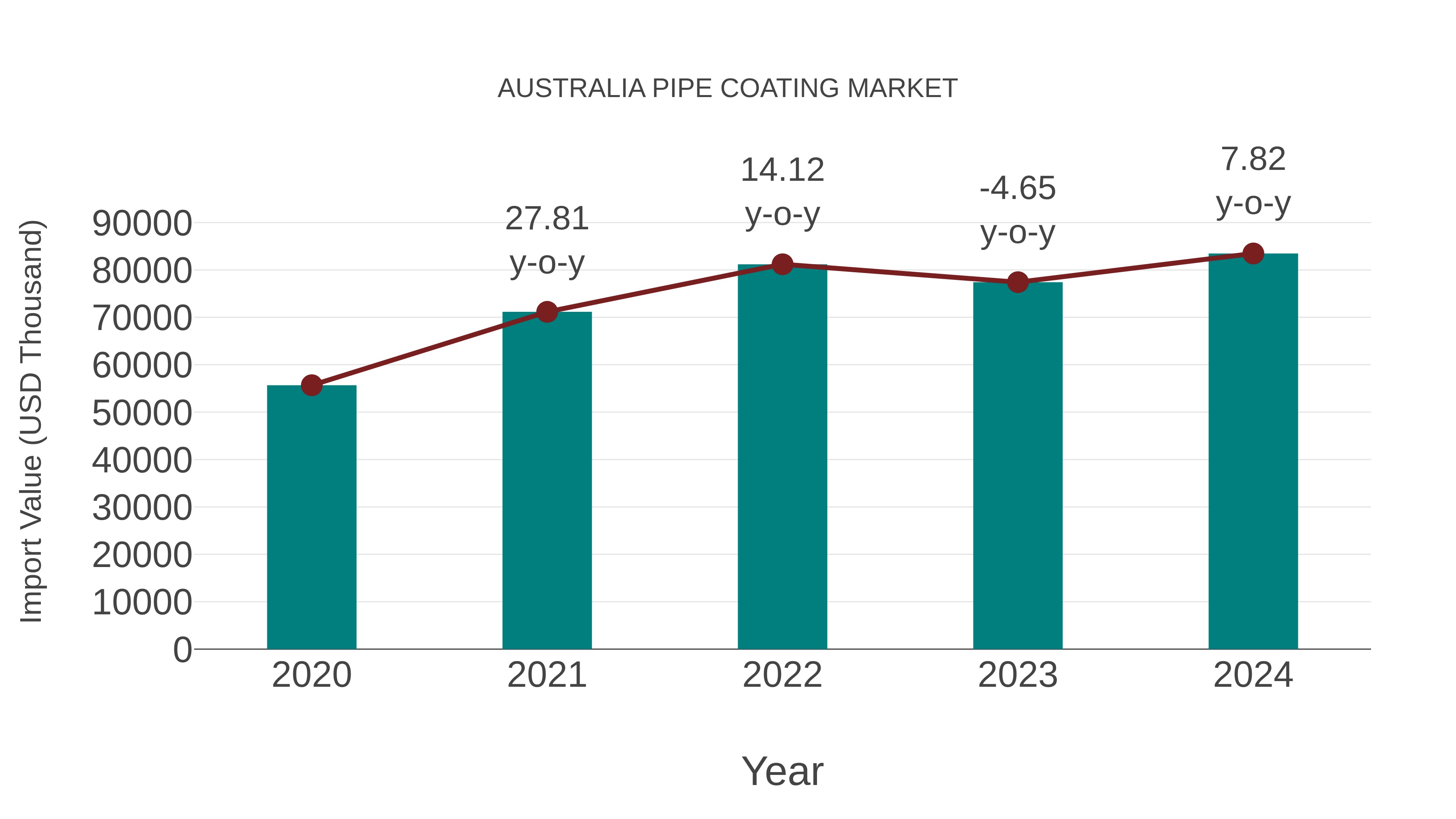
In the Australia pipe coating market, the import trend showed a growth rate of 7.82% from 2023 to 2024, with a compound annual growth rate (CAGR) of 10.66% from 2020 to 2024. This upward import momentum can be attributed to increased infrastructure projects driving demand and market stability post-pandemic recovery.
Australia Pipe Coating Market Overview
The pipe coating market in Australia is driven by the increasing demand for corrosion protection in the oil, gas, and water pipeline industries. Advanced coating technologies such as fusion-bonded epoxy (FBE), polyurethane, and polyethylene coatings are widely used to enhance pipe durability and longevity. Infrastructure investments, along with stringent environmental regulations, are encouraging the adoption of more effective pipe coating solutions to prevent leakage and environmental hazards.
Trends of the market
The Australia Pipe Coating Market is witnessing significant growth driven by increased infrastructure development and the demand for durable, corrosion-resistant coatings. Innovations in eco-friendly and high-performance coatings, such as polyurethane and epoxy-based solutions, are gaining traction to extend the lifespan of pipelines in harsh environments. The market is also influenced by stringent environmental regulations encouraging the use of sustainable and low-VOC coatings.
Challenges of the market
The Australia Pipe Coating Market is challenged by stringent environmental regulations that restrict the types of coatings and chemicals that can be used, pushing manufacturers to invest heavily in research for eco-friendly alternatives. High costs associated with advanced coating technologies and the need for skilled labor to apply these coatings limit market growth. Additionally, the market faces fluctuations in demand tied closely to the construction and oil & gas sectors, making it vulnerable to economic slowdowns.
Investment opportunities in the Market
The Australian pipe coating market presents significant investment potential driven by increasing infrastructure projects in the oil and gas, water, and construction sectors. Growing demand for corrosion-resistant coatings to extend pipe life, especially in harsh environmental conditions, creates opportunities for innovation in advanced coating materials such as epoxy, polyurethane, and thermal spray coatings. Investments focusing on eco-friendly and sustainable coatings aligned with stricter environmental regulations can also yield strong returns.
Government Policy of the market
The pipe coating market in Australia is influenced by stringent environmental and industrial safety regulations aimed at ensuring the longevity and corrosion resistance of pipelines. Government policies mandate compliance with standards such as AS/NZS 4158 (Fusion bonded epoxy coatings) and other international benchmarks. Environmental protection laws also require coatings to minimize harmful emissions and avoid toxic substances, especially in sectors like oil, gas, and water infrastructure. Incentives for sustainable materials and technologies also shape the market`s development.
Key Highlights of the Report:
- Australia Pipe Coating Market Outlook
- Market Size of Australia Pipe Coating Market, 2025
- Forecast of Australia Pipe Coating Market, 2032
- Historical Data and Forecast of Australia Pipe Coating Revenues & Volume for the Period 2022 - 2032F
- Australia Pipe Coating Market Trend Evolution
- Australia Pipe Coating Market Drivers and Challenges
- Australia Pipe Coating Price Trends
- Australia Pipe Coating Porter's Five Forces
- Australia Pipe Coating Industry Life Cycle
- Historical Data and Forecast of Australia Pipe Coating Market Revenues & Volume By Type for the Period 2022 - 2032F
- Historical Data and Forecast of Australia Pipe Coating Market Revenues & Volume By Thermoplastic Polymer Coatings for the Period 2022 - 2032F
- Historical Data and Forecast of Australia Pipe Coating Market Revenues & Volume By Fusion Bonded Epoxy Coating for the Period 2022 - 2032F
- Historical Data and Forecast of Australia Pipe Coating Market Revenues & Volume By Bituminous for the Period 2022 - 2032F
- Historical Data and Forecast of Australia Pipe Coating Market Revenues & Volume By Concrete for the Period 2022 - 2032F
- Historical Data and Forecast of Australia Pipe Coating Market Revenues & Volume By Others for the Period 2022 - 2032F
- Historical Data and Forecast of Australia Pipe Coating Market Revenues & Volume By Form for the Period 2022 - 2032F
- Historical Data and Forecast of Australia Pipe Coating Market Revenues & Volume By Liquid for the Period 2022 - 2032F
- Historical Data and Forecast of Australia Pipe Coating Market Revenues & Volume By Powder for the Period 2022 - 2032F
- Historical Data and Forecast of Australia Pipe Coating Market Revenues & Volume By End Use Industry for the Period 2022 - 2032F
- Historical Data and Forecast of Australia Pipe Coating Market Revenues & Volume By Oil & Gas for the Period 2022 - 2032F
- Historical Data and Forecast of Australia Pipe Coating Market Revenues & Volume By Water and Waste Water for the Period 2022 - 2032F
- Historical Data and Forecast of Australia Pipe Coating Market Revenues & Volume By Chemical Processing for the Period 2022 - 2032F
- Historical Data and Forecast of Australia Pipe Coating Market Revenues & Volume By Mining for the Period 2022 - 2032F
- Historical Data and Forecast of Australia Pipe Coating Market Revenues & Volume By Agriculture for the Period 2022 - 2032F
- Historical Data and Forecast of Australia Pipe Coating Market Revenues & Volume By Others for the Period 2022 - 2032F
- Australia Pipe Coating Import Export Trade Statistics
- Market Opportunity Assessment By Type
- Market Opportunity Assessment By Form
- Market Opportunity Assessment By End Use Industry
- Australia Pipe Coating Top Companies Market Share
- Australia Pipe Coating Competitive Benchmarking By Technical and Operational Parameters
- Australia Pipe Coating Company Profiles
- Australia Pipe Coating Key Strategic Recommendations






































