Australia Printed Electronics Market Size, Share & Growth Rate
The Australia Printed Electronics Market was estimated at USD 80 Million in 2025 and is projected to reach USD 93 Million by 2032, growing at a CAGR of 2.2% from 2026 to 2032. This growth trajectory is primarily driven by the increasing demand for flexible and lightweight electronic components across various applications, particularly in smart packaging and wearable technologies. Furthermore, advancements in conductive inks and substrates are fostering innovative solutions tailored for IoT-enabled devices, which align with Australia's digital transformation goals.
Australia Printed Electronics Market Year-wise Growth Rate and Key Drivers
This graph highlights how the Australia Printed Electronics Market has steadily grown over the years, supported by major growth factors.
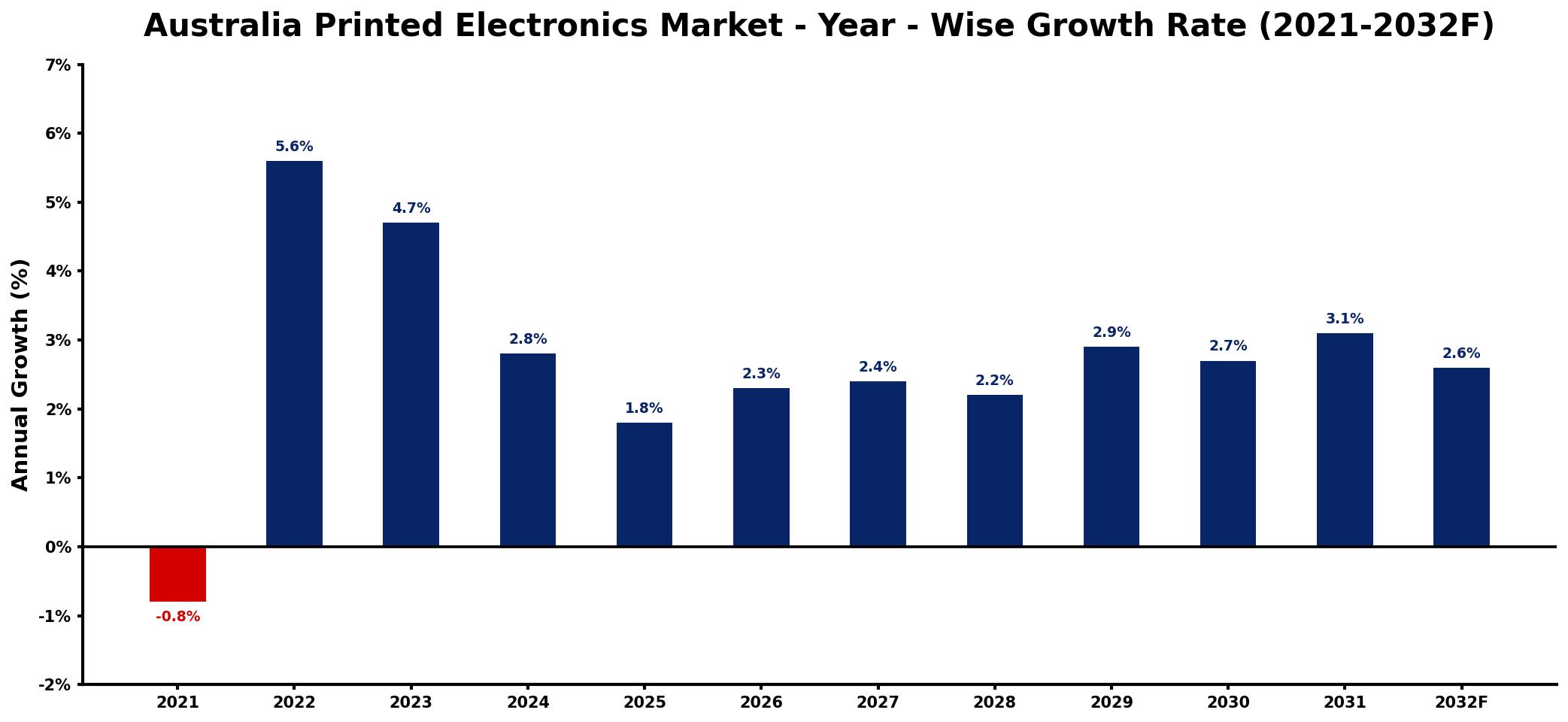
The table below presents the year‑wise growth rates along with the key drivers influencing the market
| Year | Growth Rate | Major Drivers |
| 2021 | -0.8% | decrease in consumer investment trends |
| 2022 | 5.6% | rise in smart packaging applications |
| 2023 | 4.7% | growth in renewable energy sectors |
| 2024 | 2.8% | expansion of wearable technology market |
| 2025 | 1.8% | increased demand for sustainable solutions |
| 2026 | 2.3% | advancements in manufacturing techniques |
| 2027 | 2.4% | development of innovative healthcare solutions |
| 2028 | 2.2% | surge in IoT integration projects |
| 2029 | 2.9% | increased overall sector activity |
| 2030 | 2.7% | increased focus on smart textiles |
| 2031 | 3.1% | strengthening underlying market demand |
| 2032 | 2.6% | increased domestic production output |
Note: Market size estimations and growth projections presented in this report are based on 6Wresearch's proprietary forecasting methodology, utilizing the latest available industry data, government publications, and primary research inputs.
Australia Printed Electronics Market Synopsis
The strongest force shaping the Australian printed electronics market is the surge in applications across industries such as healthcare and consumer electronics. As companies aim to enhance product functionality and user experience, the integration of printed electronics has become essential for maintaining competitive advantage.
The growing emphasis on sustainability also plays a critical role in shaping market dynamics. With environmental initiatives encouraging the use of sustainable materials and processes, printed electronics are positioned to meet the demands for environmentally friendly solutions in electronic manufacturing.
Australia Printed Electronics Market Key Takeaways
- Innovations in conductive inks and lightweight materials are driving growth across diverse applications.
- Increased demand for smart packaging and wearable technology enhances market potential.
- Government regulations ensure quality standards, shaping the landscape for printed electronics.
- Environmental sustainability initiatives are fostering the development of eco-friendly printed electronics.
- Investment opportunities are expanding as industries seek to integrate printed electronics into their offerings.
Evaluation of Restraints in Australia Printed Electronics Market
Despite its promising growth, the Australian printed electronics market faces several constraints. High initial investment costs are a significant barrier, particularly for smaller firms that may struggle to secure the necessary funding for research and development. Moreover, the limited local expertise in advanced printed electronics technologies poses a challenge, making it difficult for companies to fully harness the potential of this market. Integrating printed electronics into established manufacturing processes also remains a complex task, hindering widespread adoption.
Australia Printed Electronics Market Trends
Several current and emerging trends are shaping the demand for printed electronics in Australia. The rise of Internet of Things (IoT) devices is prompting innovation in printed sensors and displays, enhancing interconnectivity and smart functionality. Additionally, there is a noticeable shift toward personalized and health-oriented wearable technology, driving the need for flexible printed circuits that can seamlessly integrate with clothing and accessories. Furthermore, advances in manufacturing techniques are enabling low-cost mass production of printed electronic components, which will likely stimulate further market growth.
Australia Printed Electronics Market Opportunities
Opportunities for growth within the Australian printed electronics market are particularly strong in sectors such as healthcare, automotive, and consumer electronics. Investors can focus on developing innovative conductive inks and sustainable printing technologies that meet both functional and environmental standards. Collaborations across industries can also unlock new avenues for market expansion, particularly as companies seek to enhance product performance through smart packaging solutions and intelligent displays.
Government Initiatives in the Australia Printed Electronics Market
Government policies in Australia are actively supporting the printed electronics market through regulations aimed at ensuring quality and safety in flexible electronic components. Performance standards are enforced for critical applications, including sensors and RFID tags, promoting confidence among manufacturers and consumers. Additionally, environmental initiatives encourage the exploration and use of sustainable materials, aimed at reducing electronic waste and fostering greener production practices.
Future Insights of the Australia Printed Electronics Market
Looking ahead to the period from 2026 to 2032, the Australian printed electronics market is expected to evolve significantly. The growing integration of IoT and digital transformation initiatives will enhance the demand for innovative electronic solutions, driving investment in research and development. As market players adapt to emerging technologies and consumer preferences, the landscape is likely to witness increased collaboration and partnerships across various sectors. This forward momentum, combined with ongoing regulatory support, positions the market for robust growth in the coming years.
Australia Printed Electronics Market Latest Developments (2025 - 2026)
Recent developments in the Australian printed electronics market reflect a shift towards innovative solutions and sustainable practices. Companies are actively exploring new manufacturing techniques that enhance the efficiency and cost-effectiveness of printed electronic components. Additionally, increased collaboration between academia and industry is leading to breakthroughs in conductive materials and printing processes. These advancements are positioning Australia to be a key player in the global printed electronics landscape.
Australia Printed Electronics Market - Key Attractiveness of the Report
- 10 Years of Market Numbers
- Historical Data Starting from 2022 to 2025
- Base Year: 2025
- Forecast Data until 2032
- Key Performance Indicators Impacting the Market
- Major Upcoming Developments and Projects
Key Highlights of the Report:
- Australia Printed Electronics Market Outlook
- Market Size of Australia Printed Electronics Market, 2025
- Forecast of Australia Printed Electronics Market, 2032
- Historical Data and Forecast of Australia Printed Electronics Revenues & Volume for the Period 2022-2032F
- Australia Printed Electronics Market Trend Evolution
- Australia Printed Electronics Market Drivers and Challenges
- Australia Printed Electronics Price Trends
- Australia Printed Electronics Porter's Five Forces
- Australia Printed Electronics Industry Life Cycle
- Historical Data and Forecast of Australia Printed Electronics Market Revenues & Volume By Material for the Period 2022-2032F
- Historical Data and Forecast of Australia Printed Electronics Market Revenues & Volume By Ink for the Period 2022-2032F
- Historical Data and Forecast of Australia Printed Electronics Market Revenues & Volume By Substrate for the Period 2022-2032F
- Historical Data and Forecast of Australia Printed Electronics Market Revenues & Volume By Technology for the Period 2022-2032F
- Historical Data and Forecast of Australia Printed Electronics Market Revenues & Volume By Screen for the Period 2022-2032F
- Historical Data and Forecast of Australia Printed Electronics Market Revenues & Volume By Inkjet for the Period 2022-2032F
- Historical Data and Forecast of Australia Printed Electronics Market Revenues & Volume By Flexographic for the Period 2022-2032F
- Historical Data and Forecast of Australia Printed Electronics Market Revenues & Volume By Gravure for the Period 2022-2032F
- Historical Data and Forecast of Australia Printed Electronics Market Revenues & Volume By Device for the Period 2022-2032F
- Historical Data and Forecast of Australia Printed Electronics Market Revenues & Volume By Displays for the Period 2022-2032F
- Historical Data and Forecast of Australia Printed Electronics Market Revenues & Volume By Photovoltaic for the Period 2022-2032F
- Historical Data and Forecast of Australia Printed Electronics Market Revenues & Volume By Lighting for the Period 2022-2032F
- Historical Data and Forecast of Australia Printed Electronics Market Revenues & Volume By RFID for the Period 2022-2032F
- Historical Data and Forecast of Australia Printed Electronics Market Revenues & Volume By Others for the Period 2022-2032F
- Australia Printed Electronics Import Export Trade Statistics
- Market Opportunity Assessment By Material
- Market Opportunity Assessment By Technology
- Market Opportunity Assessment By Device
- Australia Printed Electronics Top Companies Market Share
- Australia Printed Electronics Competitive Benchmarking By Technical and Operational Parameters
- Australia Printed Electronics Company Profiles
- Australia Printed Electronics Key Strategic Recommendations






































