australia skateboard market
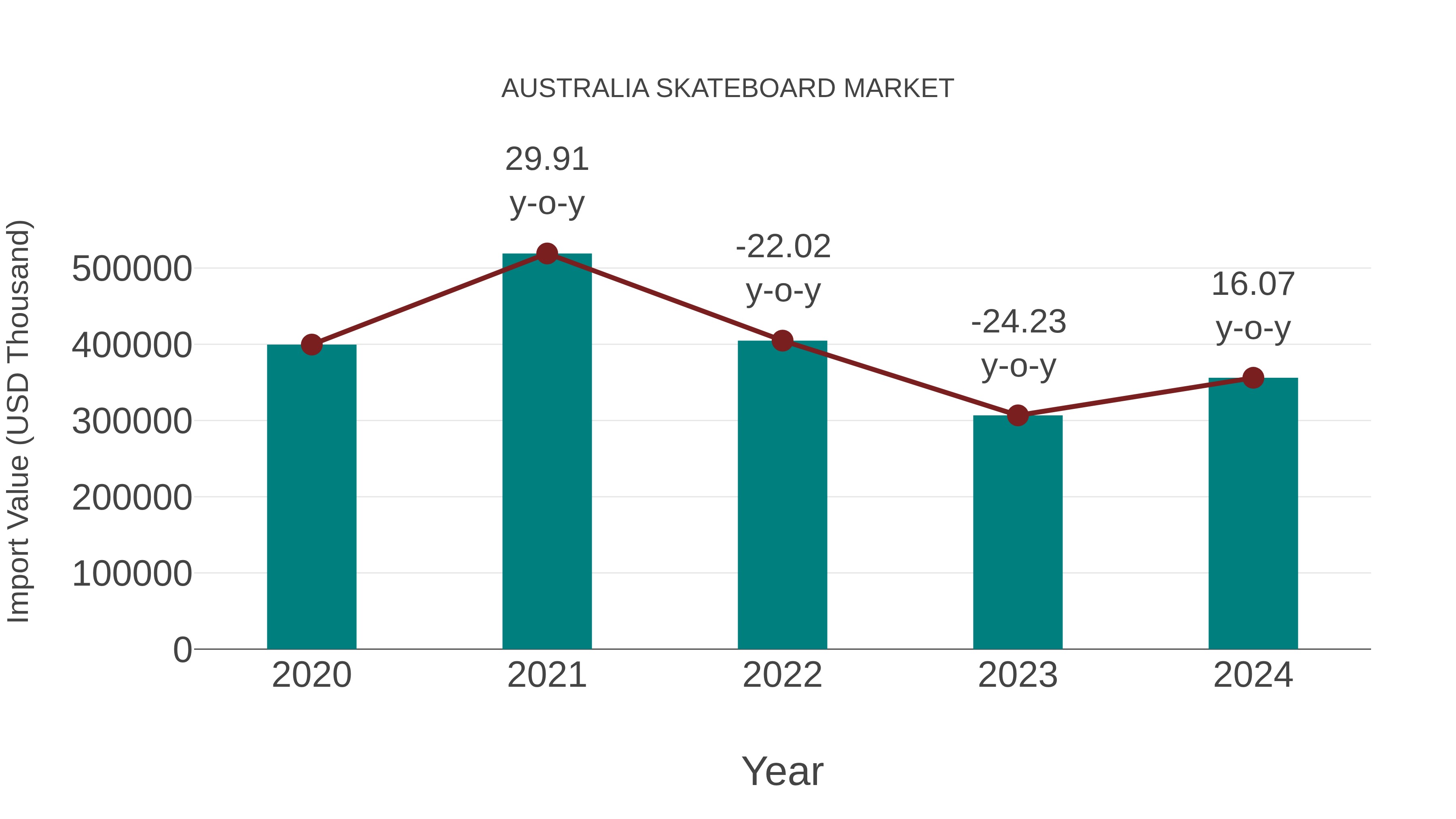
Australia Skateboard Market Growth Rate
According to 6Wresearch internal database and industry insights,
Five-Year Growth Trajectory of the Australia Skateboard Market with Core Drivers
Below is the evaluation of year-wise growth rates along with key drivers:
| Year | Est. Annual Growth (%) | Growth Drivers |
| 2021 | 3.5 | Rise in youth participation in outdoor sports and recreational activities. |
| 2022 | 4 | Expansion of skate park infrastructure nationwide. |
| 2023 | 4.4 | Strong interest among teenagers and adults in cultural and fitness skateboarding. |
| 2024 | 4.8 | Technological innovations in skateboard design and materials. |
| 2025 | 5.2 | Increase in organized community events and competitions promoting skateboarding participation. |
Topics Covered in the Australia Skateboard Market Report
The Australia Skateboard Market report thoroughly covers the market by product and end-user. It provides an unbiased and detailed analysis of ongoing market trends, opportunities, challenges, and market drivers, helping stakeholders align their strategies with current and future market dynamics.
Australia Skateboard Market Highlights
| Report Name | Australia Skateboard Market |
| Forecast period | 2026-2032 |
| CAGR | 6.1% |
| Growing Sector | Sporting Goods & Recreation |
Australia Skateboard Market Synopsis
Australia Skateboard Market is projected to record massive growth owing to increasing youth engagement in action sports, expanding infrastructure of skate parks, and growing interest in outdoor recreational activities. Apart from this, there has been technological developments in skateboard design, such as lightweight materials and improved performance features which further attracts a wider consumer base. Generally, skateboarding culture, buoyed by community events, continues to create strong awareness and participation across all age groups.
Evaluation of Growth Drivers in the Australia Skateboard Market
Below are some prominent drivers and their impact on the Australia Skateboard Market dynamics:
| Drivers | Primary Segment Affected | Why It Matters (Evidence) |
| Government Policies and Incentives | All Segments | Various Initiatives have been put in place to develop skate parks and including skateboard in community recreation programs encourages wider participation among various age groups. |
| Youth and Teen Engagement | Teenagers (12–17) | There has been growing interest in action sports which upsurges demand for skateboards and related gear. |
| Urban Recreation Trends | Adults (18 & above) | Urban lifestyle choices and fitness activities include skateboarding as a highly preferred outdoor pursuit. |
| Technological Advancements | All Segments | Modernizations in this field such as better-quality board materials and design accelerates performance and attract new users. |
| Community Events and Competitions | All Segments | Organized skate events and local competitions actively proliferate visibility and participation. |
Australia Skateboard Market is projected to grow at a CAGR of 6.1% from 2026 to 2032. Due to growing youth participation in skateboarding, augmented recreational infrastructure, and technological advancements in skateboard performance, the growth of this market is set to boom in the upcoming years. Along with this, the demand for different variants of skateboards—such as street boards, cruiser boards, long boards, park boards, and hybrid boards—is increasing across age segments such as kids, teenagers, and adults.
Evaluation of Restraints in the Australia Skateboard Market
Below are some major restraints and their influence on the Australia Skateboard Market dynamics:
| Restraints | Primary Segment Affected | What This Means (Evidence) |
| Seasonal Demand Fluctuations | All Segments | Demand for skateboards varies with seasons, affecting year‑round sales stability. |
| Competition from Other Sports | Teenagers & Adults | Sports face challenges from competing sports and activities. |
| High Cost of Advanced Boards | All Segments | Higher-end skateboard models with cutting-edge technology can be expensive for customers on a tight budget. |
| Limited Skateboarding Facilities | All Segments | In some regions, the unavailability of skate parks may delay the activity. |
| Regulatory and Safety Concerns | All Segments | Safety policies and helmet mandates may impact casual skateboard use. |
Australia Skateboard Market Challenges
While the market for skateboard in Australia is transforming, there are a few challenges such as seasonal demand variations that create inconsistent sales patterns throughout the year. Apart from this, there is high competition from other sports and leisure activities which can restrict growth in various age segments. Besides this, the increasing cost of premium and technologically advanced skateboards presents affordability concerns for some consumers.
Emerging Trends in the Australia Skateboard Market
Some of the trends driving the Australia Skateboard Market Growth are mentioned below:
- Inclusivity and Gender Participation: Skateboarding initiatives targeting girls and understated groups are proliferating greater participation.
- Incorporation in Physical Education: The inclusion of skateboarding in schools and colleges as part of physical education helps in incorporating it at the grassroots level.
- Improvement in Skateboards: There have been advancements in the designs of skateboards incorporating lightweight and high-performance materials.
- Remarkable Growth in Skate Culture: Growing skate culture is driven by community activities, events, and competitions such as the Alex Chalmers Memorial and Social media influence.
Investment Opportunities in the Australia Skateboard Sector
Key investment avenues in the Australia Skateboard Market are:
- Skate Park Development Initiatives: Invest in world-class skate parks and amenities that will lead to more engagement.
- Environmentally Sustainable Skateboard Manufacturing: Working towards the development of eco-friendly manufacturing materials.
- Youth Programs and Training Schools: Establishing training academies or programs for the promotion of young skateboarders.
- Performance Skateboard Innovations: R&D focused on high performance skateboard models catering to professional and competitive segments.
Top 5 Leading Players in the Australia Skateboard Market
Below is the list of prominent companies leading in the Australia Skateboard Market:
1. Penny Skateboards
| Company Name | Penny Skateboards |
|---|---|
| Established Year | 2010 |
| Headquarters | Brisbane, Australia |
| Official Website | Click Here |
Penny Skateboards is a leading Australian skateboard manufacturer known for its innovative compact plastic cruiser boards that are especially popular among younger riders and urban users.
2. Globe International Ltd.
| Company Name | Globe International Ltd. |
|---|---|
| Established Year | 1980s |
| Headquarters | Melbourne, Australia |
| Official Website | Click Here |
Globe International is a major skateboard and board sports company with a strong presence in Australia and internationally, offering a range of skateboards, apparel, and accessories.
3. Surfa Sam Skateboards
| Company Name | Surfa Sam Skateboards |
|---|---|
| Established Year | 1963 |
| Headquarters | Sydney, Australia |
| Official Website | Click Here |
Surfa Sam is one of Australia’s oldest skateboard brands, known for its classic wooden boards and long legacy in the skateboard industry.
4. Element Skateboards
| Company Name | Element Skateboards |
|---|---|
| Established Year | 1992 |
| Headquarters | Irvine, USA |
| Official Website | - |
Element is a globally recognized skateboard brand popular in Australia for its high‑quality street boards and commitment to sustainability in materials.
5. DC Shoes (Skate Division)
| Company Name | DC Shoes (Skate Division) |
|---|---|
| Established Year | 1994 |
| Headquarters | Huntington Beach, USA |
| Official Website | - |
DC Shoes offers skateboards and skate gear known for durability and performance, widely sold through Australian retail and online channels.
Government Regulations Introduced in the Australia Skateboard Market
According to Australian Government Data, through local and state government funding programs targeted at enlarging recreational facilities and community spaces, Australia promotes the development of skateboarding infrastructure. For instance, legacy funding associated with major athletic events (like Olympic legacy infrastructure programs) finances improvements to skate parks, promoting skateboarding as a healthy outdoor activity.
Future Insights of the Australia Skateboard Market
The Australia Skateboard Market is expected to grow steadily with substantial investments in skate infrastructure, growing acceptance of skateboarding as both a recreational pastime and competitive sport, and ongoing interest among youth and adults. Apart from this, technological advancements in skateboard design, increased inclusivity in participation, and enhanced digital sales platforms will continue to propel the Australia Skateboard Market Growth during the forecast period.
Market Segmentation Analysis
The report offers a comprehensive study of the following market segments and their leading categories:
By Product – Street Board to dominate the market
According to Bhawna Singh, Senior Research Analyst, 6Wresearch, Street boards are expected to dominate the Australia Skateboard Market Share on the back of its versatility in urban environments, popularity among teenagers and adults for recreational and trick‑based skateboarding, and broad appeal across skill levels.
By End‑User – Teenagers (12–17) to dominate the market
Teenagers are expected to be hold the leading position in the Australia Skateboard Industry, backed by strong youth engagement with action sports, cultural influence from skateboarding trends, and active participation in community and competitive events.
Key Attractiveness of the Report
- 10 Years of Market Numbers.
- Historical Data Starting from 2022 to 2025.
- Base Year: 2025.
- Forecast Data until 2032.
- Key Performance Indicators Impacting the Market.
- Major Upcoming Developments and Projects.
Key Highlights of the Report:
- Australia Skateboard Market Outlook
- Market Size of Australia Skateboard Market, 2025
- Forecast of Australia Skateboard Market, 2032
- Historical Data and Forecast of Australia Skateboard Revenues & Volume for the Period 2022-2032
- Australia Skateboard Market Trend Evolution
- Australia Skateboard Market Drivers and Challenges
- Australia Skateboard Price Trends
- Australia Skateboard Porter's Five Forces
- Australia Skateboard Industry Life Cycle
- Historical Data and Forecast of Australia Skateboard Market Revenues & Volume By Product for the Period 2022-2032
- Historical Data and Forecast of Australia Skateboard Market Revenues & Volume By Street Board for the Period 2022-2032
- Historical Data and Forecast of Australia Skateboard Market Revenues & Volume By Cruiser Board for the Period 2022-2032
- Historical Data and Forecast of Australia Skateboard Market Revenues & Volume By Long Board for the Period 2022-2032
- Historical Data and Forecast of Australia Skateboard Market Revenues & Volume By Park Board for the Period 2022-2032
- Historical Data and Forecast of Australia Skateboard Market Revenues & Volume By Hybrid Board for the Period 2022-2032
- Historical Data and Forecast of Australia Skateboard Market Revenues & Volume By Others for the Period 2022-2032
- Historical Data and Forecast of Australia Skateboard Market Revenues & Volume By End-User for the Period 2022-2032
- Historical Data and Forecast of Australia Skateboard Market Revenues & Volume By Kids (0-9) for the Period 2022-2032
- Historical Data and Forecast of Australia Skateboard Market Revenues & Volume By Teenagers (12-17) for the Period 2022-2032
- Historical Data and Forecast of Australia Skateboard Market Revenues & Volume By Adults (18 & above) for the Period 2022-2032
- Australia Skateboard Import Export Trade Statistics
- Market Opportunity Assessment By Product
- Market Opportunity Assessment By End-User
- Australia Skateboard Top Companies Market Share
- Australia Skateboard Competitive Benchmarking By Technical and Operational Parameters
- Australia Skateboard Company Profiles
- Australia Skateboard Key Strategic Recommendations
Markets Covered
The market report includes the following segments:
By Product
- Street Board
- Cruiser Board
- Long Board
- Park Board
- Hybrid Board
- Others
By End-User
- Kids (0-9)
- Teenagers (12-17)
- Adults (18 & above)






































