Australia Television Broadcasting Market Size, Share & Growth Rate
The Australia Television Broadcasting Market was estimated at USD 361 Million in 2025 and is projected to reach USD 486 Million by 2032, growing at a CAGR of 4.3% from 2026 to 2032. This steady growth is underpinned by the increasing consumption of digital content and the innovative strategies employed by broadcasters to attract and retain audiences. As competition from OTT platforms intensifies, traditional broadcasters are evolving, integrating advanced technologies and varied content offerings to enhance viewer engagement.
Australia Television Broadcasting Market Year-wise Growth Rate and Key Drivers
This graph highlights how the Australia Television Broadcasting Market has steadily grown over the years, supported by major growth factors.
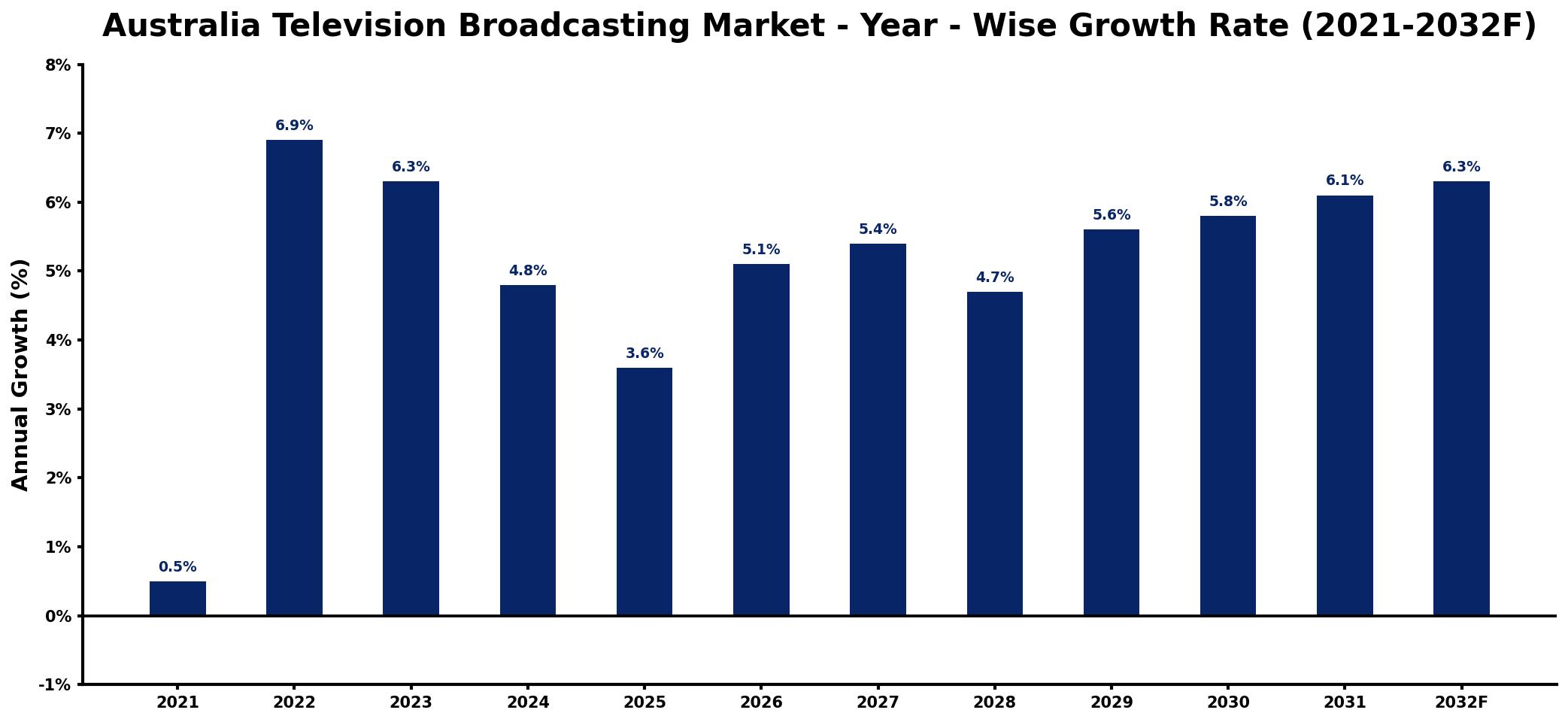
The table below presents the year‑wise growth rates along with the key drivers influencing the market
| Year | Growth Rate | Major Drivers |
| 2021 | 0.5% | Rising demand for streaming services |
| 2022 | 6.9% | Increased investment in content production |
| 2023 | 6.3% | Expansion of digital advertising platforms |
| 2024 | 4.8% | Growth in audience engagement strategies |
| 2025 | 3.6% | Emergence of new distribution channels |
| 2026 | 5.1% | Enhanced technology for content delivery |
| 2027 | 5.4% | Diversification of content offerings |
| 2028 | 4.7% | Strengthening partnerships with creators |
| 2029 | 5.6% | Adoption of interactive viewing experiences |
| 2030 | 5.8% | Focus on niche market segments |
| 2031 | 6.1% | Improvement in viewer retention rates |
| 2032 | 6.3% | Development of immersive storytelling techniques |
Note: Market size estimations and growth projections presented in this report are based on 6Wresearch's proprietary forecasting methodology, utilizing the latest available industry data, government publications, and primary research inputs.
Australia Television Broadcasting Market Synopsis
The Australian television broadcasting landscape is experiencing a notable transformation driven by the shift towards digital consumption. Despite the omnipresence of streaming services, free-to-air and subscription broadcasters continue to play a crucial role in delivering diverse content to the audience. This dynamic environment fosters an atmosphere of innovation, compelling broadcasters to enhance their content and delivery methods.
Moreover, the convergence of traditional and digital broadcasting platforms is reshaping viewer experiences and expectations. Broadcasters are not just competing for viewers' attention but also for their engagement across various digital touchpoints, which encourages a richer and more interactive viewing experience.
Australia Television Broadcasting Market Key Takeaways
- The market is characterized by an increasing demand for high-quality digital content and advanced broadcast technologies.
- Traditional broadcasting remains relevant, even as OTT platforms reshape consumer habits and preferences.
- Competition is driving innovation and strategic partnerships within the industry.
- Government regulations are key in ensuring a fair and diverse broadcasting environment.
- Advertisers are increasingly investing in targeted advertising solutions to reach audiences more effectively.
Evaluation of Restraints in Australia Television Broadcasting Market
Despite promising growth prospects, the Australia Television Broadcasting Market faces several restraints. One major concern is the rapidly evolving viewer preferences, which demand constant adaptation from broadcasters. As digital streaming platforms gain traction, traditional broadcasters may experience challenges in maintaining audience share. Additionally, regulatory changes can impose limits on advertising revenues and impact content distribution models, complicating the operational landscape for broadcasters. The need for high-quality content production requires significant investment, which can be a barrier for some players in the market.
Australia Television Broadcasting Market Trends
Several trends are shaping the future of the Australia Television Broadcasting Market. Firstly, the increasing integration of high-definition (HD) and ultra-high-definition (UHD) content is enhancing viewer experiences, encouraging higher consumer engagement. Secondly, the rise of personalized content delivery through advanced algorithms is enabling broadcasters to cater to specific viewer preferences more effectively. Lastly, the blending of live television with interactive features, driven by digital platforms, is setting new benchmarks for audience participation.
Australia Television Broadcasting Market Opportunities
The market presents significant growth and investment opportunities, particularly in content creation and technology integration. With the demand for diverse and original programming on the rise, broadcasters can capitalize on new formats and niche genres to attract wider audiences. Additionally, leveraging data analytics for targeted advertising presents a lucrative avenue for enhancing revenue streams. Collaborations with tech companies to develop innovative viewing experiences will also likely emerge as a focal point for competitive differentiation.
Government Initiatives in the Australia Television Broadcasting Market
The Australian government plays an essential role in shaping the television broadcasting landscape through regulatory policies and frameworks. These regulations ensure diversity, accuracy, and quality in content delivery, addressing licensing requirements, content standards, and media ownership limits. Government initiatives often aim to support local content production and maintain cultural representation, thereby fostering a vibrant and inclusive broadcasting environment.
Future Insights of the Australia Television Broadcasting Market
Looking ahead to 2026-2032, the Australia Television Broadcasting Market is poised for continued evolution. As digital transformation accelerates, broadcasters will increasingly adopt advanced technologies, including AI and machine learning, to enhance content creation and audience engagement. The rise of interactive and immersive viewing experiences will redefine how content is consumed, ultimately broadening the markets appeal. In response to changing regulatory environments, broadcasters will also need to innovate their business models to remain competitive in a landscape shaped by both traditional and new media.
Australia Television Broadcasting Market Latest Developments (2025 - 2026)
In recent months, the Australia Television Broadcasting Market has seen a flurry of activity as broadcasters enhance their digital capabilities. Several notable initiatives have been launched to integrate streaming and live broadcasting, responding to shifting viewer preferences. Collaborations between traditional broadcasters and tech companies are emerging, with an emphasis on creating richer interactive experiences for viewers. Regulatory bodies are also revisiting existing frameworks to better accommodate the evolving landscape, ensuring that broadcasters remain competitive and diverse.
Australia Television Broadcasting Market - Key Attractiveness of the Report
- 10 Years of Market Numbers
- Historical Data Starting from 2022 to 2025
- Base Year: 2025
- Forecast Data until 2032
- Key Performance Indicators Impacting the Market
- Major Upcoming Developments and Projects
Key Highlights of the Report:
- Australia Television Broadcasting Market Outlook
- Market Size of Australia Television Broadcasting Market, 2025
- Forecast of Australia Television Broadcasting Market, 2032
- Historical Data and Forecast of Australia Television Broadcasting Revenues & Volume for the Period 2022-2032F
- Australia Television Broadcasting Market Trend Evolution
- Australia Television Broadcasting Market Drivers and Challenges
- Australia Television Broadcasting Price Trends
- Australia Television Broadcasting Porter's Five Forces
- Australia Television Broadcasting Industry Life Cycle
- Historical Data and Forecast of Australia Television Broadcasting Market Revenues & Volume By Type for the Period 2022-2032F
- Historical Data and Forecast of Australia Television Broadcasting Market Revenues & Volume By Television Station for the Period 2022-2032F
- Historical Data and Forecast of Australia Television Broadcasting Market Revenues & Volume By Television Network for the Period 2022-2032F
- Historical Data and Forecast of Australia Television Broadcasting Market Revenues & Volume By Broadcaster Type for the Period 2022-2032F
- Historical Data and Forecast of Australia Television Broadcasting Market Revenues & Volume By Public for the Period 2022-2032F
- Historical Data and Forecast of Australia Television Broadcasting Market Revenues & Volume By Commercial for the Period 2022-2032F
- Historical Data and Forecast of Australia Television Broadcasting Market Revenues & Volume By Revenue Source for the Period 2022-2032F
- Historical Data and Forecast of Australia Television Broadcasting Market Revenues & Volume By Subscription-based for the Period 2022-2032F
- Historical Data and Forecast of Australia Television Broadcasting Market Revenues & Volume By Advertisement-based for the Period 2022-2032F
- Australia Television Broadcasting Import Export Trade Statistics
- Market Opportunity Assessment By Type
- Market Opportunity Assessment By Broadcaster Type
- Market Opportunity Assessment By Revenue Source
- Australia Television Broadcasting Top Companies Market Share
- Australia Television Broadcasting Competitive Benchmarking By Technical and Operational Parameters
- Australia Television Broadcasting Company Profiles
- Australia Television Broadcasting Key Strategic Recommendations






































