Australia Typewriter Market Size, Share & Growth Rate
The Australia Typewriter Market was estimated at USD 183 Million in 2025 and is projected to reach USD 214 Million by 2032, growing at a CAGR of 2.3% from 2026 to 2032. This growth trajectory is largely fueled by a nostalgic revival among collectors and the appeal of vintage aesthetics, which have reignited interest in typewriters as not just functional tools, but also as artistic expressions. Furthermore, the desire for a tactile typing experience in a world dominated by screens has led to a resurgence of demand from writers and hobbyists alike.
Australia Typewriter Market Year-wise Growth Rate and Key Drivers
This graph highlights how the Australia Typewriter Market has steadily grown over the years, supported by major growth factors.
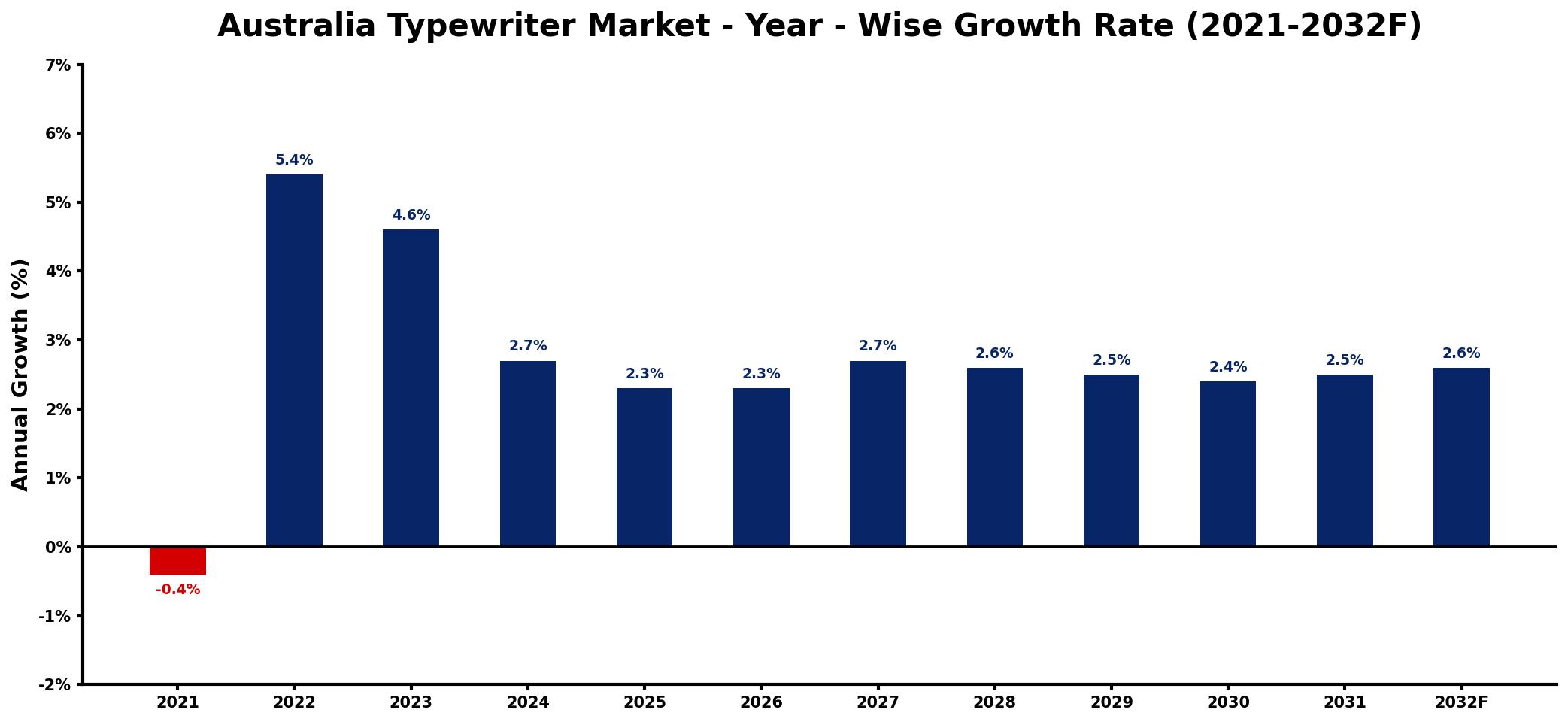
The table below presents the year‑wise growth rates along with the key drivers influencing the market
| Year | Growth Rate | Major Drivers |
| 2021 | -0.4% | shift towards digital communication |
| 2022 | 5.4% | increased demand for retro products |
| 2023 | 4.6% | growth in vintage market segments |
| 2024 | 2.7% | rising interest in craftsmanship |
| 2025 | 2.3% | expansion of niche consumer bases |
| 2026 | 2.3% | enhanced marketing strategies adopted |
| 2027 | 2.7% | growing commercial sector adoption |
| 2028 | 2.6% | increased popularity of analog tools |
| 2029 | 2.5% | growing appreciation for nostalgia |
| 2030 | 2.4% | surge in collector communities forming |
| 2031 | 2.5% | investment in creative writing tools |
| 2032 | 2.6% | development of sustainable materials market |
Note: Market size estimations and growth projections presented in this report are based on 6Wresearch's proprietary forecasting methodology, utilizing the latest available industry data, government publications, and primary research inputs.
Australia Typewriter Market Synopsis
In Australia, a distinct community of typewriter enthusiasts and collectors has emerged, seeking vintage models that embody craftsmanship and nostalgia. Vintage typewriters have not only gained traction in personal spaces but have also found their way into cafés and artisanal shops, where they enhance the ambiance and serve as a creative outlet for customers.
Moreover, the typewriter market is being influenced by a growing trend toward handmade and artisanal products. The tactile satisfaction of typing on a mechanical typewriter offers a refreshing alternative for individuals overwhelmed by digital noise, further solidifying its place in the modern creative process.
Australia Typewriter Market Key Takeaways
- The market is supported by a vibrant community of collectors and retro enthusiasts.
- Demand for typewriters as artistic tools is rising, particularly among writers and creatives.
- Collectors are particularly drawn to vintage models, creating a niche yet passionate market.
- The market is poised for modest growth, signaling a stable interest in analog technologies.
- Interest in artisan and handmade products is driving typewriter market dynamics in Australia.
Evaluation of Restraints in Australia Typewriter Market
Despite the niche market for typewriters, several restraints hinder its growth potential. The overarching decline in demand is primarily attributable to the widespread adoption of digital devices, which offer faster and more convenient options for document creation. As a result, market participants are compelled to innovate and adapt their offerings to remain relevant. Furthermore, the scarcity of parts for older models poses challenges in maintenance and repair, which can deter potential buyers. To thrive in this evolving landscape, stakeholders must continuously seek ways to enhance the appeal of typewriters while fostering community engagement among enthusiasts.
Australia Typewriter Market Trends
Current trends indicate a shift towards incorporating technology with vintage aesthetics, where refurbished typewriters are marketed alongside modern features that enhance usability without compromising on nostalgia. Additionally, the rise of online marketplaces has expanded accessibility to rare and collectible models, making it easier for enthusiasts to connect and share their passions. Social media platforms play a vital role as well, with communities emerging around typewriter appreciation, further fueling interest and knowledge-sharing.
Australia Typewriter Market Opportunities
There is significant potential for growth within the Australia Typewriter Market, particularly in catering to specific segments such as creative writing workshops and retro-themed events. Collaborations with local cafés, bookstores, and educational institutions could lead to interactive experiences that celebrate typewriters' unique characteristics. Furthermore, incorporating sustainability practices in manufacturing and selling practices could enhance brand image and attract environmentally conscious consumers. The combination of community engagement and innovation could unlock new avenues for investment and growth in this specialized market.
Government Initiatives in the Australia Typewriter Market
While there are no specific government policies exclusively targeting the typewriter market, broader initiatives promoting artisanal craftsmanship and local manufacturing could indirectly benefit this niche. Programs aimed at supporting small businesses and cultural preservation offer opportunities for typewriter retailers and enthusiasts to gain recognition and funding. Additionally, public art initiatives that incorporate typewriter themes could further enhance public awareness and appreciation of these vintage machines.
Future Insights of the Australia Typewriter Market
Looking ahead to 2026-2032, the Australia Typewriter Market is expected to continue its steady growth, driven by an enduring appreciation for vintage aesthetics and the handcrafted movement. As digital fatigue persists, more individuals are likely to seek out analog experiences. The combination of nostalgia, functional artistry, and the increasing popularity of retro-themed environments positions the typewriter market as a resilient niche. Stakeholders must stay attuned to evolving consumer preferences and leverage social trends to thrive in this evolving landscape.
Australia Typewriter Market Latest Developments (2025 - 2026)
Recent developments in the Australia Typewriter Market have highlighted a growing trend towards customization and personalization, with artisans increasingly offering bespoke typewriters tailored to individual preferences. Additionally, community-driven initiatives such as typewriter fairs and exhibitions have gained traction, providing platforms for enthusiasts to connect and share their passion. As local businesses collaborate with artists and writers, the typewriter is being reimagined as a centerpiece of creative expression, reinforcing its relevance in modern culture.
Australia Typewriter Market - Key Attractiveness of the Report
- 10 Years of Market Numbers
- Historical Data Starting from 2022 to 2025
- Base Year: 2025
- Forecast Data until 2032
- Key Performance Indicators Impacting the Market
- Major Upcoming Developments and Projects
Key Highlights of the Report:
- Australia Typewriter Market Outlook
- Market Size of Australia Typewriter Market, 2025
- Forecast of Australia Typewriter Market, 2032
- Historical Data and Forecast of Australia Typewriter Revenues & Volume for the Period 2022-2032F
- Australia Typewriter Market Trend Evolution
- Australia Typewriter Market Drivers and Challenges
- Australia Typewriter Price Trends
- Australia Typewriter Porter's Five Forces
- Australia Typewriter Industry Life Cycle
- Historical Data and Forecast of Australia Typewriter Market Revenues & Volume By Type for the Period 2022-2032F
- Historical Data and Forecast of Australia Typewriter Market Revenues & Volume By Standard Typewriter for the Period 2022-2032F
- Historical Data and Forecast of Australia Typewriter Market Revenues & Volume By Portable Typewriter for the Period 2022-2032F
- Historical Data and Forecast of Australia Typewriter Market Revenues & Volume By Noiseless Typewriter for the Period 2022-2032F
- Historical Data and Forecast of Australia Typewriter Market Revenues & Volume By Electric Typewriter for the Period 2022-2032F
- Historical Data and Forecast of Australia Typewriter Market Revenues & Volume By Variable Typewriter for the Period 2022-2032F
- Historical Data and Forecast of Australia Typewriter Market Revenues & Volume By Automatic Typewriter for the Period 2022-2032F
- Historical Data and Forecast of Australia Typewriter Market Revenues & Volume By Electronic Typewriter for the Period 2022-2032F
- Historical Data and Forecast of Australia Standard Typewriter Typewriter Market Revenues & Volume By Typewriter with Additional Attachments for the Period 2022-2032F
- Historical Data and Forecast of Australia Typewriter Market Revenues & Volume By Application for the Period 2022-2032F
- Historical Data and Forecast of Australia Typewriter Market Revenues & Volume By Commerical for the Period 2022-2032F
- Historical Data and Forecast of Australia Typewriter Market Revenues & Volume By Industrial for the Period 2022-2032F
- Historical Data and Forecast of Australia Typewriter Market Revenues & Volume By Others for the Period 2022-2032F
- Australia Typewriter Import Export Trade Statistics
- Market Opportunity Assessment By Type
- Market Opportunity Assessment By Application
- Australia Typewriter Top Companies Market Share
- Australia Typewriter Competitive Benchmarking By Technical and Operational Parameters
- Australia Typewriter Company Profiles
- Australia Typewriter Key Strategic Recommendations






































