Australia Website Builder Market Size, Share & Growth Rate
The Australia Website Builder Market was estimated at USD 226 Million in 2025 and is projected to reach USD 265 Million by 2032, growing at a CAGR of 2.3% from 2026 to 2032. This growth trajectory is primarily driven by the increasing digitization of businesses, especially among SMEs that seek accessible and effective online solutions. Moreover, the rising trend of e-commerce and entrepreneurship is amplifying demand, compelling providers to innovate with more customizable and feature-rich platforms that cater to diverse business needs.
Australia Website Builder Market Year-wise Growth Rate and Key Drivers
This graph highlights how the Australia Website Builder Market has steadily grown over the years, supported by major growth factors.
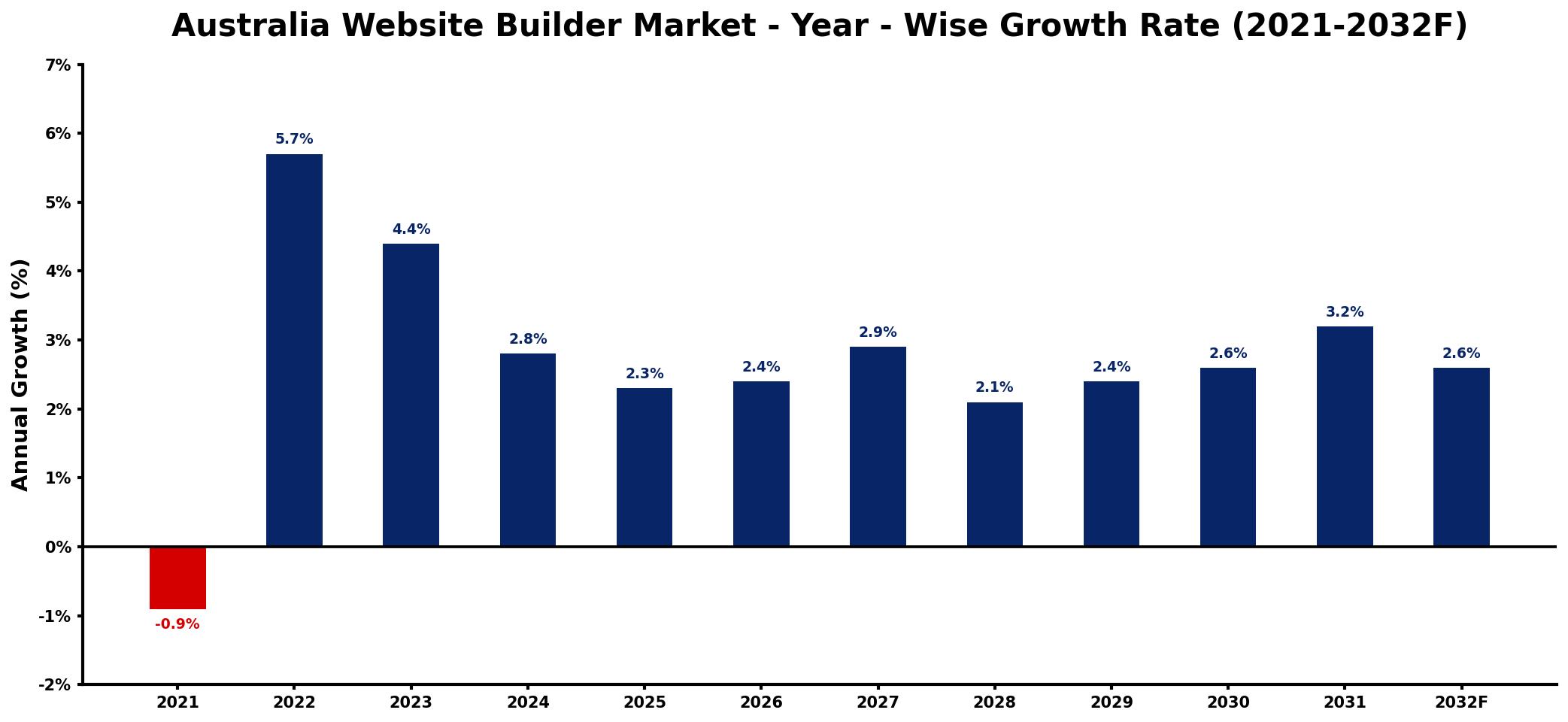
The table below presents the year‑wise growth rates along with the key drivers influencing the market
| Year | Growth Rate | Major Drivers |
| 2021 | -0.9% | Shift in consumer spending habits |
| 2022 | 5.7% | Rise in digital marketing investments |
| 2023 | 4.4% | Increased demand for e-commerce solutions |
| 2024 | 2.8% | Growth in small business startups |
| 2025 | 2.3% | Surge in remote work opportunities |
| 2026 | 2.4% | Expansion of online education platforms |
| 2027 | 2.9% | Higher adoption of cloud technologies |
| 2028 | 2.1% | Increase in mobile commerce transactions |
| 2029 | 2.4% | rising end-use demand growth |
| 2030 | 2.6% | Rising popularity of social media |
| 2031 | 3.2% | Boost in online content creation |
| 2032 | 2.6% | rising export shipment volumes |
Note: Market size estimations and growth projections presented in this report are based on 6Wresearch's proprietary forecasting methodology, utilizing the latest available industry data, government publications, and primary research inputs.
Australia Website Builder Market Synopsis
The demand for user-friendly website builder platforms is currently the strongest force shaping the Australia website builder market. As businesses prioritize their online visibility, the necessity for simple, yet effective, digital tools has skyrocketed. With SMEs leading this charge, the market is becoming increasingly competitive, prompting companies to enhance their offerings and maintain relevance in a fast-evolving landscape.
Furthermore, the landscape is characterized by a growing inclination towards DIY website creation among users, who are seeking greater control over their digital presence. This shift is not only fostering innovation but also creating opportunities for new entrants to challenge established providers with unique features and pricing structures that align with current market demands.
Australia Website Builder Market Key Takeaways
- Continuous digitization across various sectors is propelling demand for website building solutions.
- SMEs are leading the charge, focusing on user-friendly platforms that enhance their online presence.
- Market competitiveness is intensifying as providers innovate to include customizable templates and advanced functionalities.
- Government initiatives are actively supporting the growth of digital literacy and innovation in this sector.
- The rise of e-commerce is creating ample opportunities for businesses to adopt website building tools.
Evaluation of Restraints in Australia Website Builder Market
While the Australia website builder market shows promise, several restraints exist. A significant challenge is the increasing complexity associated with user expectations for advanced design features and customization. As consumers become more sophisticated, providers face the daunting task of staying ahead of evolving user preferences while maintaining the simplicity that initially drew customers to DIY platforms. Additionally, with a crowded marketplace, distinguishing offerings requires substantial investment in marketing and branding strategies to capture consumer attention.
Australia Website Builder Market Trends
Current trends in the Australia website builder market reflect a heightened focus on user experience. Companies are integrating artificial intelligence and machine learning technologies into their platforms to provide tailored recommendations, thereby enhancing user engagement. Moreover, mobile optimization and responsive design are becoming essential features, catering to the growing number of users who access the internet via mobile devices. This trend not only improves functionality but also impacts search engine rankings, compelling businesses to adopt mobile-first strategies.
Australia Website Builder Market Opportunities
Significant growth opportunities are emerging for businesses in the Australia website builder market. The ongoing expansion of the e-commerce sector is one such area, as companies require robust platforms to facilitate online sales and customer interactions. Additionally, as remote work continues to gain traction, businesses across sectors are seeking effective online tools to streamline operations. This opens doors for providers to develop tailored solutions that not only meet individual needs but also create new revenue streams through subscription models and premium features.
Government Initiatives in the Australia Website Builder Market
The Australian government is actively fostering an environment conducive to innovation and competition within the website builder market. Policies aimed at enhancing digital literacy and accessibility are pivotal, providing resources that empower businesses and individuals alike. Through various training programs and funding initiatives, the government encourages the adoption of digital tools and technologies, enabling website builder companies to flourish while ensuring consumer protection and fair market practices.
Future Insights of the Australia Website Builder Market
Looking ahead to the period from 2026 to 2032, the Australia website builder market is poised for continued evolution. The integration of more sophisticated technology, such as AI and enhanced user analytics, will likely shape the future of digital presence management. Furthermore, as consumer behavior shifts towards omnichannel experiences, providers will need to adapt by offering seamless integrations with various e-commerce platforms and social media channels. This adaptability will be crucial for maintaining competitiveness and meeting the diverse needs of users.
Australia Website Builder Market Latest Developments (2025 - 2026)
In recent months, the Australia website builder market has seen a surge in developments focused on improving user experience and engagement. Companies are enhancing their platforms with advanced analytics tools that allow users to track visitor behavior and optimize their websites accordingly. Additionally, there is a growing emphasis on providing multi-language support and localization features to cater to Australias diverse population, indicating a shift towards inclusivity in web design and development.
Australia Website Builder Market - Key Attractiveness of the Report
- 10 Years of Market Numbers
- Historical Data Starting from 2022 to 2025
- Base Year: 2025
- Forecast Data until 2032
- Key Performance Indicators Impacting the Market
- Major Upcoming Developments and Projects
Key Highlights of the Report:
- Australia Website Builder Market Outlook
- Market Size of Australia Website Builder Market, 2025
- Forecast of Australia Website Builder Market, 2032
- Historical Data and Forecast of Australia Website Builder Revenues & Volume for the Period 2022-2032F
- Australia Website Builder Market Trend Evolution
- Australia Website Builder Market Drivers and Challenges
- Australia Website Builder Price Trends
- Australia Website Builder Porter's Five Forces
- Australia Website Builder Industry Life Cycle
- Historical Data and Forecast of Australia Website Builder Market Revenues & Volume By Deployment Type for the Period 2022-2032F
- Historical Data and Forecast of Australia Website Builder Market Revenues & Volume By Cloud-Based for the Period 2022-2032F
- Historical Data and Forecast of Australia Website Builder Market Revenues & Volume By On-Premise for the Period 2022-2032F
- Historical Data and Forecast of Australia Website Builder Market Revenues & Volume By Type for the Period 2022-2032F
- Historical Data and Forecast of Australia Website Builder Market Revenues & Volume By Mobile Website Builders for the Period 2022-2032F
- Historical Data and Forecast of Australia Website Builder Market Revenues & Volume By PC Website Builders for the Period 2022-2032F
- Historical Data and Forecast of Australia Website Builder Market Revenues & Volume By End Users for the Period 2022-2032F
- Historical Data and Forecast of Australia Website Builder Market Revenues & Volume By Individuals for the Period 2022-2032F
- Historical Data and Forecast of Australia Website Builder Market Revenues & Volume By SMEs for the Period 2022-2032F
- Historical Data and Forecast of Australia Website Builder Market Revenues & Volume By Large Enterprises for the Period 2022-2032F
- Australia Website Builder Import Export Trade Statistics
- Market Opportunity Assessment By Deployment Type
- Market Opportunity Assessment By Type
- Market Opportunity Assessment By End Users
- Australia Website Builder Top Companies Market Share
- Australia Website Builder Competitive Benchmarking By Technical and Operational Parameters
- Australia Website Builder Company Profiles
- Australia Website Builder Key Strategic Recommendations






































