Austria Loudspeaker Market: Import Trend Analysis
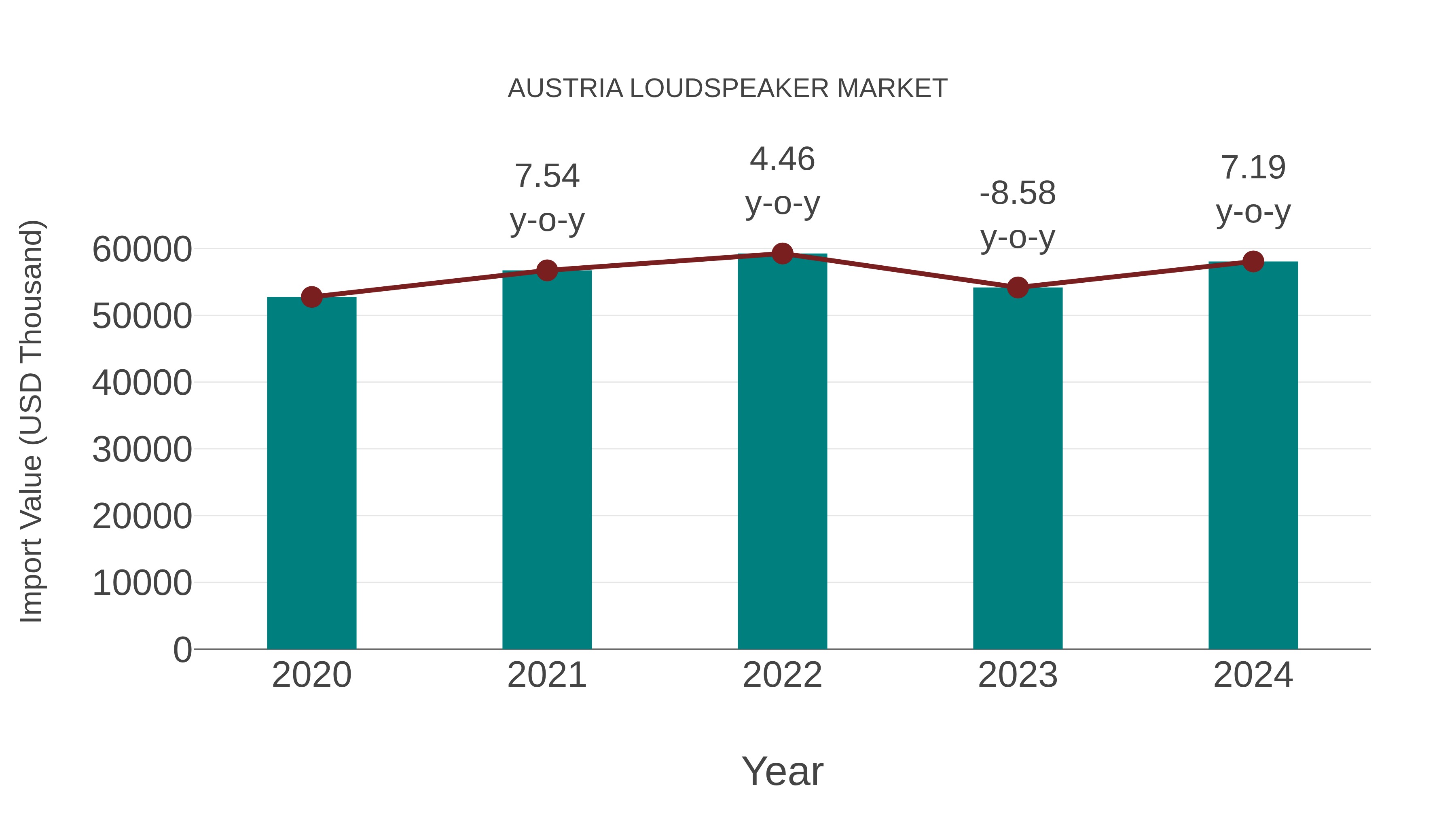
During 2020-2024, the Austria loudspeaker market witnessed a Compound Annual Growth Rate (CAGR) of 2.43%. In 2023-2024, the year-on-year growth rate surged to 7.19%, indicating a substantial increase in imports during that period.
Austria Loudspeaker Market Synopsis
The Austria Loudspeaker Market is experiencing steady growth driven by factors such as the increasing adoption of smart home devices, rising demand for high-quality audio solutions in commercial spaces, and the growing popularity of home entertainment systems. Key players in the market are focusing on product innovation, including the development of wireless and smart speakers with advanced features like voice control and connectivity options. The market is characterized by a competitive landscape with companies such as AKG Acoustics, Vienna Acoustics, and Pro-Ject Audio Systems leading the way. With the trend towards immersive audio experiences and the rise of streaming services, the Austria Loudspeaker Market is expected to continue its growth trajectory in the coming years.
Austria Loudspeaker Market Trends
The Austria Loudspeaker Market is experiencing a shift towards wireless and smart speaker solutions, driven by the increasing demand for convenience and connectivity. Consumers are looking for versatile and high-quality audio devices that can seamlessly integrate with their smart home ecosystems. This trend presents opportunities for companies to innovate in terms of design, functionality, and connectivity options. Additionally, the growing popularity of voice-controlled smart speakers powered by virtual assistants like Amazon Alexa and Google Assistant is creating new avenues for market expansion. With the rise of streaming services and home entertainment systems, there is a growing demand for premium sound quality and multi-room audio solutions in Austria, providing opportunities for companies to cater to the evolving needs of consumers in this market segment.
Austria Loudspeaker Market Challenges
In the Austria Loudspeaker Market, some key challenges include intense competition from both domestic and international players, leading to price wars and pressure on profit margins. Additionally, technological advancements and innovations in the industry require constant investment in research and development to stay competitive. Market saturation and limited growth opportunities in a relatively small market like Austria also pose challenges for companies looking to expand their market share. Furthermore, fluctuations in consumer preferences and trends, as well as changing regulations related to environmental standards and product certifications, add complexity to doing business in the Austria Loudspeaker Market. Overall, companies operating in this market need to navigate these challenges strategically to sustain growth and profitability.
Austria Loudspeaker Market Investment Opportunities
The Austria Loudspeaker Market is primarily driven by factors such as the increasing demand for high-quality audio equipment in both residential and commercial applications, advancements in technology leading to the development of innovative and premium sound systems, and the growing popularity of smart speakers and home audio systems. Additionally, the rising disposable income levels and changing consumer preferences towards superior audio experiences contribute to the market growth. The trend of integrating voice assistant technology in loudspeakers, along with the increasing adoption of wireless and portable speakers, further propels the market expansion. Furthermore, factors such as the booming entertainment industry, including music concerts and events, and the rising trend of connected and smart homes drive the demand for loudspeakers in Austria.
Austria Loudspeaker Market Government Policie
The Austria Loudspeaker Market is subject to various government policies aimed at ensuring product safety, fair competition, and environmental sustainability. The Austrian government has implemented regulations such as the CE marking requirement, which certifies that loudspeakers meet European Union safety standards. Additionally, competition laws enforced by the Federal Competition Authority (BWB) ensure fair practices within the market. In terms of environmental sustainability, the government has set targets for reducing electronic waste through the Waste Electrical and Electronic Equipment (WEEE) Directive, which requires manufacturers to take responsibility for the collection and recycling of end-of-life products. Overall, these policies aim to promote a safe, competitive, and environmentally conscious loudspeaker market in Austria.
Austria Loudspeaker Market Future Outlook
The future outlook for the Austria Loudspeaker Market is promising, with steady growth expected due to the increasing demand for high-quality audio products across various sectors such as consumer electronics, automotive, and professional audio. The market is anticipated to be driven by technological advancements in sound quality, design innovation, and the rising popularity of smart speakers and wireless audio solutions. Additionally, the growing trend of home entertainment systems and the increasing adoption of portable speakers for outdoor activities are likely to further boost market growth. However, competition among key players and price sensitivity among consumers may pose challenges. Overall, the Austria Loudspeaker Market is forecasted to experience positive growth in the coming years, presenting opportunities for companies to capitalize on the evolving consumer preferences and technological advancements in the audio industry.
Key Highlights of the Report:
- Austria Loudspeaker Market Outlook
- Market Size of Austria Loudspeaker Market, 2025
- Forecast of Austria Loudspeaker Market, 2032
- Historical Data and Forecast of Austria Loudspeaker Revenues & Volume for the Period 2022 - 2032F
- Austria Loudspeaker Market Trend Evolution
- Austria Loudspeaker Market Drivers and Challenges
- Austria Loudspeaker Price Trends
- Austria Loudspeaker Porter's Five Forces
- Austria Loudspeaker Industry Life Cycle
- Historical Data and Forecast of Austria Loudspeaker Market Revenues & Volume By Product for the Period 2022 - 2032F
- Historical Data and Forecast of Austria Loudspeaker Market Revenues & Volume By Soundbar for the Period 2022 - 2032F
- Historical Data and Forecast of Austria Loudspeaker Market Revenues & Volume By Subwoofer for the Period 2022 - 2032F
- Historical Data and Forecast of Austria Loudspeaker Market Revenues & Volume By In-wall for the Period 2022 - 2032F
- Historical Data and Forecast of Austria Loudspeaker Market Revenues & Volume By Outdoor for the Period 2022 - 2032F
- Historical Data and Forecast of Austria Loudspeaker Market Revenues & Volume By Other Product Types for the Period 2022 - 2032F
- Historical Data and Forecast of Austria Loudspeaker Market Revenues & Volume By Application for the Period 2022 - 2032F
- Historical Data and Forecast of Austria Loudspeaker Market Revenues & Volume By Communication for the Period 2022 - 2032F
- Historical Data and Forecast of Austria Loudspeaker Market Revenues & Volume By Home Entertainment for the Period 2022 - 2032F
- Historical Data and Forecast of Austria Loudspeaker Market Revenues & Volume By Automotive for the Period 2022 - 2032F
- Historical Data and Forecast of Austria Loudspeaker Market Revenues & Volume By Events and Outdoor Entertainment for the Period 2022 - 2032F
- Austria Loudspeaker Import Export Trade Statistics
- Market Opportunity Assessment By Product
- Market Opportunity Assessment By Application
- Austria Loudspeaker Top Companies Market Share
- Austria Loudspeaker Competitive Benchmarking By Technical and Operational Parameters
- Austria Loudspeaker Company Profiles
- Austria Loudspeaker Key Strategic Recommendations






































