Azerbaijan App Analytics Market Size & Growth Rate (2026-2032)
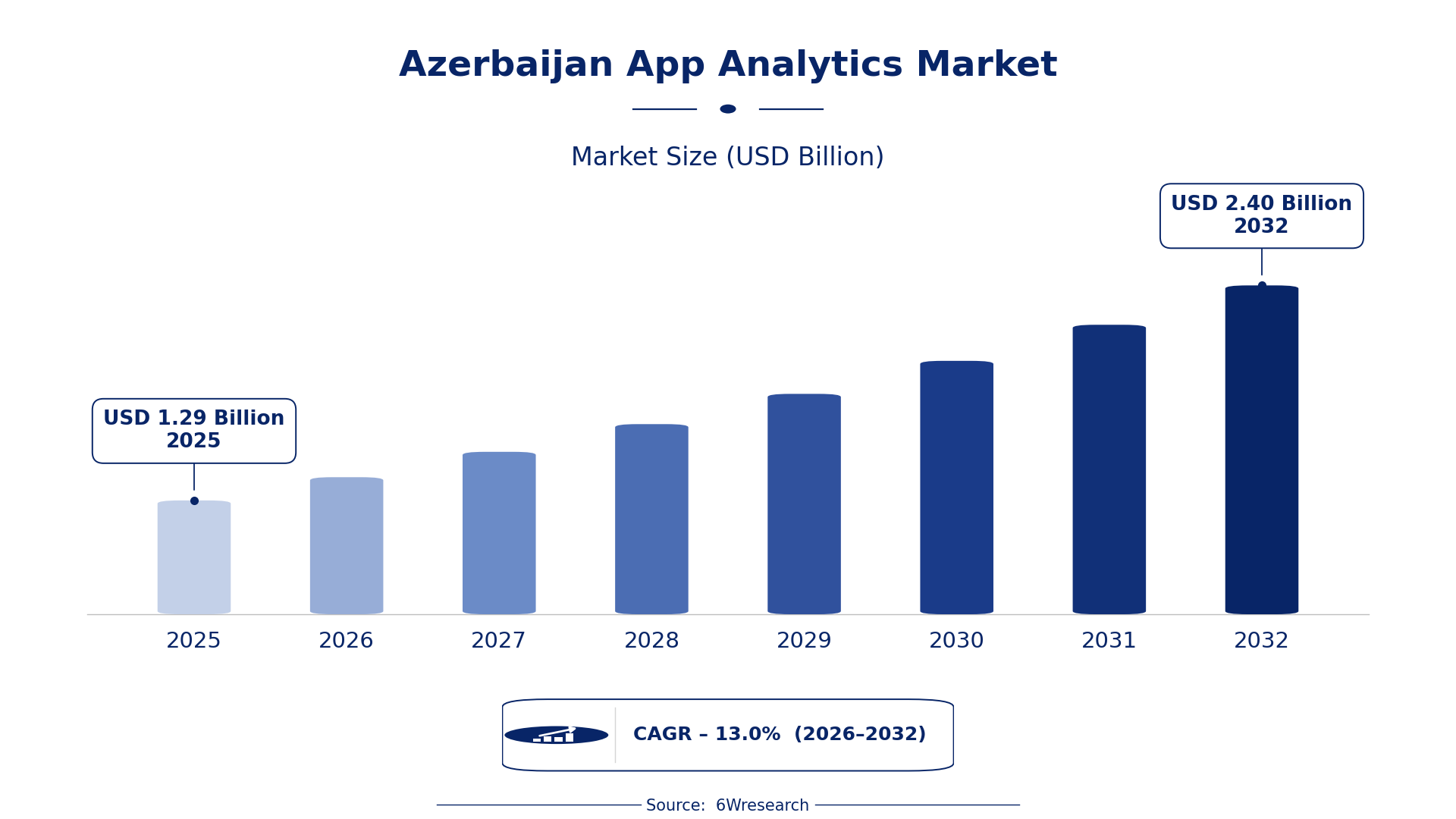
The Azerbaijan App Analytics Market was estimated at USD 1295 Million in 2025 and is projected to reach USD 2396 Million by 2032, growing at a CAGR of 13.0% from 2026 to 2032.
Azerbaijan App Analytics Market Synopsis
The growing demand for data-driven insights is the most significant force currently shaping the Azerbaijan App Analytics Market. As mobile applications proliferate across various sectors, businesses increasingly recognize the need to understand user behavior and optimize their app performance through analytics.
A surge in mobile app adoption has resulted in businesses prioritizing app analytics for informed decision-making. This shift is not just about tracking user engagement; it’s about leveraging analytics to enhance user experience and drive growth in a competitive digital environment.
Azerbaijan App Analytics Market Year-wise Growth Rate and Key Drivers
This graph illustrates the annual growth rates of the Azerbaijan App Analytics Market from 2021 to 2032, highlighting a steady upward trajectory and projected expansion over the forecast period.
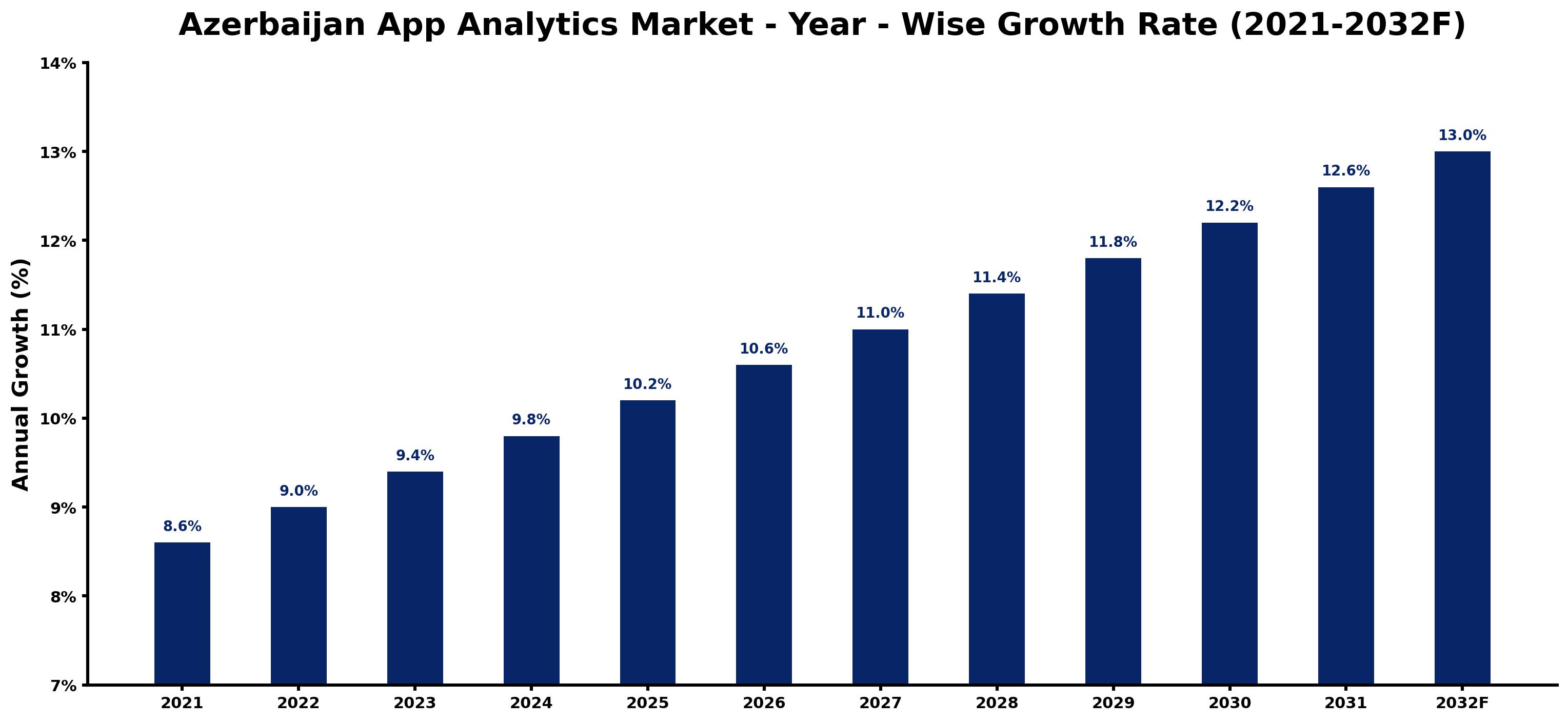
The table below presents the year‑wise growth rates along with the key drivers influencing the market
| Year | Growth Rate | Major Drivers |
| 2021 | 8.6% | Increased smartphone adoption among younger demographics. |
| 2022 | 9.0% | Government investment in tech startups boosting app innovation. |
| 2023 | 9.4% | Rise in e-commerce driving demand for shopping applications. |
| 2024 | 9.8% | Launch of national digitalization strategy supporting tech adoption. |
| 2025 | 10.2% | Growing interest in mobile health applications post-pandemic. |
| 2026 | 10.6% | Increase in mobile data consumption due to 5G rollout. |
| 2027 | 11.0% | Local gaming industry growth encouraging app development. |
| 2028 | 11.4% | Rising investment in educational apps by government initiatives. |
| 2029 | 11.8% | Shift to digital solutions in tourism enhancing app usage. |
| 2030 | 12.2% | Evolving consumer preferences towards personalized app experiences. |
| 2031 | 12.6% | Collaboration between telecoms and app developers increasing engagement. |
| 2032 | 13.0% | Adoption of AI technologies enhancing app functionality and analysis. |
Note: Market size estimations and growth projections presented in this report are based on 6Wresearch's proprietary forecasting methodology, utilizing the latest available industry data, government publications, and primary research inputs.
Azerbaijan App Analytics Market Key Takeaways
Below are some of the specific key takeaways from the market, including:
- The Azerbaijan App Analytics Market is projected to grow significantly from 2025 to 2032.
- There is an increasing emphasis on advanced analytics tools that provide deeper insights into user behavior.
- AI and machine learning technologies are gaining traction for their role in predictive analytics.
- Data privacy and compliance with regulations are critical considerations for businesses adopting app analytics.
- Investment opportunities are emerging as the demand for sophisticated analytics solutions rises.
Evaluation of Restraints in Azerbaijan App Analytics Market
One of the primary restraints holding back the Azerbaijan App Analytics Market is the lack of awareness among businesses about the benefits of app analytics. Many companies do not fully understand how these tools can provide insights into user behavior or enhance app performance. Additionally, limited access to advanced technologies and the necessary expertise hampers effective implementation. Coupled with growing concerns over data privacy and regulatory compliance, these factors create a challenging environment for broader adoption of app analytics solutions.
Azerbaijan App Analytics Market Trends
The market is witnessing an increasing demand for sophisticated analytics tools that offer real-time monitoring and actionable insights. More businesses are recognizing the importance of integrating app analytics with marketing automation platforms to refine their campaigns. Another notable trend is the integration of AI and machine learning for predictive analytics, helping businesses anticipate user needs and optimize engagement strategies. As the app ecosystem evolves, staying ahead of these trends will be vital for businesses aiming to maintain a competitive edge.
Azerbaijan App Analytics Market Opportunities
Investment opportunities abound in the Azerbaijan App Analytics Market, particularly for companies offering advanced analytics tools tailored to local needs. As businesses increasingly seek data-driven insights to enhance user engagement and app performance, there is a strong demand for solutions that address these requirements. Collaborating with local partners can also help navigate regulatory challenges and cultural nuances, providing a clearer path to market entry and expansion.
Government Initiatives in the Azerbaijan App Analytics Market
The government of Azerbaijan is actively promoting the app analytics market through various initiatives aimed at fostering innovation and improving technological capabilities. This includes creating a favorable regulatory environment and supporting collaboration between industry stakeholders and educational institutions. Such policies are essential for enhancing the skills necessary for businesses to thrive in the app analytics sector.
- A national digital infrastructure upgrade program launched in early 2025 aims to enhance internet access, critical for app analytics growth.
- Ongoing tax incentives for technology companies are intended to stimulate investment in app analytics solutions.
- Current collaborations with universities are underway to develop curricula focusing on app analytics and data science.
- A regulatory framework introduced in 2025 mandates improved data privacy measures for app developers.
- Planned initiatives expected to roll out by 2026 will focus on fostering public-private partnerships to bolster app analytics innovation.
Future Insights of the Azerbaijan App Analytics Market
From 2026 to 2032, the Azerbaijan App Analytics Market is set to experience substantial growth, driven by the escalating adoption of mobile applications across diverse industries. As businesses increasingly prioritize data analytics for decision-making, demand for app analytics solutions will only intensify. The rise of e-commerce and fintech will particularly contribute to this growth, as companies seek advanced analytics to optimize their operations and enhance user experiences. A young, tech-savvy population will further catalyze innovation and the adoption of app analytics tools, positioning Azerbaijan as a key player in the regional market.
Azerbaijan App Analytics Market Latest Developments
Recent activity in the Azerbaijan App Analytics Market highlights a growing trend towards technological advancements and strategic partnerships. Over the past year, several initiatives have been launched to enhance app analytics capabilities and improve data-driven decision-making across industries.
- A major technology vendor introduced a new analytics platform in Q1 2025 that focuses on real-time user engagement metrics.
- A local startup completed the rollout of an AI-driven app analytics tool by mid-2025, enhancing predictive capabilities for businesses.
- An initiative to foster industry collaborations is currently underway, aiming to connect app developers with analytics experts.
- A planned expansion of a national data center is expected to support analytics infrastructure by late 2026.
- A partnership between a leading regional operator and an analytics firm is set to launch in early 2026, focusing on enhancing app performance monitoring.
Azerbaijan App Analytics Market - Key Attractiveness of the Report
- 10 Years of Market Numbers
- Historical Data Starting from 2022 to 2025
- Base Year: 2025
- Forecast Data until 2032
- Key Performance Indicators Impacting the Market
- Major Upcoming Developments and Projects
Key Highlights of the Report:
- Azerbaijan App Analytics Market Outlook
- Market Size of Azerbaijan App Analytics Market, 2025
- Forecast of Azerbaijan App Analytics Market, 2032
- Historical Data and Forecast of Azerbaijan App Analytics Revenues & Volume for the Period 2022-2032F
- Azerbaijan App Analytics Market Trend Evolution
- Azerbaijan App Analytics Market Drivers and Challenges
- Azerbaijan App Analytics Price Trends
- Azerbaijan App Analytics Porter's Five Forces
- Azerbaijan App Analytics Industry Life Cycle
- Historical Data and Forecast of Azerbaijan App Analytics Market Revenues & Volume By Component for the Period 2022-2032F
- Historical Data and Forecast of Azerbaijan App Analytics Market Revenues & Volume By Software for the Period 2022-2032F
- Historical Data and Forecast of Azerbaijan App Analytics Market Revenues & Volume By Services for the Period 2022-2032F
- Historical Data and Forecast of Azerbaijan App Analytics Market Revenues & Volume By Application for the Period 2022-2032F
- Historical Data and Forecast of Azerbaijan App Analytics Market Revenues & Volume By Revenue analytics for the Period 2022-2032F
- Historical Data and Forecast of Azerbaijan App Analytics Market Revenues & Volume By App performance analytics and operations for the Period 2022-2032F
- Historical Data and Forecast of Azerbaijan App Analytics Market Revenues & Volume By User analytics for the Period 2022-2032F
- Historical Data and Forecast of Azerbaijan App Analytics Market Revenues & Volume By Ad monitoring and marketing analytics for the Period 2022-2032F
- Historical Data and Forecast of Azerbaijan App Analytics Market Revenues & Volume By Type for the Period 2022-2032F
- Historical Data and Forecast of Azerbaijan App Analytics Market Revenues & Volume By Mobile app analytics for the Period 2022-2032F
- Historical Data and Forecast of Azerbaijan App Analytics Market Revenues & Volume By Web app analytics for the Period 2022-2032F
- Historical Data and Forecast of Azerbaijan App Analytics Market Revenues & Volume By Vertical for the Period 2022-2032F
- Historical Data and Forecast of Azerbaijan App Analytics Market Revenues & Volume By Banking, Financial Services, and Insurance (BFSI) for the Period 2022-2032F
- Historical Data and Forecast of Azerbaijan App Analytics Market Revenues & Volume By Retail for the Period 2022-2032F
- Historical Data and Forecast of Azerbaijan App Analytics Market Revenues & Volume By Media and entertainment for the Period 2022-2032F
- Historical Data and Forecast of Azerbaijan App Analytics Market Revenues & Volume By Logistics, travel, and transportation for the Period 2022-2032F
- Historical Data and Forecast of Azerbaijan App Analytics Market Revenues & Volume By Telecom and IT for the Period 2022-2032F
- Historical Data and Forecast of Azerbaijan App Analytics Market Revenues & Volume By Others for the Period 2022-2032F
- Azerbaijan App Analytics Import Export Trade Statistics
- Market Opportunity Assessment By Component
- Market Opportunity Assessment By Application
- Market Opportunity Assessment By Type
- Market Opportunity Assessment By Vertical
- Azerbaijan App Analytics Top Companies Market Share
- Azerbaijan App Analytics Competitive Benchmarking By Technical and Operational Parameters
- Azerbaijan App Analytics Company Profiles
- Azerbaijan App Analytics Key Strategic Recommendations






































