Azerbaijan Briquette Market Size, Share & Growth Rate
The Azerbaijan Briquette Market was estimated at USD 979 Million in 2025 and is projected to reach USD 1762 Million by 2032, growing at a CAGR of 8.8% from 2026 to 2032. This upward trajectory is primarily driven by increasing consumer awareness of environmental sustainability and governmental support for renewable energy initiatives. The shift towards cleaner fuel options in both residential and industrial sectors further fuels this market expansion.
Azerbaijan Briquette Market Year-wise Growth Rate and Key Drivers
This graph highlights how the Azerbaijan Briquette Market has steadily grown over the years, supported by major growth factors.
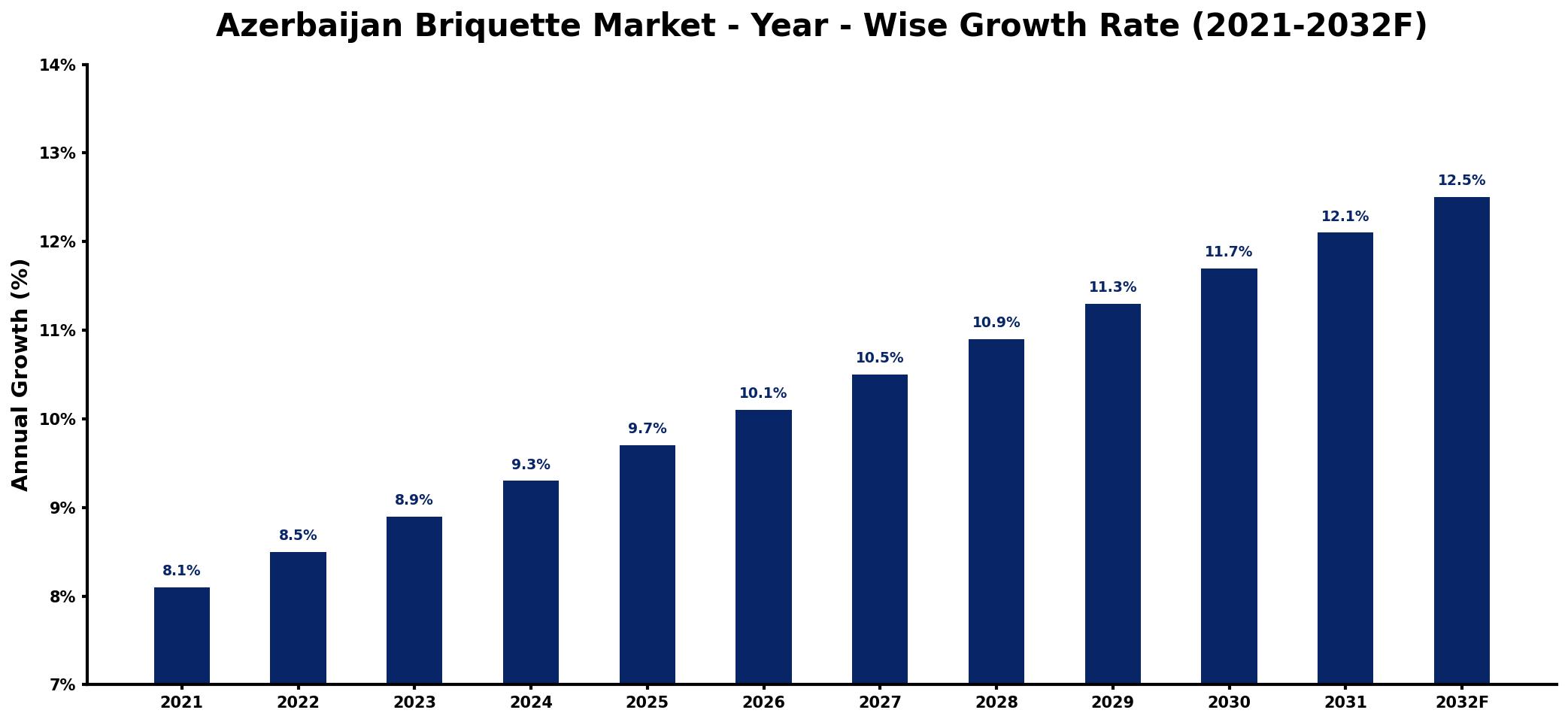
The table below presents the year‑wise growth rates along with the key drivers influencing the market
| Year | Growth Rate | Major Drivers |
| 2021 | 8.1% | increased industrial energy demand |
| 2022 | 8.5% | growing renewable energy investments |
| 2023 | 8.9% | expansion of residential heating solutions |
| 2024 | 9.3% | rising export opportunities abroad |
| 2025 | 9.7% | enhanced production technologies adoption |
| 2026 | 10.1% | government incentives for sustainability |
| 2027 | 10.5% | increased urbanization and infrastructure |
| 2028 | 10.9% | growing environmental consciousness trends |
| 2029 | 11.3% | diverse applications across industries |
| 2030 | 11.7% | strengthened supply chain efficiencies |
| 2031 | 12.1% | innovative product development initiatives |
| 2032 | 12.5% | rising global energy prices |
Note: Market size estimations and growth projections presented in this report are based on 6Wresearch's proprietary forecasting methodology, utilizing the latest available industry data, government publications, and primary research inputs.
Azerbaijan Briquette Market Synopsis
The strongest force shaping the Azerbaijan Briquette Market today is the growing emphasis on sustainable energy solutions. Consumers and businesses alike are progressively recognizing the advantages of briquettes as a cleaner, eco-friendly alternative to traditional fuels such as coal and firewood.
Additionally, as production capacities improve and technology advances, the overall quality and efficiency of briquettes are on the rise. This, coupled with favorable government policies aimed at promoting renewable energy, positions the market for significant growth in the coming years.
Azerbaijan Briquette Market Key Takeaways
- Increasing consumer demand for eco-friendly fuel alternatives is a major market driver.
- Government incentives and subsidies are fostering growth in briquette production and use.
- Technological advancements are enhancing briquette quality, efficiency, and affordability.
- Awareness campaigns are essential to educate consumers on the benefits of briquettes.
- The market is becoming increasingly attractive for investments in production and distribution infrastructure.
Evaluation of Restraints in Azerbaijan Briquette Market
Despite promising growth prospects, the Azerbaijan briquette market faces notable challenges. A significant barrier to adoption is the prevailing lack of awareness among consumers regarding the benefits of briquettes compared to traditional fuels. This knowledge gap results in slow consumer acceptance and reluctance to transition from established fuel sources. Furthermore, infrastructure hurdles hinder the efficient distribution of briquettes, particularly in remote regions where accessibility remains a concern. Additionally, while briquettes may offer long-term cost savings, their initial pricing can deter budget-conscious consumers.
Azerbaijan Briquette Market Trends
Several key trends are shaping the Azerbaijan Briquette Market. An increasing focus on sustainable energy sources has led consumers to seek out eco-friendly alternatives like briquettes. Moreover, there's a marked rise in production capacity, as manufacturers invest in advanced technologies that improve the quality and efficiency of briquettes. The market also sees a growing diversification of applications, catering not just to residential but also commercial and industrial sectors.
Azerbaijan Briquette Market Opportunities
The Azerbaijan briquette market offers compelling investment opportunities primarily due to the increasing demand for alternative energy sources. Given the countrys abundant reserves of biomass raw materials, theres significant potential for establishing production facilities. Moreover, forming partnerships with existing manufacturers can yield lucrative returns as the market grows. The governments proactive stance on promoting renewable energy further solidifies this potential, presenting a landscape ripe for innovation and expansion.
Government Initiatives in the Azerbaijan Briquette Market
The Azerbaijani government has enacted various policies to bolster the briquette market. These include the imposition of tariffs on imported briquettes, aimed at protecting local manufacturers while encouraging domestic production. Additionally, the government offers subsidies and incentives designed to foster the use of eco-friendly briquettes. Quality control standards are being enforced to ensure consumer safety, alongside initiatives promoting research and development to drive innovation within the industry.
Future Insights of the Azerbaijan Briquette Market
Looking ahead to 2026-2032, the Azerbaijan briquette market is poised for sustained growth. As awareness around environmental sustainability continues to rise, coupled with the government's commitment to renewable energy policies, a shift towards cleaner energy sources is inevitable. The ample availability of raw materials for briquette production, such as agricultural residues and wood waste, provides a strategic advantage for the market. This increasing focus on eco-friendly practices underscores the promising trajectory for investments and innovations in the sector.
Azerbaijan Briquette Market Latest Developments (2025 - 2026)
Recent developments in the Azerbaijan briquette market highlight a growing trend towards sustainability and technological advancement. Manufacturers are actively exploring innovative production methods to enhance the quality of briquettes, while ongoing government initiatives aim to bolster renewable energy initiatives. Collaborations within the industry are becoming more common, signaling a collective movement towards strengthening the market framework and improving distribution efficiency.
Azerbaijan Briquette Market - Key Attractiveness of the Report
- 10 Years of Market Numbers
- Historical Data Starting from 2022 to 2025
- Base Year: 2025
- Forecast Data until 2032
- Key Performance Indicators Impacting the Market
- Major Upcoming Developments and Projects
Key Highlights of the Report:
- Azerbaijan Briquette Market Outlook
- Market Size of Azerbaijan Briquette Market, 2025
- Forecast of Azerbaijan Briquette Market, 2032
- Historical Data and Forecast of Azerbaijan Briquette Revenues & Volume for the Period 2022-2032F
- Azerbaijan Briquette Market Trend Evolution
- Azerbaijan Briquette Market Drivers and Challenges
- Azerbaijan Briquette Price Trends
- Azerbaijan Briquette Porter's Five Forces
- Azerbaijan Briquette Industry Life Cycle
- Historical Data and Forecast of Azerbaijan Briquette Market Revenues & Volume By Type for the Period 2022-2032F
- Historical Data and Forecast of Azerbaijan Briquette Market Revenues & Volume By Spruce for the Period 2022-2032F
- Historical Data and Forecast of Azerbaijan Briquette Market Revenues & Volume By Pine for the Period 2022-2032F
- Historical Data and Forecast of Azerbaijan Briquette Market Revenues & Volume By Beech for the Period 2022-2032F
- Historical Data and Forecast of Azerbaijan Briquette Market Revenues & Volume By Straw for the Period 2022-2032F
- Historical Data and Forecast of Azerbaijan Briquette Market Revenues & Volume By Others for the Period 2022-2032F
- Historical Data and Forecast of Azerbaijan Briquette Market Revenues & Volume By Application for the Period 2022-2032F
- Historical Data and Forecast of Azerbaijan Briquette Market Revenues & Volume By Heating of Residential and Commercial Buildings for the Period 2022-2032F
- Historical Data and Forecast of Azerbaijan Briquette Market Revenues & Volume By District Heating and Electricity Production for the Period 2022-2032F
- Historical Data and Forecast of Azerbaijan Briquette Market Revenues & Volume By End-Use for the Period 2022-2032F
- Historical Data and Forecast of Azerbaijan Briquette Market Revenues & Volume By Pharmaceutical Industry for the Period 2022-2032F
- Historical Data and Forecast of Azerbaijan Briquette Market Revenues & Volume By Food for the Period 2022-2032F
- Historical Data and Forecast of Azerbaijan Briquette Market Revenues & Volume By Chemical Industry for the Period 2022-2032F
- Historical Data and Forecast of Azerbaijan Briquette Market Revenues & Volume By Dye and Pigment for the Period 2022-2032F
- Historical Data and Forecast of Azerbaijan Briquette Market Revenues & Volume By Paper Mills for the Period 2022-2032F
- Historical Data and Forecast of Azerbaijan Briquette Market Revenues & Volume By Textile Industry for the Period 2022-2032F
- Historical Data and Forecast of Azerbaijan Briquette Market Revenues & Volume By Leather Manufacturing for the Period 2022-2032F
- Azerbaijan Briquette Import Export Trade Statistics
- Market Opportunity Assessment By Type
- Market Opportunity Assessment By Application
- Market Opportunity Assessment By End-Use
- Azerbaijan Briquette Top Companies Market Share
- Azerbaijan Briquette Competitive Benchmarking By Technical and Operational Parameters
- Azerbaijan Briquette Company Profiles
- Azerbaijan Briquette Key Strategic Recommendations






































