Azerbaijan Flexible Intermediate Bulk Container Market Size Growth Rate
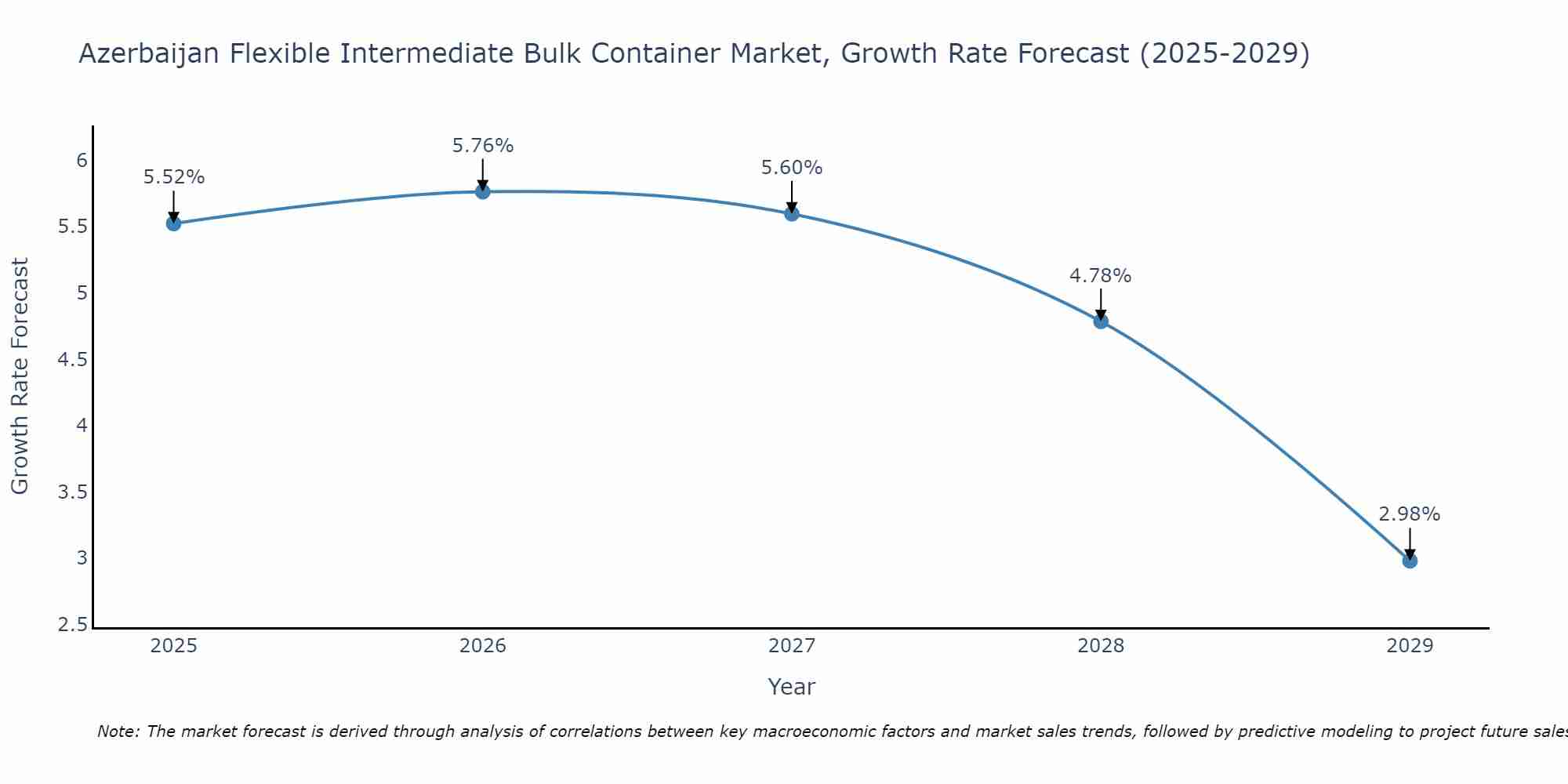
The Azerbaijan Flexible Intermediate Bulk Container Market is projected to witness mixed growth rate patterns during 2025 to 2029. Growth accelerates to 5.76% in 2026, following an initial rate of 5.52%, before easing to 2.98% at the end of the period.
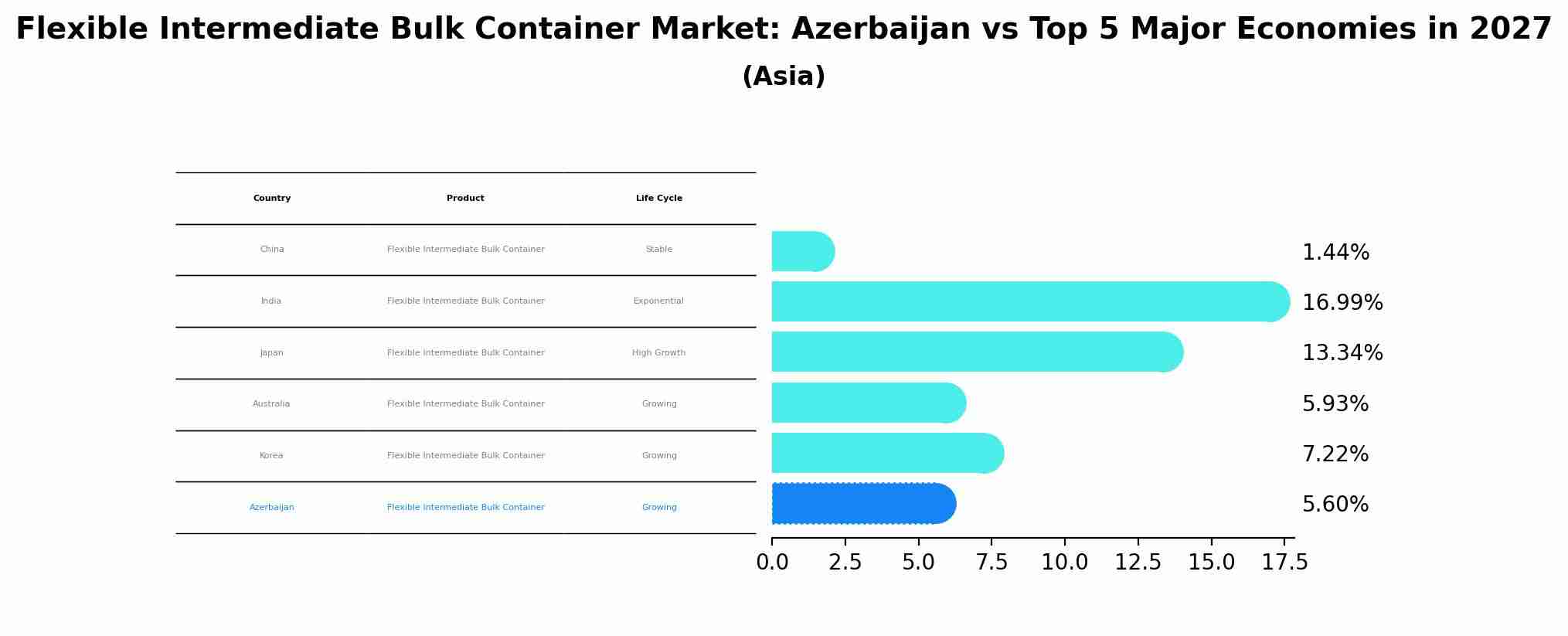
Flexible Intermediate Bulk Container Market: Azerbaijan vs Top 5 Major Economies in 2027 (Asia)
In the Asia region, the Flexible Intermediate Bulk Container market in Azerbaijan is projected to expand at a growing growth rate of 5.60% by 2027. The largest economy is China, followed by India, Japan, Australia and South Korea.
Azerbaijan Flexible Intermediate Bulk Container Market Synopsis
The Azerbaijan Flexible Intermediate Bulk Container (FIBC) market is experiencing steady growth driven by increased demand across various industries such as agriculture, construction, chemicals, and food processing. The market is primarily fueled by the growing need for efficient and cost-effective bulk packaging solutions. Key factors contributing to the market growth include the country`s expanding industrial base, infrastructure development projects, and the rise in international trade activities. As more companies in Azerbaijan seek to optimize their logistics and supply chain processes, the demand for FIBCs is expected to rise further. Market players are focusing on product innovation, quality enhancements, and sustainability measures to cater to the evolving needs of customers and maintain a competitive edge in the Azerbaijan FIBC market.
Azerbaijan Flexible Intermediate Bulk Container Market Trends
The Azerbaijan Flexible Intermediate Bulk Container (FIBC) market is witnessing several key trends. One prominent trend is the increasing demand for FIBCs in industries such as agriculture, construction, and chemicals due to their cost-effectiveness and efficiency in transporting bulk goods. Another trend is the focus on sustainable and eco-friendly FIBCs made from recyclable materials, in line with global environmental concerns. Additionally, technological advancements such as the development of anti-static FIBCs for handling flammable materials and the use of RFID tracking systems for improved logistics management are gaining traction in the market. Overall, the Azerbaijan FIBC market is experiencing growth driven by these trends and the expanding industrial sectors in the country.
Azerbaijan Flexible Intermediate Bulk Container Market Challenges
In the Azerbaijan Flexible Intermediate Bulk Container (FIBC) market, challenges include fluctuating raw material prices, quality control issues, and competition from alternative packaging solutions. The volatility of raw material prices can impact production costs and profit margins for FIBC manufacturers. Ensuring consistent quality control throughout the manufacturing process is crucial to meet industry standards and customer expectations. Additionally, the market faces competition from alternative packaging solutions such as drums, cardboard boxes, and metal containers, which offer different advantages and may be preferred by certain industries or customers. Adapting to changing customer preferences, maintaining cost-efficiency, and enhancing product quality are key areas that FIBC manufacturers in Azerbaijan need to focus on to remain competitive in the market.
Azerbaijan Flexible Intermediate Bulk Container Market Investment Opportunities
Investment opportunities in the Azerbaijan Flexible Intermediate Bulk Container (FIBC) market are promising due to the country`s growing industrial sectors such as construction, agriculture, and chemicals which require bulk packaging solutions. Investing in FIBC manufacturing companies or distribution networks can be lucrative, as the demand for cost-effective and efficient bulk packaging solutions is increasing. With Azerbaijan`s strategic location as a gateway between Europe and Asia, there is potential for exporting FIBCs to neighboring countries as well. Additionally, focusing on innovation in FIBC design and materials to cater to specific industry needs can provide a competitive edge in the market. Overall, investing in the Azerbaijan FIBC market presents opportunities for growth and profitability in line with the country`s industrial development.
Azerbaijan Flexible Intermediate Bulk Container Market Future Outlook
The future outlook for the Azerbaijan Flexible Intermediate Bulk Container (FIBC) market appears promising, with sustained growth anticipated in the coming years. This can be attributed to the increasing demand for FIBCs across various industries such as agriculture, construction, chemicals, and pharmaceuticals in Azerbaijan. The market is expected to benefit from the country`s expanding industrial sector and growing exports, driving the need for efficient and cost-effective bulk packaging solutions. Additionally, advancements in FIBC technology, including innovations in materials and design for enhanced strength and safety, are likely to further boost market growth. Overall, favorable economic conditions and a supportive regulatory environment are expected to contribute to the continued expansion of the Azerbaijan FIBC market.
Key Highlights of the Report:
- Azerbaijan Flexible Intermediate Bulk Container Market Outlook
- Market Size of Azerbaijan Flexible Intermediate Bulk Container Market, 2021
- Forecast of Azerbaijan Flexible Intermediate Bulk Container Market, 2031
- Historical Data and Forecast of Azerbaijan Flexible Intermediate Bulk Container Revenues & Volume for the Period 2018 - 2031
- Azerbaijan Flexible Intermediate Bulk Container Market Trend Evolution
- Azerbaijan Flexible Intermediate Bulk Container Market Drivers and Challenges
- Azerbaijan Flexible Intermediate Bulk Container Price Trends
- Azerbaijan Flexible Intermediate Bulk Container Porter's Five Forces
- Azerbaijan Flexible Intermediate Bulk Container Industry Life Cycle
- Historical Data and Forecast of Azerbaijan Flexible Intermediate Bulk Container Market Revenues & Volume By Product for the Period 2018 - 2031
- Historical Data and Forecast of Azerbaijan Flexible Intermediate Bulk Container Market Revenues & Volume By Type A for the Period 2018 - 2031
- Historical Data and Forecast of Azerbaijan Flexible Intermediate Bulk Container Market Revenues & Volume By Type B for the Period 2018 - 2031
- Historical Data and Forecast of Azerbaijan Flexible Intermediate Bulk Container Market Revenues & Volume By Type C for the Period 2018 - 2031
- Historical Data and Forecast of Azerbaijan Flexible Intermediate Bulk Container Market Revenues & Volume By Type D for the Period 2018 - 2031
- Historical Data and Forecast of Azerbaijan Flexible Intermediate Bulk Container Market Revenues & Volume By End-Use for the Period 2018 - 2031
- Historical Data and Forecast of Azerbaijan Flexible Intermediate Bulk Container Market Revenues & Volume By Food for the Period 2018 - 2031
- Historical Data and Forecast of Azerbaijan Flexible Intermediate Bulk Container Market Revenues & Volume By Chemical for the Period 2018 - 2031
- Historical Data and Forecast of Azerbaijan Flexible Intermediate Bulk Container Market Revenues & Volume By Pharmaceuticals for the Period 2018 - 2031
- Historical Data and Forecast of Azerbaijan Flexible Intermediate Bulk Container Market Revenues & Volume By Others for the Period 2018 - 2031
- Azerbaijan Flexible Intermediate Bulk Container Import Export Trade Statistics
- Market Opportunity Assessment By Product
- Market Opportunity Assessment By End-Use
- Azerbaijan Flexible Intermediate Bulk Container Top Companies Market Share
- Azerbaijan Flexible Intermediate Bulk Container Competitive Benchmarking By Technical and Operational Parameters
- Azerbaijan Flexible Intermediate Bulk Container Company Profiles
- Azerbaijan Flexible Intermediate Bulk Container Key Strategic Recommendations






































