Azerbaijan Gamification Market Size, Share & Growth Rate
The Azerbaijan Gamification Market was estimated at USD 786 Million in 2025 and is projected to reach USD 1470 Million by 2032, growing at a CAGR of 9.4% from 2026 to 2032. This remarkable growth is driven by an increasing recognition among Azerbaijani businesses of the value that gamification brings to enhancing user engagement, employee productivity, and customer loyalty. As sectors such as education, healthcare, and marketing embrace gamified solutions, the market is set to expand significantly in the coming years.
Azerbaijan Gamification Market Year-wise Growth Rate and Key Drivers
This graph highlights how the Azerbaijan Gamification Market has steadily grown over the years, supported by major growth factors.
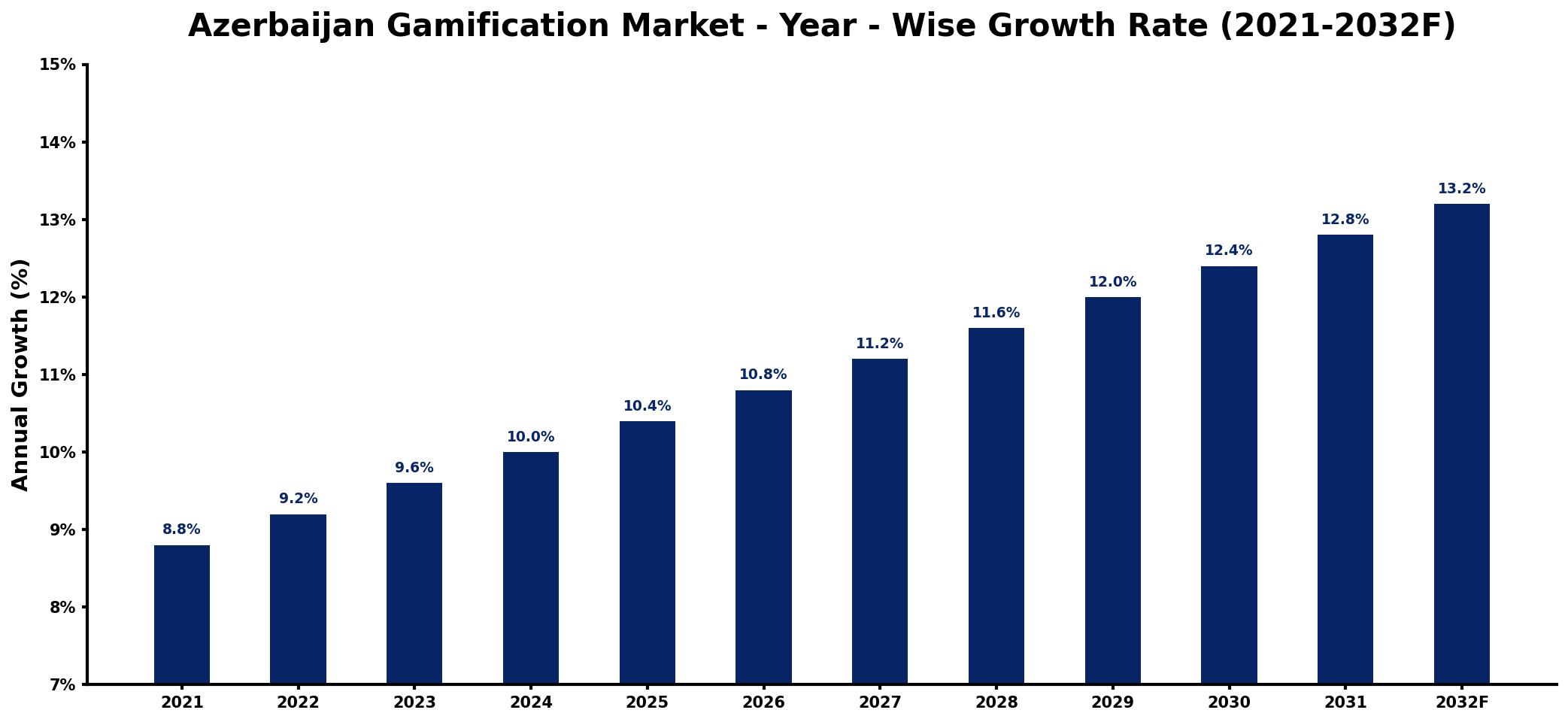
The table below presents the year‑wise growth rates along with the key drivers influencing the market
| Year | Growth Rate | Major Drivers |
| 2021 | 8.8% | increased interest in digital engagement |
| 2022 | 9.2% | growing adoption of mobile applications |
| 2023 | 9.6% | rise in remote learning platforms |
| 2024 | 10.0% | expansion of corporate training programs |
| 2025 | 10.4% | increased investment in user experience |
| 2026 | 10.8% | expanding industrial usage applications |
| 2027 | 11.2% | growth in educational technology solutions |
| 2028 | 11.6% | enhanced focus on employee motivation |
| 2029 | 12.0% | growing downstream application demand |
| 2030 | 12.4% | increased demand for interactive content |
| 2031 | 12.8% | rising demand from electronics |
| 2032 | 13.2% | growing popularity of community engagement |
Note: Market size estimations and growth projections presented in this report are based on 6Wresearch's proprietary forecasting methodology, utilizing the latest available industry data, government publications, and primary research inputs.
Azerbaijan Gamification Market Synopsis
Currently, Azerbaijan is witnessing a transformation in its business environment as companies adopt gamification strategies to drive desired behaviors and enhance overall performance. This shift is particularly evident in sectors like education and marketing, where organizations are implementing game-based learning and interactive loyalty programs to capture user interest.
In this burgeoning market, customized gamification solutions are being developed to address the unique requirements of various industries. As organizations increasingly leverage these technologies, there is an observable trend toward data-driven, personalized experiences that resonate with the local audience, thereby fostering deeper engagement.
Azerbaijan Gamification Market Key Takeaways
- The market is driven by the growing need for enhanced user engagement and performance improvement across industries.
- Increasing adoption of mobile gamification applications is providing interactive experiences for users.
- Customized gamification solutions are becoming essential for businesses to cater to local market needs.
- Data analytics is playing a crucial role in tailoring gamified experiences for users in Azerbaijan.
- Government support for digital economy initiatives is creating a favorable environment for market growth.
Evaluation of Restraints in Azerbaijan Gamification Market
Despite the promising outlook, the Azerbaijan Gamification Market faces significant challenges. A lack of awareness and understanding of gamification's potential benefits may hinder investment from businesses reluctant to adopt new technologies. Furthermore, there is a scarcity of skilled professionals proficient in creating tailored gamification strategies, leading to gaps in implementation quality. Cultural nuances and language barriers also complicate the design of gamified solutions that resonate with the Azerbaijani population, necessitating a concerted effort for education and collaboration within the industry.
Azerbaijan Gamification Market Trends
The landscape of the Azerbaijan Gamification Market is shaped by several key trends. Companies are increasingly incorporating competitive elements and social interactions into their gamification strategies to boost user engagement and foster loyalty. The rise of mobile technology has led to a surge in gamified applications, allowing businesses to reach customers in an interactive manner. Moreover, there is a growing emphasis on utilizing data analytics to create personalized experiences that cater specifically to the preferences of Azerbaijani users, enhancing the effectiveness of gamified solutions.
Azerbaijan Gamification Market Opportunities
The Azerbaijan Gamification Market presents a wealth of investment opportunities for forward-thinking companies. The increasing focus on improving customer engagement, employee motivation, and overall user experiences suggests a significant demand for innovative gamification solutions. Investing in the development of tailored platforms and applications can yield substantial returns, particularly as businesses seek to differentiate themselves through unique gamified experiences. Additionally, forming partnerships with local organizations to implement gamified strategies could unlock new revenue streams and reinforce a presence in this dynamic sector.
Government Initiatives in the Azerbaijan Gamification Market
While there are no specific government policies directly targeting the gamification market, Azerbaijan's focus on developing its digital economy provides a beneficial backdrop for growth. Initiatives aimed at fostering innovation and entrepreneurship can facilitate the establishment of gamification solutions. This overall commitment to digital transformation is likely to create opportunities for companies operating in the gamification space, encouraging adoption and engagement across various sectors.
Future Insights of the Azerbaijan Gamification Market
Looking ahead, the future of the Azerbaijan Gamification Market is bright, supported by a rising trend of adopting gamification across diverse sectors such as education, healthcare, and retail. As companies increasingly recognize the advantages of engaging and interactive technologies, the market is set to experience robust growth. Advancements in mobile technology and analytics will further enhance gamification initiatives, enabling businesses to cultivate customer loyalty, boost employee motivation, and achieve strategic objectives. This trajectory is bolstered by government initiatives that advocate digitalization and innovation, positioning the market for substantial expansion in the coming years.
Azerbaijan Gamification Market Latest Developments (2025 - 2026)
Recent developments in the Azerbaijan Gamification Market have focused on innovative applications and partnerships aimed at enhancing user engagement. Companies are increasingly experimenting with new gamification strategies that integrate augmented reality and virtual reality components. Collaborative efforts among businesses have also been on the rise, with organizations pooling resources to create comprehensive gamified solutions that cater to the evolving demands of consumers. This collaborative spirit is indicative of a burgeoning market poised for transformative change.
Azerbaijan Gamification Market - Key Attractiveness of the Report
- 10 Years of Market Numbers
- Historical Data Starting from 2022 to 2025
- Base Year: 2025
- Forecast Data until 2032
- Key Performance Indicators Impacting the Market
- Major Upcoming Developments and Projects
Key Highlights of the Report:
- Azerbaijan Gamification Market Outlook
- Market Size of Azerbaijan Gamification Market, 2025
- Forecast of Azerbaijan Gamification Market, 2032
- Historical Data and Forecast of Azerbaijan Gamification Revenues & Volume for the Period 2022-2032F
- Azerbaijan Gamification Market Trend Evolution
- Azerbaijan Gamification Market Drivers and Challenges
- Azerbaijan Gamification Price Trends
- Azerbaijan Gamification Porter's Five Forces
- Azerbaijan Gamification Industry Life Cycle
- Historical Data and Forecast of Azerbaijan Gamification Market Revenues & Volume By Component for the Period 2022-2032F
- Historical Data and Forecast of Azerbaijan Gamification Market Revenues & Volume By Solution for the Period 2022-2032F
- Historical Data and Forecast of Azerbaijan Gamification Market Revenues & Volume By Services for the Period 2022-2032F
- Historical Data and Forecast of Azerbaijan Gamification Market Revenues & Volume By Deployment for the Period 2022-2032F
- Historical Data and Forecast of Azerbaijan Gamification Market Revenues & Volume By Cloud for the Period 2022-2032F
- Historical Data and Forecast of Azerbaijan Gamification Market Revenues & Volume By On-premises for the Period 2022-2032F
- Historical Data and Forecast of Azerbaijan Gamification Market Revenues & Volume By Organization Size for the Period 2022-2032F
- Historical Data and Forecast of Azerbaijan Gamification Market Revenues & Volume By SMEs for the Period 2022-2032F
- Historical Data and Forecast of Azerbaijan Gamification Market Revenues & Volume By Large Enterprises for the Period 2022-2032F
- Historical Data and Forecast of Azerbaijan Gamification Market Revenues & Volume By End-User for the Period 2022-2032F
- Historical Data and Forecast of Azerbaijan Gamification Market Revenues & Volume By Enterprise-Driven for the Period 2022-2032F
- Historical Data and Forecast of Azerbaijan Gamification Market Revenues & Volume By Consumer-Driven for the Period 2022-2032F
- Azerbaijan Gamification Import Export Trade Statistics
- Market Opportunity Assessment By Component
- Market Opportunity Assessment By Deployment
- Market Opportunity Assessment By Organization Size
- Market Opportunity Assessment By End-User
- Azerbaijan Gamification Top Companies Market Share
- Azerbaijan Gamification Competitive Benchmarking By Technical and Operational Parameters
- Azerbaijan Gamification Company Profiles
- Azerbaijan Gamification Key Strategic Recommendations






































