Azerbaijan Insecticide Market Size, Share & Growth Rate
The Azerbaijan Insecticide Market was estimated at USD 478 Million in 2025 and is projected to reach USD 833 Million by 2032, growing at a CAGR of 8.3% from 2026 to 2032. This growth trajectory is primarily fueled by the increasing agricultural production aimed at enhancing food security, coupled with urbanization that amplifies the need for effective pest control solutions across various sectors. Furthermore, rising awareness regarding public health and the management of pest-borne diseases is set to bolster demand for insecticides in both agricultural and residential settings.
Azerbaijan Insecticide Market Year-wise Growth Rate and Key Drivers
This graph highlights how the Azerbaijan Insecticide Market has steadily grown over the years, supported by major growth factors.
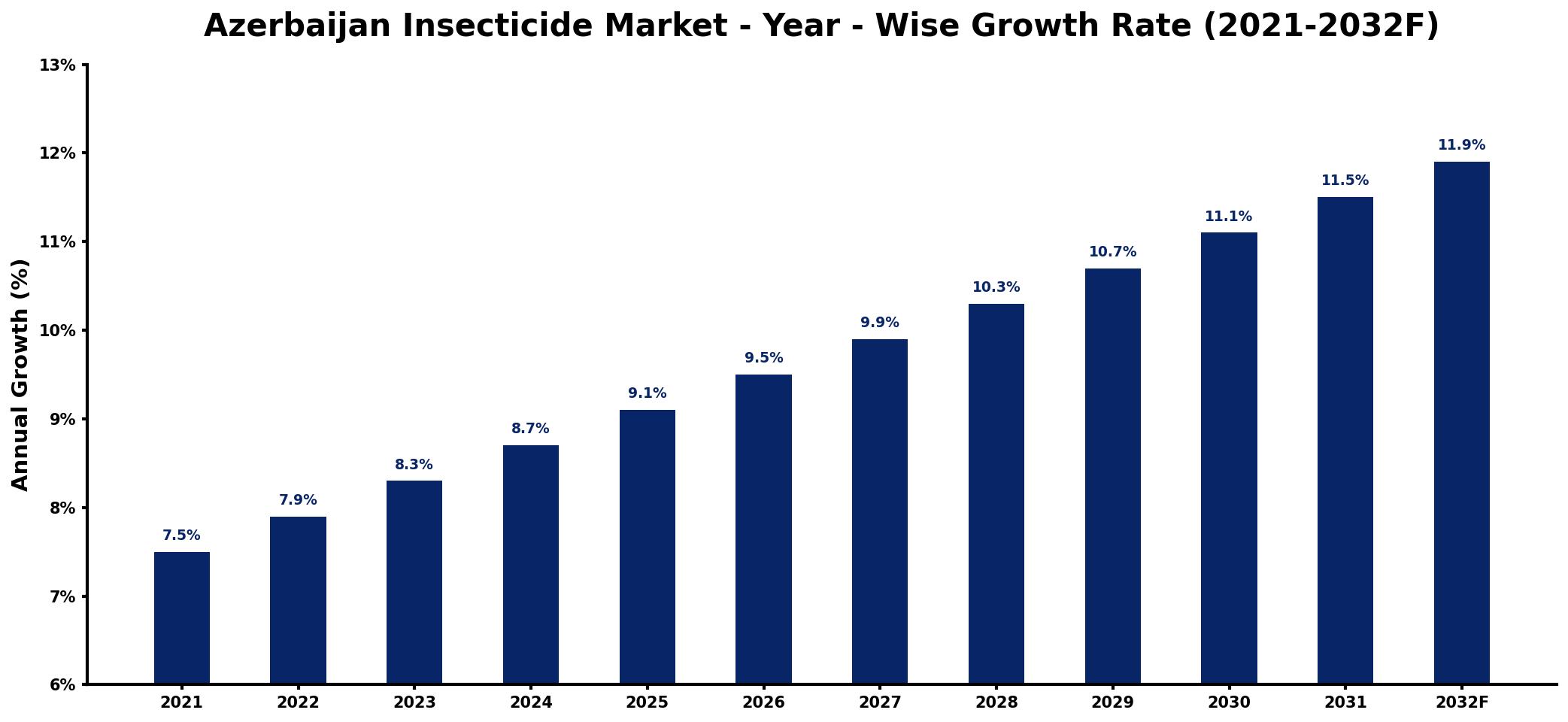
The table below presents the year‑wise growth rates along with the key drivers influencing the market
| Year | Growth Rate | Major Drivers |
| 2021 | 7.5% | increased agricultural production demand |
| 2022 | 7.9% | growing awareness of pest control |
| 2023 | 8.3% | rising organic farming practices |
| 2024 | 8.7% | expansion of commercial agriculture |
| 2025 | 9.1% | increased government agricultural support |
| 2026 | 9.5% | surge in crop protection investments |
| 2027 | 9.9% | growing urban gardening trends |
| 2028 | 10.3% | enhanced distribution network efficiency |
| 2029 | 10.7% | rising export opportunities for crops |
| 2030 | 11.1% | increased research and development funding |
| 2031 | 11.5% | growing consumer preference for quality |
| 2032 | 11.9% | emergence of smart farming technologies |
Note: Market size estimations and growth projections presented in this report are based on 6Wresearch's proprietary forecasting methodology, utilizing the latest available industry data, government publications, and primary research inputs.
Azerbaijan Insecticide Market Synopsis
In Azerbaijan, insecticides serve as vital tools in the fight against pests that threaten agricultural yield and public health. The reliance on these chemical substances is becoming increasingly pronounced, particularly with the growth of crop cultivation and urban development initiatives throughout the country. Stakeholders are actively seeking innovative solutions to combat evolving pest challenges, which are exacerbated by climate change and changing agricultural practices.
Moreover, the market dynamics are influenced by factors such as pest resistance and environmental sustainability. As Azerbaijan's regulatory environment evolves, market players are compelled to develop formulations that not only address efficacy and safety but also align with environmental protection standards, ensuring a balanced approach to pest management.
Azerbaijan Insecticide Market Key Takeaways
- The Azerbaijan Insecticide Market is expected to grow significantly, with a CAGR of 8.3% from 2026 to 2032.
- Innovative and sustainable pest management solutions are increasingly demanded due to climate change and urbanization.
- Government policies are steering the focus toward integrated pest management practices.
- Awareness surrounding public health and environmental concerns is prompting the development of new formulations.
- Research and development investments are critical to overcoming challenges such as pest resistance.
Evaluation of Restraints in Azerbaijan Insecticide Market
The Azerbaijan Insecticide Market faces notable restraints that could impede its growth. Stringent regulatory scrutiny affects market entry and compliance costs for manufacturers, potentially limiting product availability. Additionally, environmental concerns regarding pesticide use raise apprehensions among consumers and regulators, necessitating a shift towards more sustainable practices. The development of resistance among target pest populations complicates pest management strategies, compelling stakeholders to innovate continuously and adapt their approaches. These factors create a challenging environment that requires careful navigation by market participants.
Azerbaijan Insecticide Market Trends
Current trends in the Azerbaijan Insecticide Market highlight a growing emphasis on environmentally friendly formulations and integrated pest management practices. As agricultural producers and urban pest control services seek sustainable solutions, innovations like biopesticides and eco-friendly insecticides are gaining traction. Additionally, advancements in technology are facilitating more efficient application methods, thereby enhancing the effectiveness of pest management strategies. The increasing prevalence of pest resistance issues is also driving research into new active ingredients that offer alternative modes of action.
Azerbaijan Insecticide Market Opportunities
There are substantial growth opportunities within the Azerbaijan Insecticide Market, particularly for companies developing sustainable and innovative pest management solutions. The rising demand for organic farming practices presents an opening for biopesticide products, which are perceived as safer and more environmentally responsible. Furthermore, as urbanization continues to expand, there is a growing need for effective pest control solutions in residential and industrial settings. Collaborative initiatives between industry stakeholders and government bodies focused on research and development can also yield significant advancements in pest management technology.
Government Initiatives in the Azerbaijan Insecticide Market
The Azerbaijani government has implemented a framework of policies designed to regulate the insecticide market, ensuring that products are safe and effective for public health and the environment. By establishing guidelines for registration, safety standards, and compliance monitoring, the government aims to protect consumers and promote sustainable agricultural practices. Additionally, initiatives encouraging integrated pest management and training programs for farmers and pesticide applicators reflect a commitment to educating stakeholders on responsible insecticide use and fostering innovation in the sector.
Future Insights of the Azerbaijan Insecticide Market
From 2026 to 2032, the Azerbaijan Insecticide Market is poised for significant advancements, primarily driven by increased agricultural productivity and evolving pest management practices. As food security remains a priority, the demand for effective insecticides will likely increase. Furthermore, advancements in biotechnology and a strong focus on sustainability are expected to facilitate the development of new, innovative products that meet both regulatory standards and market expectations. The emphasis on environmental safety is likely to shape future product lines, fostering a more resilient and diverse pest management industry.
Azerbaijan Insecticide Market Latest Developments (2025 - 2026)
Recent developments in the Azerbaijan Insecticide Market indicate a growing trend toward innovation and sustainability. Research initiatives are being supported that focus on the development of safer, more effective insecticide formulations. Additionally, public awareness campaigns are increasing regarding responsible pesticide use and the importance of integrated pest management strategies. New regulations have also emerged to further ensure the safety and efficacy of pest control products used in both agricultural and urban settings.
Azerbaijan Insecticide Market - Key Attractiveness of the Report
- 10 Years of Market Numbers
- Historical Data Starting from 2022 to 2025
- Base Year: 2025
- Forecast Data until 2032
- Key Performance Indicators Impacting the Market
- Major Upcoming Developments and Projects
Key Highlights of the Report:
- Azerbaijan Insecticide Market Outlook
- Market Size of Azerbaijan Insecticide Market, 2025
- Forecast of Azerbaijan Insecticide Market, 2032
- Historical Data and Forecast of Azerbaijan Insecticide Revenues & Volume for the Period 2022-2032F
- Azerbaijan Insecticide Market Trend Evolution
- Azerbaijan Insecticide Market Drivers and Challenges
- Azerbaijan Insecticide Price Trends
- Azerbaijan Insecticide Porter's Five Forces
- Azerbaijan Insecticide Industry Life Cycle
- Historical Data and Forecast of Azerbaijan Insecticide Market Revenues & Volume By Type for the Period 2022-2032F
- Historical Data and Forecast of Azerbaijan Insecticide Market Revenues & Volume By Pyrethroids for the Period 2022-2032F
- Historical Data and Forecast of Azerbaijan Insecticide Market Revenues & Volume By Organophosphorus for the Period 2022-2032F
- Historical Data and Forecast of Azerbaijan Insecticide Market Revenues & Volume By Carbamates for the Period 2022-2032F
- Historical Data and Forecast of Azerbaijan Insecticide Market Revenues & Volume By Organochlorine for the Period 2022-2032F
- Historical Data and Forecast of Azerbaijan Insecticide Market Revenues & Volume By Botanicals for the Period 2022-2032F
- Historical Data and Forecast of Azerbaijan Insecticide Market Revenues & Volume By Other Types for the Period 2022-2032F
- Historical Data and Forecast of Azerbaijan Insecticide Market Revenues & Volume By Crop Type for the Period 2022-2032F
- Historical Data and Forecast of Azerbaijan Insecticide Market Revenues & Volume By Cereals & Grains for the Period 2022-2032F
- Historical Data and Forecast of Azerbaijan Insecticide Market Revenues & Volume By Oilseeds & Pulses for the Period 2022-2032F
- Historical Data and Forecast of Azerbaijan Insecticide Market Revenues & Volume By Fruits & Vegetables for the Period 2022-2032F
- Historical Data and Forecast of Azerbaijan Insecticide Market Revenues & Volume By Other Crop Types for the Period 2022-2032F
- Historical Data and Forecast of Azerbaijan Insecticide Market Revenues & Volume By Formulation for the Period 2022-2032F
- Historical Data and Forecast of Azerbaijan Insecticide Market Revenues & Volume By Wettable Powder for the Period 2022-2032F
- Historical Data and Forecast of Azerbaijan Insecticide Market Revenues & Volume By Emulsifiable Concentrate for the Period 2022-2032F
- Historical Data and Forecast of Azerbaijan Insecticide Market Revenues & Volume By Suspension Concentrate for the Period 2022-2032F
- Historical Data and Forecast of Azerbaijan Insecticide Market Revenues & Volume By Oil Emulsion In Water for the Period 2022-2032F
- Historical Data and Forecast of Azerbaijan Insecticide Market Revenues & Volume By Microencapsulated Suspension for the Period 2022-2032F
- Historical Data and Forecast of Azerbaijan Insecticide Market Revenues & Volume By Granules for the Period 2022-2032F
- Historical Data and Forecast of Azerbaijan Insecticide Market Revenues & Volume By Other Formulations for the Period 2022-2032F
- Historical Data and Forecast of Azerbaijan Insecticide Market Revenues & Volume By Form for the Period 2022-2032F
- Historical Data and Forecast of Azerbaijan Insecticide Market Revenues & Volume By Sprays for the Period 2022-2032F
- Historical Data and Forecast of Azerbaijan Insecticide Market Revenues & Volume By Baits for the Period 2022-2032F
- Historical Data and Forecast of Azerbaijan Insecticide Market Revenues & Volume By Strips for the Period 2022-2032F
- Azerbaijan Insecticide Import Export Trade Statistics
- Market Opportunity Assessment By Type
- Market Opportunity Assessment By Crop Type
- Market Opportunity Assessment By Formulation
- Market Opportunity Assessment By Form
- Azerbaijan Insecticide Top Companies Market Share
- Azerbaijan Insecticide Competitive Benchmarking By Technical and Operational Parameters
- Azerbaijan Insecticide Company Profiles
- Azerbaijan Insecticide Key Strategic Recommendations






































