Azerbaijan Middleware Market Size & Growth Rate (2026-2032)
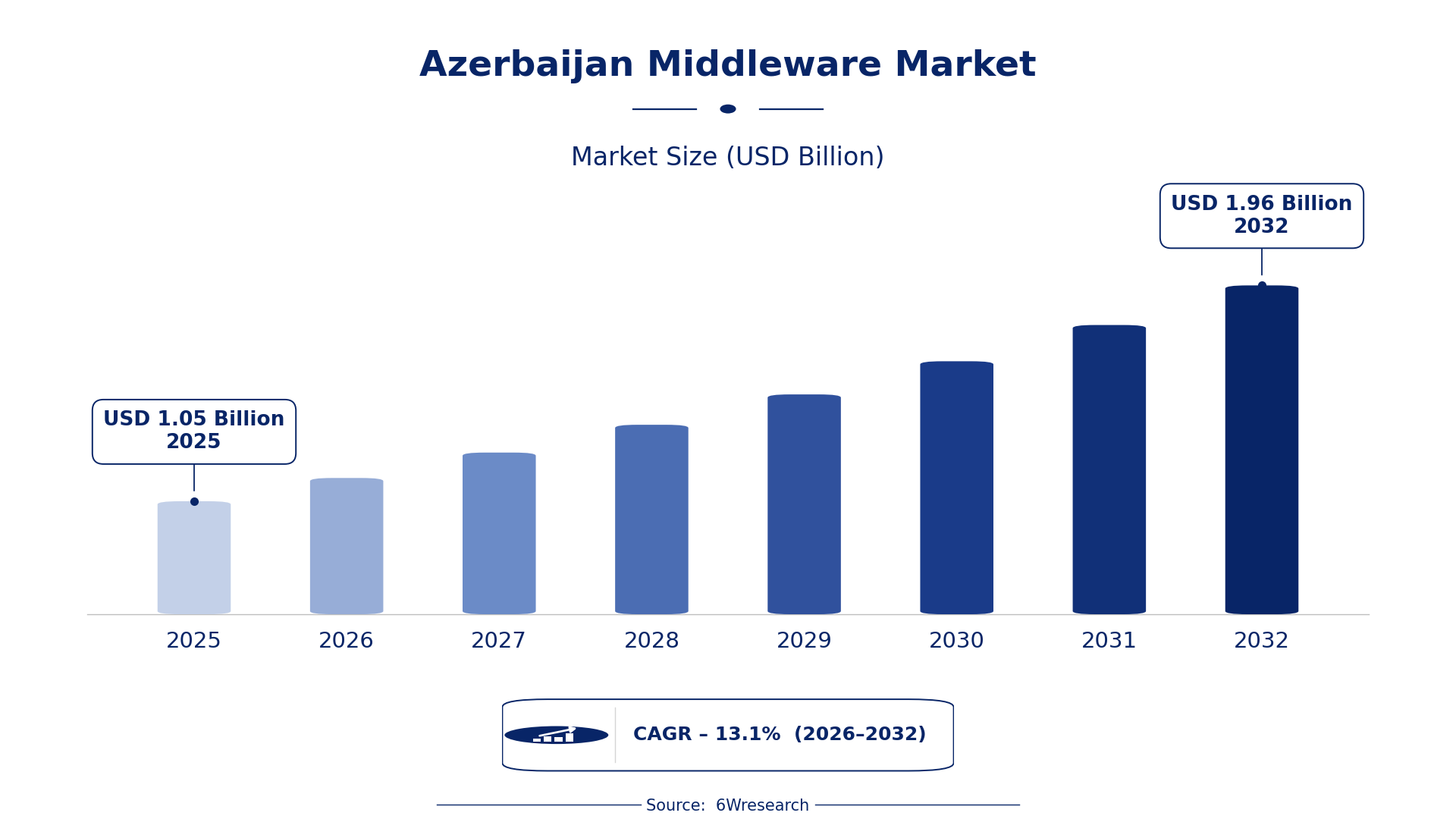
The Azerbaijan Middleware Market was estimated at USD 1054 Million in 2025 and is projected to reach USD 1960 Million by 2032, growing at a CAGR of 13.1% from 2026 to 2032.
Azerbaijan Middleware Market Synopsis
The drive towards digital transformation is the strongest force shaping the Azerbaijan Middleware Market today. Organizations across sectors are increasingly recognizing the critical need for effective integration of diverse IT systems and applications, prompting a surge in middleware adoption.
Middleware solutions have become essential for facilitating communication between disparate software components, enhancing operational efficiency, and supporting agile business practices. As a result, businesses are investing in these technologies to streamline processes and ensure interoperability in their IT environments.
Azerbaijan Middleware Market Year-wise Growth Rate and Key Drivers
This graph illustrates the annual growth rates of the Azerbaijan Middleware Market from 2021 to 2032, highlighting a steady upward trajectory and projected expansion over the forecast period.
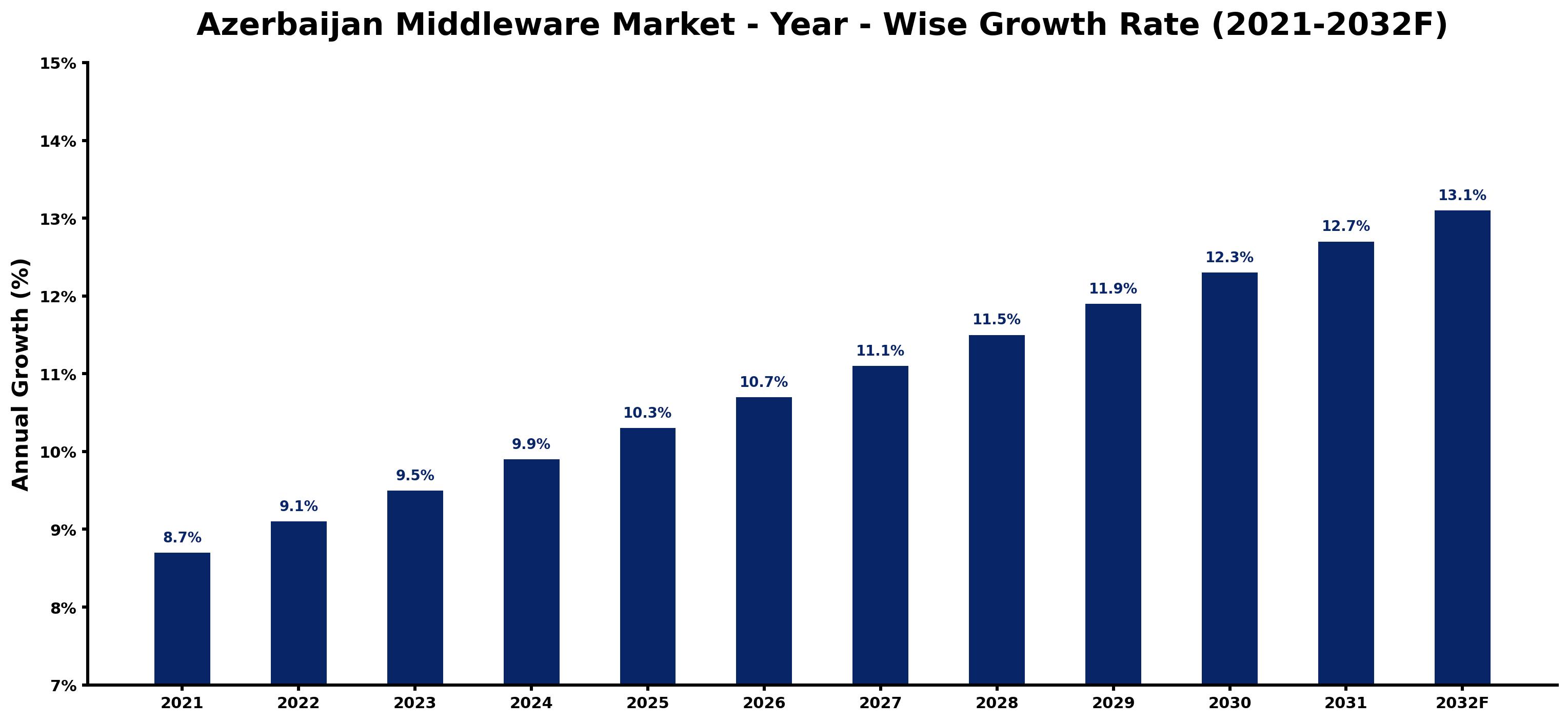
The table below presents the year‑wise growth rates along with the key drivers influencing the market
| Year | Growth Rate | Major Drivers |
| 2021 | 8.7% | Government's digitalization strategy boosts software integration demand. |
| 2022 | 9.1% | Increased adoption of cloud solutions in local businesses. |
| 2023 | 9.5% | Growing fintech sector drives demand for middleware solutions. |
| 2024 | 9.9% | Telecom sector upgrades enhance interoperability among services. |
| 2025 | 10.3% | Emergence of local startups fuels innovation in middleware. |
| 2026 | 10.7% | Strong foreign investment in tech promotes middleware adoption. |
| 2027 | 11.1% | Government support for IT training enhances skilled workforce. |
| 2028 | 11.5% | Rising e-commerce activity increases demand for backend systems. |
| 2029 | 11.9% | Local regulations promote data management and security tools. |
| 2030 | 12.3% | Significant growth in IoT applications drives middleware needs. |
| 2031 | 12.7% | Partnerships between tech firms accelerate API development. |
| 2032 | 13.1% | Cybersecurity policies necessitate advanced middleware solutions. |
Note: Market size estimations and growth projections presented in this report are based on 6Wresearch's proprietary forecasting methodology, utilizing the latest available industry data, government publications, and primary research inputs.
Azerbaijan Middleware Market Key Takeaways
Below are some of the specific key takeaways from the market, including:
- Integration and connectivity needs are driving middleware demand across various sectors.
- The market is hindered by challenges related to standardization and interoperability.
- Government initiatives are increasingly supporting middleware adoption and development.
- Investment in digital infrastructure remains critical for future growth.
- Emerging technologies such as cloud computing are reshaping middleware strategies.
Evaluation of Restraints in Azerbaijan Middleware Market
The Azerbaijan Middleware Market faces several real constraints that impact its growth trajectory. One of the most pressing issues is the lack of standardized protocols, which complicates integration efforts and leads to compatibility challenges. Many organizations still operate on legacy systems, making the adoption of modern middleware solutions difficult.
In addition, the relatively low levels of investment in IT infrastructure hinder the widespread adoption of middleware technologies. Many companies require convincing of the benefits middleware can bring to their operations. Concerns over data security and privacy also linger, requiring middleware vendors to navigate complex compliance landscapes to build trust with potential clients.
Azerbaijan Middleware Market Trends
Several trends are currently shaping the Azerbaijan Middleware Market. A notable shift towards cloud migration is driving demand for middleware solutions that facilitate integration between on-premises systems and cloud-based applications. Organizations are increasingly prioritizing hybrid IT architectures to enhance flexibility and scalability.
on top of that, the rise of microservices architecture is influencing middleware design and implementation. This trend supports the development of more agile and efficient applications, enabling businesses to respond rapidly to changing market demands.
Azerbaijan Middleware Market Opportunities
The Azerbaijan Middleware Market presents genuine growth opportunities for organizations ready to invest. As businesses increasingly embrace digital transformation, the demand for middleware solutions that enhance connectivity and streamline processes will continue to rise. Sectors such as banking, telecommunications, and e-commerce are particularly ripe for innovation.
Additionally, companies that can demonstrate the security and compliance of their middleware solutions are likely to gain a competitive edge. The government’s support for technology development and digital infrastructure investment further opens avenues for collaboration between public and private sectors.
Government Initiatives in the Azerbaijan Middleware Market
Government policies play a crucial role in shaping the Azerbaijan Middleware Market. The Azerbaijani government is actively promoting the adoption of middleware technologies through various initiatives that enhance integration and interoperability across sectors. These policies aim to foster innovation and support the domestic IT industry.
- A recently completed initiative focused on providing research grants to local tech startups developing middleware solutions.
- A currently ongoing project aims to upgrade national digital infrastructure, enhancing capabilities for middleware integration.
- A planned public-private partnership is expected to launch in 2026 to create standardized protocols for middleware solutions.
- Current training programs are being implemented to upskill professionals in middleware technologies, boosting market readiness.
- A regulatory framework introduced in 2025 seeks to ensure data security and compliance for middleware providers.
Future Insights of the Azerbaijan Middleware Market
Looking ahead to 2026-2032, the Azerbaijan Middleware Market is expected to experience robust growth driven by ongoing digital transformation efforts. The push for seamless integration of diverse systems will be a crucial factor as organizations seek to improve operational efficiency and agility.
on top of that, as cloud adoption rates rise, middleware solutions that can bridge on-premises and cloud environments will be in high demand. Organizations that proactively adapt to these trends and invest in middleware capabilities are likely to find themselves at a competitive advantage.
Azerbaijan Middleware Market Latest Developments
In the past year, the Azerbaijan Middleware Market has seen notable activity as businesses continue to adapt to digital challenges. The focus on integration and interoperability remains high, prompting several advancements in middleware technologies and partnerships.
- A major technology vendor launched a new middleware platform in Q1 2025, enhancing integration capabilities for local enterprises.
- An initiative began in mid-2025, aiming to facilitate collaboration among software developers to create standardized middleware solutions.
- A leading regional operator is currently working on a project to implement middleware solutions for enhanced customer experience, scheduled for completion by late 2025.
- A rollout expected to begin in early 2026 aims to upgrade existing middleware services across government sectors to improve operational efficiency.
- A technology transfer program was initiated in late 2024 to encourage innovation in middleware development among local startups.
Azerbaijan Middleware Market - Key Attractiveness of the Report
- 10 Years of Market Numbers
- Historical Data Starting from 2022 to 2025
- Base Year: 2025
- Forecast Data until 2032
- Key Performance Indicators Impacting the Market
- Major Upcoming Developments and Projects
Key Highlights of the Report:
- Azerbaijan Middleware Market Outlook
- Market Size of Azerbaijan Middleware Market, 2025
- Forecast of Azerbaijan Middleware Market, 2032
- Historical Data and Forecast of Azerbaijan Middleware Revenues & Volume for the Period 2022-2032F
- Azerbaijan Middleware Market Trend Evolution
- Azerbaijan Middleware Market Drivers and Challenges
- Azerbaijan Middleware Price Trends
- Azerbaijan Middleware Porter's Five Forces
- Azerbaijan Middleware Industry Life Cycle
- Historical Data and Forecast of Azerbaijan Middleware Market Revenues & Volume By Product Type for the Period 2022-2032F
- Historical Data and Forecast of Azerbaijan Middleware Market Revenues & Volume By Communication Middleware for the Period 2022-2032F
- Historical Data and Forecast of Azerbaijan Middleware Market Revenues & Volume By Platform Middleware for the Period 2022-2032F
- Historical Data and Forecast of Azerbaijan Middleware Market Revenues & Volume By Integration Middleware for the Period 2022-2032F
- Historical Data and Forecast of Azerbaijan Middleware Market Revenues & Volume By Others for the Period 2022-2032F
- Historical Data and Forecast of Azerbaijan Middleware Market Revenues & Volume By Deployment Types for the Period 2022-2032F
- Historical Data and Forecast of Azerbaijan Middleware Market Revenues & Volume By On-Premise for the Period 2022-2032F
- Historical Data and Forecast of Azerbaijan Middleware Market Revenues & Volume By Hosted for the Period 2022-2032F
- Historical Data and Forecast of Azerbaijan Middleware Market Revenues & Volume By Hybrid for the Period 2022-2032F
- Historical Data and Forecast of Azerbaijan Middleware Market Revenues & Volume By Organization Size for the Period 2022-2032F
- Historical Data and Forecast of Azerbaijan Middleware Market Revenues & Volume By Small businesses for the Period 2022-2032F
- Historical Data and Forecast of Azerbaijan Middleware Market Revenues & Volume By Medium businesses for the Period 2022-2032F
- Historical Data and Forecast of Azerbaijan Middleware Market Revenues & Volume By Enterprises for the Period 2022-2032F
- Historical Data and Forecast of Azerbaijan Middleware Market Revenues & Volume By Large enterprises for the Period 2022-2032F
- Historical Data and Forecast of Azerbaijan Middleware Market Revenues & Volume By Verticals for the Period 2022-2032F
- Historical Data and Forecast of Azerbaijan Middleware Market Revenues & Volume By Banking, financial services and insurance (BFSI) for the Period 2022-2032F
- Historical Data and Forecast of Azerbaijan Middleware Market Revenues & Volume By Consumer Goods and Retail for the Period 2022-2032F
- Historical Data and Forecast of Azerbaijan Middleware Market Revenues & Volume By IT and telecom for the Period 2022-2032F
- Historical Data and Forecast of Azerbaijan Middleware Market Revenues & Volume By Manufacturing for the Period 2022-2032F
- Historical Data and Forecast of Azerbaijan Middleware Market Revenues & Volume By Oil and Gas for the Period 2022-2032F
- Historical Data and Forecast of Azerbaijan Middleware Market Revenues & Volume By Healthcare for the Period 2022-2032F
- Historical Data and Forecast of Azerbaijan Middleware Market Revenues & Volume By Government for the Period 2022-2032F
- Azerbaijan Middleware Import Export Trade Statistics
- Market Opportunity Assessment By Product Type
- Market Opportunity Assessment By Deployment Types
- Market Opportunity Assessment By Organization Size
- Market Opportunity Assessment By Verticals
- Azerbaijan Middleware Top Companies Market Share
- Azerbaijan Middleware Competitive Benchmarking By Technical and Operational Parameters
- Azerbaijan Middleware Company Profiles
- Azerbaijan Middleware Key Strategic Recommendations






































