Azerbaijan Mobile Application Security Market Size & Growth Rate (2026-2032)
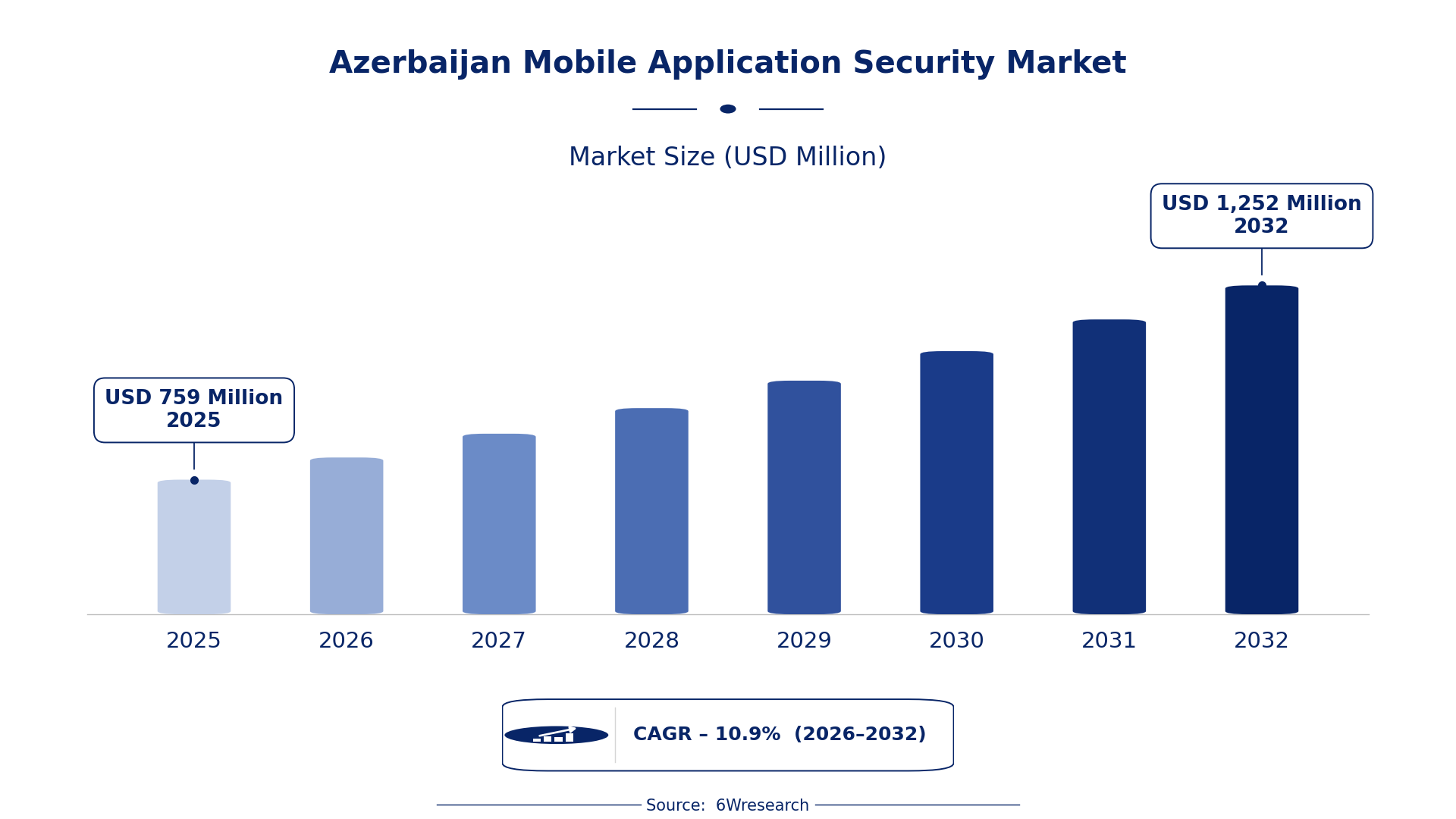
The Azerbaijan Mobile Application Security Market was estimated at USD 759 Million in 2025 and is projected to reach USD 1252 Million by 2032, growing at a CAGR of 10.9% from 2026 to 2032.
Azerbaijan Mobile Application Security Market Synopsis
The demand for mobile application security solutions in Azerbaijan is rapidly increasing, fueled by a sharp rise in mobile device usage. Cyber threats, such as malware and data breaches, are compelling businesses to prioritize securing their mobile applications to safeguard sensitive user data.
In response, the market is witnessing an influx of advanced security features like encryption, secure coding practices, and authentication methods. As organizations strive to comply with regulatory standards, the landscape is becoming increasingly competitive, with both local and international players vying for market share.
Azerbaijan Mobile Application Security Market Year-wise Growth Rate and Key Drivers
This graph illustrates the annual growth rates of the Azerbaijan Mobile Application Security Market from 2021 to 2032, highlighting a steady upward trajectory and projected expansion over the forecast period.
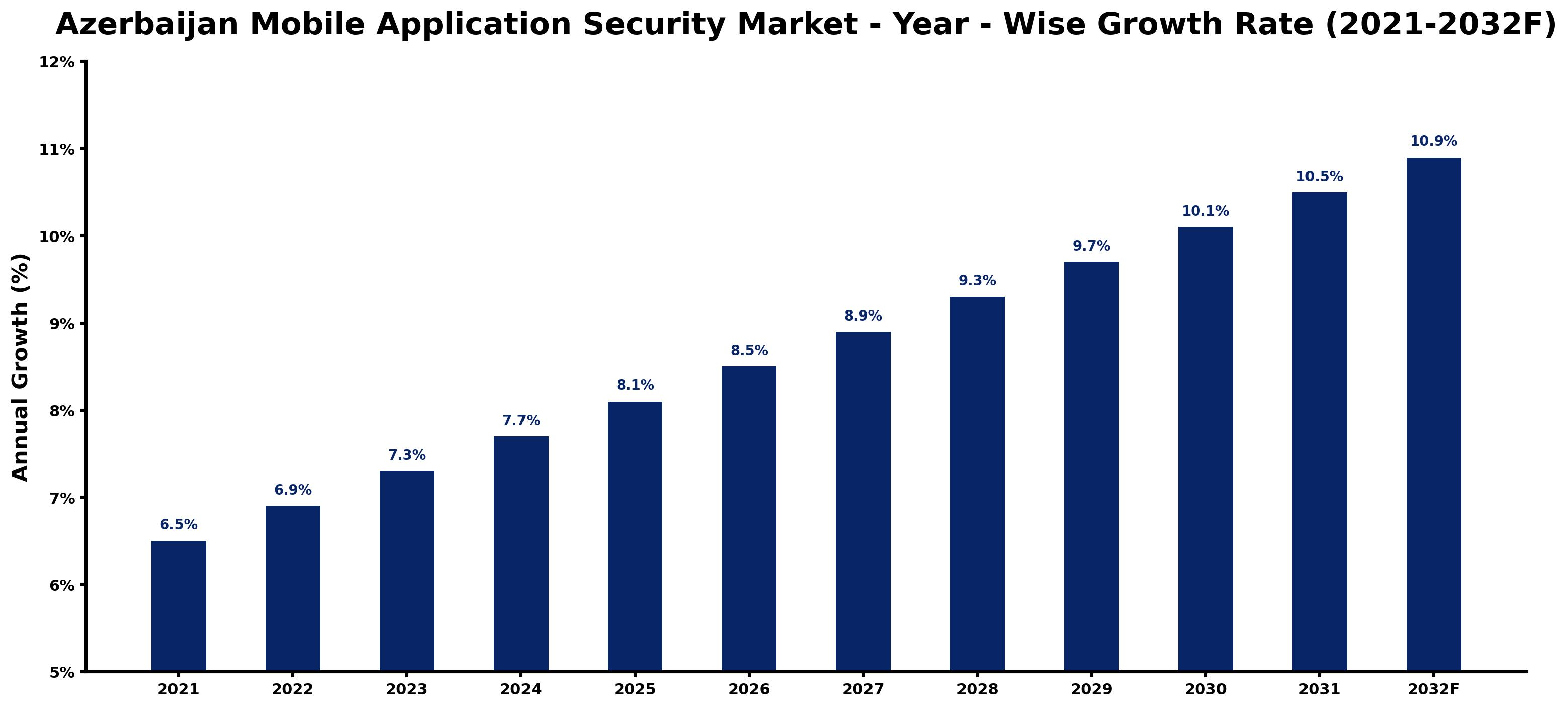
The table below presents the year‑wise growth rates along with the key drivers influencing the market
| Year | Growth Rate | Major Drivers |
| 2021 | 6.5% | Government's digital transformation strategy enhances mobile app security. |
| 2022 | 6.9% | Local cybersecurity regulations promoting app safety standards. |
| 2023 | 7.3% | Rise in mobile banking necessitating robust app security solutions. |
| 2024 | 7.7% | Increased smartphone usage driving demand for secure applications. |
| 2025 | 8.1% | Investment in privacy protection spurred by national policy changes. |
| 2026 | 8.5% | Collaboration with international tech firms strengthening local security protocols. |
| 2027 | 8.9% | E-commerce expansion creating need for secure transaction apps. |
| 2028 | 9.3% | Popularity of gaming apps boosting mobile security focus. |
| 2029 | 9.7% | Emerging AI technologies enhancing mobile app protection measures. |
| 2030 | 10.1% | Government initiatives incentivizing cybersecurity innovation in startups. |
| 2031 | 10.5% | Local development conferences increasing awareness of app vulnerabilities. |
| 2032 | 10.9% | Increased cyber threats prompting urgent demand for app security. |
Note: Market size estimations and growth projections presented in this report are based on 6Wresearch's proprietary forecasting methodology, utilizing the latest available industry data, government publications, and primary research inputs.
Azerbaijan Mobile Application Security Market Key Takeaways
Below are some of the specific key takeaways from the market, including:
- The market is responding to rising cyber threats that pose serious risks to sensitive data.
- Proliferation of mobile devices and apps is driving heightened demand for security solutions.
- Awareness and education among developers about best security practices are lacking.
- Government initiatives are crucial for fostering innovation and compliance in the sector.
- Investment priorities will be influenced by economic conditions affecting budget allocations.
Evaluation of Restraints in Azerbaijan Mobile Application Security Market
Despite the clear need for mobile application security, several barriers impede its progress in Azerbaijan. A significant restraint is the prevalent lack of awareness among businesses and app developers regarding essential security protocols. Many stakeholders remain uninformed about the ramifications of inadequate security measures, which affects adoption rates of necessary solutions.
Compounding this issue are the challenges associated with compliance and data protection. Organizations often struggle to maintain regulatory standards while ensuring their apps perform optimally. This balancing act necessitates ongoing investment in security measures, which can be particularly challenging amidst budget constraints. The perception of security as a cost rather than an investment further stifles growth potential.
Azerbaijan Mobile Application Security Market Trends
Emerging trends in the Azerbaijan Mobile Application Security Market indicate a shift toward integrating artificial intelligence in threat detection systems. This technology allows for more proactive defense mechanisms and enhances the ability to respond to security incidents swiftly.
on top of that, the rising adoption of DevSecOps methodologies signifies a move towards embedding security within the software development lifecycle. By doing so, organizations can foster a culture of security, ensuring that security considerations are prioritized from the outset.
Azerbaijan Mobile Application Security Market Opportunities
The growing focus on digital transformation presents significant opportunities in the Azerbaijan Mobile Application Security Market. Businesses transitioning to cloud-based solutions require tailored security measures, creating a demand for advanced security services.
on top of that, as the government reinforces its policies regarding data protection, companies offering compliance solutions will find fertile ground for growth. Investment in mobile security infrastructure, combined with a rising security consciousness among consumers, sets the stage for robust market expansion.
Government Initiatives in the Azerbaijan Mobile Application Security Market
The Azerbaijani government is increasingly aware of the critical need to bolster the mobile application security sector. With a focus on ensuring compliance with global standards and promoting homegrown solutions, government policies are laying the groundwork for a secure digital environment. This support will be pivotal for businesses as they seek to enhance their security postures.
- A national cybersecurity strategy was launched in 2025, emphasizing the protection of critical infrastructure and mobile applications.
- Currently, an initiative is underway to provide grants for startups developing innovative mobile security technologies, fostering local innovation.
- The government is planning to introduce a regulatory framework by 2026 that mandates enhanced data protection standards for mobile applications.
- Public-private partnerships are being encouraged to facilitate knowledge-sharing and collaboration in cybersecurity efforts.
- Investment incentives are being offered to firms that commit to improving their mobile security measures and technology.
Future Insights of the Azerbaijan Mobile Application Security Market
Looking ahead to 2026-2032, the Azerbaijan Mobile Application Security Market is set to experience accelerated growth driven by increased awareness and investment. As businesses prioritize cybersecurity amidst rising threats, demand for integrated security solutions will surge.
The continuous evolution of mobile technologies will require ongoing adaptation of security strategies, further supporting the market’s expansion. Organizations that proactively embrace these changes will find themselves better positioned to combat emerging threats.
Azerbaijan Mobile Application Security Market Latest Developments
Recent developments within the Azerbaijan Mobile Application Security Market highlight a growing recognition of the importance of security in mobile applications. Companies are actively seeking out innovative solutions and technologies to enhance their security posture as the threat landscape evolves.
- A major technology vendor launched a new suite of mobile security tools in early 2025, focusing on machine learning capabilities for real-time threat detection.
- A pilot program began in Q2 2025 to train developers on best practices for secure coding, which aims to raise awareness and improve overall security standards.
- A partnership between local cybersecurity firms and international organizations was formed in late 2025, enhancing knowledge-sharing and innovation efforts.
- A nationwide campaign encouraging mobile security awareness and practices is currently ongoing, aiming to educate businesses and consumers alike.
- Plans are in place to introduce a mobile application security certification program by mid-2026 to ensure compliance and standardization.
Azerbaijan Mobile Application Security Market - Key Attractiveness of the Report
- 10 Years of Market Numbers
- Historical Data Starting from 2022 to 2025
- Base Year: 2025
- Forecast Data until 2032
- Key Performance Indicators Impacting the Market
- Major Upcoming Developments and Projects
Key Highlights of the Report:
- Azerbaijan Mobile Application Security Market Outlook
- Market Size of Azerbaijan Mobile Application Security Market, 2025
- Forecast of Azerbaijan Mobile Application Security Market, 2032
- Historical Data and Forecast of Azerbaijan Mobile Application Security Revenues & Volume for the Period 2022-2032F
- Azerbaijan Mobile Application Security Market Trend Evolution
- Azerbaijan Mobile Application Security Market Drivers and Challenges
- Azerbaijan Mobile Application Security Price Trends
- Azerbaijan Mobile Application Security Porter's Five Forces
- Azerbaijan Mobile Application Security Industry Life Cycle
- Historical Data and Forecast of Azerbaijan Mobile Application Security Market Revenues & Volume By Solution for the Period 2022-2032F
- Historical Data and Forecast of Azerbaijan Mobile Application Security Market Revenues & Volume By Antivirus & Antitheft for the Period 2022-2032F
- Historical Data and Forecast of Azerbaijan Mobile Application Security Market Revenues & Volume By Data Recovery for the Period 2022-2032F
- Historical Data and Forecast of Azerbaijan Mobile Application Security Market Revenues & Volume By Others for the Period 2022-2032F
- Historical Data and Forecast of Azerbaijan Mobile Application Security Market Revenues & Volume By Deployment Type for the Period 2022-2032F
- Historical Data and Forecast of Azerbaijan Mobile Application Security Market Revenues & Volume By Cloud for the Period 2022-2032F
- Historical Data and Forecast of Azerbaijan Mobile Application Security Market Revenues & Volume By On Premise for the Period 2022-2032F
- Historical Data and Forecast of Azerbaijan Mobile Application Security Market Revenues & Volume By Industry Vertical for the Period 2022-2032F
- Historical Data and Forecast of Azerbaijan Mobile Application Security Market Revenues & Volume By BFSI for the Period 2022-2032F
- Historical Data and Forecast of Azerbaijan Mobile Application Security Market Revenues & Volume By Healthcare for the Period 2022-2032F
- Historical Data and Forecast of Azerbaijan Mobile Application Security Market Revenues & Volume By IT & Telecom for the Period 2022-2032F
- Historical Data and Forecast of Azerbaijan Mobile Application Security Market Revenues & Volume By Manufacturing for the Period 2022-2032F
- Historical Data and Forecast of Azerbaijan Mobile Application Security Market Revenues & Volume By Government and Public Sector for the Period 2022-2032F
- Historical Data and Forecast of Azerbaijan Mobile Application Security Market Revenues & Volume By Retail & E-commerce for the Period 2022-2032F
- Historical Data and Forecast of Azerbaijan Mobile Application Security Market Revenues & Volume By Others for the Period 2022-2032F
- Azerbaijan Mobile Application Security Import Export Trade Statistics
- Market Opportunity Assessment By Solution
- Market Opportunity Assessment By Deployment Type
- Market Opportunity Assessment By Industry Vertical
- Azerbaijan Mobile Application Security Top Companies Market Share
- Azerbaijan Mobile Application Security Competitive Benchmarking By Technical and Operational Parameters
- Azerbaijan Mobile Application Security Company Profiles
- Azerbaijan Mobile Application Security Key Strategic Recommendations






































