Azerbaijan Personal Computers Market Size, Share & Growth Rate
The Azerbaijan Personal Computers Market was estimated at USD 645 Million in 2025 and is projected to reach USD 1206 Million by 2032, growing at a CAGR of 9.4% from 2026 to 2032. This growth trajectory is fueled by an increasing focus on digitalization across various sectors, coupled with a tech-savvy young population eager to adopt new technologies. Moreover, the demand for high-performance laptops and desktops, especially in the realms of education and remote work, is further driving market expansion.
Azerbaijan Personal Computers Market Year-wise Growth Rate and Key Drivers
This graph highlights how the Azerbaijan Personal Computers Market has steadily grown over the years, supported by major growth factors.
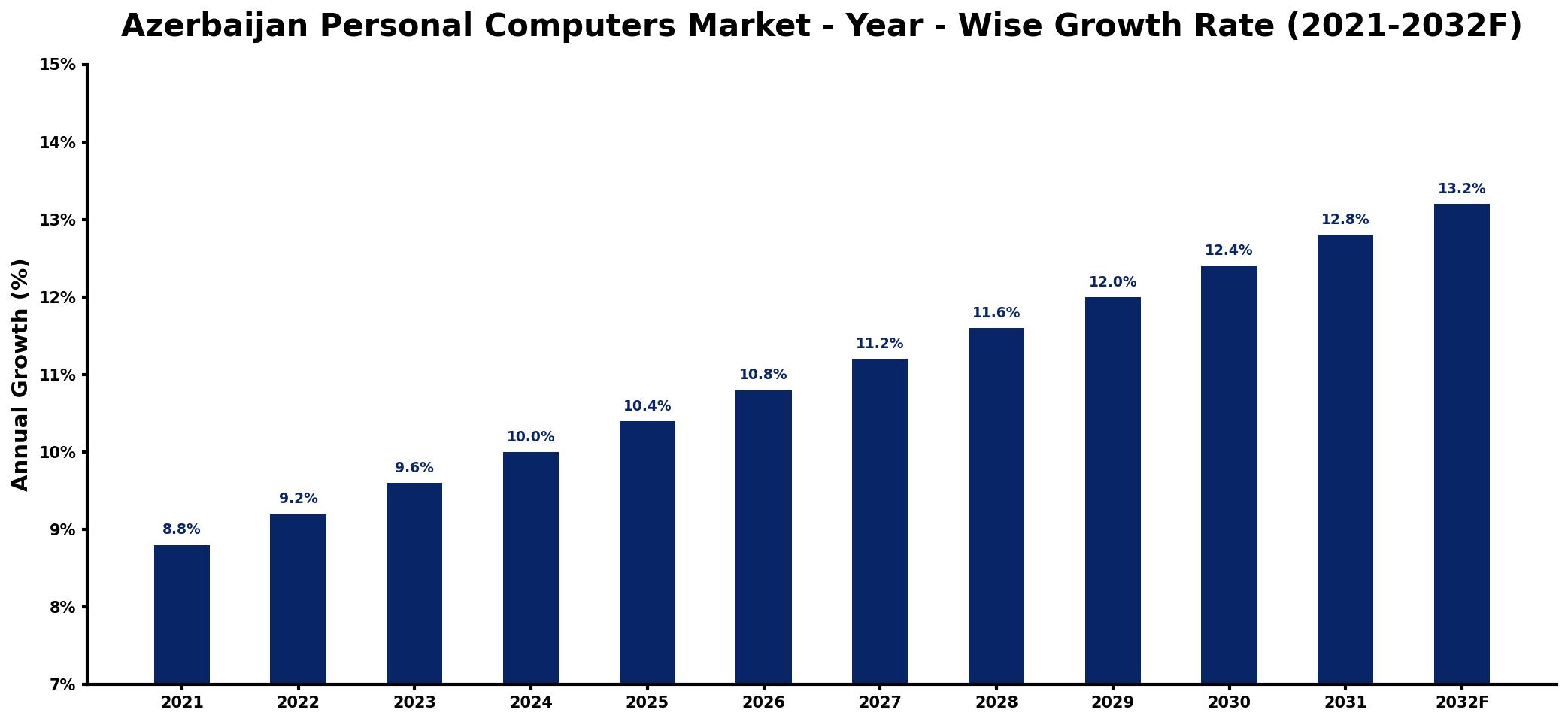
The table below presents the year‑wise growth rates along with the key drivers influencing the market
| Year | Growth Rate | Major Drivers |
| 2021 | 8.8% | rising consumer technology adoption |
| 2022 | 9.2% | increased remote work requirements |
| 2023 | 9.6% | growing e-learning platforms usage |
| 2024 | 10.0% | expanding digital entertainment sector |
| 2025 | 10.4% | enhanced internet infrastructure investments |
| 2026 | 10.8% | increased demand for gaming solutions |
| 2027 | 11.2% | growing emphasis on cybersecurity needs |
| 2028 | 11.6% | rising popularity of smart homes |
| 2029 | 12.0% | improved processing technologies adoption |
| 2030 | 12.4% | expanding software development initiatives |
| 2031 | 12.8% | growing interest in cloud services |
| 2032 | 13.2% | increased focus on digital transformation |
Note: Market size estimations and growth projections presented in this report are based on 6Wresearch's proprietary forecasting methodology, utilizing the latest available industry data, government publications, and primary research inputs.
Azerbaijan Personal Computers Market Synopsis
The Azerbaijan Personal Computers Market is currently characterized by a vibrant demand for both laptops and desktops, stemming from an ongoing shift towards digital workspaces and online education. Government initiatives aimed at promoting digital literacy are also enhancing the adoption rate of personal computing devices among consumers.
A significant trend within the market is the increasing preference for portable computing solutions such as ultrabooks and 2-in-1 devices, driven by the necessity for mobility in both personal and professional settings. In parallel, the burgeoning gaming community is propelling demand for specialized gaming PCs, which is expected to influence market dynamics moving forward.
Azerbaijan Personal Computers Market Key Takeaways
- The market is witnessing a notable shift towards portable and lightweight personal computing devices.
- Growing disposable incomes are enabling consumers to invest more in personal technology.
- A surge in remote work and e-learning is amplifying the demand for high-performance PCs.
- Government policies are fostering local manufacturing, potentially reducing dependency on imports.
- The gaming sector is emerging as a significant driver of growth within the personal computers market.
Evaluation of Restraints in Azerbaijan Personal Computers Market
While the Azerbaijan Personal Computers Market holds significant potential, several restraints hinder its growth. Economic volatility has led to limited consumer purchasing power, which impacts the adoption rates of the latest technologies. Additionally, the presence of counterfeit products undermines trust in established brands, creating barriers for consumers. High import tariffs on electronic goods further inflate prices, making it challenging for budget-conscious buyers to invest in personal computing devices. Moreover, inconsistent access to high-speed internet in certain areas limits the demand for advanced models requiring robust connectivity.
Azerbaijan Personal Computers Market Trends
The Azerbaijan Personal Computers Market is currently influenced by various trends. The increasing demand for laptops and ultrabooks is primarily due to the rising need for mobile devices that cater to both educational and professional needs. Concurrently, the gaming segment is gaining traction, as more consumers seek high-performance PCs for gaming experiences. There is also a noticeable shift towards all-in-one PCs and enhanced desktop solutions for home entertainment and productivity, showcasing an evolution towards versatile devices that meet diverse consumer preferences.
Azerbaijan Personal Computers Market Opportunities
Investment opportunities in the Azerbaijan Personal Computers Market are abundant. The demand for high-quality personal computers is expected to rise in tandem with the digital transformation of businesses and households. There is a lucrative potential for investing in local assembly and manufacturing operations to meet the growing market needs and reduce import dependencies. Furthermore, partnerships with local IT companies to deliver tailored computing solutions and after-sales services represent a strategic path for new entrants and established businesses alike.
Government Initiatives in the Azerbaijan Personal Computers Market
The Azerbaijan government has undertaken various initiatives aimed at bolstering the Personal Computers Market. Policies to lower tariffs on imported hardware have made computers more accessible to consumers and businesses. Additionally, programs aimed at promoting local manufacturing of technology products are designed to stimulate economic growth within the sector. These initiatives not only enhance affordability but also prioritize data protection and cybersecurity measures, thereby fostering a trustworthy digital environment for consumers.
Future Insights of the Azerbaijan Personal Computers Market
Looking ahead to 2026-2032, the Azerbaijan Personal Computers Market is poised for steady growth. Increasing integration of technology within education, healthcare, and governmental sectors will create new demands for personal computing solutions. As the country continues its efforts to diversify its economy and embrace digital initiatives, the appeal of personal computers will likely expand. Nevertheless, potential market challenges, such as competition from mobile devices and ongoing economic fluctuations, could impact growth rates. Overall, a favorable environment for technological investment presents substantial opportunities for both existing and new market players.
Azerbaijan Personal Computers Market Latest Developments (2025 - 2026)
Recent developments in the Azerbaijan Personal Computers Market indicate a strong focus on enhancing product offerings and supply chain efficiencies. Companies are increasingly investing in research and development to introduce innovative computing devices that cater to changing consumer preferences. The trend towards remote working continues to influence purchasing decisions, prompting market players to adapt their strategies in order to capitalize on this shift. Furthermore, local manufacturers are ramping up production capabilities to meet the growing demand for personal computers across various sectors.
Azerbaijan Personal Computers Market - Key Attractiveness of the Report
- 10 Years of Market Numbers
- Historical Data Starting from 2022 to 2025
- Base Year: 2025
- Forecast Data until 2032
- Key Performance Indicators Impacting the Market
- Major Upcoming Developments and Projects
Key Highlights of the Report:
- Azerbaijan Personal Computers Market Outlook
- Market Size of Azerbaijan Personal Computers Market, 2025
- Forecast of Azerbaijan Personal Computers Market, 2032
- Historical Data and Forecast of Azerbaijan Personal Computers Revenues & Volume for the Period 2022-2032F
- Azerbaijan Personal Computers Market Trend Evolution
- Azerbaijan Personal Computers Market Drivers and Challenges
- Azerbaijan Personal Computers Price Trends
- Azerbaijan Personal Computers Porter's Five Forces
- Azerbaijan Personal Computers Industry Life Cycle
- Historical Data and Forecast of Azerbaijan Personal Computers Market Revenues & Volume By Product Type for the Period 2022-2032F
- Historical Data and Forecast of Azerbaijan Personal Computers Market Revenues & Volume By Desktop for the Period 2022-2032F
- Historical Data and Forecast of Azerbaijan Personal Computers Market Revenues & Volume By Notebook for the Period 2022-2032F
- Historical Data and Forecast of Azerbaijan Personal Computers Market Revenues & Volume By Workstation for the Period 2022-2032F
- Historical Data and Forecast of Azerbaijan Personal Computers Market Revenues & Volume By Others for the Period 2022-2032F
- Historical Data and Forecast of Azerbaijan Personal Computers Market Revenues & Volume By Distribution Channel for the Period 2022-2032F
- Historical Data and Forecast of Azerbaijan Personal Computers Market Revenues & Volume By Business-To-Business (B2B) for the Period 2022-2032F
- Historical Data and Forecast of Azerbaijan Personal Computers Market Revenues & Volume By Business-To-Consumer (B2C) for the Period 2022-2032F
- Historical Data and Forecast of Azerbaijan Personal Computers Market Revenues & Volume By Application for the Period 2022-2032F
- Historical Data and Forecast of Azerbaijan Personal Computers Market Revenues & Volume By Consumer for the Period 2022-2032F
- Historical Data and Forecast of Azerbaijan Personal Computers Market Revenues & Volume By Commercial for the Period 2022-2032F
- Historical Data and Forecast of Azerbaijan Personal Computers Market Revenues & Volume By Industrial for the Period 2022-2032F
- Azerbaijan Personal Computers Import Export Trade Statistics
- Market Opportunity Assessment By Product Type
- Market Opportunity Assessment By Distribution Channel
- Market Opportunity Assessment By Application
- Azerbaijan Personal Computers Top Companies Market Share
- Azerbaijan Personal Computers Competitive Benchmarking By Technical and Operational Parameters
- Azerbaijan Personal Computers Company Profiles
- Azerbaijan Personal Computers Key Strategic Recommendations






































